13 essential steps to streamline EOFY and prepare your R&D Tax Incentive (R&DTI) claim
Last reviewed: July 17, 2026
The end of the financial year (EOFY) in Australia falls on 30 June, and for businesses, now is the time to act. Rather than treating it purely as a compliance deadline, use it as your prime opportunity to organise your finances, reduce your tax burden, and plan strategically for the year ahead.
And why not prepare your R&D Tax Incentive (R&DTI) documentation at the same time?
In this guide we focus on what matters most for your business this EOFY: key dates, understanding tax return types, and deploying effective strategies to maximise deductions and ensure a successful tax time. And for maximum efficiency, get your documentation ready for upcoming R&DTI claim.
- Key EOFY related deadlines
- Business Activity Statements (BAS)
- Taxable Payments Annual Report (TPAR)
- The End of Financial Year checklist: Your business action plan (13 steps)
- For greater efficiency combine EOFY and R&DTI
- Common EOFY tax mistakes to avoid
- EOFY preparation — the foundation of funding success
Key takeaways
- EOFY is more than a compliance exercise. It is an opportunity to organise finances, optimise tax outcomes and prepare for the year ahead.
- Understanding key lodgement deadlines is essential, including obligations for tax returns, BAS and TPAR reporting.
- Preparing EOFY records early reduces errors, improves efficiency and helps avoid last-minute stress.
- EOFY preparation and R&D Tax Incentive planning can be done together, helping businesses streamline documentation and reporting requirements.
- Good record-keeping supports stronger tax and funding outcomes, making it easier to substantiate deductions and future claims.
- Avoiding common EOFY mistakes can save time and reduce compliance risk, particularly when managing tax obligations and supporting documentation.
Key EOFY related deadlines
Knowing your key lodgement dates will help you stay organised during tax time. There are various deadlines to pay attention to, depending on your circumstances. According to the Australian Taxation Office (ATO), the deadlines are:
For individuals — 31st October
For businesses — 28th February
And there are the crucial deadlines for Business Activity Statements (BAS) and Taxable Payments Annual Report (TPAR) around the end of the financial year.
Business Activity Statements (BAS)
Your BAS reporting frequency (monthly, quarterly, or annually) determines your specific due dates.
- Monthly lodgers: Your June BAS is due by 21 July. (Note: The December monthly BAS often has an extended deadline of 21 February for eligible businesses lodging electronically via an agent).
- Quarterly lodgers (Standard): The standard deadline for the Quarter 4 BAS (covering April, May, June) is 28 July. Other standard quarterly dates are 28 October (Q1), 28 February (Q2), and 28 April (Q3).
- Quarterly lodgers (via Agent): If lodging through a registered Tax or BAS agent, you typically benefit from extended deadlines under the lodgement program (except for Quarter 2). For the crucial Quarter 4 (ending 30 June), this generally pushes the deadline out to 25 August. Always confirm your specific date via the ATO portal or with your agent.
Taxable Payments Annual Report (TPAR)
If your business pays contractors for services in industries like building and construction, cleaning, courier services, road freight, IT services, or security, investigation, or surveillance services, you must lodge a TPAR.
- TPAR deadline: This report, covering payments made during the 1 July to 30 June financial year, must be lodged with the ATO by 28 August each year.
The End of Financial Year checklist: Your business action plan
The EOFY requires thorough financial housekeeping, compliance adherence, and planning. Successfully navigating this period ensures accuracy in your reporting, helps you meet your obligations, and positions your business for future success.
To guide you through the essential activities — from year-round record-keeping and embracing technology to specific tasks like finalising accounts, managing tax obligations, and reviewing your overall business strategy — here is our comprehensive checklist to help you through a smooth and productive EOFY process.
Step 1 | Gather and organise your documents throughout the year
The first step to getting organised for tax time success is gather all your important paperwork, like receipts, invoices, bank statements, and any other relevant documents throughout the year. Having everything in order saves time and by doing this you can easily categorise them at the end of each financial year.
Step 2 | Embrace technology
Managing your documents is not always easy, so take advantage of accounting software or record-keeping apps to simplify the process. These tools can help you with expenses, generate reports and connect you directly to your tax accountant. This can simplify record-keeping throughout the year and result in a smoother EOFY process for you.
Step 3 | Consult a tax accountant
Do you need to consult a tax accountant?
Tax matters can be complex or overwhelming, so it could be worth consulting a tax accountant and seeking advice. A qualified tax professional can provide expert guidance and determine the best approach for filing combined returns. They will ensure compliance with tax laws, help you navigate deadlines, and maximise deductions across your business and personal finances.
Step 4 | Prepay expenses
Paying for expenses that can qualify for a tax deduction before June 30 will boost your tax refund. These costs might come from work-related expenses or donations to charities. Check out the ATO guidelines to see what work-related costs you can claim.
Step 5 | Write off bad debts
Can you write off bad debts before 30 June?
You can deduct bad debts from your taxes if you don’t think you’ll be able to pay them back. You need to have proof of your claim and have made a sincere effort to collect the debt to be eligible for a bad debt deduction. Reducing your taxable income can be achieved by writing off bad debts before the end of the financial year. This can be helpful when filing your tax return lodgement. Speak to your accountant to see if this is the right option for you.
Step 6 | Bank reconciliation
Bank accounts, debtors, asset registry, and other assets, like payroll-related income in advance, leases, and other liabilities, can be addressed in reconciliations. Make sure your bank statements and bookkeeping records match. Plan to avoid delays and meet end of financial year deadlines.
Step 7 | Review assets and asset depreciation
Examine your asset register and make any necessary updates, including asset sales or purchases, during the financial year. Analyse and precisely record the depreciation costs for every asset.
Step 8 | Review business expenses
Examine your business expenses to make sure they are justified and accompanied by the necessary records. Determine whatever tax write-offs or deductions might be available for the current fiscal year.
Step 9 | Complete and lodge Business Activity Statements (BAS)
Prepare and submit your BAS, outlining all transactions related to GST for the fiscal year. Make certain that every statistic is true and backed up by the necessary records.
Step 10 | Manage superannuation obligations
Are your superannuation obligations up to date?
Tax time can be a good opportunity to review your superannuation requirements for the new financial year. As a business, it is your legal obligation to pay superannuation guarantee (SG) payments to eligible employees. Ensure timely payments and maintain accurate records to avoid penalties from the ATO. For every eligible employee, you are required to pay at least 12% of their ordinary time earnings (OTE) as the SG rate. Consider consulting with a financial advisor to optimise your superannuation strategy, ensuring compliance and maximising benefits for both your business and your employees.
Step 11 | Maintain accurate payroll records
Keeping correct and accurate payroll records comes next on the EOFY checklist. Employers are required to utilise Single Touch Payroll (STP) to automatically transmit payroll tax information to the ATO for reporting purposes.
Step 12 | Taxable Payments Annual Report (TPAR)
The Taxable Payments Annual Report (TPAR) is a key ATO reporting requirement for many businesses that make payments to contractors or subcontractors. The industries that must file a TPAR through the Taxable Payments Reporting System (TPRS) have been added to the government’s list. Currently that list includes building and construction, government grant providers, IT services, and security services.
Step 13 | Analyse your business structure
Is your current business structure still right for you?
Is your current business structure (sole trader, partnership, or company) still the best option for you? Take into consideration liability protection, expansion objectives, and tax consequences when determining your business structure. Seek advice from an expert in taxes about how to organise your company to minimise taxes may be advantageous.
For greater efficiency combine EOFY and R&DTI
Consider combining the preparation of your EOFY and Research and Development Tax Incentive (R&DTI) documents for ultimate efficiency.
While you are already deep in reviewing financial records, assessing project costs, and finalising accounts as part of EOFY activities, why not consider including the preparation for your Research and Development Tax Incentive (R&DTI) claim?
Rather than seeing your R&DTI claim as a separate, later task, consider integrating it with your EOFY processes. Much of the detailed financial data required for R&DTI claims like payroll costs for R&D staff, specific project expenditures, and overhead allocation is already being gathered for your tax return and financial statements. By identifying and collating R&D specific information at the same time, you can significantly streamline workflows, reduce duplication of effort, and save valuable time and transform compliance from two separate burdens into one more efficient process.
To qualify for the R&D Tax Incentive, your business generally needs to meet the following conditions:
- Entity type: must be an incorporated company (sole traders and partnerships are not eligible)
- Minimum spend: at least $20,000 in eligible R&D expenditure for the income year, unless you use a registered Research Service Provider
- Activity type: activities must involve genuine experimental work aimed at generating new knowledge, not just routine development or quality testing
- Registration: R&D activities must be registered with AusIndustry within 10 months of your income year ending (i.e. by 30 April for a 30 June year-end)
Common EOFY tax mistakes to avoid
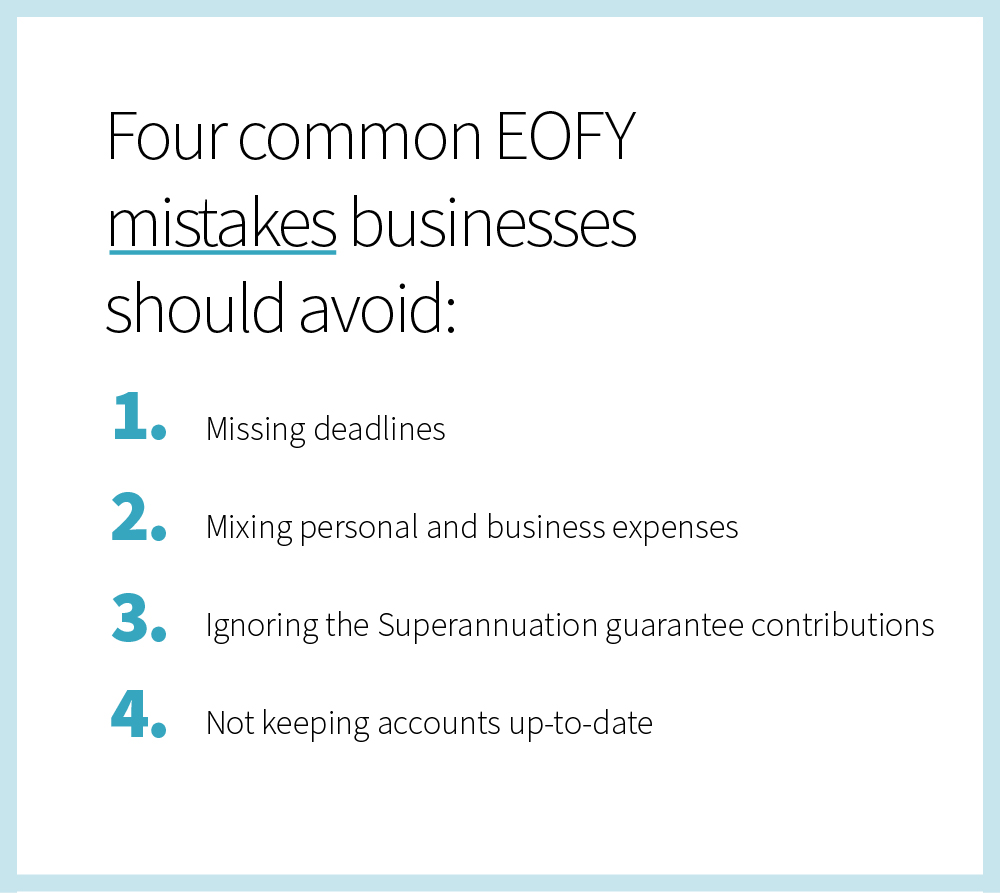
Here are the four most common mistakes you should avoid when it comes to EOFY.
- Missing deadlines: Failing to meet crucial tax deadlines for lodgements or payments can result in penalties and interest charges directly from the ATO.
- Mixing personal and business expenses: Mixing personal and business finances makes it difficult to report taxes accurately and can result in disallowed claims or trigger an audit from the ATO.
- Ignoring Superannuation Guarantee contributions: Not meeting your Superannuation Guarantee (SG) obligations, including paying the correct amounts by the deadline, can lead to substantial penalties like the Superannuation Guarantee Charge (SGC) from the ATO.
- Not keeping accounts up-to-date: Failing to keep accounting records current makes EOFY preparation difficult and increases the risk of inaccurate reporting, potentially leading to errors or compliance problems with the ATO.
EOFY preparation — the foundation of funding success
EOFY isn’t just about closing the books; it’s the launchpad for smarter planning and accessing vital funding through grants and the R&D Tax Incentive. Strong EOFY records are essential for this, and although FundFindrs aren’t tax agents, we specialise in helping you leverage that financial data for successful funding applications. Connect with FundFindrs today to discuss maximising grants and R&DTI opportunities for your business. Book a FREE consultation today.