November 2025 - FundFindrs

Who’s Winning Grants – and What They’re Doing Differently

Last reviewed: July 28, 2026


Every year, billions of dollars in grants are distributed across Australia – from federal and state programs to corporate, philanthropic, and regional funding. Yet for every successful application, there are hundreds (and sometimes thousands) that don’t make it through. 

So, who’s actually winning grants right now? And what are they doing that others aren’t? 

I’ve seen thousands of applications, from community organisations and social enterprises to startups and larger businesses, and clear patterns emerge. The organisations and founders who consistently win funding don’t just write better applications. They think strategically, align with funding priorities, and treat grants as part of a long-term growth strategy.

Here’s what sets them apart.


  1. They build before they apply
  2. They align their mission with the funder’s agenda
  3. They measure what matters
  4. They use technology to stay ahead
  5. They think long-term 


Key takeaways 


  • Successful grant applicants prepare before opportunities open, with clear project plans, budgets, evidence and measurable outcomes already in place.
  • Winning grants requires strong alignment with funder priorities, demonstrating how a project supports outcomes such as innovation, sustainability, regional growth or job creation.
  • Funders assess outcomes, not just activities. Strong applications explain the impact a project will deliver and how success will be measured.
  • Funding-ready organisations maintain core application materials, including organisation profiles, financial information, project plans and capability statements.
  • Government priorities influence future funding opportunities, making it important to monitor policy, budget and industry trends.
  • Grant success is part of a long-term strategy, not a one-off application process.


1. They build before they apply 

The most successful applicants start long before they hit “submit.” They’re not waiting for the perfect opportunity to appear; they’re already funding-ready. 

That means: 

  • Clear goals and measurable outcomes 
  • A well-defined project plan 
  • A realistic budget 
  • Evidence of capability and delivery
     

When a grant opens, they can quickly align their work to the funder’s criteria. Meanwhile, less-prepared applicants scramble to retrofit their ideas into opportunities that don’t quite fit. 

Grant’d tip: Build a funding readiness kit — your go-to folder with your organisation profile, ABN/financials, capability statement, project plan, and team bios. It’ll save you hours later. 


2. They align their mission with the funder’s agenda

Winning grants means more than good writing. It’s about strategic alignment. 

Funders have agendas. Their job is to distribute money that achieves specific outcomes, like innovation, sustainabilitydigital transformation, inclusion, or regional growth.

Your job is to show how your project contributes to those outcomes. 

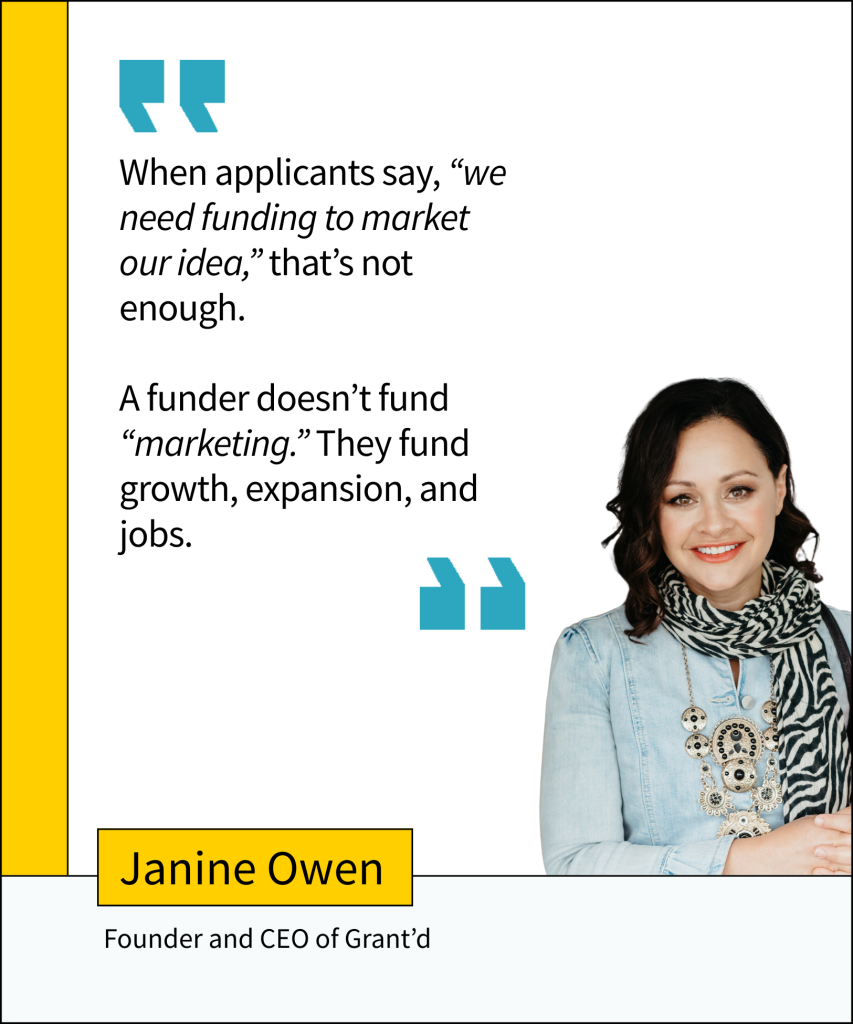
When applicants say, “we need funding to market our idea,” that’s not enough. A funder doesn’t fund “marketing.” They fund growth, expansion, and jobs. 

For example: 

  • “Marketing” → “Driving export growth and new market entry” 
  • “Software development” → “Digitising operations and enhancing industry productivity” 
  • “Community workshops” → “Building local resilience and creating pathways to employment”
     

Winners speak the language of impact, not just activity. 

Grant’d tip: Every funding opportunity is shaped by policy. If you follow the Federal Budget, state strategies, and ministerial priorities, you’ll see where funding is headed 6–12 months before programs launch. 

Janine Owen Founder and CEO of Grant'd RDTI quote


3. They measure what matters

The best applications go beyond outputs (“we’ll deliver 10 workshops”) to outcomes (“we’ll train 100 people and help 30 into new jobs”). 

Funders want to see tangible social or economic value, and confidence that you can track and report on it. 

The most competitive organisations integrate data collection and impact reporting from the start. They can easily quantify their outcomes when applying or acquitting.


4. They use technology to stay ahead

 Successful applicants don’t rely on luck or late-night research; they use systems and tools to keep their funding pipeline organised and opportunities visible.

Whether it’s tracking upcoming programs, setting alerts for new grants, or managing documentation in one central place, they make technology work for them.   

This gives them more time to focus on what really matters: refining their strategy, building strong partnerships, and demonstrating impact.  

Grant’d tip: Explore tools that help you centralise your grant search and management. The goal isn’t just efficiency — it’s freeing up time to focus on the strategic work that drives funding success. 


5. They think long-term

Winning one grant is great. But the real magic happens when organisations create a funding pipeline, planning 6–12 months ahead and aligning multiple grants across growth stages. 

That’s how small projects become sustainable programs and startups scale faster without relying entirely on investors.


Need help building your funding strategy?

Chat with our team to explore how we can help you plan, prepare, and position your next grant application.


Takeaway

The businesses winning grants aren’t chasing everything; they’re choosing strategically. They understand policy, stay prepared, and align their projects with the outcomes funders care about most. 

And the result? Less chasing, more winning.


About Grant’d  

Our mission is to make that process easier – giving you the AI tools, insights, and community to find, manage, and win grants with confidence.  

Learn more at grantd.com.au

 

The Power of Perception: Why Your Brand Shapes Trust

Think about the first time you came across a business. Maybe you found their website, saw a post on social media or were handed a flyer. Before you knew anything about their track record, you already had a feeling about them. “Did they look professional? Did they feel trustworthy? Did you believe they could deliver what they have promised?” 

That is the power of brand perception. Not only in life, but also when it comes to business, people often make decisions long before they get the chance to explain themself. 

For business owners, this perception influences how investors, partners, customers and award judges interpret your story long before they dive into details. 


  1. Access cash sooner  
  2. It’s easier to recall recent work
  3. Make all your lodgements seamless
  4. Avoid the seasonal bottlenecks 
  5. It gives you time to focus on your business
  6. FundFindrs makes it easy for everyone 


1. First impressions that stick  

A brand does not need to be large to feel credible. What matters is clarity and consistency. A clean logo, a simple message and a website that works on any device all send the same signal: “we are professional, we are organised, and you can rely on us.” 

When those signals are missing, doubts creep in. Outdated design, broken links or mismatched messaging can leave people wondering if your business is ready to deliver. Even if your product is excellent, the perception created by your brand may hold you back. 

This becomes especially important when you’re competing for visibility whether that’s award programs, accelerator opportunities, partnerships or media. A strong brand helps your achievements feel more believable and your narrative more compelling. 


2. Why perception is about trust

Trust is the currency of growth. Funders, partners and customers are all taking a chance on your business, and most of them will only take that step if they feel safe doing so. The way your brand looks and sounds creates the first layer of that safety. 

This does not mean dressing your business up to be something it is not. It means presenting your business with enough clarity and consistency that people believe you are capable of following through. 


3. Digital presence as proof

Today, trust is often checked online. People will type your name into a search bar before they return your call. They will skim your website, scroll your social channels and look for signs of trustiness such as awards and other public recognitions. If what they find is current, consistent and active, their confidence grows. If it feels outdated or disconnected, doubts rise quickly. 

The advantage for startups is that a digital presence makes this perception easier and cheaper to manage than ever. Posting on social media, keeping a website updated or sending simple email updates can all create signals of activity and reliability without big budgets. 


4. How Wollip helps 

  • At Wollip, we work with growing organisations to build those signals of trust. That might mean: 
    • Refreshing websites so they feel alive and current 
    • Creating content strategies that show traction on social media 
    • Designing brand systems that bring consistency across every touchpoint 
    • Developing messaging that is clear, simple and confident 

    It is about making sure perception matches capability. 


5. A final thought

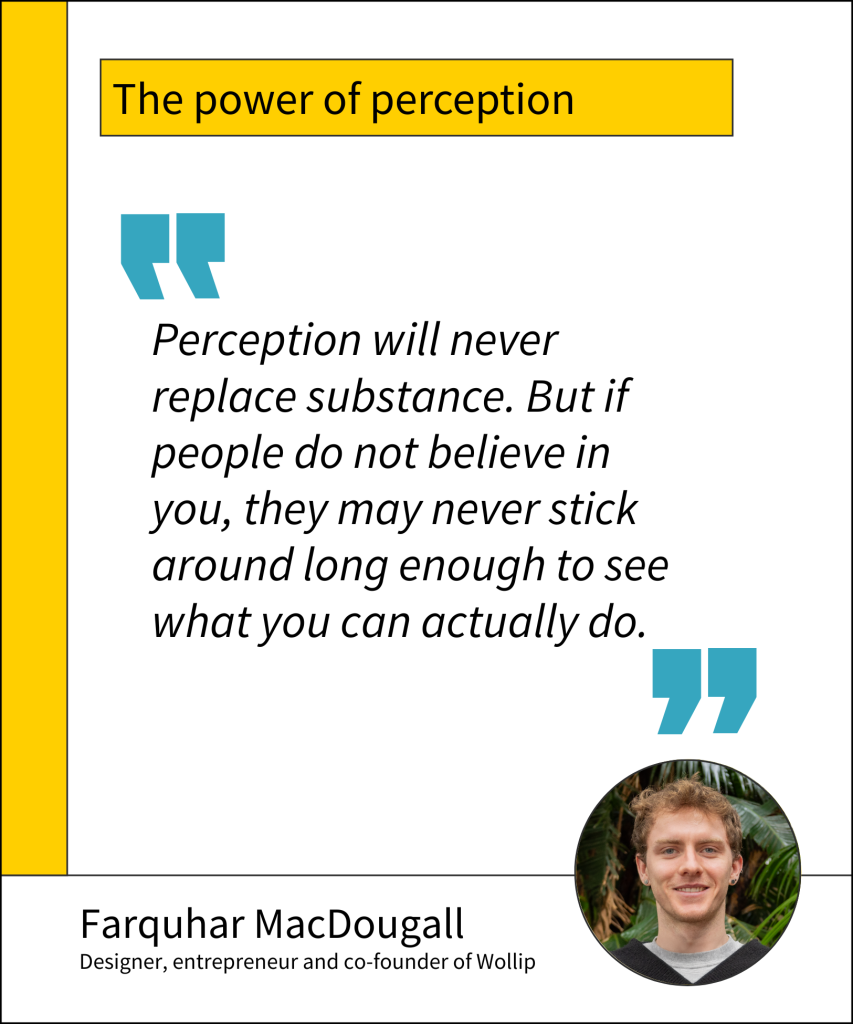
Perception will never replace substance. But if people do not believe in you, they may never stick around long enough to see what you can actually do. The way your brand looks, feels and communicates shapes that belief. When you get it right, you open the door for trust, and trust is what turns opportunities into growth. 

And for businesses pursuing awards, partnerships or recognition alongside funding, building a strong brand narrative becomes a powerful asset for influence, connection and long-term growth. 


About the author

Farquhar MacDougall is a designer, entrepreneur and co-founder of  Wollip, a design and digital agency built to support growth and impact. With a background in communication design and a passion for startups, Farquhar combines creativity and strategy to help businesses turn ideas into clear, credible brands. Through Wollip, he also champions the next generation of designers by providing mentorship and real-world experience, helping students step confidently from university into industry.  


From Mistakes to Mastery: Learning from Grant Application Errors

Last reviewed: July 28, 2026


If you’ve ever submitted a grant and received the dreaded “unsuccessful” email, you’re not alone. Every organisation that applies for funding experiences rejection at some point, even the best. 

The difference between those who give up and those who grow is what they do next. 

At Grant’d, we believe unsuccessful applications aren’t failures – they’re feedback. Every “no” is a data point you can learn from. 

Here’s how to turn mistakes into mastery.

  1. Most grant rejections are fixable
  2. Treat feedback as data, not emotion
  3. Build reusable system
  4. Remember: timing is everything
  5. Learn from others 


Key takeaways 


  • Most grant rejections are fixable, with common issues including poor alignment, unclear outcomes, weak evidence and unrealistic budgets.
  • Grant feedback should be treated as a learning opportunity, helping applicants identify gaps and improve future submissions.
  • Tracking lessons from previous applications can strengthen future results, making it easier to identify recurring weaknesses and opportunities for improvement.
  • Reusable grant content can improve efficiency, including organisation overviews, impact statements, team biographies and budget templates.
  • Timing matters. A strong project may be unsuccessful if it does not align with current funding priorities or program objectives.
  • Learning from other applicants and industry networks can improve grant readiness, helping businesses refine their approach and increase future funding success.


1. Most grant rejections are fixable 

When we unpack unsuccessful applications, the reasons are usually predictable, and solvable.

Common Mistake How to Fix It
Poor alignment Ensure your project directly advances the funder’s stated goals.
Vague outcomes Define clear deliverables and measurable impact.
Budget mismatches Keep figures realistic and consistent with the project scope.
Weak evidence Add supporting data, testimonials, or case studies.
Timing Sometimes, it’s just not the right round or focus – try again later.


Each of these can be addressed with better preparation and reflection. 


2. Treat feedback as data, not emotion

It’s easy to take rejection personally, but funders are assessing fit, not worth. When you receive feedback, analyses it systematically:
 

  • What keywords or themes do they use in the rejection? 
  • Which parts of your proposal might not have aligned? 
  • Were you clear about your outcomes and beneficiaries?
     

Document it. Build a “grant lessons” folder where you record what you learn from each submission. Over time, you’ll start to see patterns and strengths.


3. Build reusable system

Grant applications can be repetitive, but that’s an opportunity. Create templates for your: 

  • Organisation overview 
  • Impact statement 
  • Key team bios 
  • Budget structure
     

Then adapt them per grant. Tools like Grant’d help centralise this, so you can reuse winning language and track performance metrics over time.


Want expert eyes on your next grant or R&DTI submission? 
FundFindrs’ experts help you refine, align, and get funding-ready.


4. Remember: timing is everything


Sometimes, your project is excellent, but the funding cycle just doesn’t match. Government priorities shift annually. If your project wasn’t funded this round, it might be perfect next quarter when new programs open. 

The key is to stay funding-ready, your project brief, budget, and outcomes clear, so you can move fast when the right opportunity appears. 


5. Learn from others

Don’t learn in isolation. Join communities like Grant’d and FundFindrs to find other founders and learn from their experiences what have worked, what didn’t, and what changed their success rates. 

You’ll learn that every successful applicant has a history of rejection and every rejection made their next win stronger.

Takeaway 

Rejection isn’t the end of your funding journey; it’s part of the process. Every “no” gives you insight, clarity, and direction for the next “yes.”


About Grant’d  

Grant’d helps you build repeatable success, with smart matching, application tracking, and insights that evolve with you.  

 Learn more at grantd.com.au 


Eligible R&D Activities: What It Means for the R&D Tax Incentive in Australia

Last reviewed: July 17, 2026


The R&D Tax Incentive (R&DTI) is one of Australia’s most valuable programs for innovative businesses, but many companies still struggle with one core question: “What actually counts as eligible R&D activities?” 

Understanding what the legislation means by eligible R&D activities, and how to distinguish core from supporting activities, is essential for maximising your claim and reducing compliance risk. This guide breaks it down in clear, practical terms to help you assess eligibility with confidence.  


Key takeaways 


  • Eligible R&D activities must address a technical uncertainty through a structured process of experimentation.
  • Not all innovative work qualifies for the R&D Tax Incentive. Activities must satisfy specific legislative requirements.
  • Core R&D activities require an unknown outcome, a systematic progression of work, and the generation of new knowledge.
  • Supporting R&D activities may also be claimable when they are directly related to eligible core R&D activities.
  • Correct classification is critical, helping businesses maximise eligible claims while reducing compliance risk.
  • Good documentation is essential, including evidence of hypotheses, testing, results and conclusions.


What “eligible R&D activities” means 


Under Australian law (Income Tax Assessment Act 1997), eligible R&D activities are activities that involve experimentation, carried out for the purpose of creating new knowledge or developing new or improved products, processes, materials or services. 

To be eligible, activities must meet specific legal criteria, not simply feel “innovative” or “new to your business”. 

In simple terms: Eligible R&D must try to solve a technical uncertainty using a structured, experimental approach. 


Core R&D activities. Definition and requirements 


Core R&D activities are the heart of your claim. According to business.gov.au and the legislation, a core R&D activity must meet all of the following: 


1. The Outcome cannot be known in advance

There must be technological or scientific uncertainty, and you genuinely do not know whether something will work until you test it. 


Example: 

  • Developing a new process to convert agricultural waste into a stable biofuel where no proven methodology exists. 
  • Attempting to improve battery performance beyond known industry baselines using a novel electrolyte formula. 


2. Conducted using a systematic progression of work

This means you must follow an experimental method, such as: 

  • Defining a hypothesis 
  • Designing an experiment 
  • Observing results 
  • Evaluating findings 
  • Drawing conclusions 


Example: 

  • A robotics startup documents assumptions, test parameters, failure modes, modifications, and retesting cycles while prototyping a new autonomous navigation system. 


3. Based on established principles of science, engineering or computer science

You don’t need to be developing a world-first invention, but your work must use a recognised technical discipline. 


4. For the purpose of generating new knowledge

This includes new or improved materials, products, devices, processes or services.


Not sure if you’re eligible for the R&D Tax Incentive?
Our FREE R&DTI Blueprint breaks it down with an eligibility checklist, examples, and expert tips from the FundFindrs team.


Supporting R&D activities. What qualifies? 


Supporting R&D activities are activities that directly relate to a core R&D activity or, in some cases, are undertaken for the main purpose of supporting core R&D. 


Key requirement:
 

 Supporting activities must not stand alone. They only become eligible because they enable, assist or provide necessary input into the core experiments. 


Examples of supporting R&D activities:

  • Designing prototypes required for testing 
  • Software coding that implements the algorithm being experimentally tested 
  • Data cleaning or dataset preparation for machine learning model experiments 
  • Engineering drawings for test rigs 
  • Technical research to inform experiment design 
  • Testing materials, components, or code modules to isolate variables 


Activities requiring the “dominant purpose” test
 

 Some tasks could be everyday business activities unless they exist solely to support R&D. These must pass the dominant purpose test. 


Examples include: 

  • Project management of an R&D project 
  • Feasibility studies 
  • Compliance testing required to characterise experimental outcomes (not regulatory approval testing) 
  • Technical analysis outside of normal production work 


What is NOT considered eligible R&D (common exclusions) 


Many activities feel innovative but do not meet legislative requirements for eligible R&D. 

 Here are some of the most common exclusions: 


Routine activities

  • Routine testing or quality assurance 
  • Debugging that follows known solutions 
  • Cosmetic changes to products 


Market-focused or business activities

  • Market research 
  • Consumer testing for preferences 
  • Branding, UI/UX work that isn’t technically experimental 
  • Sales activities or customer discovery interviews 


Software exclusions 

  • Software developed for internal administration, such as: 
  • Payroll systems 
  • CRMs 
  • Inventory management 
  • Scheduling systems 


Commercial or regulatory tasks 

  • Product certification 
  • Compliance testing for approval 
  • Beta testing by customers 


Replicating known technology

If the method, solution or approach is publicly available or already proven, it cannot be claimed as core R&D. 


Assess your activities


Here’s your FundFindrs handy checklist to help you more easily decide which activities are eligible R&D activities and which are not. Note, this advice is general in nature. 


Core R&D eligibility checklist 

 Your activity likely qualifies as core R&D if: 

  • You faced a technical problem with no known solution 
  • Your team could not predict the outcome using existing knowledge 
  • You ran structured experiments (hypothesis → test → evaluate → iterate) 
  • You recorded observations, failures, data, and conclusions 
  • The work involved scientific/engineering/computer science principles 
  • The purpose was to create new knowledge or capability 


Supporting R&D eligibility checklist 

Your activity may qualify as supporting R&D if: 

  • It enabled, assisted or directly related to a core R&D experiment 
  • The activity would not have been undertaken if the R&D project didn’t exist 
  • Technical staff or engineers were required to perform it 
  • Documentation exists linking the activity to the core R&D timeline 
  • If the “dominant purpose” test is necessary, it’s established that the dominant purpose was to support experimentation 


Exclusion red flags

If any of these apply, you may need to rethink your activities’ eligibility: 

  • The work was commercially focused, not experimentally focused 
  • The outcome was known before testing 
  • The work followed standard testing or debugging processes 
  • Activities were administrative, operational or design-only without experimentation


To discuss the eligibility of R&D activities you are conducting (even if you are unsure), book a FREE consultation with a FundFindrs expert.


Evidence requirements. What documentation should you keep? 


Good record-keeping is essential for demonstrating eligible R&D activities in Australia. 

Required evidence includes: 

  • Technical project plans and hypotheses 
  • Experiment logs, test plans and test results 
  • Version control logs (Git, JIRA, Confluence, etc.) 
  • Data sets and analysis outputs 
  • Photographs or videos of prototypes 
  • Lab notes or engineering notebooks 
  • Time tracking for R&D personnel 
  • Invoices for materials, prototypes and contractors 
  • Minutes from technical meetings 
  • Failure analysis and iteration notes 


FundFindrs’ tip

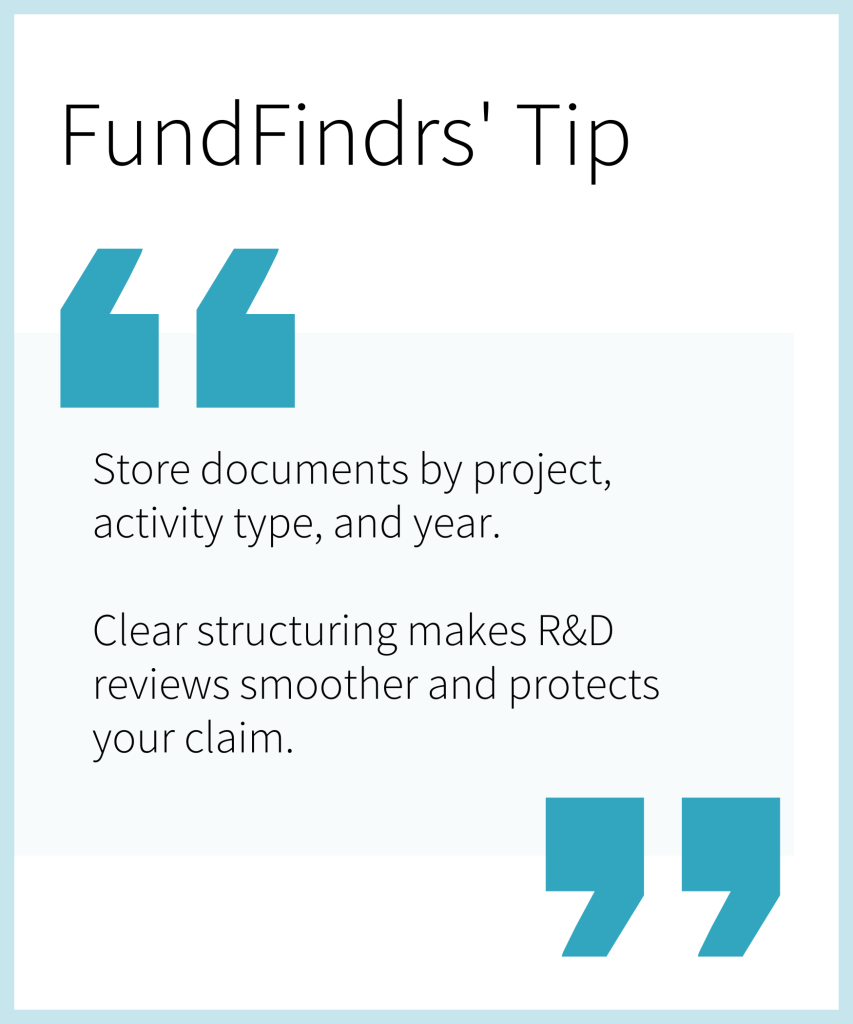
 Store documents by project, activity type, and year. Clear structuring makes R&D reviews smoother and protects your claim. 


Why correct classification matters

Incorrectly claiming activities as R&D can lead to: 

  • Claims being denied 
  • Audits 
  • Repayment of offsets 
  • Penalties 


Correctly identifying core vs supporting R&D activities is the foundation of an eligible, defensible R&D Tax Incentive claim. 


Thinking about your R&D eligibility? FundFindrs can help.

Assessing eligible R&D activities in Australia can be complex, especially when innovation overlaps with day-to-day operations.  

Our team specialises in helping founders, business leaders and technical teams: 

  • Identify eligible core and supporting R&D activities 
  • Build defendable documentation 
  • Align financials and technical work 
  • Maximise R&D returns while reducing compliance risk 


If you’d like clarity on how to assess R&D eligibility or you need support with preparing your claim, book a FREE consultation with FundFindrs today.