Australian Business Funding Archives - FundFindrs

Business Tips for FY27: Empowering Australian SMEs for success

Last reviewed: July 17, 2026 


The Australian business landscape is experiencing a significant surge in entrepreneurial activity, with 97% of all businesses classified as small businesses according to the Australian Small Business and Family Enterprise Ombudsman (ASBFEO). This shift reflects a broader trend where innovation, adaptability, and strategic funding are essential for business growth regardless of size or industry.


As we move into a new financial year (FY27), small to medium-sized enterprises (SMEs) must proactively secure funding, embrace AI, and adapt to emerging market trends to stay competitive. Whether you’re launching a startup, scaling an existing business, or investing in digital transformation, understanding available resources is crucial.


This guide provides expert insights into the most relevant business strategies, funding opportunities, and industry trends shaping the next financial year. From R&D Tax Incentive (R&DTI) and business grants to AI-driven efficiency and industry-specific funding, we’ve compiled the most critical tips to help your business succeed in the next 12 months.


  1. Embrace AI & Digital Transformation
  2. Secure Grants & Funding for Business Growth
  3. Focus on Industry-Specific Growth Areas
  4. Strengthen Cash Flow & Financial Resilience
  5. Engage with Industry Associations & Networks
  6. Build a Strong Online Presence
  7. Maximise Your Business Potential with Award Recognition


Key takeaways 


  • AI and automation are becoming essential growth drivers, helping SMEs improve productivity, efficiency and decision-making.
  • Grants, funding programs and the R&D Tax Incentive can support business growth, innovation and digital transformation initiatives.
  • Industry-specific opportunities continue to emerge, making it important to align growth plans with market and funding trends.
  • Strong cash flow and financial resilience remain critical for sustainable business growth.
  • Industry networks and associations can provide valuable connections, insights and opportunities for SMEs.
  • A strong online presence and market visibility help businesses remain competitive in a rapidly changing environment.
  • Awards and recognition can strengthen credibility, improve brand awareness and support business growth.


1. Embrace AI & Digital Transformation

Let’s start with the trend topic of the moment: AI and automation are becoming essential growth drivers for SMEs, and businesses that embrace them will gain a competitive edge.


According to theTech Council of Australia, AI is expected to be the defining technology trend in 2026,with business leaders increasingly viewing it as a key driver of operational efficiency and cost savings. Additionally, the Australian Parliament has highlighted AI and automated decision-making as crucial for boosting productivity and economic growth.  


FundFindrs Tip | SMEs can benefit from AI & automation by using:

How can Australian SMEs use AI and automation to grow in FY27?
  • AI-powered analytics tools to help businesses optimise cash flow, predict market trends, and manage risk.
  • Automation tools to reduce administrative burden, freeing up time for strategic growth.
  • AI-driven chatbots and virtual assistants to enhance customer service while reducing operational costs.
  • Cybersecurity automation to protects businesses from increasing digital threats.


Did you know? There are several government-backed grants and incentives for businesses investing in AI, automation, and digital transformation, making now the perfect time to explore those funding options.  


2. Secure Grants & Funding for Business Growth 

What grants and funding programs are available for Australian SMEs in FY27?

There are thousands of grants available for SMEs across various industries in Australia. Whether you’re in technology, manufacturing, renewable energy, or agriculture, securing the right funding can accelerate business growth.


FundFindrs Tip | Examples of Grants and Tax Offset Programs to watch:

  • NSW Minimum Viable Product (MVP) Grant

The NSW Government’s MVP Grant supports startups and innovative SMEs who aim to commercialise new and highly innovative products. Eligible businesses can receive up to $50,000 until available funding is exhausted. 

  • Research & Development Tax Incentive (R&DTI) 

The R&D Tax Incentive remains one of the most valuable funding sources for Australian SMEs, offering a tax offset of up to 43.5% for eligible R&D expenses. This program is crucial for businesses investing in innovation, product development, and scientific advancements.


With thousands of funding programs available, working with specialists like FundFindrs ensures you access the most relevant grants for your industry.


3. Focus on Industry-Specific Growth Areas

Aligning your business with emerging industries receiving strong government investment can improve funding eligibility and open new growth opportunities in the upcoming financial year.


FundFindrs Tip | Key sectors to drive business success in FY27:

Which industries are receiving the most government funding in Australia in FY27?
  • Agricultural Innovation & AgTech – AI-driven farm management, precision agriculture, and climate-resilient technologies are attracting investment.
  • Health & Aged Care ServicesAccording to the Australian Treasury’s 2023 Intergenerational Report, the share of Australians aged 65 and over is projected to reach 23% by 2062–63. This will generate a demand for aged care innovations, assistive technologies, and healthcare services is rapidly increasing.
  • Construction & Infrastructure – Government-backed infrastructure projects are creating funding opportunities for smart-projects, energy-efficient buildings and sustainable solutions.
  • Renewable Energy & Sustainability – Businesses investing in clean energy solutions carbon capture, and circular economy innovations will benefit from ongoing grantssuch as the Advancing Renewables Program (ARENA).  
  • Cybersecurity & Digital Security – With increasing cyber threats, SMEs investing in cybersecurity solutions will gain access to funding opportunities.


4. Strengthen Cash Flow & Financial Resilience

How can SMEs strengthen cash flow and financial resilience in FY27?

In an economic climate marked by rising interest rates, inflation, and market volatility, SMEs must take a proactive approach to financial resilience. A strong financial position not only ensures business stability but also improves eligibility for grants and investment.


Cash flow stability isn’t just about survival — it’s about creating the capacity for growth, innovation, and long-term sustainability.


FundFindrs Tip | Top strategies for cash flow stability and building financial resilience:

  • Leverage tax incentives like the R&D Tax Incentive to offset costs.
  • Use AI-driven financial forecasting tools to predict revenue fluctuations.
  • Diversify revenue streams by expanding product lines, targeting new markets, or introducing subscription-based services to enhance financial security.
  • Secure working capital funding to ensure smooth operations during economic downturns.
  • Review and optimise business expenses to enhance profitability.
  • Adjust pricing strategies in response to market changes and inflation while maintaining customer loyalty.


Not sure if you’re eligible for the R&D Tax Incentive?
Our free Blueprint breaks it down with an eligibility checklist, examples, and expert tips from the FundFindrs team.


5. Engage with Industry Associations & Networks

Industry associations and business networks play a critical role in connecting SMEs with funding opportunities, mentorship, and strategic partnerships. Many awards and funding programs give preference to businesses that demonstrate industry involvement, making these connections highly valuable. Beyond financial benefits, being part of a strong business network provides insights into industry trends, regulatory updates, and collaboration opportunities.


As FY27 brings increased competition for grants and funding, along with new government-backed initiatives, SMEs with strong industry ties will have a strategic advantage. Engaging in these networks can open access to exclusive funding streams, provide early insights into regulatory changes, and position businesses as key players in their sectors, making them more attractive to investors and grant providers.


FundFindrs Tip | How to maximise industry connections:

  • Join local and national business chambers, trade associations, and industry-specific groups to stay informed about sector-specific grants and emerging opportunities.
  • Participate in networking events, grant information sessions, and workshops to build relationships with funding bodies, potential partners, and advisors.
  • Collaborate with industry bodies and advocacy groups to gain credibility and improve your business’s chances of securing funding.
  • Engage with accelerator programs and innovation hubs, which often provide grant access, investor connections, and growth support for high-potential businesses.
  • Seek mentorship from experienced industry leaders, who can guide you on grant applications, business development, and long-term strategic planning.


Fy27 tips industry connection


6. Build a Strong Online Presence

A robust digital presence is no longer optional: it’s essential for securing grants, attracting investors, and growing your customer base. According to Google, 88% of consumers research businesses online and read reviews before making purchasing decisions.


Now more than ever, a well-optimised digital footprint can improve discoverability, enhance brand authority, and position your business for greater success in a competitive landscape.


FundFindrs Tip | Key steps to strengthen your online presence:

  • Optimise your website with clear messaging, products and services offering, and case studies.
  • Leverage social media to share success stories, customer’s feedback, and industry insights.
  • Implement SEO strategies to ensure your business is discoverable by your target audience.
  • Ask your clients to leave testimonials and reviews of their experience with you service or product.


7. Maximise Your Business Potential with Award Recognition

Being recognised with a business award is more than just a badge of honour: it’s a strategic tool for accelerating your business. Winning an award can significantly boost business visibility, leading to increased partnerships, customer trust, and revenue growth. If you’re serious about expanding in this new financial year, FundFindrs can help position your business for awards recognition and success.


FundFindrs Tip | How we can help you build winning awards submissions:

  • Identifying the best awards for your industry and achievements.
  • Crafting compelling, high-impact submissions that increase success rates.
  • Managing the entire application process, so you don’t have to worry about deadlines or paperwork.
 

7 business tips for fy27


How FundFindrs Can Support Your Business Growth

At FundFindrs, we’re here to support your business through every stage of growth. From securing grants and maximising your R&D Tax Incentive claim to managing award submissions and identifying the right funding opportunities, our expert team has you covered. Explore our full range of services designed to help you grow, innovate, and strengthen your financial position in FY27 and beyond.

Claiming the R&D Tax Incentive in Australia: Common Misconceptions

Last reviewed: June 24, 2026 

The Research & Development Tax Incentive (R&DTI) is an invaluable funding opportunity, supporting business innovation and growth. However, claiming the R&D Tax Incentive in Australia can often be misunderstood, leading to missed opportunities or incorrect applications.


In our previous article “Mastering the R&D Tax Incentive: top mistakes to avoid with your application” our R&DTI expert, Bruce Murray, talked to us about common application mistakes.


With decades of direct experience reviewing R&D Tax Incentive applications as a programme assessor within the Department of Industry, Science and Resources (AusIndustry), and a background spanning corporate governance, compliance, and risk management, Bruce’s insights carry the weight of someone who has sat on both sides of the assessment process.


For this article, we asked him to share frequent misconceptions around the R&D Tax Incentive and clarify them for us.

  1. What does the term ‘core R&D activities’ mean?
  2. Do some business owners believe the R&DTI is only for large businesses?
  3. How detailed do R&D records need to be?
  4. What do businesses often get wrong about how much time they have to submit their claims?
  5. Is the application process the same for R&D activities conducted outside of Australia?


Key takeaways 

  • A core R&D activity must have an unknown outcome, follow a scientific process, and aim to generate new knowledge. 
  • Company size and industry do not determine eligibility while the $20,000 minimum spend threshold does. 
  • Records must meet the “desktop understanding” standard; being self-explanatory, without needing further input from you. 
  • You have until 30 April to submit, but earlier lodgement means faster processing and quicker access to your rebate. 
  • Overseas R&D activities require a separate Overseas Finding application before they can be included in a claim. 


1. The term “core R&D activities” can be misinterpreted when it comes to R&D activities. What does it mean according to the R&DTI program?

To meet the definition of an R&D activity, there are several legislative requirements that need to be demonstrated for the R&D Tax Incentive program to respond.


Prior to commencement, the outcome of the R&D activity must not have been known or determined in advance by a competent professional in the field, based on current knowledge, information, and experience. This needs to be a true innovation or, in simple words, no one else knows this; no one else is doing it.


The unknown outcome must be determined by applying a systematic progression of work following a scientific process i.e. hypothesis, experimentation, observations, and conclusions. There needs to be a methodical process supported by clear and documented evidence.


Additionally, The R&D activity must be conducted for the purpose of generating new knowledge – where previously there was a knowledge gap, and the R&D project activities were required to address it.


Bruce Murray, FundFindrs R&D consultant and former AusIndustry assessor, shares insights on R&D Tax Incentive misconceptions


2. Do some business owners believe the R&DTI is only for large business or specific industries?

Definitely, the R&DTI program is not only for large companies. To be honest, the size of the company itself is not that important. Similarly, the sector, or industry type is not an influence on the R&DTI claim outcome.


 In October 2025, the ATO released their “R&D tax incentive transparency report 2022–23  in which they noted a significant number of SMEs and smaller companies across all types and sectors of industry.


This means it does not matter what the industry is, nor how large (or small) the company is. So long as anticipated eligible R&D expenditure exceeds the threshold of $20k, an R&DTI application can be considered.


3. How detailed do R&D records need to be to apply successfully for the R&D Tax Incentive?

The records of a company’s R&D activities need to be as detailed and comprehensive as possible and reflect how those activities fit within the overall project.


R&DTI applications are subject to what we call “desktop understanding”. An assessment on merit, on the evidence presented at the time, without needing further explanation from an external source. This allows for objective assessment.


Maintaining organised documentation is crucial for supporting applications and providing evidence if needed. I recommend clients prepare comprehensive documentation in advance to ensure easy retrieval during a possible inspection.


FundFindrs helps you stay audit-ready. We support you in building clear, compliant documentation that strengthens your R&DTI claim.


4. What do businesses often get wrong about how much time they have to submit their claims?

Businesses have up to 10 months after the End of Financial Year (EOFY) to submit their application, with the deadline falling on 30 April each year. However, submitting an R&DTI application shortly after the financial year-end offers several advantages.


Firstly, it provides ample time for thorough due diligence, enabling a more comprehensive investigation and discussion of activities potentially eligible for the R&DTI. Secondly, early submission helps avoid the application backlog AusIndustry typically experiences as the April 30th deadline approaches, thereby increasing the likelihood of a faster processing time.


Finally, submitting the R&DTI Schedule, an ATO document, concurrently with the Company Tax Return (CTR) simplifies the process, facilitates a more streamlined submission, and ultimately enables a quicker rebate, which can significantly improve a company’s cash flow.


5. What about R&DTI applications for businesses conducting R&D activities outside of Australia? Is the application process the same?

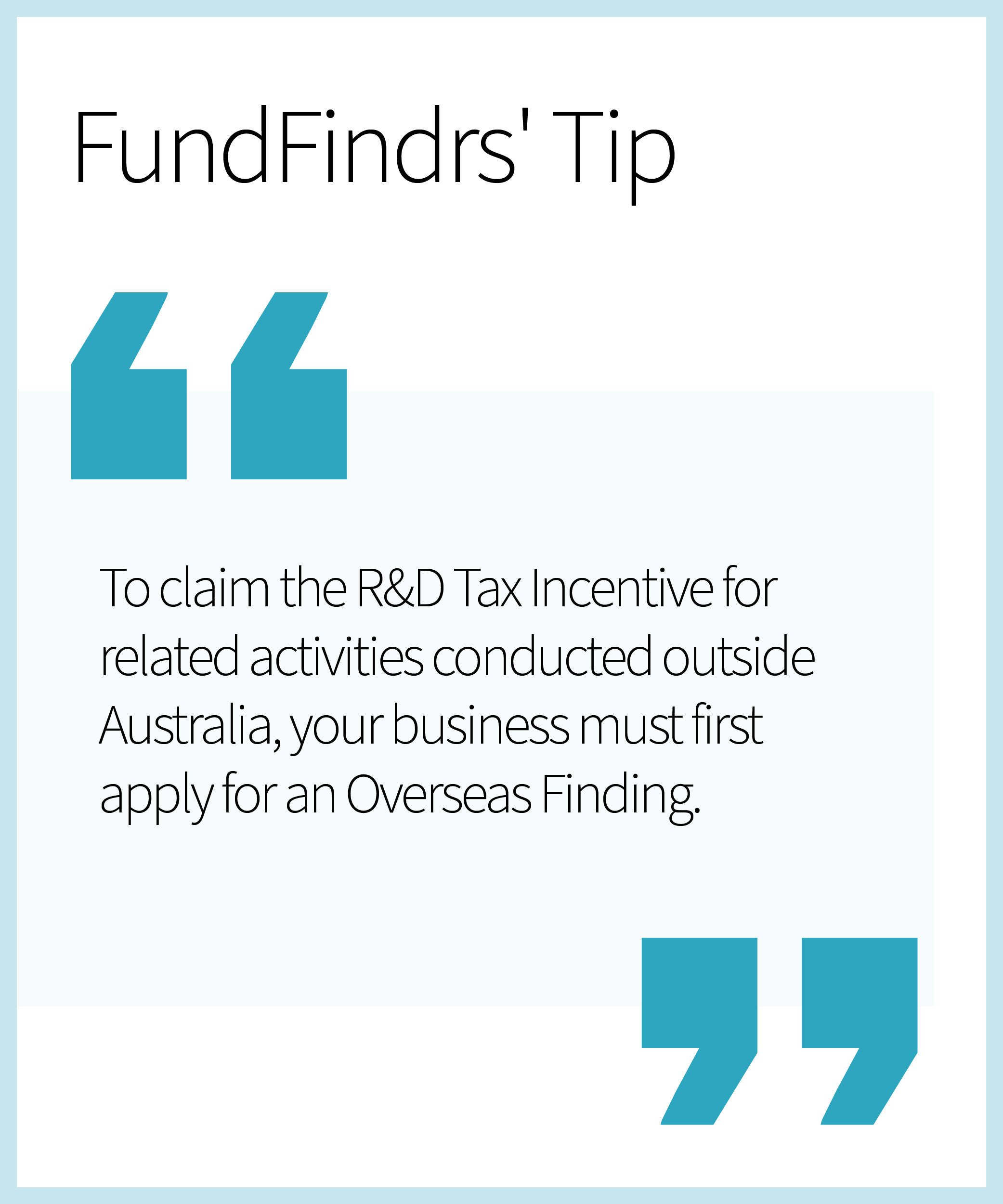
To claim the R&DTI for related activities conducted outside Australia, your business must first apply for an Overseas Finding.


To be eligible, your overseas R&D activities must meet all five of the following criteria:

  1. The activity must qualify as an eligible R&D activity.
  2. It must have a scientific link to a core R&D activity carried out in Australia.
  3. It must be conducted outside Australia and its external Territories.
  4. You must show that the overseas activity cannot be conducted in Australia due to specific reasons such as the lack of necessary facilities, expertise, or environment
  5. The total cost of overseas activities must be less than the cost of the directly related R&D work undertaken in Australia.


You can find more information from the government’s website for the Australian business community here.


FundFindrs tip on claiming the R&D Tax Incentive in Australia — common misconceptions explained


Knowing what activities qualify for the R&D Tax Incentive (and also which do not) can be tricky. Fortunately, FundFindrs’ team of experts is here to help guide your business through its R&DTI application.

Book a FREE consultation with one of our specialists now.


How Winning a Grant Helped Me Step Off the Hamster Wheel and Build Grant’d

Running a business — especially as a solo founder — can sometimes feel like you’re sprinting on a treadmill that never stops. You’re juggling everything: clients, cash flow, product, people (or no people), planning, and that ever-present question — “How do I grow this without breaking myself in the process?”


I’ve spent years helping charities and organisations raise millions through grants and fundraising. Over $100 million, in fact. But when it came to funding my own vision — when it was my name on the application and my business that needed the next step — I felt just as stuck as so many others do. I was deep in the grind. Delivering services to stay afloat. Doing all the things — workshops, webinars, strategy sessions — just to keep revenue coming in. But I knew I was only building sideways. Not up. Not forward. And that’s when something shifted.


In 2023, I received a grant through the Boosting Female Founders Program. Now, let me say this clearly: it wasn’t a miracle, or magic. I still had to apply, still had to articulate the vision, still had to show the numbers. But when that approval came through, something changed. It gave me space. Not just time — although yes, that too — but mental space. Permission to pause the scramble, step off the hamster wheel, and finally double down on building what I knew the sector desperately needed: a smarter, simpler way to help businesses, charities, and communities find and win grants.


The grant that changed everything

That funding was a turning point. It wasn’t just cash in the bank — it was validation. It was momentum. It allowed me to hire support, invest in the product, and shift from being a consultant in motion to a founder with a vision. It let me take Grant’d — something I’d been dreaming about for years — and turn it into a product. Not just another database. Not just a directory. But a proper, intelligent platform designed to guide people through the entire grants journey: from discovery and deadlines, to writing and reporting.


Until that point, I’d always been “doing the work” — writing, applying, researching, advising — manually. And I knew I wasn’t the only one. I knew that thousands of others were wasting hours trying to search for grants late at night, rewriting the same applications, second-guessing every eligibility criteria, and often missing out on funding they were perfectly suited for. But I couldn’t fix the system while I was still stuck inside it. That grant gave me the runway to build something better. Something scalable. Something for everyone who didn’t have time, money or a consultant on speed dial. It gave me the freedom to move from survival mode to strategy — and honestly, that’s the difference between staying stuck and stepping into something game-changing.


But let’s be honest — Applying was still nerve-wracking

Even with all my experience in fundraising, when it came to applying for a grant for my own business, I had the same nerves so many others do. The fear of getting it wrong. The overwhelm of documentation. The “Who am I to apply for this?” mindset. But it was also incredibly clarifying.


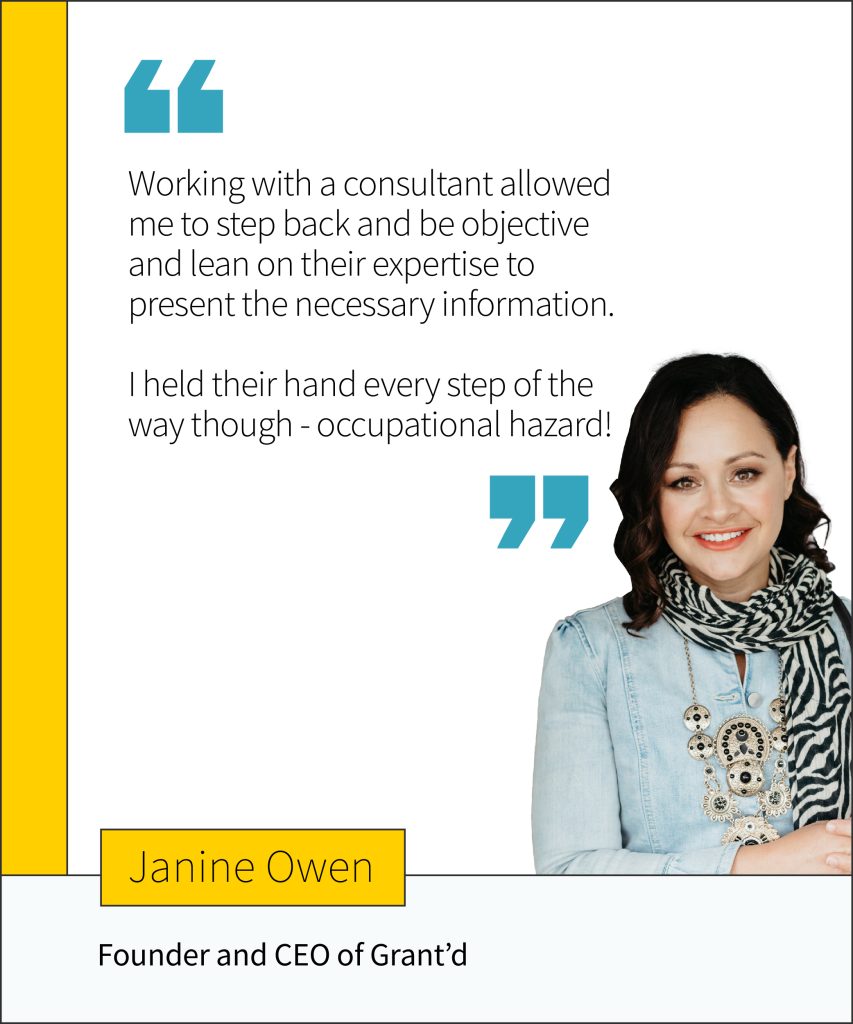
It forced me to get really clear about what I was building, why it mattered, and where I was heading. It made me step outside the day-to-day and think bigger. And most importantly, it made me believe — in myself, in the idea, and in the impact we could have. That clarity? It’s been one of the most valuable outcomes of all. Plus, I got support from experts (yep, other grant specialists). You see I knew what I was good at, but I also knew my limitations. Presenting my own work felt so overwhelming and I was so close to it I lost perspective. Working with a consultant allowed me to step back and be objective and lean on their expertise to present the necessary information. I held their hand every step of the way though – occupational hazard!


FundFindrs - Janine Owens (Grant'd) Quote


Why grants are more than just funding

I talk to so many people who say they don’t apply for grants because they think they’re too small, too early, too busy, or just “not ready.” But here’s the truth: grants aren’t just about the money. They’re about momentum.


They’re about carving out time to build properly. About showing funders — and yourself — that you have something worth investing in. Grants can give you space, clarity, validation, and structure. They make you stop and articulate your purpose, your strategy, your plan. They make you ready — not just for that application, but for what comes next. And if you get one? It can absolutely change the game.


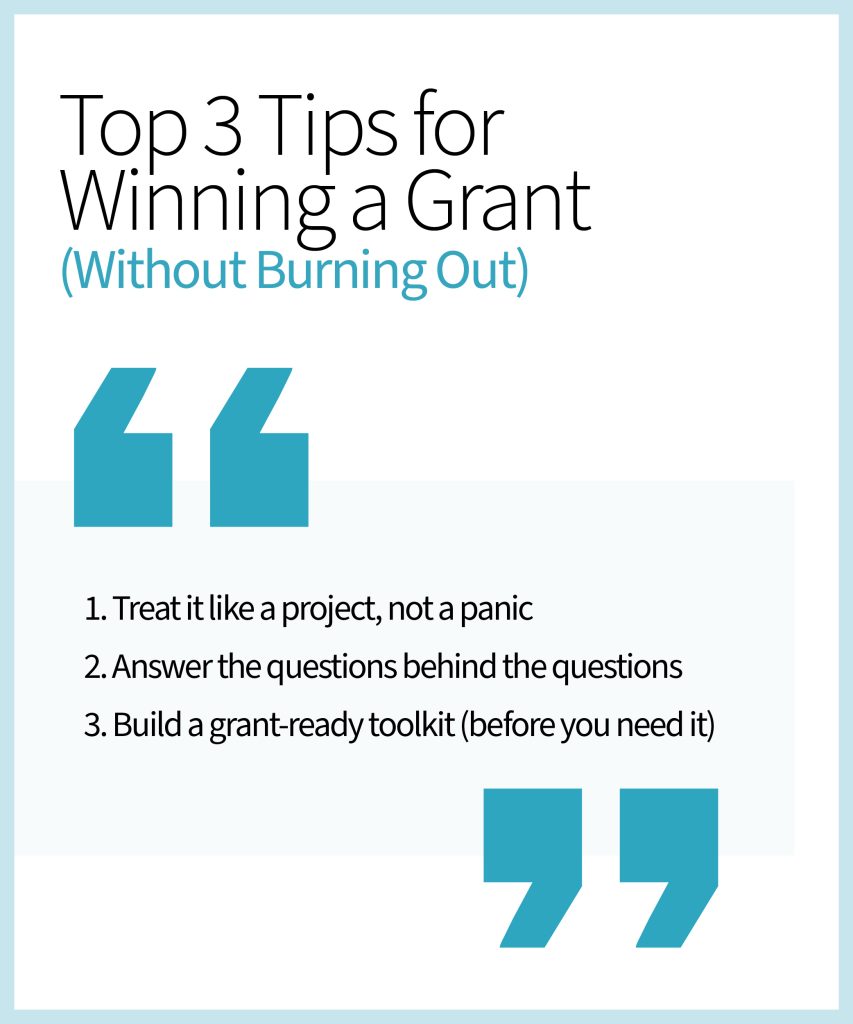
My top 3 tips for winning a grant (without burning out)

1. Treat it like a project, not a panic

Too many people scramble to write their applications the night before it’s due. I get it — we’re all busy. But when you treat the grant process like a panic, you rush the parts that matter.


Instead, treat it like a mini-project. Break it into stages:

  • Week 1: Gather your docs
  • Week 2: Draft your responses
  • Week 3: Get someone to review
  • Week 4: Polish and submit


Give it the structure it deserves. Not only will your application be stronger, but you’ll actually enjoy the process more (yes, really).


2. Answer the questions behind the questions

Grant applications all boil down to a few key things:

  • What problem are you solving?
  • Why are you the right person/team to solve it?
  • What will the funding actually do?
  • How can you help the funder fulfil their strategies/policies by investing in you?


Every time you write, think about the “why” behind the question. Don’t just list what you want to do — explain why it matters, who it will impact, and how you’ll make it happen. Use numbers, real examples, and a strong case for what comes next. Clarity wins. Every time.


3. Build a grant-ready toolkit (before you need it)

Here’s the best advice I can give you: be ready before the next perfect grant drops.

Keep a folder with:

  • A one-pager about your business or project that you can turn into a longer business plan if needed
  • A project budget (invest upfront to have a proper budget created if you can’t do this)
  • A couple of great testimonials and some statistics to support your case for funding
  • Your org bio and mission
  • A pitch deck or visual overview (if you’ve got one, if not, you should create one)


These building blocks are gold. They’ll save you time, reduce stress, and help you apply more often. Because — let’s be honest — grant success is a numbers game. The more you apply (with quality), the better your odds.


FundFindrs - Top 3 Tips for Winning A Grant


The truth: I wouldn’t be here without that grant

That one application helped me build a product, grow a team, serve thousands of users, and raise further investment. But beyond that, it helped me believe in the next version of myself — the one who wasn’t just fundraising for others, but building something of her own. If you’re sitting on an idea, a project, or a purpose that needs funding — apply. You don’t have to have it all figured out. You don’t have to be a grant-writing expert. You just have to start.


So here’s your nudge: go for it. You might just surprise yourself.


We’re excited to welcome Janine as a guest author, sharing her grant success story and insights with the FundFindrs community. Her story is a powerful reminder of what’s possible when the right idea meets the right support. We love seeing founders use grants not just as funding, but as fuel for growth, clarity, and confidence. The work Janine and the team at Grant’d are doing is helping more people take that step. At FundFindrs, we’re proud to be part of a growing movement that’s making access to grants more strategic, impactful and achievable for businesses across Australia.

Curious about what support might be available for your business? Our team is happy to help. Book a FREE consultation with to explore your grant options.


Leading Together: Jen & Kate on Two Years as General Managers of FundFindrs

Jen Manuel and Kate Downing share the role of General Manager of FundFindrs, a role in which they celebrate their two-year anniversary. Here they reflect on their partnership and what they’ve achieved together. 


  1. A unique partnership
  2. Driving growth with agility
  3. Making impact for clients
  4. A team built to thrive
  5. Looking ahead


1. A unique partnership 

Their story began seven years ago, when both were looking for flexible work arrangements after having children. With broad and differing business backgrounds, it was a chance meeting over coffee that revealed a shared work ethic, ambition, and complementary skills. Their first experience of a job share was as Marketing Managers, which later evolved into senior roles where they built strategies and led teams. They continued to work together across a range of industries, moving from managing existing functions to creating new ones, establishing departments, setting direction, and driving change on the way. What started as a job share became a leadership style — two strategic minds tackling every business challenge. 

Then two years ago, Jen and Kate stepped into the shared role as General Manager of FundFindrs. Since then, the duo’s successful leadership partnership has strengthened and helped build a business that continues to thrive, adapt and deliver meaningful impact for Australian businesses. 

“Collaboration is second nature,” Jen explains. “One of us has an idea and the other springboards it further. It gives us built-in validation and allows us to see challenges from multiple angles.” 

Kate adds: “Our team gets the benefit of two different perspectives, and clients get leaders who truly understand the diversity of industries they work in.” 


2. Driving growth with agility 

In their time, FundFindrs has welcomed new clients and expanded its team. For Jen and Kate, success has come from a clear people strategy; hiring individuals who not only understand business but are passionate about contributing to others’ success. 

They also credit their growth to a “fail fast” mentality. “We test, we learn, and we pivot,” says Kate. “Sometimes weekly. The funding landscape changes quickly, and our agility helps us adapt.” 

“Real-time financial insight and forecasting underpin everything we do and the decisions we make. We’ve always been data-driven,” Jen says. This combination of strong people, constant feedback loops, and data at the core is what lets FundFindrs move fast without losing precision. 


3. Making impact for clients 

At its heart, FundFindrs helps businesses access growth funding while retaining control. Jen notes: “Often clients don’t realise what funding they’re eligible for. When they see what’s possible, the excitement builds and all of a sudden they’re planning new projects and seeing bigger opportunities.” 

Unlike consultants who appear once a year to process an R&D claim, FundFindrs takes a deeper, ongoing role. “Although we do support clients with R&D Tax Incentive, we do much more than that; we get to know businesses, their goals and innovation plans. This is what FundFindrs is all about and why we love what we do,” Kate explains. “And knowing their business helps us unlock a range funding strategies, award submissions, and greater opportunities for support and growth, more broadly than R&DTI submissions,” adds Jen. 


4. A team built to thrive 

Jen and Kate are upfront about the realities of startup life. “It requires a level of comfort with uncertainty, which we’re transparent about throughout the hiring process, because you need to thrive in an environment where things change quickly,” says Jen. “We’ve come from different corporate backgrounds, and we too have needed to adjust and adapt. We love being able to make quick decisions and give the team ownership to drive the business forward as well,” adds Kate. 

Onboarding and empowerment are key. “We want people set up to succeed from day one, and given the space to use their strengths,” says Jen, and Kate adds “We make sure we give people the best chance to succeed. It’s so important and getting it right means you see people flourish here, and that’s what makes FundFindrs special.” 

Technology plays a big part in this too. “We invest heavily in giving the team the right tools and training,” says Jen. “Exploring AI is a good example, not because it’s novel, but because it amplifies what our team can do, helping them work smarter and produce better outcomes for clients.” 


5. Looking ahead  

As for the future, both are excited about continuing to expand services and evolve with client needs. “We want to be a real partner that businesses come to for support, to grow their business, and who want to succeed together. We will cater to the needs of our clients and expand our services accordingly.” Kate says. 

The Female Founders Co Investment Fund: Everything You Need to Know

Last reviewed: July 28, 2026


Securing initial capital remains a significant hurdle for female-led organisations in Australia. 

Recent reporting from the State of Australia’s Startup Funding reinforced this disparity, showing that from a $4 billion funding pool, only 2% was allocated to businesses founded entirely by women, 15% went to ventures with at least one female founder, while a staggering 70% was directed toward male-founded startups. 

This is why initiatives like the Female Founders Co Investment fund provided by the Queensland Government have been introduced to reduce the support gap that female innovators often face. 

In this article, we break down the Co Investment structure and what you need to know before applying. We also cover some features that can help increase the strength of your application. 


      1. What is the Female Founders Co Investment Fund?
      2. Program funding available
      3. How can I secure the Female Founders Fund
      4. Co-investment breakdown
      5. Timings and deadlines
      6. Uses of funding
      7. Expenditure not covered by funding
      8. What is the closing date for applications?
      9. Application status


Key takeaways 


  • The Female Founders Co-Investment Fund provides $50,000 to $200,000 in matched funding for eligible Queensland businesses raising early-stage investment capital.
  • Businesses must be female-founded and female-led, including at least 51% female ownership and female executive leadership.
  • The Female Founders Co-Investment Fund is available to innovation-driven businesses developing or commercialising innovative products or services.
  • Applicants must be headquartered in Queensland, have an active ABN and GST registration, and employ no more than 50 full-time equivalent staff.
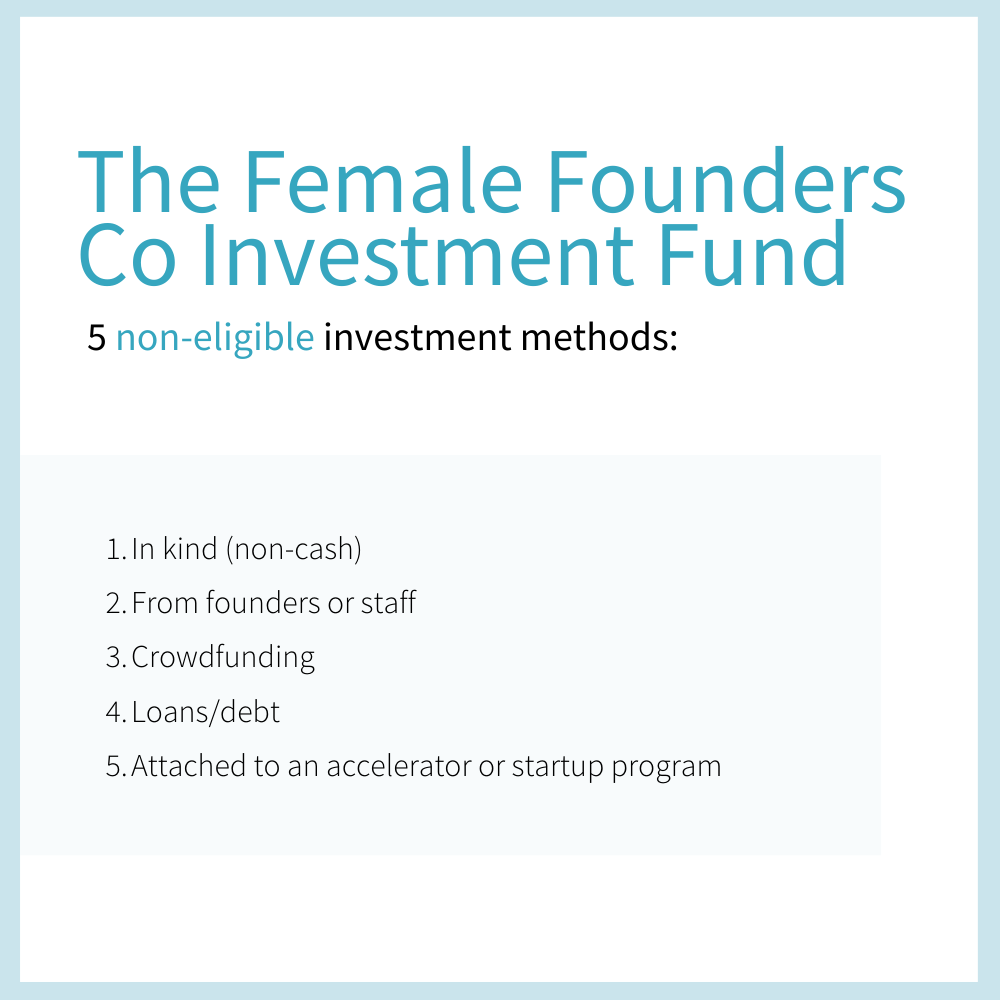
  • Businesses that have previously raised more than $500,000 in capital are not eligible for the Female Founders Co-Investment Fund.
  • Private investment is required, as the fund operates through a co-investment model rather than a standalone grant.


1. What is the Female Founders Co Investment Fund? 

The Female Founders Co-Investment Fund was launched to support female-led, innovation-driven businesses in Queensland that are raising early-stage capital. The goal is to increase the volume and quality of private investment flowing to women-founded businesses with high-growth potential. 

The program offers matched grant funding to support qualifying capital raises. 


2. Program funding available 

The Female Founders Co-Investment Fund QLD is open to businesses looking at securing early investment. This grant has a threshold of $50,000 minimum to a maximum grant of $200,000 (1:3 matched with private investment) 


3. How can I secure the Female Founders Fund 

  1. Must be headquartered in Queensland, with an active ABN and GST registration 
  2. Be a female-founded and female-led business for at least six months prior to applying: 
    • Majority female-owned: at least 51% of shares held by a woman or women
    • Female-led: at least one woman holds a primary executive role (e.g. CEO, CFO, CTO, CSO)
    • If shares are held via a trust, the business must still demonstrate compliance
  3. Be an innovation-driven enterprise (IDE) developing or commercialising innovative products or services 
  4. Have no more than 50 full-time equivalent employees 
  5. Not be a subsidiary of a larger group 
  6. Not have previously raised more than $500,000 in capital.


Book a FREE consultation to find out if your business matches the application criteria.


4. Co-investment breakdown  

This fund adopts an alternative approach in government support by utilising a co-investment method. Rather than providing individual grants, the program is designed to work together with private investors.  

For every $3 raised from eligible external investors, the fund contributes $1 as a grant, up to a maximum of $200,000 (excluding GST), paid over a 12-month period. 


What does this mean? 

  Here’s an example of how the 1:3 ratio works: 

    • A startup led by a female founder secures $180,000 from eligible investors. 
    • The government fund will contribute $60,000 as a grant. 

That means the total funds available to the startup become: 

$180,000 (investors) + $60,000 (grant) = $240,000 


To qualify for a minimum grant of $50,000, the organisation must secure at least $150,000 in external investment. 

If this grant isn’t the one for you, check out our Top 5 Queensland Government Business Grants.


5. Timings and deadlines  

An important aspect of the Female Founders Co-Investment Fund is timing. Businesses that are provisionally approved for funding do not receive the grant immediately.  

Instead, they are given 180 calendar days (six months) to secure the required private investment from eligible investors. 


Application timeline: 

    • Apply: Your application is assessed. 
    • If provisionally approved: That means the fund likes your application in principle, but you don’t get the money right away. 
    • Clock starts: From the date of your provisional approval, you have 180 calendar days to secure your external private investment.  
    • If you succeed: Once you show proof of investment, the grant is confirmed and paid out. 
    • Unsuccessful: If you can’t secure the private investment in that timeframe, the grant funding offer lapses.


6. Uses of funding 

In the application, the use of funds must be specified. The grant must be used for projects to grow the business, such as:  

    • R&D 
    • marketing and advertising  
    • acquiring new customers 
    • expanding to new markets  
    • scaling production 
    • salary expenditure – subject to terms  


7. Expenditure not covered by funding  

    • construction of physical or IT infrastructure  
    • employee benefits 
    • seminar fees 
    • travel costs  
    • legal or licences fees 
    • general business operating costs 


8. What is the closing date for applications? 

The Program will remain open until all funds have been allocated. 

Applicants who meet the eligibility criteria will be assessed competitively and notified of the outcome by email within approximately 6-10 weeks. 

Not sure where to start, find out how a grant expert can help you:  What Does a Grant Consultant Do? | Comprehensive Guide by FundFindrs 


9. Application status 

Great news, submissions are now OPEN. Make sure your application is ready; remember you only have 6 months to secure funding once approved.  

If your business is currently raising or preparing to, this program can significantly boost your capital support. The FundFindrs team of experts can help you prepare the funding strategy, validate eligibility, and align your investment narrative to meet requirements.  

Maybe the Female Founders Co Investment Fund is not suitable to you, check out alternative supports available to Women In Business.


While self-assessment is possible, it’s easy to miss opportunities or make simple mistakes that will result in your application been rejected. Working with FundFindrs can help increase your chances of approval and ensure you optimise your time attracting external investment.   

Book a FREE consultation with our team today. 


5 Benefits of Lodging Your R&DTI Claim Right Now


Last reviewed: July 17, 2026


Every year, thousands of Australian businesses benefit from the R&D Tax Incentive (R&DTI) — a government program offering up to 43.5% in tax offsets for eligible research and development activities. But many wait until the last minute to lodge their claim, which can slow cashflow, increase stress, and complicate tax lodgements.  

Whether you’ve claimed before or are exploring the R&DTI for the first time, FundFindrs is here to support you through the process, making it straightforward, simple and rewarding.

Early lodgement is the smart move and here are five reasons why.


  1. Access cash sooner  
  2. It’s easier to recall recent work
  3. Make all your lodgements seamless
  4. Avoid the seasonal bottlenecks 
  5. It gives you time to focus on your business
  6. FundFindrs makes it easy for everyone 


Key takeaways 


  • Early lodgement can improve cashflow, helping businesses access their R&D Tax Incentive refund sooner.
  • Claiming while activities are still recent makes it easier to capture accurate project details and supporting evidence.
  • Getting started early reduces administrative burden, helping avoid amendments and last-minute tax return adjustments.
  • Avoid seasonal bottlenecks caused by holiday periods and peak R&D Tax Incentive lodgement volumes.
  • Earlier access to funding may be possible through specialist lending solutions linked to expected R&D Tax Incentive refunds.
  • Taking action sooner provides greater certainty, allowing business owners to focus on growth rather than compliance deadlines.


1. Access cash sooner  

The sooner you lodge, the sooner you access your refund. That’s real money you can reinvest into your business, whether it’s hiring staff, launching a new product, or strengthening your financial position. For businesses new to the R&DTI, this can be a powerful funding boost to fuel innovation and growth. 


2. It’s easier to recall recent work

Your R&D activities for FY25 took place between 1 July 2024 and 30 June 2025. If you wait until the April 2026 deadline, that means you’ll be looking back nearly two years. Preparing now means the details are fresh, making it easier to gather accurate information and reducing the risk of missed or incomplete documentation. 


3. Make all your lodgements seamless

Your R&DTI Schedule and Company Tax Return (CTR) are separate but closely linked. Preparing your R&DTI claim early helps you or your accountant lodge your CTR with the correct R&D figures from the start. That means fewer amendments, less rework, and a smoother process for everyone involved. Even if you aren’t ready to submit your CTR yet, there are options available so you can still get the funding now.

We have partners who offer R&D loans, which are advances on your R&DTI refund, meaning you don’t have to wait until after you lodge your company tax return; you can access your refund and reinvest earlier. 


Looking for faster access to your R&D refund?

We work with specialist partners who can help you unlock your funds early


4. Avoid the seasonal bottlenecks 

There are two busy periods which can slow things down:

  • December/January means summertime, when some of your key staff may be on leave. 
  • March/April is when AusIndustry experiences peak R&DTI claim volumes because people didn’t get their claims in sooner.


5. It gives you time to focus on your business

Submitting your claim early gives you peace of mind, freeing up headspace to focus on your business. Instead of scrambling at the last minute, you’ll have confidence knowing your R&DTI refund is on its way — freeing up time and energy to focus on this year’s growth. 


Research and Development in the manufacturing sector.


6. FundFindrs makes it easy for everyone 

Whether you’ve claimed the R&DTI in the past, or you’re applying for the first time, FundFindrs supports you every step of the way to simplify what can often feel complex.

Our specialists work with you throughout the year to:  

  1. Identify and define eligible R&D activities with precision and clarity.  
  2. Strengthen documentation and evidence to support compliance.  
  3. Review previous claims for missed or under-claimed opportunities.  
  4. Provide guidance on structuring future projects for long-term benefit.  

This proactive, year-round partnership ensures your R&D claims are accurate, defensible, and optimised for value.


Let’s get your R&DTI started now 

 If you’re ready to get your refund sooner and make next year’s claim easier, our team can help you start today. Click here to book a FREE consultation. 

Who’s Winning Grants – and What They’re Doing Differently

Last reviewed: July 28, 2026


Every year, billions of dollars in grants are distributed across Australia – from federal and state programs to corporate, philanthropic, and regional funding. Yet for every successful application, there are hundreds (and sometimes thousands) that don’t make it through. 

So, who’s actually winning grants right now? And what are they doing that others aren’t? 

I’ve seen thousands of applications, from community organisations and social enterprises to startups and larger businesses, and clear patterns emerge. The organisations and founders who consistently win funding don’t just write better applications. They think strategically, align with funding priorities, and treat grants as part of a long-term growth strategy.

Here’s what sets them apart.


  1. They build before they apply
  2. They align their mission with the funder’s agenda
  3. They measure what matters
  4. They use technology to stay ahead
  5. They think long-term 


Key takeaways 


  • Successful grant applicants prepare before opportunities open, with clear project plans, budgets, evidence and measurable outcomes already in place.
  • Winning grants requires strong alignment with funder priorities, demonstrating how a project supports outcomes such as innovation, sustainability, regional growth or job creation.
  • Funders assess outcomes, not just activities. Strong applications explain the impact a project will deliver and how success will be measured.
  • Funding-ready organisations maintain core application materials, including organisation profiles, financial information, project plans and capability statements.
  • Government priorities influence future funding opportunities, making it important to monitor policy, budget and industry trends.
  • Grant success is part of a long-term strategy, not a one-off application process.


1. They build before they apply 

The most successful applicants start long before they hit “submit.” They’re not waiting for the perfect opportunity to appear; they’re already funding-ready. 

That means: 

  • Clear goals and measurable outcomes 
  • A well-defined project plan 
  • A realistic budget 
  • Evidence of capability and delivery
     

When a grant opens, they can quickly align their work to the funder’s criteria. Meanwhile, less-prepared applicants scramble to retrofit their ideas into opportunities that don’t quite fit. 

Grant’d tip: Build a funding readiness kit — your go-to folder with your organisation profile, ABN/financials, capability statement, project plan, and team bios. It’ll save you hours later. 


2. They align their mission with the funder’s agenda

Winning grants means more than good writing. It’s about strategic alignment. 

Funders have agendas. Their job is to distribute money that achieves specific outcomes, like innovation, sustainabilitydigital transformation, inclusion, or regional growth.

Your job is to show how your project contributes to those outcomes. 

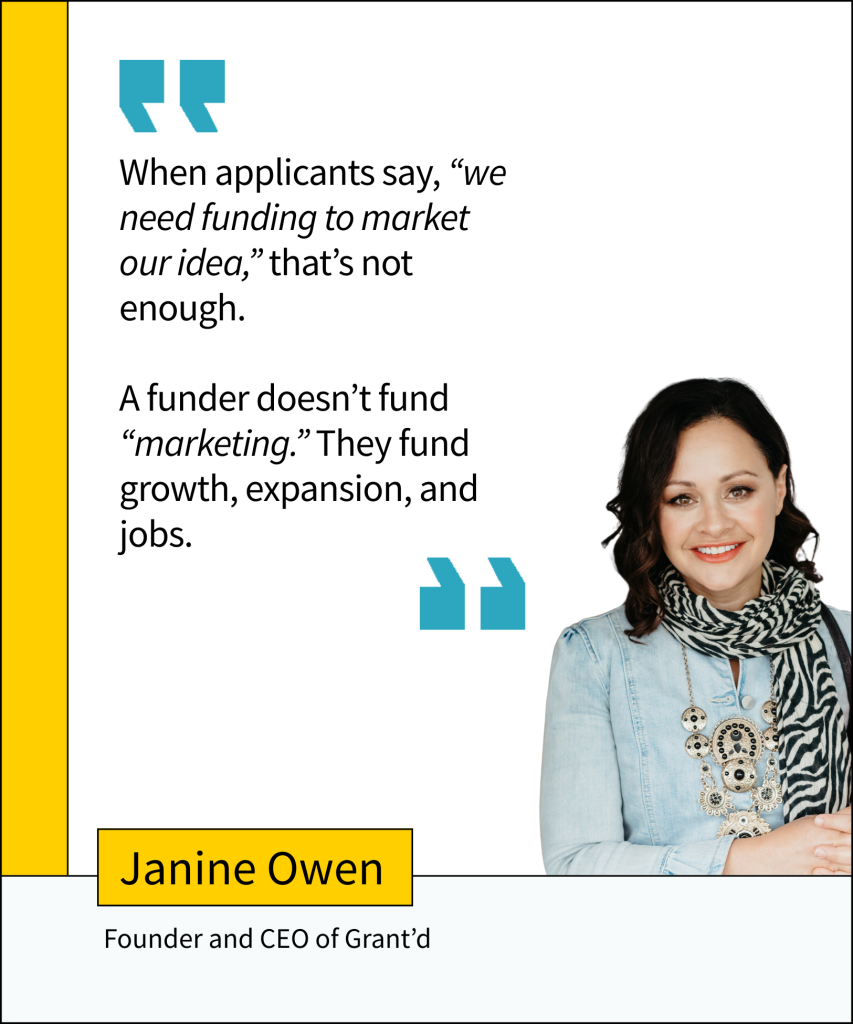
When applicants say, “we need funding to market our idea,” that’s not enough. A funder doesn’t fund “marketing.” They fund growth, expansion, and jobs. 

For example: 

  • “Marketing” → “Driving export growth and new market entry” 
  • “Software development” → “Digitising operations and enhancing industry productivity” 
  • “Community workshops” → “Building local resilience and creating pathways to employment”
     

Winners speak the language of impact, not just activity. 

Grant’d tip: Every funding opportunity is shaped by policy. If you follow the Federal Budget, state strategies, and ministerial priorities, you’ll see where funding is headed 6–12 months before programs launch. 


Janine Owen Founder and CEO of Grant'd RDTI quote


3. They measure what matters

The best applications go beyond outputs (“we’ll deliver 10 workshops”) to outcomes (“we’ll train 100 people and help 30 into new jobs”). 

Funders want to see tangible social or economic value, and confidence that you can track and report on it. 

The most competitive organisations integrate data collection and impact reporting from the start. They can easily quantify their outcomes when applying or acquitting.


4. They use technology to stay ahead

 Successful applicants don’t rely on luck or late-night research; they use systems and tools to keep their funding pipeline organised and opportunities visible.

Whether it’s tracking upcoming programs, setting alerts for new grants, or managing documentation in one central place, they make technology work for them.   

This gives them more time to focus on what really matters: refining their strategy, building strong partnerships, and demonstrating impact.  

Grant’d tip: Explore tools that help you centralise your grant search and management. The goal isn’t just efficiency — it’s freeing up time to focus on the strategic work that drives funding success. 


5. They think long-term

Winning one grant is great. But the real magic happens when organisations create a funding pipeline, planning 6–12 months ahead and aligning multiple grants across growth stages. 

That’s how small projects become sustainable programs and startups scale faster without relying entirely on investors.


Need help building your funding strategy?

Chat with our team to explore how we can help you plan, prepare, and position your next grant application.


Takeaway

The businesses winning grants aren’t chasing everything; they’re choosing strategically. They understand policy, stay prepared, and align their projects with the outcomes funders care about most. 

And the result? Less chasing, more winning.


About Grant’d  

Our mission is to make that process easier – giving you the AI tools, insights, and community to find, manage, and win grants with confidence.  

Learn more at grantd.com.au


From Mistakes to Mastery: Learning from Grant Application Errors

Last reviewed: July 28, 2026


If you’ve ever submitted a grant and received the dreaded “unsuccessful” email, you’re not alone. Every organisation that applies for funding experiences rejection at some point, even the best. 

The difference between those who give up and those who grow is what they do next. 

At Grant’d, we believe unsuccessful applications aren’t failures – they’re feedback. Every “no” is a data point you can learn from. 

Here’s how to turn mistakes into mastery.

  1. Most grant rejections are fixable
  2. Treat feedback as data, not emotion
  3. Build reusable system
  4. Remember: timing is everything
  5. Learn from others 


Key takeaways 


  • Most grant rejections are fixable, with common issues including poor alignment, unclear outcomes, weak evidence and unrealistic budgets.
  • Grant feedback should be treated as a learning opportunity, helping applicants identify gaps and improve future submissions.
  • Tracking lessons from previous applications can strengthen future results, making it easier to identify recurring weaknesses and opportunities for improvement.
  • Reusable grant content can improve efficiency, including organisation overviews, impact statements, team biographies and budget templates.
  • Timing matters. A strong project may be unsuccessful if it does not align with current funding priorities or program objectives.
  • Learning from other applicants and industry networks can improve grant readiness, helping businesses refine their approach and increase future funding success.


1. Most grant rejections are fixable 

When we unpack unsuccessful applications, the reasons are usually predictable, and solvable.

Common Mistake How to Fix It
Poor alignment Ensure your project directly advances the funder’s stated goals.
Vague outcomes Define clear deliverables and measurable impact.
Budget mismatches Keep figures realistic and consistent with the project scope.
Weak evidence Add supporting data, testimonials, or case studies.
Timing Sometimes, it’s just not the right round or focus – try again later.


Each of these can be addressed with better preparation and reflection. 


2. Treat feedback as data, not emotion

It’s easy to take rejection personally, but funders are assessing fit, not worth. When you receive feedback, analyses it systematically:
 

  • What keywords or themes do they use in the rejection? 
  • Which parts of your proposal might not have aligned? 
  • Were you clear about your outcomes and beneficiaries?
     

Document it. Build a “grant lessons” folder where you record what you learn from each submission. Over time, you’ll start to see patterns and strengths.


3. Build reusable system

Grant applications can be repetitive, but that’s an opportunity. Create templates for your: 

  • Organisation overview 
  • Impact statement 
  • Key team bios 
  • Budget structure
     

Then adapt them per grant. Tools like Grant’d help centralise this, so you can reuse winning language and track performance metrics over time.


Want expert eyes on your next grant or R&DTI submission? 
FundFindrs’ experts help you refine, align, and get funding-ready.


4. Remember: timing is everything


Sometimes, your project is excellent, but the funding cycle just doesn’t match. Government priorities shift annually. If your project wasn’t funded this round, it might be perfect next quarter when new programs open. 

The key is to stay funding-ready, your project brief, budget, and outcomes clear, so you can move fast when the right opportunity appears. 


5. Learn from others

Don’t learn in isolation. Join communities like Grant’d and FundFindrs to find other founders and learn from their experiences what have worked, what didn’t, and what changed their success rates. 

You’ll learn that every successful applicant has a history of rejection and every rejection made their next win stronger.

Takeaway 

Rejection isn’t the end of your funding journey; it’s part of the process. Every “no” gives you insight, clarity, and direction for the next “yes.”


About Grant’d  

Grant’d helps you build repeatable success, with smart matching, application tracking, and insights that evolve with you.  

 Learn more at grantd.com.au 


The Australian Business Funding Roadmap: 7 Funding Pathways and How to Combine Them

Australian businesses have access to a wide range of funding pathways, each designed to support different stages of growth and business objectives. These can include founder capital, government grants, the R&D Tax Incentive, business loans and other forms of non-equity finance, angel investment, venture capital, and export funding programs. The most appropriate funding pathway will depend on what a business is trying to achieve, whether that is developing a new product, commercialising innovation, scaling operations, improving cash flow or expanding into international markets. 

The right pathway depends on what you are trying to fund. A founder validating an idea will need something different from a manufacturer scaling production, a software company solving technical uncertainty, or an exporter entering a new overseas market. 

At FundFindrs, we work with Australian businesses to identify and access government grants and the R&D Tax Incentive. These are often powerful non-dilutive funding options because they can support innovation, commercialisation and growth without requiring founders to give away equity. But they rarely sit in isolation. In many cases, grants and R&D support work best when they are part of a broader funding roadmap. 


In this article, we will examine seven of the different funding pathways available to Australian businesses.


Key takeaways 


  • There is no single best funding option for every business. The right pathway depends on the business stage, growth objectives and the type of project being funded. 
  • Government grants and the R&D Tax Incentive can provide valuable non-dilutive funding for businesses investing in innovation, commercialisation, manufacturing capability and growth. 
  • Different funding pathways serve different purposes, from founder capital and debt funding through to angel investment, venture capital and export support. 
  • Many grant programs require businesses to contribute part of the project cost, making funding strategy, timing and co-contribution planning important. 
  • Grants and the R&D Tax Incentive do not need to replace investment or debt. They can often work alongside other funding sources as part of a broader funding roadmap. 
  • Businesses that understand their funding roadmap early are often better positioned to prepare evidence, align projects with eligibility requirements and identify future opportunities. 
  • The strongest funding outcomes occur when funding is aligned with business strategy rather than pursued as a standalone goal. 


Finding the right funding strategy


Australian businesses have more funding options available than ever before, from government grants and the R&D Tax Incentive through to loans, angel investment, venture capital and export funding. 

However, each funding pathway is designed to support different business objectives. Some are suited to innovation and product development. Others are designed to support commercialisation, international expansion, manufacturing capability or rapid scale. 

Understanding which funding options align with your business goals is an important first step in building a sustainable growth strategy. 


How the R&D Tax Incentive can support growth:

  • What funding options are available now 
  • What funding options may become available later 
  • Which grant programs require matched funding 
  • How to avoid relying too heavily on one source of capital 
  • How to preserve equity while still funding growth 
  • How to build the evidence needed for future applications 


7 funding pathways at a glance


Each funding pathway plays a different role in a business’s growth journey. The table below provides a high-level overview of the most common funding options available to Australian businesses, including when they are typically used and the key considerations associated with each. 


Funding pathway Best suited to Key benefit Key consideration
1. Founder capital Early validation Control and speed Personal risk and limited capacity
2. R&D Tax Incentive Eligible R&D activity Can help recover innovation costs Requires eligible activities, records and compliance
3. Government grants Defined projects Non-dilutive project funding Competitive and often requires co-contribution
4. Debt finance Working capital, equipment, bridging Avoids dilution Must be repaid
5. Angel investment Early growth and traction Capital plus expertise Equity dilution
6. Venture capital High-growth scaleups Large growth capital Dilution and growth expectations
7. Export funding International market expansion Supports export marketing and promotion Eligibility and timing vary by round


1. Founder capital


Founder capital is often the first funding pathway. It may come from personal savings, early shareholder contributions, director loans or money reinvested into the business by the founding team. 

It is useful because it gives founders control and can move quickly. There is no application round, no lender approval and no investor negotiation. But it also has limits. Founder capital can place personal pressure on the business owners and may not be enough to fund larger commercialisation, manufacturing, R&D or export projects. 


Best for:

Early validation, initial product development, customer discovery, small pilots and bridging gaps before external funding is available.


2. The R&D Tax Incentive


The R&D Tax Incentive (R&DTI) is one of the most important funding pathways for innovative Australian businesses. It is not a grant. It is a tax offset designed to encourage eligible companies to conduct research and development activities in Australia. 

According to the Australian Taxation Office (ATO), approximately 16,000 companies claim the R&D Tax Incentive each year, highlighting just how widely the program is used across the Australian innovation ecosystem. 

For many founders, CFOs and business leaders, the R&D Tax Incentive is overlooked because they do not describe their work as “research”. They may call it product development, engineering, testing, software development, process improvement or technical problem solving. But if the business is undertaking systematic experimentation to resolve technical uncertainty, it may be worth assessing whether the activity could qualify.
 

How the R&D Tax Incentive can support growth:

  • It can help recover part of eligible R&D costs. 
  • It can support reinvestment into future development. 
  • It can improve cash flow for eligible companies. 
  • It can sit alongside grants, investment and debt when structured correctly. 
  • It encourages businesses to keep better records of technical activities, experimentation and expenditure. 


The R&D Tax Incentive can be especially relevant for businesses developing software, engineering solutions, manufacturing processes, medical technology, clean technology, mining technology, agtech, robotics, AI or other innovation-led products and systems. 

Understanding what qualifies as an eligible R&D activity is often one of the most challenging aspects of preparing an R&D Tax Incentive claim. 


Best for:

Businesses developing new or improved products, processes, software, services or technologies through systematic experimentation, and seeking to reduce the cost of innovation through a tax offset or cash refund.


Not sure if you’re eligible for the R&D Tax Incentive?
Our FREE R&DTI Blueprint breaks it down with an eligibility checklist, examples, and expert tips from the FundFindrs team.


3. Government grants


Government grants can be powerful, but they are often misunderstood. The strongest grant candidates are not simply businesses that need money. They are businesses undertaking defined projects that align with government priorities, such as innovation, commercialisation, manufacturing capability, export growth, regional development, sustainability or productivity improvement.


What grants commonly support: 

  • Commercialising a new product, process or service 
  • Progressing a prototype or pilot into market readiness 
  • Scaling manufacturing capability 
  • Building sovereign capability in priority sectors 
  • Export promotion and international market development 
  • Sustainability, clean energy or emissions reduction projects 
  • Research collaborations and pre-commercialisation activities
     

What grants usually do not support:

  • General operating costs 
  • Undefined business growth 
  • Ordinary payroll expenses 
  • Business survival or cash flow gaps 
  • Projects with no clear innovation, commercial or economic outcome 


This is why eligibility is usually project-based. A business may be a strong company but still not have a suitable grant project. Conversely, a smaller business with a clearly defined innovation or commercialisation project may be better placed than it first assumes. 


Stronger grant candidates Less suitable candidates
Have a defined project Only have a general business idea
Have a prototype, proof of concept, pilot or commercialisation pathway Are at concept stage only
Can show economic, technical or commercial outcomes Need general operating funds
Can contribute matched funding where required Cannot fund their contribution
Have evidence, milestones and a delivery plan Have limited documentation or unclear scope


4. Business loans and non-equity finance


Loans and debt funding can support business growth without requiring founders to give away ownership. Options may include traditional bank loans, equipment finance, working capital facilities, invoice finance, venture debt and alternative lending products. Unlike grants or the R&D Tax Incentive, debt funding must be repaid, but it can provide faster access to capital for businesses with a clear repayment pathway, predictable revenue or an identifiable asset being funded. 


Businesses now have access to a broad range of funding providers, including:

  • Major banks 
  • Specialist and alternative lenders 
  • Equipment finance providers 
  • Invoice and debtor finance providers 
  • Venture debt and revenue-based finance providers 


Each provider will have different lending criteria, security requirements, repayment structures and risk appetites, so it’s important to understand which solution best aligns with your business objectives and cash flow position. 


Before taking on debt, businesses should consider:

  • Repayment capacity 
  • Interest costs and fees 
  • Security requirements and personal guarantees 
  • Cash flow impacts 
  • How debt integrates with grants, the R&D Tax Incentive and other funding sources 


The most effective funding strategies typically use debt as one component of a broader funding mix rather than as a standalone solution. 


FundFindrs insight:  

Debt funding and grants are often viewed as separate funding pathways, but they frequently work together. Many grant programs require businesses to contribute a portion of project costs through matched funding. Depending on the program rules and business circumstances, debt funding may help fund that contribution, allowing the business to undertake a larger project than would be possible using available cash alone. 


 5. Angel investment


Angel investors typically provide early-stage capital to startups and scaleups, often before a business is ready for institutional venture capital. Unlike loans, angel investment does not need to be repaid. In exchange, investors receive an ownership stake in the business and become invested in its future success. 

For many founders, the value of angel investment extends beyond the capital itself. The right investor may bring industry knowledge, founder experience, strategic guidance, commercial introductions and access to networks that can help accelerate growth. 

Angel investment can also work well alongside grants and the R&D Tax Incentive. A founder may use angel capital to support product development, fund the business contribution required for a matched grant, or extend runway while eligible R&D activities are underway. When combined effectively, these funding pathways can help businesses progress faster without relying on a single source of capital. 

Not all angel investors bring the same value, so it is important to look beyond funding and consider the experience, networks, and support they can offer. 


When evaluating potential investors, founders should consider:

  • Relevant industry knowledge and experience 
  • Access to customers, partners or industry networks 
  • A track record of supporting growing businesses 
  • Alignment with the founder’s vision and long-term goals 
  • The ability to support future fundraising activities 


Many experienced founders will tell you that choosing the right investor can be just as important as securing the investment itself. FundFindrs partners with Angel Investing  business Impactiv to support clients at the right time. 


Best for:

Early and growth-stage businesses seeking capital, strategic advice and industry connections from experienced investors who are willing to back high-potential growth opportunities.


6. Venture capital


Venture capital (VC) is a funding pathway used by high-growth businesses looking to scale quickly. Unlike grants, debt funding or the R&D Tax Incentive, venture capital involves exchanging equity in the business for investment capital. 

VC funding is typically suited to businesses with large market opportunities, scalable business models and ambitious growth plans. Beyond capital, investors may also provide strategic advice, industry expertise, customer introductions and support with future fundraising activities. 

However, venture capital is not the right pathway for every business at every stage. Many founders assume they need investment immediately, when there may be opportunities to build value first through grants, the R&D Tax Incentive or other non-dilutive funding sources. 


Non-dilutive funding pathways such as grants and the R&D Tax Incentive may help businesses:

  • Fund technical development before valuation discussions 
  • Build commercialisation evidence that investors want to see 
  • Extend runway without immediate dilution 
  • Demonstrate the ability to secure and manage external funding 
  • Reach key milestones before entering fundraising conversations 
  • Perhaps most importantly, grants and the R&D Tax Incentive do not need to replace investment. They can often work alongside venture capital to support specific projects, reduce cash burn and help businesses achieve more with the capital they raise. 


Best for:

High-growth businesses with a scalable business model that need significant capital to accelerate expansion, enter new markets or achieve rapid growth.


7. Export funding and market expansion support


Export funding becomes relevant once a business is ready to sell, promote or expand into international markets. Programs such as the Export Market Development Grants program have historically supported eligible Australian businesses with export marketing and promotional activities. 

Export funding is different from R&D or commercialisation funding. It generally does not fund the development of the product itself. Instead, it helps eligible businesses promote Australian goods, services, software, IP or know-how into international markets. 


Best for:

Businesses that have a market-ready product or service, a clear export strategy and eligible export promotion activity.


How these funding pathways work together


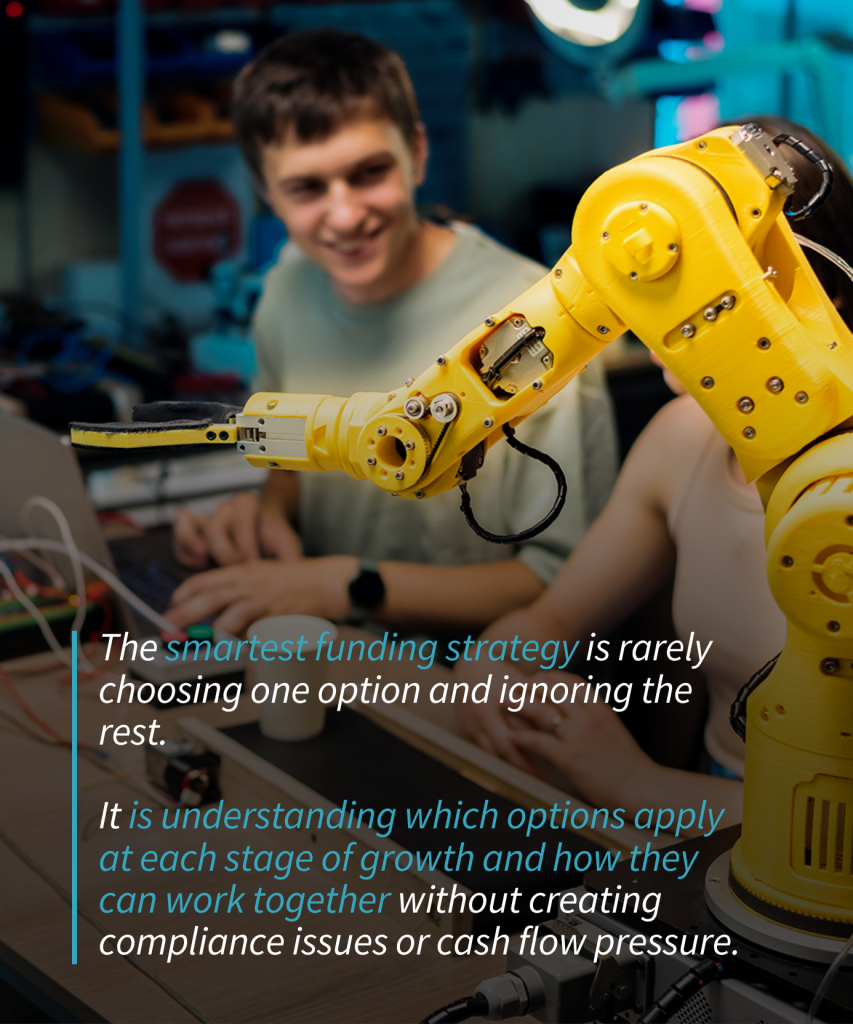
The smartest funding strategy is rarely choosing one option and ignoring the rest. It is understanding which options apply at each stage of growth and how they can work together without creating compliance issues or cash flow pressure. 


Business stage Likely funding need Relevant pathways Funding strategy question
Validate Prove the problem, develop early product, test demand Founder capital, angel investment, early R&D assessment What evidence do we need before applying for external funding?
Innovate Solve technical problems, build or improve product, test uncertainty R&D Tax Incentive, founder/angel capital Are we documenting eligible R&D as we go?
Commercialise Move from prototype or pilot toward market Government grants, angel investment, debt, R&D Tax Incentive Do we have a defined project, budget, milestones and matched funding?
Scale Grow production, hire, enter new markets, improve capability Grants, debt, VC, R&D Tax Incentive What capital mix gives us speed without unnecessary dilution?
Expand Export, international marketing, larger partnerships Export funding, VC, debt, grants Is our export plan well evidenced and timed with funding rounds?


Example funding stacks


Example 1: Early-stage technology startup 

  • Founder capital funds early validation and proof of concept. 
  • Angel investment supports the first team members and product development. 
  • The R&D Tax Incentive is assessed for eligible technical development work. 
  • A commercialisation grant is explored once the project, budget and market pathway are clearer. 


Example 2: Innovative manufacturer

  • Internal cash funds planning and early design work. 
  • Equipment finance supports new machinery or production capability. 
  • Government grants are explored for eligible manufacturing capability or commercialisation projects. 
  • The R&D Tax Incentive is assessed for technical experimentation and eligible development activity.
     

Example 3: Export-ready business

  • Revenue or working capital funds core operations. 
  • Export funding supports eligible international marketing or promotion. 
  • R&D Tax Incentive may support ongoing product or technology development. 
  • Debt or investment may fund inventory, staffing or market-entry costs that grants do not cover.


funding pathways article


Key considerations before choosing a funding pathway


1. What are you funding? 

A funding pathway should map to a specific need. Are you developing technology, commercialising a product, buying equipment, funding export marketing, covering working capital or hiring a team? The answer changes which options are relevant. 


2. Are you eligible now, or preparing for later? 

Some funding options are available only at certain stages. For example, many grants require evidence of a prototype, pilot, market demand or matched funding. If you are not eligible now, the right strategy may be to prepare your documentation and timing for a future round. 


3. Do you have the evidence?

For grants, evidence may include project plans, budgets, quotes, customer demand, IP ownership, financial capacity and commercialisation milestones. For the R&D Tax Incentive, evidence usually relates to activities, technical uncertainty, experimentation, records and expenditure. 


4. What is the true cost of capital? 

A grant may be non-dilutive, but it may require a co-contribution and reporting. Debt avoids dilution, but it must be repaid. Equity can accelerate growth, but it reduces ownership. The right answer depends on the business model and risk profile. 


5. Can the funding sources be combined properly?

Some funding pathways can complement each other. Others may create issues if the same expenditure is claimed twice or if program rules restrict the use of other funding. This is why a funding roadmap matters. The goal is not to chase every opportunity. It is to understand what fits and when. 


Final thoughts: funding should follow strategy


The most successful businesses do not chase funding for the sake of it. They understand what they are building, what stage they are at, what capital they need, and which funding pathways can support their next move. 

 For innovative Australian businesses, grants and the R&D Tax Incentive should be core considerations. They can support product development, commercialisation, manufacturing capability, export growth and reinvestment into future innovation. But they work best when considered alongside the full funding mix, including founder capital, debt, angel investment and venture capital. 

 If you are building, testing, commercialising or scaling something new, FundFindrs can help you understand what funding pathways may be available and how grants and the R&D Tax Incentive could fit into your broader growth strategy. 

Speak with FundFindrs about grants, R&D Tax Incentive eligibility and funding opportunities aligned with your growth plans. 


Industry Growth Program (IGP):what’s changed, what matters, and who should apply

Last reviewed: July 02, 2026


The Industry Growth Program (IGP) is one of the Federal Government’s key funding pathways for Australian SMEs looking to commercialise innovation and scale their businesses. 

However, the program has shifted significantly. 

Following the Federal Government’s $102 million funding reduction (MYEFO), the IGP is no longer a broadly accessible grant. It is now a highly competitive program focused on commercially viable projects with clear economic impact. 

For businesses, this changes the approach entirely. The question is no longer: “Are we eligible?” but it should be: “Are we competitive enough to be funded?”.

In this article, we break down how the program works today, what has changed, and, most importantly, how to assess whether your business is genuinely positioned to succeed. 


IMPORTANT NOTE: Following the announcement of the Federal Budget 2026-27, the Industry Growth program has been put on hold affecting both new applicants and those already in the pipeline. At this stage, it hasn’t been confirmed if it will re-commence, be replaced or be cancelled. We will update as further information comes to light.


Key takeaways 

  • The IGP is currently paused. Following the 2026–27 Federal Budget, the program is on hold for new applicants and those already in the pipeline.
  • Funding was reduced by $102 million. The IGP is no longer a broadly accessible grant and is now focused on highly competitive, commercially viable projects.
  • Competitiveness matters more than eligibility. Being eligible does not guarantee funding in the current assessment environment.
  • The program has two stages: Advisory support to strengthen commercialisation strategy, followed by grant funding for the strongest projects.
  • Innovation alone is not enough. Successful applications must demonstrate commercial readiness, execution capability and measurable economic impact.
  • IGP and R&DTI serve different purposes. R&DTI supports eligible R&D activities retrospectively, while IGP supports future commercialisation and growth.
  • Application quality is critical. Strong positioning and commercial evidence play a major role in funding outcomes.


1 – What is the Industry Growth Program  

The IGP, delivered through business.gov.au, combines advisory support and matched grant funding to help businesses move from innovation to commercialisation. 


In practice, the program operates as a two-stage process: 

  1. Advisory stage – designed to assess and strengthen your commercial strategy  
  1. Grant stage – where funding is awarded to the most competitive projects  


This structure reflects a clear objective from government: to fund outcomes, not just ideas. The program prioritises businesses that can demonstrate a clear pathway to market, the ability to execute, and the capacity to generate measurable economic outcomes. As a result, technical innovation alone is not enough, applications must show how that innovation translates into commercial impact. 


2 – What’s changed in the Industry Growth Program: funding cuts and increased competition 

Recent funding reductions have reshaped the Industry Growth Program. 

Businesses should expect: 

  • Fewer grants awarded  
  • Greater scrutiny on applications  
  • Stronger focus on commercial readiness  
  • Increased importance of financial capability and co-investment  

As a result, application quality and positioning now play a critical role in success. 


Stronger competition means greater emphasis on commercial positioning, financial capacity and delivery readiness. FundFindrs helps businesses strengthen these areas before applying.


3 – How the program works 

Step 1: Advisory Service (mandatory) 

All applicants must begin with the IGP Advisory Service. 

This involves submitting an application that assesses your: 

  • Business model  
  • Innovation viability  
  • Commercialisation pathway  


If eligible, you will work with an Industry Growth Program Adviser to: 

  • Test your strategy  
  • Identify risks and gaps  
  • Define a clear pathway to market  


It’s important to know this stage is mandatory once you cannot access grant funding without completing it. 


Step 2: Grant Funding 

Businesses that successfully progress may be eligible for one of two streams: 

Early-Stage commercialisation grants
– Funding available: $50,000 – $250,000
– Objective: Supporting businesses moving toward market readiness 

Commercialisation and growth grants
– Funding available: $100,000 – $5 million
– Objective: Supporting businesses ready to scale 

Both streams require: 

  • Matched funding (co-contribution)  
  • Demonstrated financial capability  
  • Clear commercial outcomes  

Funding is awarded on merit, and competition is strong.


Industry Growth program Tip


4 – Industry Growth Program eligibility overview 

To be eligible, businesses must generally: 

  • Be an Australian SME  
    • Fewer than 200 employees  
    • Turnover under $20 million (last three financial years) 
       
    • Value-add in resources  
    • Agriculture, forestry and fisheries  
    • Transport  
    • Medical science  
    • Renewables and low emissions technologies  
    • Defence capability  
    • Enabling technologies (e.g. AI, robotics, biotech)  
  • Demonstrate:  
    • Commercial potential and scalability  
    • IP ownership or access rights  
    • Financial capacity to co-invest  


5 – What makes a competitive application in 5-steps 

With increased competition, successful applications typically demonstrate: 

1 – Clear commercial outcomes
A defined pathway to revenue, market adoption, or industry impact 

2 – Strong market and technical positioning
Evidence of demand, traction, or validated development 

3 – Financial readiness
Capacity to fund your share of the project, supported by evidence and an Accountant Declaration 

4 – Structured project planning
Clear milestones, timelines, budgets, and risk considerations 

5 – Alignment with government priorities
A direct link to NRF sectors and broader economic outcomes 


6 – A common misconception 

One of the most common mistakes is treating the IGP as a standard grant application. 

In reality, it functions as a commercial assessment process. That’s why eligibility alone does not determine outcome success. Applications are assessed on quality, clarity, and commercial viability — which is why many businesses consider working with a grant writing consultant to strengthen their approach and overall submission strategy. 

Is the Industry Growth Program right for your business? 

The IGP is best suited to businesses that: 

  • Are developing commercially viable innovations  
  • Have a clear pathway to market  
  • Can co-invest in their growth  
  • Are ready to compete in a merit-based funding environment  

If your business is still validating early-stage ideas or lacks financial readiness, it may be worth exploring alternative pathways first. 


7 – Where IGP fits within your funding strategy 

The Industry Growth Program (IGP) is often considered alongside programs such as the R&D Tax Incentive (R&DTI). 

While both support innovation, they serve different purposes: 

  • R&DTI supports eligible R&D activities retrospectively  
  • IGP supports forward-looking commercialisation and growth  

For many businesses, these programs can be complementary when used strategically. 


8 – How FundFindrs can support your application 

Navigating programs like the IGP requires more than understanding eligibility criteria. If you’re considering apply to it, the first step is understanding your position — not just your eligibility. 

At FundFindrs, we work with businesses to: 

  • Assess whether the program is the right fit  
  • Strengthen commercial positioning before applying  
  • Prepare clear, compliant applications  
  • Support both advisory and funding stages  

Our approach is grounded in practical experience across multiple funding programs and industries.  


Book a FREE consultation with FundFindrs to assess your suitability for the Industry Growth Program and build a clear strategy before applying.