Australian government grants Archives - FundFindrs

Research & Development Tax Incentive (R&DTI): What you really need to know

Last reviewed: June 30, 2026 


Answers to the most common questions about Australia’s R&DTI program

The Research and Development Tax Incentive (R&DTI) can be a valuable tool for Australian businesses investing in innovation, but it’s not always easy to navigate. To help business owners, founders, and finance teams get clear on how it works and who can benefit, we’ve answered the most common and relevant questions about the program.


Whether you’re just starting your first claim R&DTI or fine-tuning your process this financial year, this guide brings together key information in one place, broken down by topic.


Key takeaways 

  • The R&DTI is a federal tax offset (not a grant) offering either a 43.5% refundable or 38.5% non-refundable offset depending on your company’s turnover. 
  • Eligible activities must involve genuine experimentation to resolve a technical unknown. Routine development or work with a known outcome does not qualify. 
  • Registration with DISR is mandatory and must be lodged within 10 months of your income year end. There are no extensions. 
  • Poor record-keeping is one of the most common reasons claims are reduced or disallowed. Keeping detailed records throughout the year is as important as the activities themselves. 
  • The offset rate and whether it’s refundable depends on your turnover; understanding which bracket you fall into helps to define how much you can claim.


General Overview

1. What is the Research and Development Tax Incentive (R&DTI)?

The R&DTI is an Australian Government program designed to encourage companies to engage in research and development activities that benefit Australia. It provides tax offsets for eligible R&D activities, helping businesses recover some of the costs associated with innovation. The program is jointly administered by the ATO and the Department of Industry, Science and Resources (DISR).


Eligibility

2. Who is eligible for the R&DTI?

Eligible entities, known as R&D entities, include:

  • Corporations incorporated under Australian law
  • Corporations incorporated under foreign law but an Australian resident for income tax purposes, or
  • Corporations incorporated under foreign law and a resident of a country with which Australia has a double tax agreement, carrying out business in Australia through a permanent establishment.


Entities must also be liable to pay income tax in Australia and must engage in eligible R&D activities.


In addition, you must be:

  • Operating without a trust in your business structure
  • Attempting to develop new/improved materials, products, devices, processes or services
  • Conducting systematic experimentation for the purpose of creating new knowledge
  • Have spent at least AU$20,000 on R&D projects
  • Conducting the activities in Australia.


Activities and Structure

3. What are eligible R&D activities and how are they defined?

Eligible R&D activities are classified as:

  • Core R&D activities. These are experimental activities where the outcome cannot be known or determined in advance, They’re conducted through a systematic progression of work involving hypothesis, experiment, observation, evaluation, and drawing conclusions.
  • Supporting R&D activities. These are activities directly related to core R&D activities or undertaken for the dominant purpose of supporting core R&D activities.


Certain routine or excluded activities are not eligible as core R&D.


4. How can I structure and track my R&D activities to maximise eligibility?

To ensure your activities are eligible and make the most of your R&D claim:

  • Identify the innovative, experimental parts of your project (core R&D).
  • Separate routine development from genuine experimentation.
  • Maintain detailed records: hypotheses, experiments, iterations, and results.
  • Track costs in real-time, including salaries, materials, contractors, and overheads.
  • Collaborate with your accountant or R&D advisor to make sure your project structure supports a compliant claim.


Application Process and Deadlines

5. How do I apply for the R&DTI?

To apply:

  1. Register your R&D activities with AusIndustry within 10 months after the end of your company’s income year.
  2. Once registered, claim the tax offset by completing the R&D tax incentive schedule and relevant labels in your company tax return and lodging them with the ATO.


However, the best time to start your application is when you’re preparing your tax return, because you’ll have all your information to hand, so you can make the process more efficient and effective, meaning you have more time to spend on your core business.


Book a FREE consultation to find out how we can help you through the application process.


6. What is the deadline for registration?

You must register your R&D activities with AusIndustry within 10 months after the end of your company’s income year. For example, if your income year ends on 30 June, the deadline is 30 April of the following year.


Financial Benefits and Rates

7. How much can I claim through the R&DTI?

Typically, companies can claim up to 43.5% of their R&D spend. However, the amount you can claim depends on your company’s aggregated turnover.


For companies with annual turnover of less than $20 million, it’s the refundable tax offset equal to the company’s corporate tax rate plus an 18.5% premium.


For companies with annual turnover of $20 million or more, it’s the non-refundable tax offset equal to the corporate tax rate plus:

  • 8.5% premium for R&D expenditure up to 2% of total expenditure (R&D intensity).
  • 16.5% premium for R&D expenditure above 2% of total expenditure.
  • Note: The rate is reduced to the company tax rate for notional R&D deductions exceeding $150 million.


Not sure which offset rate applies to your business? Talk to our R&D specialists.


8. What’s the difference between refundable and non-refundable tax offsets?

  • Refundable tax offset is when the offset exceeds your tax liability, the excess is refunded. This is especially relevant for earlier-stage businesses or those in a loss position.
  • Non-refundable tax offset is when the excess offset can be carried forward to future income years but is not refunded


Overseas and Non-Australian Activities

9. Can I claim R&D activities performed overseas?

Generally, only R&D activities conducted in Australia qualify. However, you can claim overseas activities if you obtain an Advanced Overseas Finding from AusIndustry before conducting the activities and are able to demonstrate that:

  • The overseas activity is eligible R&D;
  • There is a scientific link to Australian core R&D;
  • It cannot be done in Australia for specific reasons; and
  • The cost of overseas activities is less than related Australian R&D activities.


Eligible Expenses

10. What expenses can I claim under the R&DTI?

Eligible expenditure includes:

  • Salaries and wages of employees engaged in R&D;
  • Contractor fees for R&D work;
  • Materials used in R&D;
  • Depreciation of R&D assets;
  • Overheads directly related to R&D;
  • Payments to Research Service Providers (RSPs).


Expenses must be incurred during the income year and directly related to eligible R&D activities.


11. What should companies with significant R&D spend consider before lodging? 

The R&DTI rewards careful preparation regardless of claim sizeAreas deserve extra attention before you lodge: 


  • Activity classification: Ensure the boundary between core and supporting R&D activities is clearly defined and documented.  
  • Documentation readiness: Audit-ready records should be in place before lodgement, not assembled after.  
  • Engaging a specialist early: The complexity of a large claim makes early specialist involvement valuable to maximise the claim and to ensure it withstands review. 


12. Some of our expenses were paid personally. Can we claim them through the R&DTI?

R&D claims must be for expenses paid by the company. Personally paid expenses or those paid outside a corporate structure generally aren’t eligible. To claim R&D, ensure the company incurs and pays for eligible expenses. 


Documentation and Compliance

13. What documentation should I keep?

Robust documentation is essential for compliance and audits. Maintain contemporaneous records that clearly show:

  • The nature and scope of your R&D activities;
  • Evidence of technical uncertainty and experimentation;
  • Expenditure records;
  • How costs are apportioned between R&D and non-R&D work.


14. What happens if I get audited?

If you’re audited and your documentation isn’t robust, you may have to repay the R&D offset plus penalties.


You can avoid this by aligning your workflows with ATO and AusIndustry requirements and maintaining audit-ready records from the outset. It’s important to work closely with your accountant or R&D consultant to make sure your documentation is fully robust.


Additional Considerations

15. What is the R&DTI Registration Number?

After registering your R&D activities with AusIndustry, you’ll receive a unique registration number. You must include this in your company’s R&D Tax Incentive schedule when lodging your tax return. This will link the two and help avoid any unnecessary delays.


16. Can I claim R&D expenses from previous years?

Unfortunately not. R&D tax offsets can only be claimed for eligible activities and expenditure incurred in the current income year. Each year’s activities must be registered separately within the 10-month timeframe. That’s another reason not to delay. When applications close, they are closed for that year.


17. What are common mistakes or risks in claiming the R&DTI?

Some common mistakes or challenges include:

  • Claiming routine or ineligible activities.
  • Poor documentation or tracking of activities.
  • Incorrectly allocating overhead costs.
  • Failing to register on time.
  • Not meeting the legislative definitions of core or supporting R&D activities.


It is critical to make sure you submit accurate, complete and well-documented claims to avoid delays, inefficiencies and even rejection.


Download the FundFindrs R&DTI Blueprintour practical guide to preparing an accurate and complete R&DTI application.


18. What’s the difference between a project, a core R&D activity, and a supporting activity?

This simple summary outlines the differences between the three.

  1. A Project is the overall effort to create or improve a product or process.
  2. Core R&D Activity is the experimental work undertaken to resolve technical uncertainty.
  3. Supporting Activity is any activity directly supporting core R&D (e.g., testing, data analysis).


Understanding these differences helps ensure your claim aligns with the program’s intent.


19. How do I know if my technology is innovative enough?

For it to qualify, your technology must involve experimentation and technical uncertainty. It needs to be something that hasn’t been proven or done before. Even if your product looks similar to others, it’s the underlying technology or algorithms that  determine eligibility.


20. What are the most common industries that typically apply for the R&DTI?

A broad mix of sectors take advantage of the R&DTI, but some appear more often than others. Technology and software businesses regularly use the program to support digital development work that improves tools, processes, or user outcomes.


We frequently see submissions from engineering and manufacturing firms. These businesses are often developing new systems or refining how things are made, which aligns well with the incentive’s criteria.


At FundFindrs, we work extensively across manufacturing, engineering, clean technologiespharma, agriculture, AI and softwareindustries where significant R&D investment is common and the incentive can return substantial value. 


Don’t leave money on the table

While self-assessment is possible, it’s easy to miss opportunities or make simple mistakes that delay or reduce your claim. Working with specialists like FundFindrs can help you get it right first time and save hours of unnecessary admin. If your work is eligible, the R&DTI allows you to offset a portion of those expenses. If you do not claim it when you’re able to, it’s like leaving money on the table.


Are ready to see how much you could claim or if your business is eligible?

Book a FREE consultation with our team today.



Start Smart: Leveraging the New Financial Year for Grant Success

The start of the financial year can feel like a deep breath after the sprint to June 30. But it’s not just a moment to pause, it’s a chance to reset. If you lead a, July is one of the most strategic times to get your house in order, especially if grants are part of your funding mix this year.


July is more than just a new ledger

While you’re refreshing your financials, budget, or operations plan, many funders are doing the same. Government departments have confirmed allocations and corporate programs are finalising the grants they’ll offer in the coming months.

If you wait until grants open to start preparing, you’re already behind. Now is the time to be proactive.


Your grant readiness mid-year reset

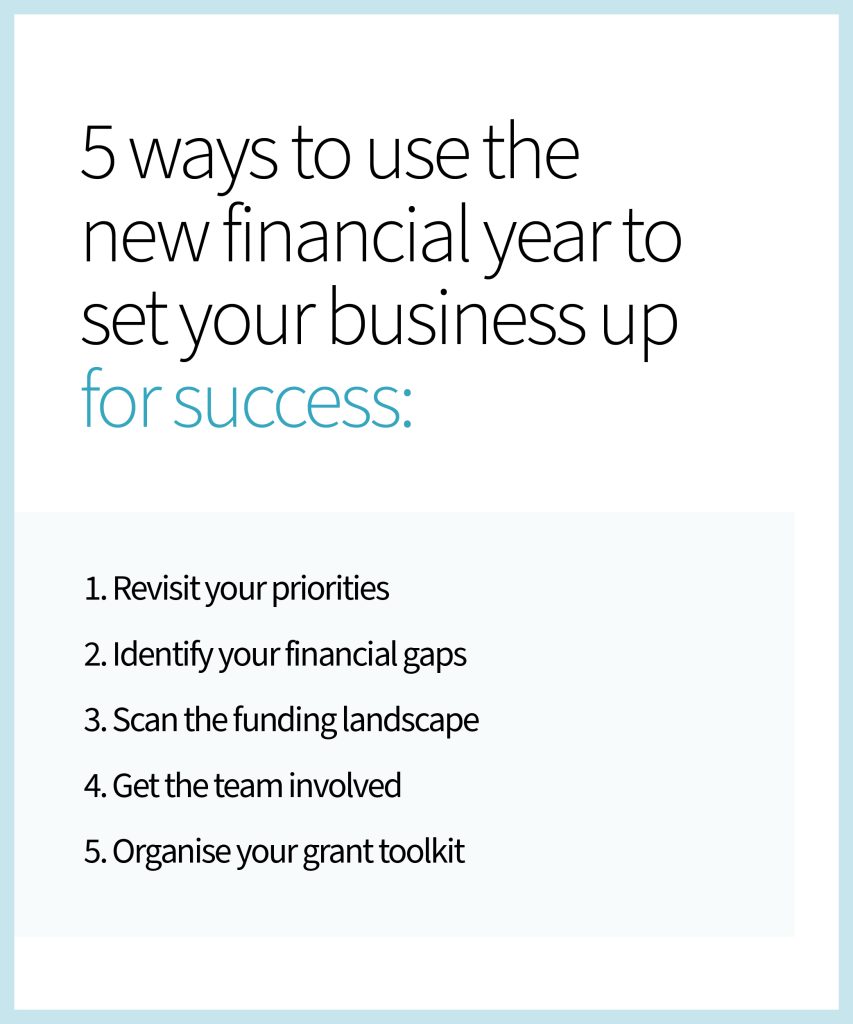
Here are five ways to use the new financial year to set your business up for success:

       1. Revisit your priorities:

What are you aiming to grow, test or expand this year? What matters most to your organisation right now? Funders respond best to clearly articulated goals.

      2. Identify your financial gaps:

Grants should fill specific funding needs, not general shortfalls. Clarify which projects need support and how much you’ll need. If budgeting isn’t your strong suit, now’s a good time to seek advice.


Need help identifying grants or shaping your funding budget? We’ve got you covered.


     3. Scan the funding landscape:

Look ahead 3–6 months. What’s likely to open based on recent budgets or government announcements? Which funders back your kind of work? Keep an eye on programs that require longer preparation or partner engagement.

     4. Get the team involved:

Whether it’s your staff, board, or co-founders, set time aside to review priorities and assign owners for grant opportunities. If you’re a solo operator, connect with other founders and support each other.

    5. Organise your grant toolkit:

Refresh or pull together the basics: a clear business plan, project budgets, your ABN and compliance docs, previous success stories, and any evaluation data you have. Having this on hand saves time when grants land.


FundFindrs - New Financial Year Success


Be proactive, not predictive

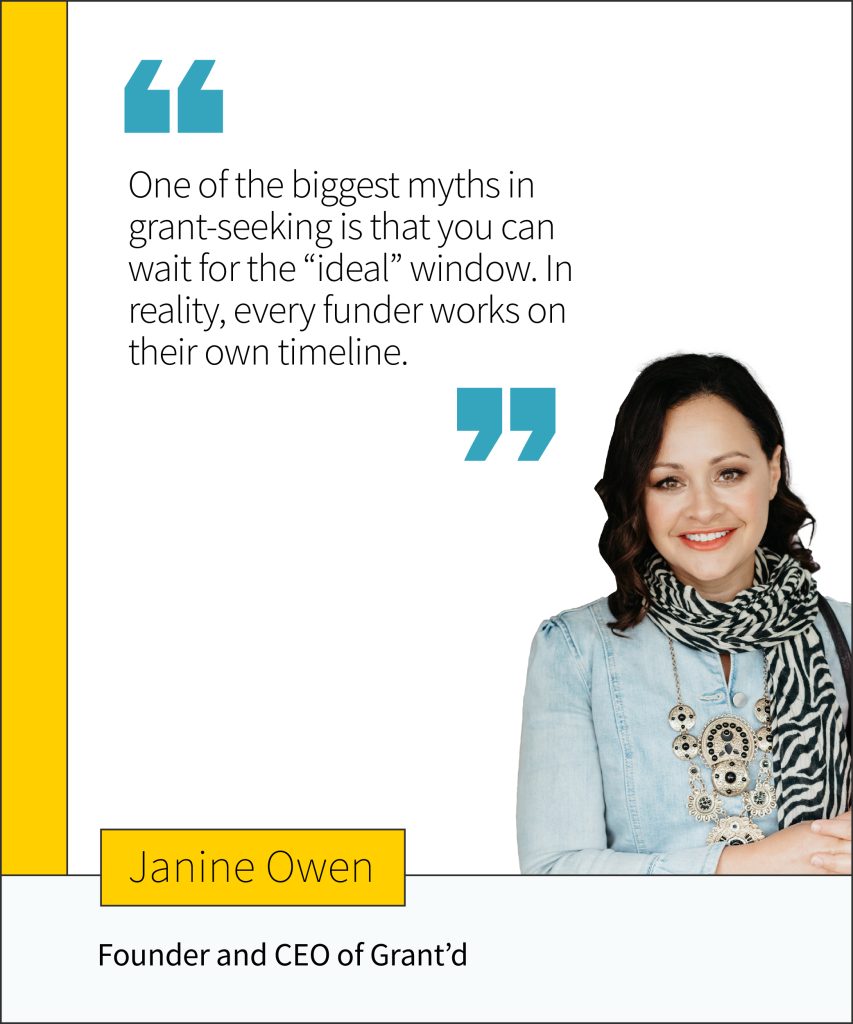
One of the biggest myths in grant-seeking is that you can wait for the “ideal” window. In reality, every funder works on their own timeline.

Government grants often align with federal and state budgets, but rollout dates vary while larger infrastructure or multi-year grants can take months to prepare.

Emergency or rapid-response funding appears without warning, but if you’re organised, you’ll be ready to apply quickly.

A clear takeaway? Don’t wait to act. Instead, build habits that keep you ready year-round.


FundFindrs - Janine Owens Biggest Myths Quote


Why you need a grants calendar

A 12-month grants calendar isn’t just a list of deadlines – it’s a practical tool that:

  • Keeps your team aligned
  • Flags key dates well in advance
  • Helps you balance internal project timing with external opportunities
  • Reduces stress and improves quality through better planning

You can use a basic spreadsheet, a whiteboard, or a digital tool. Grant’d offers an integrated calendar that updates as new grants are added. Whatever you choose, consistency is key.


Final thought

A new financial year doesn’t have to mean more hustle. It can be a chance to lead with intention.

Reassess. Reset. Get ahead of the curve. When you build the systems early, applying for grants becomes easier, faster, and far more strategic.


Want to start the new financial year right? The Grant’d grants calendar is a free way to plan smarter this year.


Ready to put your grants calendar into action?

At FundFindrs, we’re here to turn your mid-year planning into funding success.

Whether you’re identifying the right grants, preparing your documentation, or navigating the R&D Tax Incentive eligibility requirements, our experienced consultants are by your side. We simplify the application process, reduce stress, and boost your chances of success by applying for grants and tax incentives.

Book your FREE consultation with the FundFindrs team today and take the next step toward funding your future.

The Essential Grants Glossary: 10 Must-Know Terms Explained

Last reviewed: July 28, 2026


Writing a grant can sometimes feel like translating another language. Funders have their own terminology, and getting familiar with it can save you time, improve your applications, and help you avoid common mistakes. 

Here are ten key terms every grant seeker should know, with deeper context and real-world insight: 

  1. Eligibility criteria
  2. Assessment criteria
  3. Co-contribution 
  4. In-kind support 
  5. Funding agreement
  6. Milestone reporting
  7. Acquittal 
  8. Letters of support
  9. Matched funding
  10. Auspicing 


Key takeaways 


  • Eligibility criteria determine whether you can apply for a grant, making them the first section to review before investing time in an application.
  • Assessment criteria explain how applications are scored, helping applicants align their responses with funder priorities.
  • Co-contributions and matched funding often require applicants to share project costs, demonstrating commitment and reducing funder risk.
  • In-kind support refers to non-cash contributions, but not all grant programs allow these contributions to count towards funding requirements.
  • Milestone reporting and acquittals are important post-award obligations, requiring recipients to demonstrate how grant funds were used and what outcomes were achieved.
  • Letters of support and auspicing arrangements can strengthen funding applications, particularly for organisations that need partnerships, endorsements or administrative support.


1. Eligibility criteria

The non-negotiables. These are the rules that define who can apply. They might relate to your business structure, size, location, turnover, tax status (like DGR or TCC), or the purpose of the funding. 

Example: 

A regional small business grant may only accept applications from ABN-holding businesses operating outside metropolitan areas with under 20 full time employees (FTEs). Some require applicants to have been trading for a certain number of years, or to have a minimum revenue. 

Why it matters: 

If you don’t meet the core eligibility, your application won’t even be assessed. Even strong projects will be knocked out early if the box can’t be ticked. 

Expert’s tip: 

Always read eligibility before anything else. If something’s unclear, call the funder. And if you’re unsure, don’t assume – ask. 


Need support understanding grant eligibility?
Chat with our team to get clarity before you apply.


2. Assessment criteria

This is how your application will be scored. Every funder has assessment criteria that reflect what matters to them. Your job is to write directly to these points. 

Common criteria include: 

    • How well your project aligns with the funder’s goals or priorities 
    • The strength and clarity of your project plan 
    • Organisational capacity to deliver what you’re proposing 
    • Value for money and efficient use of funds 
    • Expected outcomes and how they’ll be measured
       

Expert’s tip:  

Use each criterion as a heading or structure in your responses. Don’t make assessors go hunting for the information – make it easy and obvious. 


3. Co-contribution

Some grants require you to contribute to the project financially. This might be a dollar-for-dollar match, or a percentage of the total cost. 

Example:  

If you’re applying for a $50,000 grant with a 50% co-contribution requirement, you need to put in $50,000 of your own (or sourced) funds. 

Why it matters:  

Co-contributions demonstrate buy-in, lower the funder’s risk, and are often seen as a measure of your commitment. 

Expert’s tip:  

Some grants don’t allow in-kind contributions to count toward the match. Always check the guidelines carefully and confirm the source of your match is eligible.


4. In-kind support

In-kind support refers to non-cash resources that contribute value to your project. These are goods or services provided either by your organisation or by partners, volunteers, or sponsors, without a direct financial transaction. 

Examples include: 

    • Donated venue or meeting space
       
    • Volunteer hours (often calculated using a standard hourly rate)
       
    • Loaned equipment or technology
       
    • Pro bono professional services, like legal advice, graphic design, or evaluation support
       
    • Advertising or promotional support at no cost
       

Why it matters: 

In-kind contributions demonstrate that your project has support beyond the grant. They show resourcefulness, partnership, and a broader commitment to success. In many cases, in-kind support can also be included in your project budget to reflect the true value of the initiative — and in some grant programs, it may count toward your co-contribution. 

Expert’s tip: 

Always estimate the value of in-kind support accurately and explain how you calculated it. Where possible, include a letter of confirmation or a memorandum of understanding (MOU) from the person or organisation providing the support.  

This strengthens your application and builds trust with the funder.


5. Funding agreement

If your application is successful, you’ll be asked to sign a funding agreement: a legal contract that outlines how the grant must be used and what you’re committing to deliver. This document covers everything from project timelines and approved budget items to reporting obligations and branding requirements. 

Why it matters: 

Once signed, you’re legally responsible for meeting the terms of the agreement. That includes hitting your milestones, delivering on promised outcomes, and using the funds exactly as stated. 

Expert’s tip:  

Take the time to read every clause carefully. If you’re unsure about anything, get legal or financial advice before signing. 


6. Milestone reporting

Most grants don’t just hand over funds and walk away. You’ll usually need to submit progress reports at key points throughout the project. These are called milestone reports, and they demonstrate how the work is tracking. 

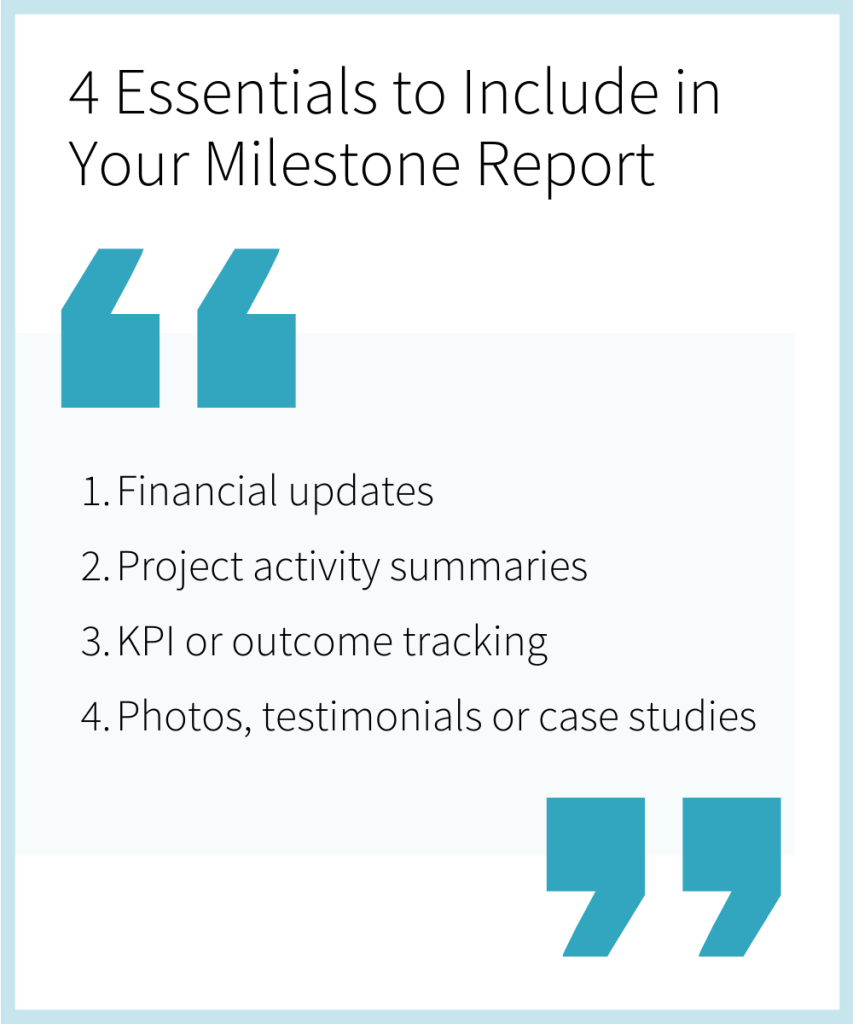
What’s included: 

    • Financial updates
       
    • Project activity summaries
       
    • KPI or outcome tracking
       
    • Photos, testimonials or case studies
       

Expert’s Tip:  

As soon as you sign the funding agreement, enter all milestone dates into your calendar. Missing deadlines or submitting incomplete reports can delay payments or impact future funding. 


Four Essentials to Include in your Milestone Report


7. Acquittal

The acquittal is the final report you submit after your project is complete. It shows how the grant money was spent and what was achieved.
 

What to expect: 

    • A full financial breakdown matching your approved budget
       
    • A report on project outcomes and impacts
       
    • Evidence such as receipts, media, photos, or evaluations
       

Expert’s tip:  

Don’t leave this to the last minute. Start collecting data and documentation from day one so your acquittal is accurate, thorough, and stress-free. 


8. Letters of support

These are written endorsements from individuals, organisations, or stakeholders who back your project. They show that others believe in your idea, are willing to partner with you, or will benefit from the outcome. 

Example:

A local council might provide a letter confirming they’ll offer a venue, help promote the program, or provide referrals. 

Expert’s tip:

Tailor each letter to the funder and the project. Generic or copy-paste letters won’t carry much weight. Ask for letters early and provide key points to make it easy for your supporters to write something strong. 


9. Matched funding

This is where you’re required to contribute an amount equal (or proportional) to the grant you’re applying for. It could be through your own funds, other grants, or investment

Why it matters:

Funders use matched funding to stretch their resources further and to see that you’re equally committed to the project’s success

Expert’s tip:

Some grants will only accept external sources for your matched funding, for example investment capital or a confirmed co-funder. Internal revenue or in-kind contributions might not count. Always read the guidelines closely. 


10. Auspicing

Auspicing is when an eligible organisation applies for and manages a grant on behalf of a group or business that doesn’t meet the funder’s eligibility criteria. 

How it works: 

    • The auspice organisation takes legal and financial responsibility
       
    • You deliver the project under their oversight
       
    • Both parties sign a formal agreement defining who does what
       

Example: 

A grassroots creative collective without legal status might partner with an established not-for-profit to auspice a grant for an arts festival. 

Expert’s tip:

Choose your auspice partner carefully. Trust, clear communication, and strong governance are essential. Always have a written agreement outlining roles, reporting, and how funds will be managed


Final thought 
Understanding the language of grants gives you power. It helps you write better, present stronger, and stay confident through the process. 

Bookmark this glossary. Share it with your team. The more fluent you are, the fewer roadblocks you’ll hit. 


Need support turning all this grant knowledge into action? 

At FundFindrs, we help businesses simplify and manage the entire grant process: from identifying the right opportunity to submitting a standout application. 

Contact us for a FREE consultation and let’s get your funding journey underway. 

Why Grant Applications Get Rejected (and What to Do About It)

Last reviewed: July 28, 2026


So much work goes into applying for a grant. That’s why rejection stings. But it’s often not about the strength of your idea, it’s about how well you followed the brief. 

Below are ten of the most common reasons grant applications miss the mark, and how you can avoid the same fate next time.


  1. Ignoring eligibility
  2. A weak or wandering story
  3. Unclear budgets
  4. No evidence or outcomes
  5. Missing governance or compliance info
  6. Not following instructions
  7. No risk or sustainability plan
  8. Submitting at the last minute
  9. No community buy-in
  10. Weak reporting plan


Key takeaways 


  • Grant applications are often rejected because they do not meet eligibility requirements, making the initial eligibility check one of the most important steps.
  • A clear project narrative matters. Funders want to understand what the project will achieve, why it matters and how it will be delivered.
  • Budgets should be detailed and transparent, with costs clearly explained and aligned to project activities.
  • Evidence and measurable outcomes strengthen applications, helping demonstrate the need for funding and how success will be evaluated.
  • Governance, compliance and supporting documents are essential, as missing information can affect eligibility and assessment.
  • Strong applications include risk, sustainability and reporting plans, showing how the project will be managed and measured beyond the funding period.


1. Ignoring eligibility

Always check the basics. If you’re not eligible, you’re out from the start. Don’t waste your time on grants that don’t fit.


2.  A weak or wandering story

Funders need clarity. If you can’t explain what your project does, why it matters, and how it will be delivered – quickly and clearly – it will cost you.


3. Unclear budgets

Avoid vague terms like “miscellaneous”. Break down your numbers and explain them. Funders want transparency.


4. No evidence or outcomes

Back up your case. Use data to show the need, and outline how you’ll measure success.


5. Missing governance or compliance info

Many grants require proof of insurance, board details, policies or financials. Make sure your documents are current and ready.


6. Not following instructions

Stick to word counts. Use the right templates. Upload the correct file types. A great application can still be ruled ineligible for admin errors.


7. No risk or sustainability plan

Funders want to know your project is viable — even if something goes wrong or funding ends. Spell that out.


8. Submitting at the last minute

Leave time for reviews, tech issues, and final polish. Rushing means mistakes.


9. No community buy-in

If the project serves a community, show how they’ve been involved. Add letters of support or quote conversations and feedback.


10. Weak reporting plan

Funders expect to see how you’ll track and report on progress. It’s a core part of grant accountability.


Final thought 

Grants are competitive. But most rejections happen for predictable reasons. By planning ahead, tightening your narrative, and double-checking the details, you’ll improve your chances dramatically. 

Get grant ready – not just application ready!


Ready to avoid these common pitfalls?

At FundFindrs, we specialise in making sure your grant application doesn’t fall at the avoidable hurdles. From checking eligibility and strengthening your story, to building clear budgets and managing compliance, we partner with you through the entire process. Our team knows what funders are looking for and how to help you stand out. 

Book a FREE consultation today and take the guesswork out of your next grant application. 


The Australian Business Funding Roadmap: 7 Funding Pathways and How to Combine Them

Australian businesses have access to a wide range of funding pathways, each designed to support different stages of growth and business objectives. These can include founder capital, government grants, the R&D Tax Incentive, business loans and other forms of non-equity finance, angel investment, venture capital, and export funding programs. The most appropriate funding pathway will depend on what a business is trying to achieve, whether that is developing a new product, commercialising innovation, scaling operations, improving cash flow or expanding into international markets. 

The right pathway depends on what you are trying to fund. A founder validating an idea will need something different from a manufacturer scaling production, a software company solving technical uncertainty, or an exporter entering a new overseas market. 

At FundFindrs, we work with Australian businesses to identify and access government grants and the R&D Tax Incentive. These are often powerful non-dilutive funding options because they can support innovation, commercialisation and growth without requiring founders to give away equity. But they rarely sit in isolation. In many cases, grants and R&D support work best when they are part of a broader funding roadmap. 


In this article, we will examine seven of the different funding pathways available to Australian businesses.


Key takeaways 


  • There is no single best funding option for every business. The right pathway depends on the business stage, growth objectives and the type of project being funded. 
  • Government grants and the R&D Tax Incentive can provide valuable non-dilutive funding for businesses investing in innovation, commercialisation, manufacturing capability and growth. 
  • Different funding pathways serve different purposes, from founder capital and debt funding through to angel investment, venture capital and export support. 
  • Many grant programs require businesses to contribute part of the project cost, making funding strategy, timing and co-contribution planning important. 
  • Grants and the R&D Tax Incentive do not need to replace investment or debt. They can often work alongside other funding sources as part of a broader funding roadmap. 
  • Businesses that understand their funding roadmap early are often better positioned to prepare evidence, align projects with eligibility requirements and identify future opportunities. 
  • The strongest funding outcomes occur when funding is aligned with business strategy rather than pursued as a standalone goal. 


Finding the right funding strategy


Australian businesses have more funding options available than ever before, from government grants and the R&D Tax Incentive through to loans, angel investment, venture capital and export funding. 

However, each funding pathway is designed to support different business objectives. Some are suited to innovation and product development. Others are designed to support commercialisation, international expansion, manufacturing capability or rapid scale. 

Understanding which funding options align with your business goals is an important first step in building a sustainable growth strategy. 


How the R&D Tax Incentive can support growth:

  • What funding options are available now 
  • What funding options may become available later 
  • Which grant programs require matched funding 
  • How to avoid relying too heavily on one source of capital 
  • How to preserve equity while still funding growth 
  • How to build the evidence needed for future applications 


7 funding pathways at a glance


Each funding pathway plays a different role in a business’s growth journey. The table below provides a high-level overview of the most common funding options available to Australian businesses, including when they are typically used and the key considerations associated with each. 


Funding pathway Best suited to Key benefit Key consideration
1. Founder capital Early validation Control and speed Personal risk and limited capacity
2. R&D Tax Incentive Eligible R&D activity Can help recover innovation costs Requires eligible activities, records and compliance
3. Government grants Defined projects Non-dilutive project funding Competitive and often requires co-contribution
4. Debt finance Working capital, equipment, bridging Avoids dilution Must be repaid
5. Angel investment Early growth and traction Capital plus expertise Equity dilution
6. Venture capital High-growth scaleups Large growth capital Dilution and growth expectations
7. Export funding International market expansion Supports export marketing and promotion Eligibility and timing vary by round


1. Founder capital


Founder capital is often the first funding pathway. It may come from personal savings, early shareholder contributions, director loans or money reinvested into the business by the founding team. 

It is useful because it gives founders control and can move quickly. There is no application round, no lender approval and no investor negotiation. But it also has limits. Founder capital can place personal pressure on the business owners and may not be enough to fund larger commercialisation, manufacturing, R&D or export projects. 


Best for:

Early validation, initial product development, customer discovery, small pilots and bridging gaps before external funding is available.


2. The R&D Tax Incentive


The R&D Tax Incentive (R&DTI) is one of the most important funding pathways for innovative Australian businesses. It is not a grant. It is a tax offset designed to encourage eligible companies to conduct research and development activities in Australia. 

According to the Australian Taxation Office (ATO), approximately 16,000 companies claim the R&D Tax Incentive each year, highlighting just how widely the program is used across the Australian innovation ecosystem. 

For many founders, CFOs and business leaders, the R&D Tax Incentive is overlooked because they do not describe their work as “research”. They may call it product development, engineering, testing, software development, process improvement or technical problem solving. But if the business is undertaking systematic experimentation to resolve technical uncertainty, it may be worth assessing whether the activity could qualify.
 

How the R&D Tax Incentive can support growth:

  • It can help recover part of eligible R&D costs. 
  • It can support reinvestment into future development. 
  • It can improve cash flow for eligible companies. 
  • It can sit alongside grants, investment and debt when structured correctly. 
  • It encourages businesses to keep better records of technical activities, experimentation and expenditure. 


The R&D Tax Incentive can be especially relevant for businesses developing software, engineering solutions, manufacturing processes, medical technology, clean technology, mining technology, agtech, robotics, AI or other innovation-led products and systems. 

Understanding what qualifies as an eligible R&D activity is often one of the most challenging aspects of preparing an R&D Tax Incentive claim. 


Best for:

Businesses developing new or improved products, processes, software, services or technologies through systematic experimentation, and seeking to reduce the cost of innovation through a tax offset or cash refund.


Not sure if you’re eligible for the R&D Tax Incentive?
Our FREE R&DTI Blueprint breaks it down with an eligibility checklist, examples, and expert tips from the FundFindrs team.


3. Government grants


Government grants can be powerful, but they are often misunderstood. The strongest grant candidates are not simply businesses that need money. They are businesses undertaking defined projects that align with government priorities, such as innovation, commercialisation, manufacturing capability, export growth, regional development, sustainability or productivity improvement.


What grants commonly support: 

  • Commercialising a new product, process or service 
  • Progressing a prototype or pilot into market readiness 
  • Scaling manufacturing capability 
  • Building sovereign capability in priority sectors 
  • Export promotion and international market development 
  • Sustainability, clean energy or emissions reduction projects 
  • Research collaborations and pre-commercialisation activities
     

What grants usually do not support:

  • General operating costs 
  • Undefined business growth 
  • Ordinary payroll expenses 
  • Business survival or cash flow gaps 
  • Projects with no clear innovation, commercial or economic outcome 


This is why eligibility is usually project-based. A business may be a strong company but still not have a suitable grant project. Conversely, a smaller business with a clearly defined innovation or commercialisation project may be better placed than it first assumes. 


Stronger grant candidates Less suitable candidates
Have a defined project Only have a general business idea
Have a prototype, proof of concept, pilot or commercialisation pathway Are at concept stage only
Can show economic, technical or commercial outcomes Need general operating funds
Can contribute matched funding where required Cannot fund their contribution
Have evidence, milestones and a delivery plan Have limited documentation or unclear scope


4. Business loans and non-equity finance


Loans and debt funding can support business growth without requiring founders to give away ownership. Options may include traditional bank loans, equipment finance, working capital facilities, invoice finance, venture debt and alternative lending products. Unlike grants or the R&D Tax Incentive, debt funding must be repaid, but it can provide faster access to capital for businesses with a clear repayment pathway, predictable revenue or an identifiable asset being funded. 


Businesses now have access to a broad range of funding providers, including:

  • Major banks 
  • Specialist and alternative lenders 
  • Equipment finance providers 
  • Invoice and debtor finance providers 
  • Venture debt and revenue-based finance providers 


Each provider will have different lending criteria, security requirements, repayment structures and risk appetites, so it’s important to understand which solution best aligns with your business objectives and cash flow position. 


Before taking on debt, businesses should consider:

  • Repayment capacity 
  • Interest costs and fees 
  • Security requirements and personal guarantees 
  • Cash flow impacts 
  • How debt integrates with grants, the R&D Tax Incentive and other funding sources 


The most effective funding strategies typically use debt as one component of a broader funding mix rather than as a standalone solution. 


FundFindrs insight:  

Debt funding and grants are often viewed as separate funding pathways, but they frequently work together. Many grant programs require businesses to contribute a portion of project costs through matched funding. Depending on the program rules and business circumstances, debt funding may help fund that contribution, allowing the business to undertake a larger project than would be possible using available cash alone. 


 5. Angel investment


Angel investors typically provide early-stage capital to startups and scaleups, often before a business is ready for institutional venture capital. Unlike loans, angel investment does not need to be repaid. In exchange, investors receive an ownership stake in the business and become invested in its future success. 

For many founders, the value of angel investment extends beyond the capital itself. The right investor may bring industry knowledge, founder experience, strategic guidance, commercial introductions and access to networks that can help accelerate growth. 

Angel investment can also work well alongside grants and the R&D Tax Incentive. A founder may use angel capital to support product development, fund the business contribution required for a matched grant, or extend runway while eligible R&D activities are underway. When combined effectively, these funding pathways can help businesses progress faster without relying on a single source of capital. 

Not all angel investors bring the same value, so it is important to look beyond funding and consider the experience, networks, and support they can offer. 


When evaluating potential investors, founders should consider:

  • Relevant industry knowledge and experience 
  • Access to customers, partners or industry networks 
  • A track record of supporting growing businesses 
  • Alignment with the founder’s vision and long-term goals 
  • The ability to support future fundraising activities 


Many experienced founders will tell you that choosing the right investor can be just as important as securing the investment itself. FundFindrs partners with Angel Investing  business Impactiv to support clients at the right time. 


Best for:

Early and growth-stage businesses seeking capital, strategic advice and industry connections from experienced investors who are willing to back high-potential growth opportunities.


6. Venture capital


Venture capital (VC) is a funding pathway used by high-growth businesses looking to scale quickly. Unlike grants, debt funding or the R&D Tax Incentive, venture capital involves exchanging equity in the business for investment capital. 

VC funding is typically suited to businesses with large market opportunities, scalable business models and ambitious growth plans. Beyond capital, investors may also provide strategic advice, industry expertise, customer introductions and support with future fundraising activities. 

However, venture capital is not the right pathway for every business at every stage. Many founders assume they need investment immediately, when there may be opportunities to build value first through grants, the R&D Tax Incentive or other non-dilutive funding sources. 


Non-dilutive funding pathways such as grants and the R&D Tax Incentive may help businesses:

  • Fund technical development before valuation discussions 
  • Build commercialisation evidence that investors want to see 
  • Extend runway without immediate dilution 
  • Demonstrate the ability to secure and manage external funding 
  • Reach key milestones before entering fundraising conversations 
  • Perhaps most importantly, grants and the R&D Tax Incentive do not need to replace investment. They can often work alongside venture capital to support specific projects, reduce cash burn and help businesses achieve more with the capital they raise. 


Best for:

High-growth businesses with a scalable business model that need significant capital to accelerate expansion, enter new markets or achieve rapid growth.


7. Export funding and market expansion support


Export funding becomes relevant once a business is ready to sell, promote or expand into international markets. Programs such as the Export Market Development Grants program have historically supported eligible Australian businesses with export marketing and promotional activities. 

Export funding is different from R&D or commercialisation funding. It generally does not fund the development of the product itself. Instead, it helps eligible businesses promote Australian goods, services, software, IP or know-how into international markets. 


Best for:

Businesses that have a market-ready product or service, a clear export strategy and eligible export promotion activity.


How these funding pathways work together


The smartest funding strategy is rarely choosing one option and ignoring the rest. It is understanding which options apply at each stage of growth and how they can work together without creating compliance issues or cash flow pressure. 


Business stage Likely funding need Relevant pathways Funding strategy question
Validate Prove the problem, develop early product, test demand Founder capital, angel investment, early R&D assessment What evidence do we need before applying for external funding?
Innovate Solve technical problems, build or improve product, test uncertainty R&D Tax Incentive, founder/angel capital Are we documenting eligible R&D as we go?
Commercialise Move from prototype or pilot toward market Government grants, angel investment, debt, R&D Tax Incentive Do we have a defined project, budget, milestones and matched funding?
Scale Grow production, hire, enter new markets, improve capability Grants, debt, VC, R&D Tax Incentive What capital mix gives us speed without unnecessary dilution?
Expand Export, international marketing, larger partnerships Export funding, VC, debt, grants Is our export plan well evidenced and timed with funding rounds?


Example funding stacks


Example 1: Early-stage technology startup 

  • Founder capital funds early validation and proof of concept. 
  • Angel investment supports the first team members and product development. 
  • The R&D Tax Incentive is assessed for eligible technical development work. 
  • A commercialisation grant is explored once the project, budget and market pathway are clearer. 


Example 2: Innovative manufacturer

  • Internal cash funds planning and early design work. 
  • Equipment finance supports new machinery or production capability. 
  • Government grants are explored for eligible manufacturing capability or commercialisation projects. 
  • The R&D Tax Incentive is assessed for technical experimentation and eligible development activity.
     

Example 3: Export-ready business

  • Revenue or working capital funds core operations. 
  • Export funding supports eligible international marketing or promotion. 
  • R&D Tax Incentive may support ongoing product or technology development. 
  • Debt or investment may fund inventory, staffing or market-entry costs that grants do not cover.


funding pathways article


Key considerations before choosing a funding pathway


1. What are you funding? 

A funding pathway should map to a specific need. Are you developing technology, commercialising a product, buying equipment, funding export marketing, covering working capital or hiring a team? The answer changes which options are relevant. 


2. Are you eligible now, or preparing for later? 

Some funding options are available only at certain stages. For example, many grants require evidence of a prototype, pilot, market demand or matched funding. If you are not eligible now, the right strategy may be to prepare your documentation and timing for a future round. 


3. Do you have the evidence?

For grants, evidence may include project plans, budgets, quotes, customer demand, IP ownership, financial capacity and commercialisation milestones. For the R&D Tax Incentive, evidence usually relates to activities, technical uncertainty, experimentation, records and expenditure. 


4. What is the true cost of capital? 

A grant may be non-dilutive, but it may require a co-contribution and reporting. Debt avoids dilution, but it must be repaid. Equity can accelerate growth, but it reduces ownership. The right answer depends on the business model and risk profile. 


5. Can the funding sources be combined properly?

Some funding pathways can complement each other. Others may create issues if the same expenditure is claimed twice or if program rules restrict the use of other funding. This is why a funding roadmap matters. The goal is not to chase every opportunity. It is to understand what fits and when. 


Final thoughts: funding should follow strategy


The most successful businesses do not chase funding for the sake of it. They understand what they are building, what stage they are at, what capital they need, and which funding pathways can support their next move. 

 For innovative Australian businesses, grants and the R&D Tax Incentive should be core considerations. They can support product development, commercialisation, manufacturing capability, export growth and reinvestment into future innovation. But they work best when considered alongside the full funding mix, including founder capital, debt, angel investment and venture capital. 

 If you are building, testing, commercialising or scaling something new, FundFindrs can help you understand what funding pathways may be available and how grants and the R&D Tax Incentive could fit into your broader growth strategy. 

Speak with FundFindrs about grants, R&D Tax Incentive eligibility and funding opportunities aligned with your growth plans. 


Industry Growth Program (IGP):what’s changed, what matters, and who should apply

Last reviewed: July 02, 2026


The Industry Growth Program (IGP) is one of the Federal Government’s key funding pathways for Australian SMEs looking to commercialise innovation and scale their businesses. 

However, the program has shifted significantly. 

Following the Federal Government’s $102 million funding reduction (MYEFO), the IGP is no longer a broadly accessible grant. It is now a highly competitive program focused on commercially viable projects with clear economic impact. 

For businesses, this changes the approach entirely. The question is no longer: “Are we eligible?” but it should be: “Are we competitive enough to be funded?”.

In this article, we break down how the program works today, what has changed, and, most importantly, how to assess whether your business is genuinely positioned to succeed. 


IMPORTANT NOTE: Following the announcement of the Federal Budget 2026-27, the Industry Growth program has been put on hold affecting both new applicants and those already in the pipeline. At this stage, it hasn’t been confirmed if it will re-commence, be replaced or be cancelled. We will update as further information comes to light.


Key takeaways 

  • The IGP is currently paused. Following the 2026–27 Federal Budget, the program is on hold for new applicants and those already in the pipeline.
  • Funding was reduced by $102 million. The IGP is no longer a broadly accessible grant and is now focused on highly competitive, commercially viable projects.
  • Competitiveness matters more than eligibility. Being eligible does not guarantee funding in the current assessment environment.
  • The program has two stages: Advisory support to strengthen commercialisation strategy, followed by grant funding for the strongest projects.
  • Innovation alone is not enough. Successful applications must demonstrate commercial readiness, execution capability and measurable economic impact.
  • IGP and R&DTI serve different purposes. R&DTI supports eligible R&D activities retrospectively, while IGP supports future commercialisation and growth.
  • Application quality is critical. Strong positioning and commercial evidence play a major role in funding outcomes.


1 – What is the Industry Growth Program  

The IGP, delivered through business.gov.au, combines advisory support and matched grant funding to help businesses move from innovation to commercialisation. 


In practice, the program operates as a two-stage process: 

  1. Advisory stage – designed to assess and strengthen your commercial strategy  
  1. Grant stage – where funding is awarded to the most competitive projects  


This structure reflects a clear objective from government: to fund outcomes, not just ideas. The program prioritises businesses that can demonstrate a clear pathway to market, the ability to execute, and the capacity to generate measurable economic outcomes. As a result, technical innovation alone is not enough, applications must show how that innovation translates into commercial impact. 


2 – What’s changed in the Industry Growth Program: funding cuts and increased competition 

Recent funding reductions have reshaped the Industry Growth Program. 

Businesses should expect: 

  • Fewer grants awarded  
  • Greater scrutiny on applications  
  • Stronger focus on commercial readiness  
  • Increased importance of financial capability and co-investment  

As a result, application quality and positioning now play a critical role in success. 


Stronger competition means greater emphasis on commercial positioning, financial capacity and delivery readiness. FundFindrs helps businesses strengthen these areas before applying.


3 – How the program works 

Step 1: Advisory Service (mandatory) 

All applicants must begin with the IGP Advisory Service. 

This involves submitting an application that assesses your: 

  • Business model  
  • Innovation viability  
  • Commercialisation pathway  


If eligible, you will work with an Industry Growth Program Adviser to: 

  • Test your strategy  
  • Identify risks and gaps  
  • Define a clear pathway to market  


It’s important to know this stage is mandatory once you cannot access grant funding without completing it. 


Step 2: Grant Funding 

Businesses that successfully progress may be eligible for one of two streams: 

Early-Stage commercialisation grants
– Funding available: $50,000 – $250,000
– Objective: Supporting businesses moving toward market readiness 

Commercialisation and growth grants
– Funding available: $100,000 – $5 million
– Objective: Supporting businesses ready to scale 

Both streams require: 

  • Matched funding (co-contribution)  
  • Demonstrated financial capability  
  • Clear commercial outcomes  

Funding is awarded on merit, and competition is strong.


Industry Growth program Tip


4 – Industry Growth Program eligibility overview 

To be eligible, businesses must generally: 

  • Be an Australian SME  
    • Fewer than 200 employees  
    • Turnover under $20 million (last three financial years) 
       
    • Value-add in resources  
    • Agriculture, forestry and fisheries  
    • Transport  
    • Medical science  
    • Renewables and low emissions technologies  
    • Defence capability  
    • Enabling technologies (e.g. AI, robotics, biotech)  
  • Demonstrate:  
    • Commercial potential and scalability  
    • IP ownership or access rights  
    • Financial capacity to co-invest  


5 – What makes a competitive application in 5-steps 

With increased competition, successful applications typically demonstrate: 

1 – Clear commercial outcomes
A defined pathway to revenue, market adoption, or industry impact 

2 – Strong market and technical positioning
Evidence of demand, traction, or validated development 

3 – Financial readiness
Capacity to fund your share of the project, supported by evidence and an Accountant Declaration 

4 – Structured project planning
Clear milestones, timelines, budgets, and risk considerations 

5 – Alignment with government priorities
A direct link to NRF sectors and broader economic outcomes 


6 – A common misconception 

One of the most common mistakes is treating the IGP as a standard grant application. 

In reality, it functions as a commercial assessment process. That’s why eligibility alone does not determine outcome success. Applications are assessed on quality, clarity, and commercial viability — which is why many businesses consider working with a grant writing consultant to strengthen their approach and overall submission strategy. 

Is the Industry Growth Program right for your business? 

The IGP is best suited to businesses that: 

  • Are developing commercially viable innovations  
  • Have a clear pathway to market  
  • Can co-invest in their growth  
  • Are ready to compete in a merit-based funding environment  

If your business is still validating early-stage ideas or lacks financial readiness, it may be worth exploring alternative pathways first. 


7 – Where IGP fits within your funding strategy 

The Industry Growth Program (IGP) is often considered alongside programs such as the R&D Tax Incentive (R&DTI). 

While both support innovation, they serve different purposes: 

  • R&DTI supports eligible R&D activities retrospectively  
  • IGP supports forward-looking commercialisation and growth  

For many businesses, these programs can be complementary when used strategically. 


8 – How FundFindrs can support your application 

Navigating programs like the IGP requires more than understanding eligibility criteria. If you’re considering apply to it, the first step is understanding your position — not just your eligibility. 

At FundFindrs, we work with businesses to: 

  • Assess whether the program is the right fit  
  • Strengthen commercial positioning before applying  
  • Prepare clear, compliant applications  
  • Support both advisory and funding stages  

Our approach is grounded in practical experience across multiple funding programs and industries.  


Book a FREE consultation with FundFindrs to assess your suitability for the Industry Growth Program and build a clear strategy before applying. 


Emerging Technology Commercialisation Fund (ETCF) 2026: A new $20M opportunity for NSW innovators

Last reviewed: July 03, 2026 
The Emerging Technology Commercialisation Fund (ETCF) 2026 is a new NSW Government program designed to help innovative startups and SMEs move promising technologies closer to market. 

With $20 million in funding available, the program aims to support businesses developing emerging technologies that need further development before they are ready for commercial deployment. 

For companies working on breakthrough solutions, understanding how the ETCF works — and whether your project could be eligible — may open valuable opportunities to accelerate innovation and growth.


Key takeaways 

  • $20 million is available through the NSW Government’s ETCF, administered by the Office of the Chief Scientist and Engineer.
  • Grants range from $500,000 to $2 million per project and are structured as repayable grants once EBITDA exceeds $500,000.
  • The program targets technologies at TRL 3–7, supporting projects that have moved beyond early research but are not yet commercially deployed.
  • Applicants must meet NSW-based eligibility requirements, including headquarters and workforce location criteria.
  • Stage 1 includes a pitch video, meaning the commercial narrative is just as important as the technology itself.
  • ETCF and R&DTI are complementary programs, supporting different stages of the innovation and commercialisation journey.


1 – What is the Emerging Technology Commercialisation Fund (ETCF)? 

The Emerging Technology Commercialisation Fund (ETCF) is a NSW Government program administered by the Office of the Chief Scientist and Engineer. 

The program provides funding to help innovative companies advance emerging technologies toward commercial readiness, supporting projects that require further development before entering the market.

The fund was first announced in the 2025–26 NSW Budget and forms part of the government’s Innovation Blueprint, a broader strategy aimed at strengthening innovation and research commercialisation across NSW. The first funding round includes a $7 million allocation. 

ETCF focuses on technologies progressing along the Technology Readiness Level (TRL) scale, helping businesses move from prototype or proof-of-concept toward commercial demonstration.  


Key objectives of the program include:
 

  • accelerating the commercialisation of emerging technologies 
  • reducing financial risk during late-stage research and development 
  • strengthening NSW’s innovation capability and industry competitiveness 


2 – How much funding is available? 

The ETCF provides significant financial support for eligible companies progressing emerging technologies. 


Grant amount 

  • Between $500,000 and $2,000,000 per project 


Total funding pool
 

  • $20 million allocated to the program 


Grant structure

  • The ETCF is structured as a repayable grant. Repayments are typically made in instalments and commence in the financial year when the recipient’s EBITDA exceeds $500,000, as outlined in the program guidelines.


Application timeline
 

  • Applications open: 6 March 2026 
  • Applications close: 29 April 2026  

Projects funded through the program are typically expected to be completed within two years, helping accelerate development timelines and support commercial deployment.


Exploring the ETCF opportunity? 
Our team can help you assess eligibility and plan your funding strategy.


3 – What types of projects are eligible for ETCF funding?  

The ETCF focuses on technologies that have already reached an early validation stage but require further development before commercial deployment.


Eligible projects generally fall within Technology Readiness Levels (TRL) 3–7, which may include activities such as: 

  • prototype development and engineering refinement 
  • pilot programs or demonstration trials 
  • regulatory approvals and product testing 
  • scaling early-stage manufacturing processes 
  • intellectual property protection and commercialisation planning 


The program supports technologies across both physical sciences and biological sciences, including sectors such as:
 

  • advanced manufacturing 
  • biotechnology and life sciences 
  • clean energy and net-zero technologies 
  • housing and construction innovation 
  • advanced materials and engineering systems 


These sectors align with NSW priorities to strengthen innovation capability and industry competitiveness. 


4 – Who is eligible to apply? 

To apply for the ETCF, businesses must meet several key eligibility criteria.
 

Applicants must: 

  • be a for-profit company incorporated in Australia 
  • be headquartered in NSW 
  • have an active ABN 
  • employ more than 65% of staff in NSW 
  • have annual revenue under $2.5 million 
  • own or hold exclusive rights to commercialise the relevant intellectual property 


5 – What might an ETCF-supported project look like? 

To illustrate the types of innovations the ETCF aims to support, the following examples show projects that could align with the program’s commercialisation focus.


Examples of projects that may align with the program include:

  • AI-driven platforms improving safety or productivity in infrastructure and construction 
  • biotechnology innovations progressing toward clinical or regulatory validation 
  • advanced battery or energy storage technologies moving from prototype to pilot production 
  • new materials or construction technologies designed to improve sustainability 
  • robotics or automation systems developed for advanced manufacturing 


6 – Strategic considerations before applying 

Before preparing an ETCF application, businesses should assess whether their technology and project plan align with the program’s commercialisation focus. 

Competitive applications typically demonstrate more than technical innovation. They also show a clear pathway toward market deployment and economic impact. 


When evaluating whether the program is the right fit, businesses should consider:

  • whether the technology has progressed beyond early research and proof of concept 
  • whether there is a defined market need or commercial opportunity 
  • whether the project can realistically progress the technology toward deployment within the proposed timeframe 
  • whether the team has the capability to deliver the project successfully 

Taking time to assess these elements early can help determine whether ETCF is the right funding pathway for your business. 


7 – How ETCF fits into Australia’s broader innovation funding landscape 

The ETCF is part of a broader ecosystem of government initiatives designed to support innovation and commercialisation. 

For example, businesses developing new technologies may also benefit from programs such as the R&D Tax Incentive (R&DTI), which supports eligible research and development activities across Australia. Many emerging technology companies combine commercialisation grants like ETCF with the R&D Tax Incentive to support innovation across different stages of development. 

Combining different funding mechanisms can help businesses support innovation across multiple stages. 


8 – How FundFindrs helps businesses navigate emerging technology funding 

Securing government funding for innovation often requires more than simply meeting eligibility criteria. 

For the ETCF program specifically, the Stage 1 application involves submitting a short pitch video outlining the technology, the problem it solves, and the commercial opportunity. The video is expected to address the key assessment criteria and clearly communicate the strength of the project. 

Preparing a compelling pitch requires careful planning. In many cases, this means developing a clear storyline, structured messaging, and a concise script that demonstrates both the innovation and the commercial potential.
 

Successful applications typically require: 

  • clear technical and commercial narratives
  • strong financial planning
  • evidence of market opportunity and scalability
  • well-structured project documentation
  • a clear and compelling pitch narrative for the Stage 1 video submission


At FundFindrs, our team works with innovative companies across Australia to identify and secure funding opportunities aligned with their growth strategy. 

This includes: 

  • identifying relevant grant opportunities
  • assessing eligibility and program fit
  • supporting application strategy and documentation
  • assisting with storyboarding and scripting for pitch video submissions
  • integrating grants with programs such as the R&D Tax Incentive as part of a broader funding roadmap 

If your company is developing an emerging technology and considering applying for the ETCF, our team can help assess whether the program is the right fit for your innovation. 


Book a FREE consultation to discuss your project and explore potential funding opportunities. 


Advancing Renewables Program (ARENA): Most asked questions and insights

Last reviewed: July 03, 2026 

For businesses considering an application to the Advancing Renewables Program (ARENA), understanding how the assessment process works is just as important as meeting eligibility criteria.
 

While our Funding Guide explains the program structure and funding mechanics, this article answers the most common questions businesses ask about applying for ARENA funding under the Advancing Renewables Program — from assessment criteria and timelines to commercial readiness and competitiveness. 

If you’re evaluating whether your project is ready for submission, these answers provide practical clarity before going ahead. 


Key takeaways 

  • Technical merit alone won’t win funding. ARENA assesses commercial viability, market pathway and system-level impact.
  • Projects typically need to be at TRL 6–9. Early-stage research and concept development are not supported.
  • Matched funding is required. Applicants must contribute at least 50% of total project costs.
  • Applications follow a two-stage process: EOI first, then a full application covering financials, milestones and commercialisation strategy.
  • There are no fixed response timelines. Assessment is rolling and can extend across several months, so co-funding commitments should be secured early.
  • ARP and R&DTI can work together to support both commercialisation and ongoing R&D investment.


1 – What is Advancing Renewables Program (ARENA) looking for in applications?

Beyond technical merit, ARENA assesses proposals on their ability to deliver measurable, system-wide and commercial outcomes. 

Competitive projects clearly demonstrate: 

  • A credible pathway to commercial deployment at scale 
  • Strong co-funding commitments and financial robustness 
  • Clear milestones linked to outcomes, not just activities 
  • Alignment between technology performance, market demand and national energy priorities 


FundFindrs’ Tip: Projects that clearly link technical performance to commercial deployment and measurable system impact are typically more competitive. 


2 – What are Advancing Renewables Program assessment criteria?

Applications are typically evaluated across several core areas, including: 

  • Technical feasibility and innovation 
  • Commercial viability and market pathway 
  • Alignment with ARENA’s investment priorities 
  • Value for money 
  • Broader system and national energy benefits 


FundFindrs’ Tip: Strong submissions integrate technical, financial and market elements into one clear narrative rather than presenting them as separate sections. 


3 – Does arena fund early-stage research?

Under the Advancing Renewables Program, projects are generally expected to be at Technology Readiness Levels (TRL) 6–9. 

Projects focused solely on early-stage research, student training or concept development are typically not supported under ARP. Applicants must demonstrate readiness for demonstration, deployment or commercial scale-up.  


4 – What is the EOI and full application process?

Many projects under the Advancing Renewables Program progress through a staged process: 

  1. Expression ofinterest (EOI)
    An initial submission outlining the project concept, objectives and strategic alignment. 
  2. Fullapplication
    A detailed submission including technical documentation, financial modelling, milestone plans and commercialisation strategy. 


FundFindrs’ Tip: Treat the EOI as the foundation of your strategy. Weak positioning at this stage can make progression to full application significantly harder.


ARENA applications require clarity across technical, financial and commercial elements. FundFindrs helps bring these together into a strong submission strategy.


5 – What are common challenges with Advancing Renewables Program 

Common challenges include: 

  • Interpreting complex guidelines and assessment criteria 
  • Building robust financial models and co-contribution structures 
  • Defining milestones that satisfy both technical and commercial expectations 
  • Clearly articulating national and system-level benefits 

Early planning and expert guidance can significantly improve application strength. 


6 – How competitive is Advancing Renewables Program funding? 

Advancing Renewables Program funding is highly competitive and assessed on merit and value for money by Australian Renewable Energy Agency (ARENA). Funding is provided on a matched basis, meaning applicants must contribute at least 50% of total project costs.


FundFindrs’ Tip: P Projects that rely solely on innovation, without clear commercial and financial framing, often struggle to progress.
 

7 – How long does it take to hear back from ARENA? 

ARENA does not publish fixed response timeframes for the Advancing Renewables Program. 

Applications are assessed on a rolling basis, with timing influenced by pipeline volume and project complexity. In practice, applicants may experience several months between stages, with full assessment and negotiation extending across multiple months depending on scope and workload. 


FundFindrs’ Tip: Because timelines can extend across multiple months, businesses should ensure internal resources and co-funding commitments are secured early. 


8 – Can startups apply for ARENA funding? 

Yes — provided they: 

  • Are Australian-incorporated entities with an ABN 
  • Meet co-contribution requirements 
  • Demonstrate sufficient financial capacity 
  • Have projects at appropriate TRL levels 

However, startups that are still in early concept or research stages may find it difficult to qualify under ARP.


9 – What makes an Advancing Renewables Program application stand out? 

From our experience supporting complex Federal funding programs, the strongest applications are not always the most technically advanced — they are the most strategically framed. 

Projects that succeed typically: 

  • Translate technical innovation into commercial and economic value 
  • Clearly articulate why ARENA support is critical to deployment 
  • Balance ambition with delivery certainty 
  • Demonstrate long-term impact beyond the grant period 


FundFindrs’ Tip: Clear positioning of risk management and delivery certainty often differentiates competitive applications from technically similar projects. 


Advancing Renewables Program ARENA Most asked questions and insights FundFindrs Tips


How FundFindrs supports ARENA grant applications

FundFindrs works with businesses at every stage of the ARENA journey: from early eligibility assessment through to full application management. 

Our support includes: 

  • Eligibility and strategic fit assessment 
  • Interpreting ARENA guidelines and priorities 
  • Clarifying project scope, milestones and measurable outcomes 
  • Developing grant-ready budgets and financial models 
  • Strengthening commercialisation and deployment narratives 
  • End-to-end application management 


Where appropriate, we also help businesses align with Advancing Renewables Program complementary funding opportunities such as the  R&D Tax Incentive (R&DTI)  to support ongoing innovation and commercialisation. 


Considering an ARENA application? 

The Advancing Renewables Program supports renewable energy projects ready to move toward large-scale deployment, but competitiveness depends on more than technical capability. 

Strategic positioning, financial credibility and measurable impact all influence assessment outcomes. 

If you would like an independent view on your project’s readiness, FundFindrs offers a FREE consultation to help clarify eligibility and next steps. 


Advancing Renewables Program (ARENA): Funding Guide for Australian Businesses

Last reviewed: July 03, 2026

Australia’s transition to net zero relies heavily on the commercialisation and large-scale deployment of renewable energy technologies. The Advancing Renewables Program (ARP), administered by the Australian Renewable Energy Agency (ARENA), is one of the Federal Government’s flagship funding programs supporting this shift. 

Designed to back mid to late-stage renewable energy projects, the program provides flexible, milestone-based grant funding to help innovative businesses demonstrate, deploy and scale technologies that can materially reduce emissions and strengthen Australia’s clean energy system. 

This guide explains how the Advancing Renewables Program works, who it’s for, what it funds, and how Australian businesses can get support to position themselves for a competitive application.  


Key takeaways 


  • ARP is ARENA’s flagship grant program for mid to late-stage renewable energy projects focused on demonstration, deployment and commercial scale-up.
  • ARENA funding supports projects with a clear pathway to deployment and scale, not early-stage concepts or research-only activities.
  • Funding is milestone-based, with payments typically linked to agreed project outcomes and delivery progress.
  • Co-contribution is an important requirement, with applicants expected to demonstrate financial capacity and strong project backing.
  • Commercial readiness matters as much as innovation. Strong applications show a clear market pathway, financial discipline and measurable energy system impact.
  • ARENA supports projects that help accelerate Australia’s transition to net zero by improving renewable energy deployment, performance, integration or adoption.


1 – What is the Advancing Renewables Program (ARENA)? 

The Advancing Renewables Program is ARENA’s primary grant initiative focused on accelerating Australia’s transition to net zero through renewable energy innovation, demonstration and deployment. 

The program supports projects that move beyond early-stage research and are ready for real-world application and commercial scale-up. Program priorities and guidelines are maintained by ARENA and updated periodically to reflect national energy policy and market needs. 

Projects supported under the program typically aim to: 

  • Demonstrate or deploy renewable energy technologies at commercial or near-commercial scale 
  • Reduce costs and improve the performance of renewable energy generation 
  • Enable system integration, flexibility and reliability 
  • Address technical, regulatory or financial barriers to renewable energy uptake


2 – What types of projects does ARENA fund?

ARENA funding is targeted at projects with a clear pathway to deployment and scale. 

Supported project types commonly include: 

  • Renewable energy demonstration and deployment
    Projects that validate performance, reliability or cost improvements of renewable energy technologies in real-world conditions.
  • Enabling technologies for renewable energy integration
    Solutions that improve system flexibility, integration, storage, transmission or reliability across the energy network.
  • Commercial-scale clean energy solutions
    Projects focused on scaling proven technologies and accelerating market adoption.


3 – Who is the program designed for?

The program is best suited to:

  • Mid to late-stage clean energy innovators 
  • Technology developers ready for commercial deployment 
  • Energy companies implementing new or improved renewable solutions 
  • Businesses seeking to scale proven renewable technologies 

A strong application demonstrates not only innovation, but also commercial readiness, financial discipline and measurable impact. 


ARENA applications are assessed on more than technical innovation. FundFindrs supports businesses to interpret program requirements.


Eligibility criteria 

To be eligible for ARENA funding, applicants must meet both entity and project requirements.

Eligible entities must: 

  • Hold an Australian Business Number (ABN) 
  • Be an Australian-incorporated entity

Eligible project types: 

Projects must involve renewable energy technologies aligned with ARENA’s priorities and objectives.

Technology readiness requirements: 

  • Projects focused solely on early-stage research or student training are generally not supported 

Applicants must also provide a detailed project budget, financial model and milestone plan. 


ARENA - FundFindrs Tip


4 – How much funding is available through ARENA?

Grant funding structure

  • Funding is provided as milestone-based grant payments 
  • Payments are linked to the achievement of agreed project outcomes 

Grant amounts 

  • No fixed upper funding limit 
  • Previous ARENA grants have ranged from $100,000 to over $50 million, depending on scope and impact 

Co-contribution requirements 

  • Applicants must contribute a minimum of 50% of total project costs 
  • Contributions may include cash and eligible in-kind support


Application status
 

The Advancing Renewables Program operates on an open, year-round basis, rather than fixed funding rounds. 

Applications can be submitted when a project is ready, provided it aligns with ARENA’s current priorities and assessment criteria. 


Get expert support with your ARENA application
 

Excited about ARP but unsure if your project is the right fit or how competitive your application would be? 

Early preparation makes a measurable difference for complex, high-value grants like ARENA. If you want to assess eligibility, clarify next steps and build a funding strategy book a FREE consultation with FundFindrs today. 


Top 10 Grants to Watch in 2026

Last reviewed: July 03, 2026 

What businesses need to know, where funding is heading, and how to get ready. 


As Australia moves toward 2026, founders and business owners are increasingly focused on understanding which government grants and funding opportunities will have the greatest impact on growth, innovation and scale. 

In our previous article, What Government Will Be Funding in 2026, we explored the broader policy and investment themes shaping future funding. This follow-up article focuses on the top grants to watch in 2026 highlighting specific programs already announced or expected to open that Australian startups, SMEs and scaling businesses should be preparing for now. 

Together, these government grants for 2026 offer a practical snapshot of where funding is heading and the types of businesses government is actively looking to support.


Key takeaways 


  • Funding opportunities are available across federal and state programs, supporting innovation, commercialisation and business growth.
  • Several programs target underrepresented founders, including female-led startups, First Nations businesses and Indigenous-owned enterprises.
  • Funding is available at every stage, from early R&D and proof-of-concept through to commercialisation and market scale-up.
  • The R&DTI remains one of the broadest national funding opportunities, supporting eligible R&D activities across all sectors.
  • State-based grants vary significantly, with different eligibility criteria, funding amounts and strategic priorities.
  • Preparation is the key differentiator. Businesses that plan early are better positioned to secure competitive funding opportunities.


1 – Female Founders Co-Investment Fund (QLD) 

Supports innovative women-led startups raising early-stage equity. 

Funding available: $50,000 to $200,000 matched 

Why it matters: Helps female founders overcome barriers to private investment and close stronger rounds.  


2 – New Industries and Innovation Fund – Innovation Pathways (WA) 

Funds accelerator, investor readiness and entrepreneurship programs that support WA’s innovation pipeline.

Funding available: Up to $300,000
Why it matters: Builds capability and prepares businesses for investment. 


3 – First Nations Innovation Acceleration Program (QLD) 

Supports established First Nations businesses ready to scale, with advisory support included.

Funding available: Up to $100,000 

Why it matters: Creates jobs, builds capability and strengthens Indigenous-led economic growth. 


4 – CSIRO Kick-Start Program (National) 

Supports R&D projects with CSIRO researchers.

Funding available: $10,000 to $50,000 vouchers (matched) 

Why it matters: Gives early-stage businesses access to world-class R&D at a fraction of the cost. 


5 – R&D Tax Incentive (National) 

Tax offset supports eligible R&D activities across all sectors.

Funding available: Up to 43.5% of eligible R&D costs 

Why it matters: Reduces financial risk and encourages sustained innovation. 


Not sure if you’re eligible for the R&D Tax Incentive?
Our FREE R&DTI Blueprint breaks it down with an eligibility checklist, examples, and expert tips from the FundFindrs team.


6 – Start-Up Finance Package (Indigenous Business Australia)

For majority-Indigenous-owned start-ups. 

Funding available: Up to $150,000 (loan plus grant component) 

Why it matters: Reduces early barriers so First Nations founders can establish and grow businesses. 


7 – Business Growth Fund Program (QLD) 

For high-growth small businesses investing in equipment to scale. 

Funding available: $50,000 to $75,000 matched 

Why it matters: Helps growing companies boost productivity and create jobs. 


8 – AEA Ignite Grants (National)

Funds early-stage university-industry proof-of-concept projects. 

Funding available: Up to $500,000 

Why it matters: Bridges the gap between research and commercial markets. 


9 – AEA Innovate Grants (National) 

Supports scaling innovations through prototypes, pilots and proof-of-scale. 

Funding available: Up to $5 million 

Why it matters: Serious capital for founders looking to take big steps fast. 


10 – MVP Ventures Program (NSW) 

Supports TRL 3-9 innovation with higher contributions for women-led, regional and First Nations founders. 

Funding available: $20,000 to $75,000 

Why it matters: Reduces early commercialisation costs and accelerates market readiness. 


What these grants mean for your business in 2026 

These top government grants to watch in 2026 reinforce a clear trend: funding is increasingly directed toward businesses that are prepared, strategically aligned and ready to move early. 

While each program has its own eligibility rules and timelines, the strongest outcomes typically come from businesses that embed grants into their broader growth and innovation strategy, rather than treating them as last-minute opportunities. 

FundFindrs works alongside founders and business owners to help them navigate Australia’s business grants and incentives landscape — from identifying relevant funding opportunities to ensure your work is aligned with the R&DTI criteria. 

If funding is part of your 2026 growth plans, now is the right time to understand what’s coming and ensure your business is positioned to act when opportunities open.  


About Grant’d 

Grant’d is Australia’s first intelligent, end-to-end funding ecosystem for startups, SMEs and purpose-led organisations. 


The platform helps you: 

  • find the right grants in under a minute
  • understand eligibility instantly
  • build a proactive funding roadmap
  • track deadlines and manage applications in one place


Grant’d takes the guesswork out of grants so you can focus on building, scaling and delivering impact. Learn more at  grantd.com.au.