Grant Opportunities Australia Archives - FundFindrs

Top 5 Government Grants for Australian Manufacturing Companies to Boost Innovation in 2024-25

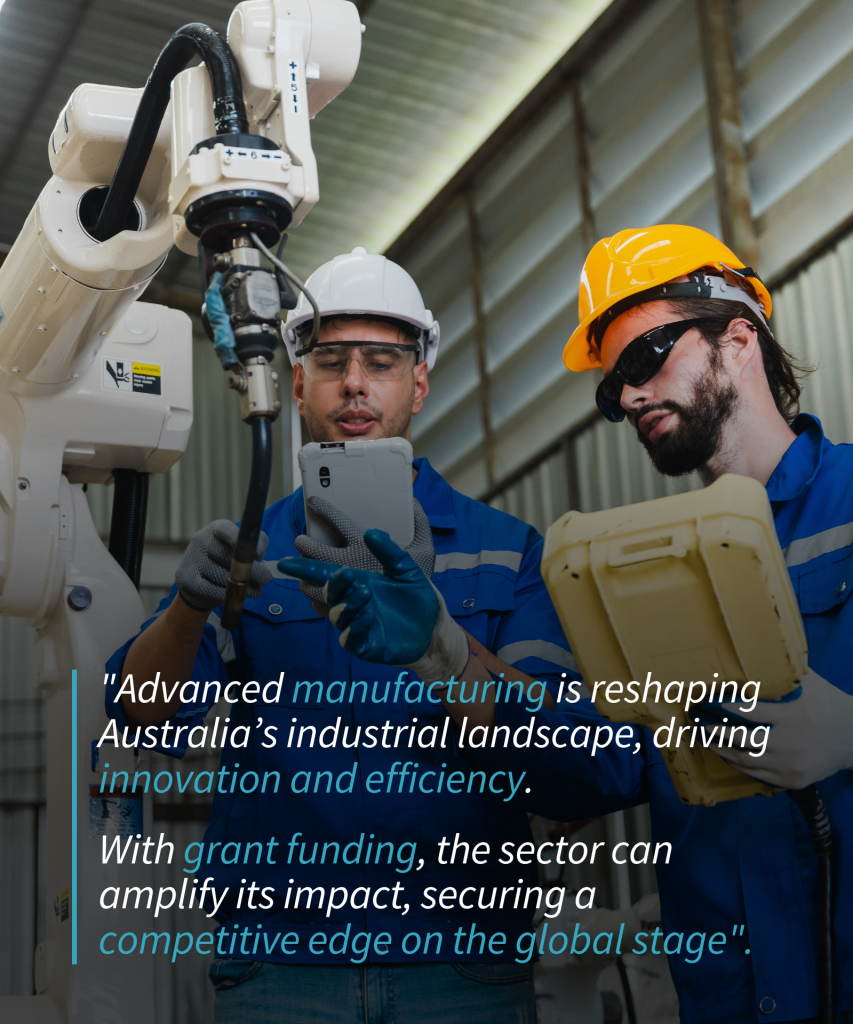
There is no doubt that Government grants offer vital support to drive innovation, improve competitiveness, and strengthen the nation’s economic growth. As advanced manufacturing emerges as a core pillar of Australia’s industrial future, businesses in this industry are increasingly embracing cutting-edge technologies such as automation, robotics, and data-driven processes. This transformation not only boosts productivity and efficiency but also positions Australian manufacturers to excel on a global scale.


However, the journey to becoming globally competitive is not without challenges. Scaling up, integrating new technologies, and navigating industry shifts require both strategic guidance and financial backing. Recognising this, it’s essential for manufacturing leaders to take advantage of the right grants, break down their requirements, and execute successful applications to maximise growth potential and drive long-term success.


In this article, we’ll explore five key grants available to Australian manufacturers, providing crucial financial resources to foster innovation, build capacity, and propel industry advancement.


  1. Made in Queensland (MIQ) Grant
  2. Advanced Manufacturing Accelerating Growth Program (TAS)
  3. Advanced Manufacturing Ecosystem Fund (AME)
  4. Manufacturing Hubs Grant Program (MHGP)
  5. Research and Development (R&D) Tax Incentive


1. Made in Queensland (MIQ) Grant

Matched funding to boost Queensland manufacturers’ competitiveness


Key Details

  • Closing by: 24 January 2025
  • Funding Available: Matched funding ranging from $50,000 to $2.5 million
  • Target Recipients: Queensland-based small to medium manufacturers


Overview

The MIQ grant supports Queensland manufacturers in adopting advanced equipment, technologies, and innovative processes. The focus includes energy efficiency, export growth, reshoring initiatives, supply chain enhancements, sustainability measures, and decarbonisation.


This $121.5 million program aims to drive productivity, international competitiveness, and high-skill job creation within the manufacturing sector. Since its inception in 2017, MIQ has backed 160 manufacturing projects statewide.


Eligibility Criteria

Businesses must:

  • Be based in Queensland with primary revenue derived from manufacturing
  • Have an active Australian Business Number (ABN) and be registered for goods and services tax (GST)
  • Be a small to medium enterprise employing 5-200 full-time equivalent (FTE) staff, with at least five FTEs in Queensland
  • Propose a project meeting program guideline
  • Cover at least 50% of the project costs


2. Advanced Manufacturing Accelerating Growth Program (TAS)

Support for capital equipment purchases by Tasmanian manufacturers


Key Details

  • Closing by: 6 January 2025
  • Funding Available: Up to $100,000
  • Grants will be provided on a co-contribution basis of 50% (grant), 50% minimum (applicant)
  • Target Recipients: Tasmanian-based advanced manufacturing enterprises


Overview

This program provides funding assistance to Tasmanian advanced manufacturers, enabling them to purchase capital equipment that boosts productivity and business growth. By fostering innovation, the initiative aims to strengthen Tasmania’s manufacturing industry and elevate its competitive edge.


The matched funding available is competitively based and assessed on the stated criterion. Eligible expenditure can cover commissioning costs, as well as plant and equipment to be used in the manufacturing process.


Eligibility Criteria

Businesses must:

  • Operate within Tasmania’s advanced manufacturing sector
  • Demonstrate project alignment with program objectives
  • Have an active Australian Business Number (ABN) and be registered for goods and services tax (GST)
  • Have annual sales turnover greater than $500,000 and less than $55 million


3 – Advanced Manufacturing Ecosystem Fund (AME)

Promoting the Northern Territory’s advanced manufacturing capacity


Key Details

  • Closing by: 30 June 2026
  • Funding Available: Matched funding of between $25,000 and $500,000
  • Eligible Businesses: Northern Territory-based manufacturers


Overview

This fund supports projects that enhance the Northern Territory’s advanced manufacturing ecosystem. The initiative seeks to drive local industry growth, foster collaboration, and develop a skilled workforce, focusing on sustainable and innovative manufacturing solutions.


Support is available for NT projects that are focused in commercialise new products, including transition innovations from prototype to full-scale operations (Stream 1), and advance early-stage or pilot research in advanced manufacturing (Stream 2).


Eligibility Criteria

Businesses must:

  • Be based in the Northern Territory
  • Present projects that significantly contribute to regional advancement advanced
  • Have an active Australian Business Number (ABN), an Australian company number (ACN) and be registered for goods and services tax (GST)
  • Be an Australian manufacturing enterprise with up to 199 employees
  • Be non-tax-exempt


Top 5 Grants for Australian Manufacturing Companies in 2024-25


4 – Manufacturing Hubs Grant Program (MHGP)

Funding to boost Queensland’s regional manufacturing capabilities


Key Details

  • Closing by: 30 June 2025, or until all funding is allocated
  • Funding Available: Matched funding between $10,000 and $500,000
  • Eligible Businesses: Small to medium Queensland-based manufacturers


Overview

This program supports manufacturers in key Queensland regions by providing funding to enhance competitiveness, productivity, and innovation. Grants focus on skills development, technology adoption, and business development, driving regional manufacturing growth.


The $33.5 million Manufacturing Hub Grant Program (MHGP) offers grants to eligible businesses in the Cairns, Central Queensland, Gold Coast, Mackay, and Townsville SA4 regions.


Eligibility Criteria

Businesses must:

  • Be a Queensland-based SME
  • Have the main operations located in one of the eligible Queensland SA4 regions
  • Have an active Australian Business Number (ABN) and be registered for goods and services tax (GST)
  • Have been operating in Queensland for at least 3 consecutive years before applying


5 – Research and Development (R&D) Tax Incentive

Tax support for Australian companies undertaking R&D


Key Details

  • Closing by: 30 April 2025 for FY24 claims (reopens on 1 July 2025 for FY25 claims)
  • Funding Available: Tax offset (refundable or non-refundable) for eligible R&D expenses, with varying rates depending on company size and annual turnover
  • Eligible Businesses: Australian entities engaging in Research and Development activities


Overview

The R&D Tax Incentive offers up to 43.5% tax offsets to support Australian companies investing in R&D. It aims to encourage businesses to undertake innovative projects, develop new products or processes, and enhance competitiveness on a global scale. The program covers a range of eligible R&D activities aligned with government guidelines.


Eligibility Criteria

To qualify, businesses must conduct eligible R&D activities as defined by program requirements and be incorporated in Australia.


Want to learn more about the R&D Tax Incentive? Fill out the form below to explore program details, eligibility requirements, and find out how our team of experts can help your business claim up to 43.5% of your research and development costs.


By leveraging these grants, Australian manufacturers can drive economic diversification, job creation, and technological advancement — positioning Australia as a global manufacturing leader. Navigating complex eligibility requirements and maximising grant outcomes can be challenging, which is why having a knowledgeable partner is essential.


This is where FundFindrs excels. As experts in manufacturing grants, we provide comprehensive support — from identifying the best funding opportunities to crafting impactful applications and offering ongoing strategic guidance. With FundFindrs by your side, you can confidently secure essential funding, foster innovation, and elevate your business within the advanced manufacturing sector. Let us help unlock your potential and achieve lasting success. Contact us to get started.



Key Grants for Food and Beverage Companies in Australia

Last reviewed: July 17, 2026


Government funding plays a fundamental role in driving growth, innovation, and operational improvements within Australia’s Food & Beverage sector. With a broad range of grants available, businesses can struggle to identify the opportunities that best align with their unique needs.


In this article, we outline several key grants selected specifically for Food & Beverage companies, covering initiatives from safety enhancements to strategic investment. Each program is designed to help businesses elevate their operations, expand their capabilities, and invest in critical infrastructure.


  1. Distillery Door Programs – Hazardous Areas and Dangerous Goods Rebate
  2. Wine Exports China Re-Engagement Support Program
  3. Value Add Investment Grants Program (VAIG) – Feasibility Stream


Key takeaways 


  • Government grants can help Food & Beverage businesses improve safety, expand operations and invest in growth initiatives.
  • Funding opportunities are available across multiple areas, including workplace safety, export market development and value-add manufacturing projects.
  • Many grants are highly targeted, with specific eligibility criteria based on industry, location and business activities.
  • Co-contributions are often required, meaning businesses should be prepared to invest alongside government funding.
  • Export-focused programs can support market expansion, helping businesses strengthen their presence in international markets.
  • Planning ahead is essential, as grant programs have different funding limits, application requirements and closing dates.


1. Distillery Door Program – Hazardous Areas and Dangerous Goods Rebate

Enhancing safety in Victoria’s distilleries with essential rebates


Key Details

  • Closing by: 30 June 2025
  • Funding Available: Up to $50,000
  • Target Recipients: Distillers of alcoholic beverages in Victoria


Overview

This program assists Victorian distillers in investing in essential equipment and infrastructure to enhance safety in their facilities. It offers a rebate on eligible expenditure — up to 70% or 80% (GST exclusive), capped at $50,000 — while requiring a cash co-contribution of 20% or 30% depending on production volumes.


As part of a $20 million initiative to support Victoria’s distillery industry, the program funds activities such as hazardous area assessments, equipment installation, and specialist training, ensuring that all upgrades comply with Australian Standards and regulatory requirements.


Eligibility Criteria

Businesses must:

  • Hold a current Australian Business Number (ABN) and be registered as a legal entity in Victoria.
  • Own at least one still with a capacity of 50 litres or more.
  • Possess a valid ATO Manufacturer’s Licence and a current Victorian General or Producer’s Liquor Licence.
  • Have completed a hazardous area assessment, dangerous goods audit, OHS Essentials Program, or equivalent assessment undertaken from 1 April 2023 until closing date.
  • Meet the required cash co-contribution based on their production level.
  • Agree to participate in future program evaluation activities and comply with relevant workplace and employment obligations.


2. Wine Exporters China Re-Engagement Support Program

Supporting SA wine exporters to re-access China’s market


Key Details

  • Closing by: Program runs until June 2026
  • Funding Available: Approximately $1.9 million total funding pool
  • Target Recipients: South Australian wine exporters


Overview

This program is designed to help South Australian wine exporters re-enter the Chinese market following the lifting of tariffs on Australian wine. It delivers strategic support through market insights, export advisory services, coordinated trade missions, and targeted marketing campaigns.


Implemented by the South Australian Government in partnership with the South Australian Wine Industry Association (SAWIA), the program aims to revitalise international trade relationships and strengthen the region’s wine sector.


Eligibility Criteria

Businesses must:

  • Be a registered South Australian wine exporters with a valid ABN.
  • Demonstrate active engagement in exporting wine internationally.


3. Value Add Investment Grants Program (VAIG) – Feasibility Stream

Empowering WA food and beverage businesses with feasibility funding


Key Details

  • Closing by: 30 June 2025
  • Funding Available: Individual grants from $15,000 to $100,000 (up to $500,000 per project; total pool of $6 million)
  • Target Recipients: Agriculture, food, and beverage businesses in Western Australia


Overview

The VAIG – Feasibility Stream supports WA-based agriculture, food, and beverage businesses planning to expand, diversify, or relocate their value-add processing operations. This program funds planning and feasibility studies that underpin investments in new manufacturing capabilities, technology upgrades, or plant modernisation. By reducing WA’s reliance on imported products, the initiative fosters innovation, enhances sustainability, and drives job creation. Applicants are required to provide a minimum cash co-contribution of 30%, with some flexibility available for Aboriginal businesses.


Eligibility Criteria

Businesses must:

  • Be a private sector entity (including incorporated trustees, public companies, or cooperatives) with a valid ABN and GST registration.
  • Plan a project located in or relocating to Western Australia.
  • Demonstrate the financial capacity to meet the minimum cash co-contribution.
  • Have been in operation for at least 12 months (or possess a similar established track record).
  • Be capable of entering into a legally binding agreement with the WA Government.
  • Regional and Aboriginal businesses are encouraged to apply.


Reminder: Don’t Miss the R&D Tax Incentive (R&DTI)


The Research and Development Tax Incentive is a powerful mechanism that offers significant tax offsets and cash refunds for eligible R&D activities, easing the financial risks of innovation. Despite its benefits, many Food & Beverage companies are overlooking this opportunity. Leveraging the R&D Tax Incentive not only reduces R&D costs but also positions your business to drive technological advancements and compete globally.


Ensure you assess your eligibility and consider expert advice to fully integrate this incentive into your financial strategy for sustained growth and market leadership. Learn more about the R&DTI Program by visiting our dedicated page.


Food and Beverage Funding Opportunities for Australian Businesses


The grants listed above represent just a snapshot of the funding opportunities available to support the growth and innovation of Food and Beverage companies in Australia. If you’re looking to explore these options further and strengthen your market position, our team of experts is here to help.


With the complexities of the application process, partnering with experienced advisors is essential. That’s where FundFindrs comes in — we support you every step of the way. Book a FREE chat today for a tailored consultation.


Mastering the R&D Tax Incentive: top mistakes to avoid with your application

Last reviewed: July 17, 2026


Navigating the Research and Development (R&D) Tax Incentive doesn’t have to be a headache if you know what pitfalls to avoid. We spoke with Bruce Murray, R&D Consultant at FundFindrs, who shares a list of the most common R&DTI application mistakes and, more importantly, how to prevent them.


The R&DTI is an invaluable funding opportunity, supporting business innovation and growth. Yet many companies struggle with eligibility criteria, fail to maintain proper records, or underestimate the importance of early submission — all of which can lead to application delays or rejections.


With extensive experience in R&D compliance and successful claims, Bruce gives us a rundown of common application mistakes and highlights what businesses can do to increase their chances of a smooth, stress-free successful application.


  1. What are some common mistakes companies make when preparing their R&D Tax Incentive application?
  2. Why are some R&D Tax Incentive applications rejected?
  3. What might first-time R&DTI applicants overlook when determining eligible projects?
  4. What are the most common mistakes companies make in documenting their R&D activities? What specific aspects do they frequently neglect?
  5. How does the submission deadline for the R&DTI impact businesses?


Key takeaways 


  • Poor record-keeping can make it difficult to substantiate an R&D Tax Incentive claim, making accurate and contemporaneous documentation essential.
  • Not all innovative work qualifies for the R&D Tax Incentive. Activities must satisfy the program’s legislative requirements and eligibility criteria.
  • Strong claims are supported by evidence, including documented methodologies, experiments, outcomes and quantifiable data.
  • Claims may be deemed ineligible when supporting evidence is insufficient to demonstrate eligible R&D activities.
  • Correctly identifying eligible projects is critical, particularly for first-time applicants navigating the program requirements.
  • Early preparation provides more time to gather evidence, address documentation gaps and strengthen a claim.


1. What are some common mistakes companies make when preparing their R&D Tax Incentive application?

One of the most common mistakes companies make is failing to keep adequate records of their R&D activities. Many businesses do not document their R&D activities thoroughly, leading to gaps in the evidence required to document and substantiate their claims.


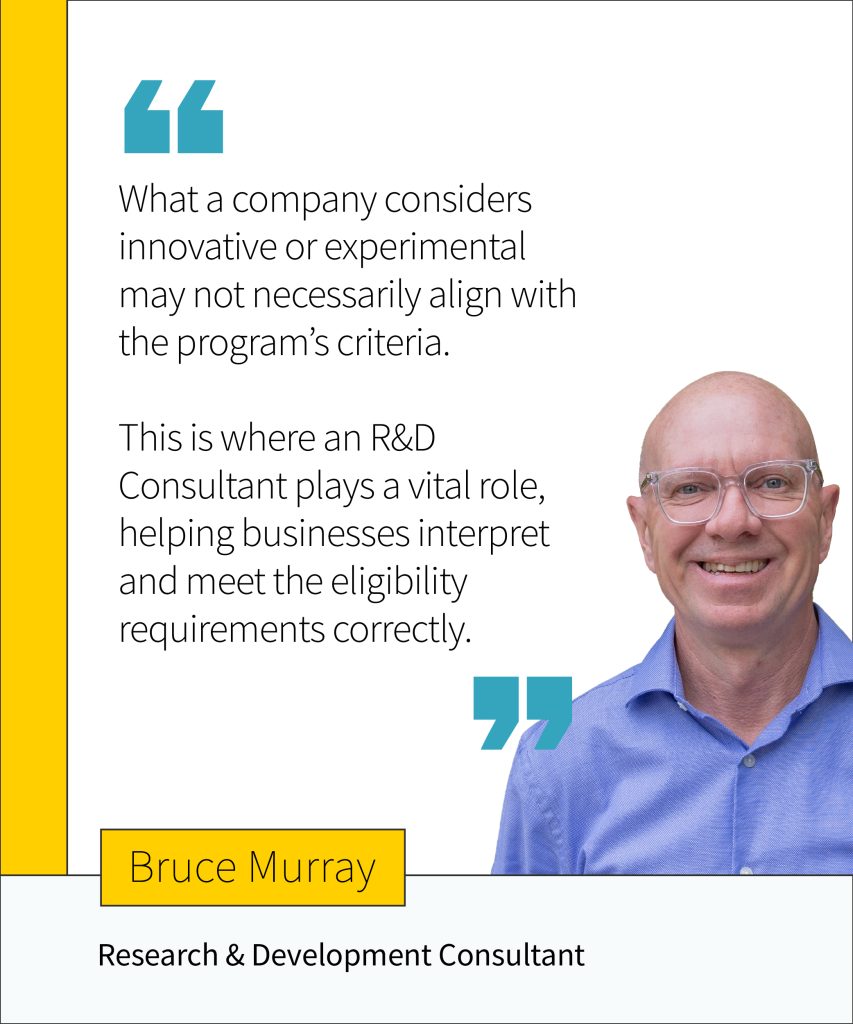
Another key issue is the misunderstanding of what constitutes eligible R&D under AusIndustry’s definition. What a company considers innovative or experimental may not necessarily align with the program’s criteria. This is where an R&D Consultant plays a vital role, helping businesses interpret and meet the eligibility requirements correctly.


Companies also sometimes lack scientific metrics to support their claims. Without proper quantifiable data documentation of methodologies, experiments and outcomes, an application may fall short of addressing the necessary criteria.


Bruce Murray, Research and Development Consultant, FundFindrs R&D Tax Incentive Tips


2. Why are some R&D Tax Incentive applications rejected?

The primary reason applications are rejected is a lack of evidence demonstrating eligible R&D activities. Each application is assessed on its own merits. If it fails to meet legislative criteria, it will not be approved.


To ensure success, companies must provide clear experimental evidence, including quantifiable data and methodologies. This involves tracking changes and improvements throughout the R&D process, showing what the data indicated before the project began and how it evolved because of the R&D efforts.


Ultimately, applications need to demonstrate a structured, scientific methodology to problem solving and innovation. Without this, even genuinely innovative work may not qualify for the incentive.


3. What might first-time R&DTI applicants overlook when determining eligible projects?

It is important that any business considering applying for the R&DTI understands the definition of eligible R&D activities. This definition comes from the legislation, rather than being based on what a company may consider R&D activities.


Once a company understands the definition of eligible R&D activities, it is important to isolate those R&D activities from general project activities. This is something businesses may overlook and therefore subsequently find challenging. Part of what we do is assist our clients with the clarification and direction to ensure eligible activities are not missed.


4. What are the most common mistakes companies make in documenting their R&D activities? What specific aspects do they frequently neglect?

We have found that some companies have done the experimental research required, and it would meet the criteria of what is eligible. However, they are let down by record keeping. It is very important to keep track of research evidence in each aspect of the research.


An example of this would be engaging an external consultant. Where an external person is engaged to deliver an outcome requiring research, the company engaging the consultant should include the experimental and research evidence in the plans and working documents of the project. These records should be maintained to demonstrate the research involved, not simply the engagement of another party to carry out the work.


Without this record of work, and detailed account of the activities, an application will likely be rejected.


FundFindrs can assist with your R&DTI application making sure all eligible activities are appropriately accounted for.


5. How does the submission deadline for the R&DTI impact businesses?

We can all identify with the pressure an approaching deadline brings, and we always recommend applying for the R&D Tax Incentive sooner rather than later. One common mistake businesses make is underestimating the time required to prepare a strong application, often assuming they have plenty of time within the 10-month window provided by AusIndustry — from 1 July following FYE to the final submission deadline of 30 April. However, many companies face competing priorities, such as business development, compliance, finance, and marketing, which can lead to last-minute submissions.


Delaying an R&DTI application can result in several negative consequences, including a delayed rebate due to longer processing times, increased administrative workload when processing tax adjustments after lodging the Company Tax Return (CTR), and reduced cash flow, which can impact overall business operations. To avoid these pitfalls, businesses should aim to submit their applications as early as possible following the end of the financial year.


Not sure if you’re eligible for the R&D Tax Incentive?
Our free Blueprint breaks it down with an eligibility checklist, examples, and expert tips from the FundFindrs team.


FundFindrs is here to help. Get in touch if you want to chat about how our team can collaborate with your business and guide your R&DTI application. Additionally, we can support identifying other funding opportunities through grants. Book a FREE chat with one of our specialist consultants now.

Business Tips for FY27: Empowering Australian SMEs for success

Last reviewed: July 17, 2026 


The Australian business landscape is experiencing a significant surge in entrepreneurial activity, with 97% of all businesses classified as small businesses according to the Australian Small Business and Family Enterprise Ombudsman (ASBFEO). This shift reflects a broader trend where innovation, adaptability, and strategic funding are essential for business growth regardless of size or industry.


As we move into a new financial year (FY27), small to medium-sized enterprises (SMEs) must proactively secure funding, embrace AI, and adapt to emerging market trends to stay competitive. Whether you’re launching a startup, scaling an existing business, or investing in digital transformation, understanding available resources is crucial.


This guide provides expert insights into the most relevant business strategies, funding opportunities, and industry trends shaping the next financial year. From R&D Tax Incentive (R&DTI) and business grants to AI-driven efficiency and industry-specific funding, we’ve compiled the most critical tips to help your business succeed in the next 12 months.


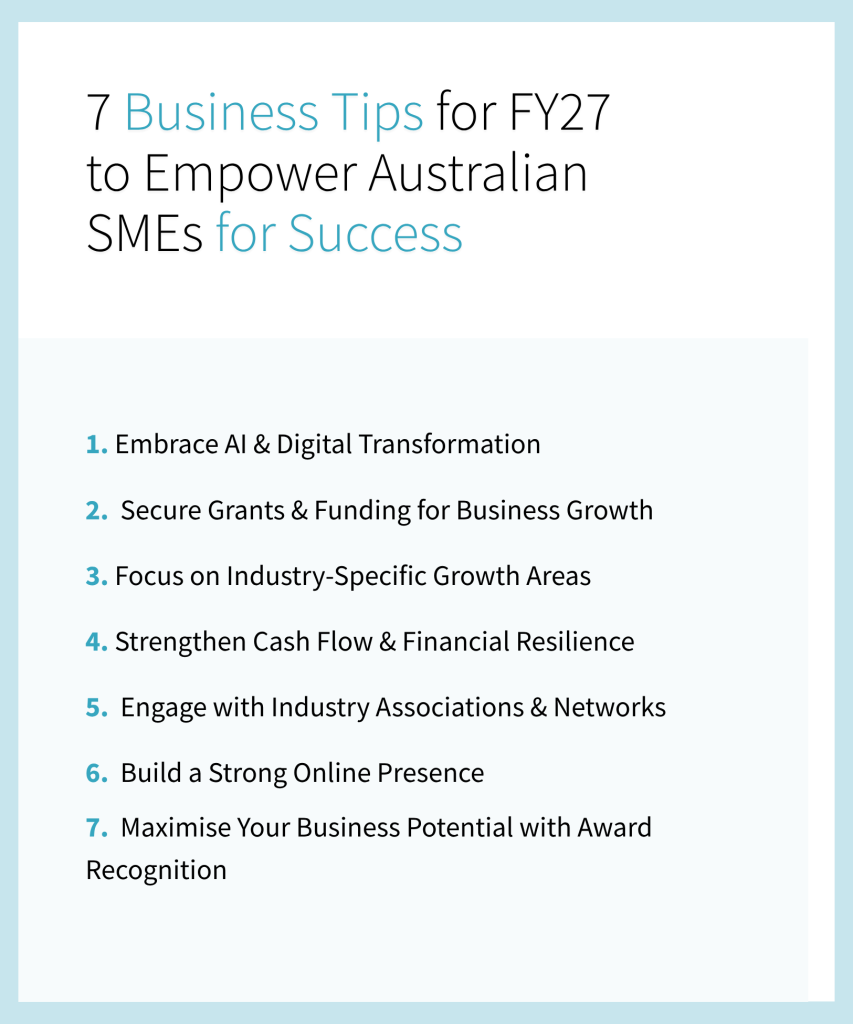
  1. Embrace AI & Digital Transformation
  2. Secure Grants & Funding for Business Growth
  3. Focus on Industry-Specific Growth Areas
  4. Strengthen Cash Flow & Financial Resilience
  5. Engage with Industry Associations & Networks
  6. Build a Strong Online Presence
  7. Maximise Your Business Potential with Award Recognition


Key takeaways 


  • AI and automation are becoming essential growth drivers, helping SMEs improve productivity, efficiency and decision-making.
  • Grants, funding programs and the R&D Tax Incentive can support business growth, innovation and digital transformation initiatives.
  • Industry-specific opportunities continue to emerge, making it important to align growth plans with market and funding trends.
  • Strong cash flow and financial resilience remain critical for sustainable business growth.
  • Industry networks and associations can provide valuable connections, insights and opportunities for SMEs.
  • A strong online presence and market visibility help businesses remain competitive in a rapidly changing environment.
  • Awards and recognition can strengthen credibility, improve brand awareness and support business growth.


1. Embrace AI & Digital Transformation

Let’s start with the trend topic of the moment: AI and automation are becoming essential growth drivers for SMEs, and businesses that embrace them will gain a competitive edge.


According to theTech Council of Australia, AI is expected to be the defining technology trend in 2026,with business leaders increasingly viewing it as a key driver of operational efficiency and cost savings. Additionally, the Australian Parliament has highlighted AI and automated decision-making as crucial for boosting productivity and economic growth.  


FundFindrs Tip | SMEs can benefit from AI & automation by using:

How can Australian SMEs use AI and automation to grow in FY27?
  • AI-powered analytics tools to help businesses optimise cash flow, predict market trends, and manage risk.
  • Automation tools to reduce administrative burden, freeing up time for strategic growth.
  • AI-driven chatbots and virtual assistants to enhance customer service while reducing operational costs.
  • Cybersecurity automation to protects businesses from increasing digital threats.


Did you know? There are several government-backed grants and incentives for businesses investing in AI, automation, and digital transformation, making now the perfect time to explore those funding options.  


2. Secure Grants & Funding for Business Growth 

What grants and funding programs are available for Australian SMEs in FY27?

There are thousands of grants available for SMEs across various industries in Australia. Whether you’re in technology, manufacturing, renewable energy, or agriculture, securing the right funding can accelerate business growth.


FundFindrs Tip | Examples of Grants and Tax Offset Programs to watch:

  • NSW Minimum Viable Product (MVP) Grant

The NSW Government’s MVP Grant supports startups and innovative SMEs who aim to commercialise new and highly innovative products. Eligible businesses can receive up to $50,000 until available funding is exhausted. 

  • Research & Development Tax Incentive (R&DTI) 

The R&D Tax Incentive remains one of the most valuable funding sources for Australian SMEs, offering a tax offset of up to 43.5% for eligible R&D expenses. This program is crucial for businesses investing in innovation, product development, and scientific advancements.


With thousands of funding programs available, working with specialists like FundFindrs ensures you access the most relevant grants for your industry.


3. Focus on Industry-Specific Growth Areas

Aligning your business with emerging industries receiving strong government investment can improve funding eligibility and open new growth opportunities in the upcoming financial year.


FundFindrs Tip | Key sectors to drive business success in FY27:

Which industries are receiving the most government funding in Australia in FY27?
  • Agricultural Innovation & AgTech – AI-driven farm management, precision agriculture, and climate-resilient technologies are attracting investment.
  • Health & Aged Care ServicesAccording to the Australian Treasury’s 2023 Intergenerational Report, the share of Australians aged 65 and over is projected to reach 23% by 2062–63. This will generate a demand for aged care innovations, assistive technologies, and healthcare services is rapidly increasing.
  • Construction & Infrastructure – Government-backed infrastructure projects are creating funding opportunities for smart-projects, energy-efficient buildings and sustainable solutions.
  • Renewable Energy & Sustainability – Businesses investing in clean energy solutions carbon capture, and circular economy innovations will benefit from ongoing grantssuch as the Advancing Renewables Program (ARENA).  
  • Cybersecurity & Digital Security – With increasing cyber threats, SMEs investing in cybersecurity solutions will gain access to funding opportunities.


4. Strengthen Cash Flow & Financial Resilience

How can SMEs strengthen cash flow and financial resilience in FY27?

In an economic climate marked by rising interest rates, inflation, and market volatility, SMEs must take a proactive approach to financial resilience. A strong financial position not only ensures business stability but also improves eligibility for grants and investment.


Cash flow stability isn’t just about survival — it’s about creating the capacity for growth, innovation, and long-term sustainability.


FundFindrs Tip | Top strategies for cash flow stability and building financial resilience:

  • Leverage tax incentives like the R&D Tax Incentive to offset costs.
  • Use AI-driven financial forecasting tools to predict revenue fluctuations.
  • Diversify revenue streams by expanding product lines, targeting new markets, or introducing subscription-based services to enhance financial security.
  • Secure working capital funding to ensure smooth operations during economic downturns.
  • Review and optimise business expenses to enhance profitability.
  • Adjust pricing strategies in response to market changes and inflation while maintaining customer loyalty.


Not sure if you’re eligible for the R&D Tax Incentive?
Our free Blueprint breaks it down with an eligibility checklist, examples, and expert tips from the FundFindrs team.


5. Engage with Industry Associations & Networks

Industry associations and business networks play a critical role in connecting SMEs with funding opportunities, mentorship, and strategic partnerships. Many awards and funding programs give preference to businesses that demonstrate industry involvement, making these connections highly valuable. Beyond financial benefits, being part of a strong business network provides insights into industry trends, regulatory updates, and collaboration opportunities.


As FY27 brings increased competition for grants and funding, along with new government-backed initiatives, SMEs with strong industry ties will have a strategic advantage. Engaging in these networks can open access to exclusive funding streams, provide early insights into regulatory changes, and position businesses as key players in their sectors, making them more attractive to investors and grant providers.


FundFindrs Tip | How to maximise industry connections:

  • Join local and national business chambers, trade associations, and industry-specific groups to stay informed about sector-specific grants and emerging opportunities.
  • Participate in networking events, grant information sessions, and workshops to build relationships with funding bodies, potential partners, and advisors.
  • Collaborate with industry bodies and advocacy groups to gain credibility and improve your business’s chances of securing funding.
  • Engage with accelerator programs and innovation hubs, which often provide grant access, investor connections, and growth support for high-potential businesses.
  • Seek mentorship from experienced industry leaders, who can guide you on grant applications, business development, and long-term strategic planning.


Fy27 tips industry connection


6. Build a Strong Online Presence

A robust digital presence is no longer optional: it’s essential for securing grants, attracting investors, and growing your customer base. According to Google, 88% of consumers research businesses online and read reviews before making purchasing decisions.


Now more than ever, a well-optimised digital footprint can improve discoverability, enhance brand authority, and position your business for greater success in a competitive landscape.


FundFindrs Tip | Key steps to strengthen your online presence:

  • Optimise your website with clear messaging, products and services offering, and case studies.
  • Leverage social media to share success stories, customer’s feedback, and industry insights.
  • Implement SEO strategies to ensure your business is discoverable by your target audience.
  • Ask your clients to leave testimonials and reviews of their experience with you service or product.


7. Maximise Your Business Potential with Award Recognition

Being recognised with a business award is more than just a badge of honour: it’s a strategic tool for accelerating your business. Winning an award can significantly boost business visibility, leading to increased partnerships, customer trust, and revenue growth. If you’re serious about expanding in this new financial year, FundFindrs can help position your business for awards recognition and success.


FundFindrs Tip | How we can help you build winning awards submissions:

  • Identifying the best awards for your industry and achievements.
  • Crafting compelling, high-impact submissions that increase success rates.
  • Managing the entire application process, so you don’t have to worry about deadlines or paperwork.


7 business tips for fy27


How FundFindrs Can Support Your Business Growth

At FundFindrs, we’re here to support your business through every stage of growth. From securing grants and maximising your R&D Tax Incentive claim to managing award submissions and identifying the right funding opportunities, our expert team has you covered. Explore our full range of services designed to help you grow, innovate, and strengthen your financial position in FY27 and beyond.

Claiming the R&D Tax Incentive in Australia: Common Misconceptions

Last reviewed: June 24, 2026 

The Research & Development Tax Incentive (R&DTI) is an invaluable funding opportunity, supporting business innovation and growth. However, claiming the R&D Tax Incentive in Australia can often be misunderstood, leading to missed opportunities or incorrect applications.


In our previous article “Mastering the R&D Tax Incentive: top mistakes to avoid with your application” our R&DTI expert, Bruce Murray, talked to us about common application mistakes.


With decades of direct experience reviewing R&D Tax Incentive applications as a programme assessor within the Department of Industry, Science and Resources (AusIndustry), and a background spanning corporate governance, compliance, and risk management, Bruce’s insights carry the weight of someone who has sat on both sides of the assessment process.


For this article, we asked him to share frequent misconceptions around the R&D Tax Incentive and clarify them for us.

  1. What does the term ‘core R&D activities’ mean?
  2. Do some business owners believe the R&DTI is only for large businesses?
  3. How detailed do R&D records need to be?
  4. What do businesses often get wrong about how much time they have to submit their claims?
  5. Is the application process the same for R&D activities conducted outside of Australia?


Key takeaways 

  • A core R&D activity must have an unknown outcome, follow a scientific process, and aim to generate new knowledge. 
  • Company size and industry do not determine eligibility while the $20,000 minimum spend threshold does. 
  • Records must meet the “desktop understanding” standard; being self-explanatory, without needing further input from you. 
  • You have until 30 April to submit, but earlier lodgement means faster processing and quicker access to your rebate. 
  • Overseas R&D activities require a separate Overseas Finding application before they can be included in a claim. 


1. The term “core R&D activities” can be misinterpreted when it comes to R&D activities. What does it mean according to the R&DTI program?

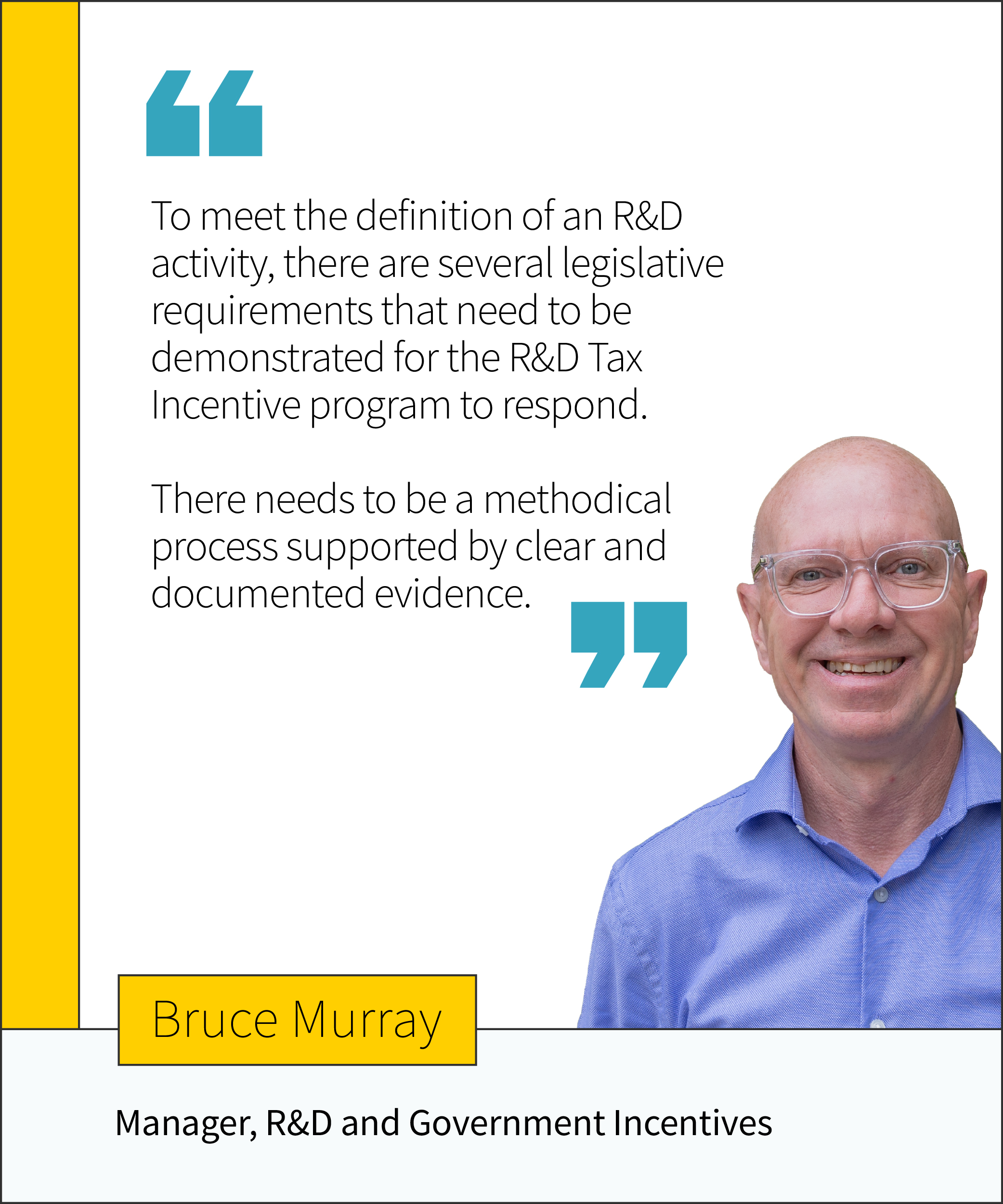
To meet the definition of an R&D activity, there are several legislative requirements that need to be demonstrated for the R&D Tax Incentive program to respond.


Prior to commencement, the outcome of the R&D activity must not have been known or determined in advance by a competent professional in the field, based on current knowledge, information, and experience. This needs to be a true innovation or, in simple words, no one else knows this; no one else is doing it.


The unknown outcome must be determined by applying a systematic progression of work following a scientific process i.e. hypothesis, experimentation, observations, and conclusions. There needs to be a methodical process supported by clear and documented evidence.


Additionally, The R&D activity must be conducted for the purpose of generating new knowledge – where previously there was a knowledge gap, and the R&D project activities were required to address it.


Bruce Murray, FundFindrs R&D consultant and former AusIndustry assessor, shares insights on R&D Tax Incentive misconceptions


2. Do some business owners believe the R&DTI is only for large business or specific industries?

Definitely, the R&DTI program is not only for large companies. To be honest, the size of the company itself is not that important. Similarly, the sector, or industry type is not an influence on the R&DTI claim outcome.


 In October 2025, the ATO released their “R&D tax incentive transparency report 2022–23  in which they noted a significant number of SMEs and smaller companies across all types and sectors of industry.


This means it does not matter what the industry is, nor how large (or small) the company is. So long as anticipated eligible R&D expenditure exceeds the threshold of $20k, an R&DTI application can be considered.


3. How detailed do R&D records need to be to apply successfully for the R&D Tax Incentive?

The records of a company’s R&D activities need to be as detailed and comprehensive as possible and reflect how those activities fit within the overall project.


R&DTI applications are subject to what we call “desktop understanding”. An assessment on merit, on the evidence presented at the time, without needing further explanation from an external source. This allows for objective assessment.


Maintaining organised documentation is crucial for supporting applications and providing evidence if needed. I recommend clients prepare comprehensive documentation in advance to ensure easy retrieval during a possible inspection.


FundFindrs helps you stay audit-ready. We support you in building clear, compliant documentation that strengthens your R&DTI claim.


4. What do businesses often get wrong about how much time they have to submit their claims?

Businesses have up to 10 months after the End of Financial Year (EOFY) to submit their application, with the deadline falling on 30 April each year. However, submitting an R&DTI application shortly after the financial year-end offers several advantages.


Firstly, it provides ample time for thorough due diligence, enabling a more comprehensive investigation and discussion of activities potentially eligible for the R&DTI. Secondly, early submission helps avoid the application backlog AusIndustry typically experiences as the April 30th deadline approaches, thereby increasing the likelihood of a faster processing time.


Finally, submitting the R&DTI Schedule, an ATO document, concurrently with the Company Tax Return (CTR) simplifies the process, facilitates a more streamlined submission, and ultimately enables a quicker rebate, which can significantly improve a company’s cash flow.


5. What about R&DTI applications for businesses conducting R&D activities outside of Australia? Is the application process the same?

To claim the R&DTI for related activities conducted outside Australia, your business must first apply for an Overseas Finding.


To be eligible, your overseas R&D activities must meet all five of the following criteria:

  1. The activity must qualify as an eligible R&D activity.
  2. It must have a scientific link to a core R&D activity carried out in Australia.
  3. It must be conducted outside Australia and its external Territories.
  4. You must show that the overseas activity cannot be conducted in Australia due to specific reasons such as the lack of necessary facilities, expertise, or environment
  5. The total cost of overseas activities must be less than the cost of the directly related R&D work undertaken in Australia.


You can find more information from the government’s website for the Australian business community here.


FundFindrs tip on claiming the R&D Tax Incentive in Australia — common misconceptions explained


Knowing what activities qualify for the R&D Tax Incentive (and also which do not) can be tricky. Fortunately, FundFindrs’ team of experts is here to help guide your business through its R&DTI application.

Book a FREE consultation with one of our specialists now.


Why Grant Applications Get Rejected (and What to Do About It)

Last reviewed: July 28, 2026


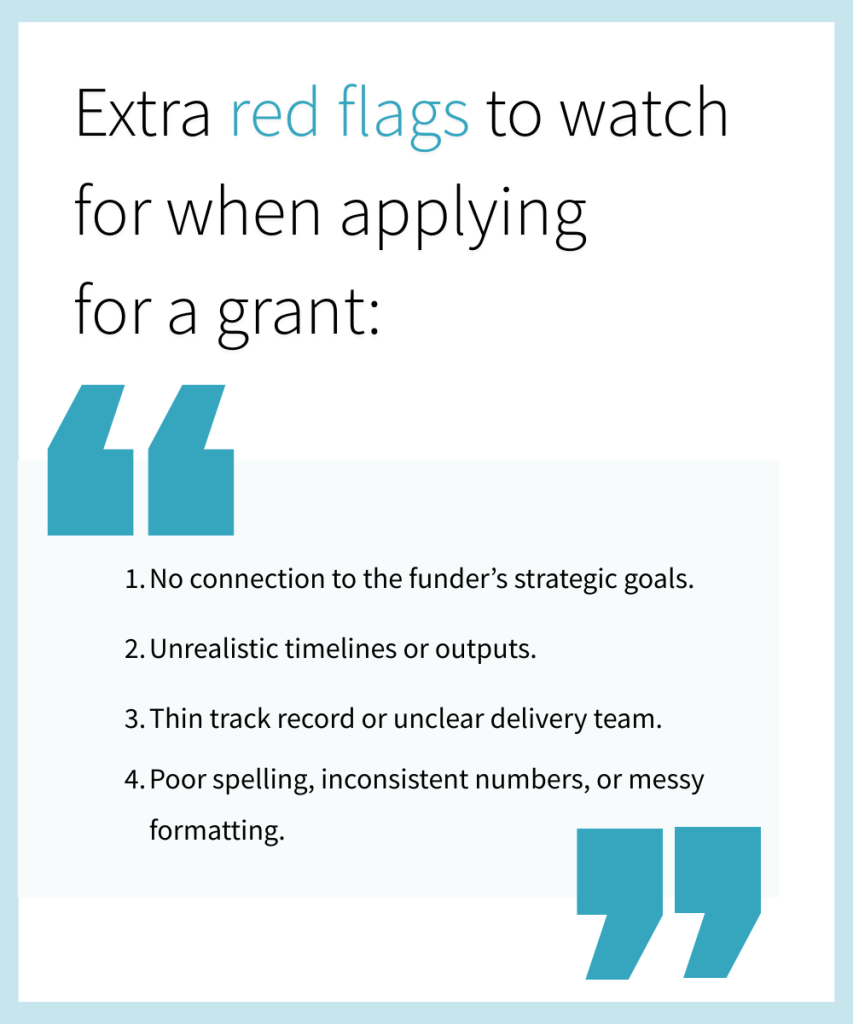
So much work goes into applying for a grant. That’s why rejection stings. But it’s often not about the strength of your idea, it’s about how well you followed the brief. 

Below are ten of the most common reasons grant applications miss the mark, and how you can avoid the same fate next time.


  1. Ignoring eligibility
  2. A weak or wandering story
  3. Unclear budgets
  4. No evidence or outcomes
  5. Missing governance or compliance info
  6. Not following instructions
  7. No risk or sustainability plan
  8. Submitting at the last minute
  9. No community buy-in
  10. Weak reporting plan


Key takeaways 


  • Grant applications are often rejected because they do not meet eligibility requirements, making the initial eligibility check one of the most important steps.
  • A clear project narrative matters. Funders want to understand what the project will achieve, why it matters and how it will be delivered.
  • Budgets should be detailed and transparent, with costs clearly explained and aligned to project activities.
  • Evidence and measurable outcomes strengthen applications, helping demonstrate the need for funding and how success will be evaluated.
  • Governance, compliance and supporting documents are essential, as missing information can affect eligibility and assessment.
  • Strong applications include risk, sustainability and reporting plans, showing how the project will be managed and measured beyond the funding period.


1. Ignoring eligibility

Always check the basics. If you’re not eligible, you’re out from the start. Don’t waste your time on grants that don’t fit.


2.  A weak or wandering story

Funders need clarity. If you can’t explain what your project does, why it matters, and how it will be delivered – quickly and clearly – it will cost you.


3. Unclear budgets

Avoid vague terms like “miscellaneous”. Break down your numbers and explain them. Funders want transparency.


4. No evidence or outcomes

Back up your case. Use data to show the need, and outline how you’ll measure success.


5. Missing governance or compliance info

Many grants require proof of insurance, board details, policies or financials. Make sure your documents are current and ready.


6. Not following instructions

Stick to word counts. Use the right templates. Upload the correct file types. A great application can still be ruled ineligible for admin errors.


7. No risk or sustainability plan

Funders want to know your project is viable — even if something goes wrong or funding ends. Spell that out.


8. Submitting at the last minute

Leave time for reviews, tech issues, and final polish. Rushing means mistakes.


9. No community buy-in

If the project serves a community, show how they’ve been involved. Add letters of support or quote conversations and feedback.


10. Weak reporting plan

Funders expect to see how you’ll track and report on progress. It’s a core part of grant accountability.


Final thought 

Grants are competitive. But most rejections happen for predictable reasons. By planning ahead, tightening your narrative, and double-checking the details, you’ll improve your chances dramatically. 

Get grant ready – not just application ready!


Ready to avoid these common pitfalls?

At FundFindrs, we specialise in making sure your grant application doesn’t fall at the avoidable hurdles. From checking eligibility and strengthening your story, to building clear budgets and managing compliance, we partner with you through the entire process. Our team knows what funders are looking for and how to help you stand out. 

Book a FREE consultation today and take the guesswork out of your next grant application. 


Industry Growth Program (IGP):what’s changed, what matters, and who should apply

Last reviewed: July 02, 2026


The Industry Growth Program (IGP) is one of the Federal Government’s key funding pathways for Australian SMEs looking to commercialise innovation and scale their businesses. 

However, the program has shifted significantly. 

Following the Federal Government’s $102 million funding reduction (MYEFO), the IGP is no longer a broadly accessible grant. It is now a highly competitive program focused on commercially viable projects with clear economic impact. 

For businesses, this changes the approach entirely. The question is no longer: “Are we eligible?” but it should be: “Are we competitive enough to be funded?”.

In this article, we break down how the program works today, what has changed, and, most importantly, how to assess whether your business is genuinely positioned to succeed. 


IMPORTANT NOTE: Following the announcement of the Federal Budget 2026-27, the Industry Growth program has been put on hold affecting both new applicants and those already in the pipeline. At this stage, it hasn’t been confirmed if it will re-commence, be replaced or be cancelled. We will update as further information comes to light.


Key takeaways 

  • The IGP is currently paused. Following the 2026–27 Federal Budget, the program is on hold for new applicants and those already in the pipeline.
  • Funding was reduced by $102 million. The IGP is no longer a broadly accessible grant and is now focused on highly competitive, commercially viable projects.
  • Competitiveness matters more than eligibility. Being eligible does not guarantee funding in the current assessment environment.
  • The program has two stages: Advisory support to strengthen commercialisation strategy, followed by grant funding for the strongest projects.
  • Innovation alone is not enough. Successful applications must demonstrate commercial readiness, execution capability and measurable economic impact.
  • IGP and R&DTI serve different purposes. R&DTI supports eligible R&D activities retrospectively, while IGP supports future commercialisation and growth.
  • Application quality is critical. Strong positioning and commercial evidence play a major role in funding outcomes.


1 – What is the Industry Growth Program  

The IGP, delivered through business.gov.au, combines advisory support and matched grant funding to help businesses move from innovation to commercialisation. 


In practice, the program operates as a two-stage process: 

  1. Advisory stage – designed to assess and strengthen your commercial strategy  
  1. Grant stage – where funding is awarded to the most competitive projects  


This structure reflects a clear objective from government: to fund outcomes, not just ideas. The program prioritises businesses that can demonstrate a clear pathway to market, the ability to execute, and the capacity to generate measurable economic outcomes. As a result, technical innovation alone is not enough, applications must show how that innovation translates into commercial impact. 


2 – What’s changed in the Industry Growth Program: funding cuts and increased competition 

Recent funding reductions have reshaped the Industry Growth Program. 

Businesses should expect: 

  • Fewer grants awarded  
  • Greater scrutiny on applications  
  • Stronger focus on commercial readiness  
  • Increased importance of financial capability and co-investment  

As a result, application quality and positioning now play a critical role in success. 


Stronger competition means greater emphasis on commercial positioning, financial capacity and delivery readiness. FundFindrs helps businesses strengthen these areas before applying.


3 – How the program works 

Step 1: Advisory Service (mandatory) 

All applicants must begin with the IGP Advisory Service. 

This involves submitting an application that assesses your: 

  • Business model  
  • Innovation viability  
  • Commercialisation pathway  


If eligible, you will work with an Industry Growth Program Adviser to: 

  • Test your strategy  
  • Identify risks and gaps  
  • Define a clear pathway to market  


It’s important to know this stage is mandatory once you cannot access grant funding without completing it. 


Step 2: Grant Funding 

Businesses that successfully progress may be eligible for one of two streams: 

Early-Stage commercialisation grants
– Funding available: $50,000 – $250,000
– Objective: Supporting businesses moving toward market readiness 

Commercialisation and growth grants
– Funding available: $100,000 – $5 million
– Objective: Supporting businesses ready to scale 

Both streams require: 

  • Matched funding (co-contribution)  
  • Demonstrated financial capability  
  • Clear commercial outcomes  

Funding is awarded on merit, and competition is strong.


Industry Growth program Tip


4 – Industry Growth Program eligibility overview 

To be eligible, businesses must generally: 

  • Be an Australian SME  
    • Fewer than 200 employees  
    • Turnover under $20 million (last three financial years) 
       
    • Value-add in resources  
    • Agriculture, forestry and fisheries  
    • Transport  
    • Medical science  
    • Renewables and low emissions technologies  
    • Defence capability  
    • Enabling technologies (e.g. AI, robotics, biotech)  
  • Demonstrate:  
    • Commercial potential and scalability  
    • IP ownership or access rights  
    • Financial capacity to co-invest  


5 – What makes a competitive application in 5-steps 

With increased competition, successful applications typically demonstrate: 

1 – Clear commercial outcomes
A defined pathway to revenue, market adoption, or industry impact 

2 – Strong market and technical positioning
Evidence of demand, traction, or validated development 

3 – Financial readiness
Capacity to fund your share of the project, supported by evidence and an Accountant Declaration 

4 – Structured project planning
Clear milestones, timelines, budgets, and risk considerations 

5 – Alignment with government priorities
A direct link to NRF sectors and broader economic outcomes 


6 – A common misconception 

One of the most common mistakes is treating the IGP as a standard grant application. 

In reality, it functions as a commercial assessment process. That’s why eligibility alone does not determine outcome success. Applications are assessed on quality, clarity, and commercial viability — which is why many businesses consider working with a grant writing consultant to strengthen their approach and overall submission strategy. 

Is the Industry Growth Program right for your business? 

The IGP is best suited to businesses that: 

  • Are developing commercially viable innovations  
  • Have a clear pathway to market  
  • Can co-invest in their growth  
  • Are ready to compete in a merit-based funding environment  

If your business is still validating early-stage ideas or lacks financial readiness, it may be worth exploring alternative pathways first. 


7 – Where IGP fits within your funding strategy 

The Industry Growth Program (IGP) is often considered alongside programs such as the R&D Tax Incentive (R&DTI). 

While both support innovation, they serve different purposes: 

  • R&DTI supports eligible R&D activities retrospectively  
  • IGP supports forward-looking commercialisation and growth  

For many businesses, these programs can be complementary when used strategically. 


8 – How FundFindrs can support your application 

Navigating programs like the IGP requires more than understanding eligibility criteria. If you’re considering apply to it, the first step is understanding your position — not just your eligibility. 

At FundFindrs, we work with businesses to: 

  • Assess whether the program is the right fit  
  • Strengthen commercial positioning before applying  
  • Prepare clear, compliant applications  
  • Support both advisory and funding stages  

Our approach is grounded in practical experience across multiple funding programs and industries.  


Book a FREE consultation with FundFindrs to assess your suitability for the Industry Growth Program and build a clear strategy before applying. 


Emerging Technology Commercialisation Fund (ETCF) 2026: A new $20M opportunity for NSW innovators

Last reviewed: July 03, 2026 
The Emerging Technology Commercialisation Fund (ETCF) 2026 is a new NSW Government program designed to help innovative startups and SMEs move promising technologies closer to market. 

With $20 million in funding available, the program aims to support businesses developing emerging technologies that need further development before they are ready for commercial deployment. 

For companies working on breakthrough solutions, understanding how the ETCF works — and whether your project could be eligible — may open valuable opportunities to accelerate innovation and growth.


Key takeaways 

  • $20 million is available through the NSW Government’s ETCF, administered by the Office of the Chief Scientist and Engineer.
  • Grants range from $500,000 to $2 million per project and are structured as repayable grants once EBITDA exceeds $500,000.
  • The program targets technologies at TRL 3–7, supporting projects that have moved beyond early research but are not yet commercially deployed.
  • Applicants must meet NSW-based eligibility requirements, including headquarters and workforce location criteria.
  • Stage 1 includes a pitch video, meaning the commercial narrative is just as important as the technology itself.
  • ETCF and R&DTI are complementary programs, supporting different stages of the innovation and commercialisation journey.


1 – What is the Emerging Technology Commercialisation Fund (ETCF)? 

The Emerging Technology Commercialisation Fund (ETCF) is a NSW Government program administered by the Office of the Chief Scientist and Engineer. 

The program provides funding to help innovative companies advance emerging technologies toward commercial readiness, supporting projects that require further development before entering the market.

The fund was first announced in the 2025–26 NSW Budget and forms part of the government’s Innovation Blueprint, a broader strategy aimed at strengthening innovation and research commercialisation across NSW. The first funding round includes a $7 million allocation. 

ETCF focuses on technologies progressing along the Technology Readiness Level (TRL) scale, helping businesses move from prototype or proof-of-concept toward commercial demonstration.  


Key objectives of the program include:
 

  • accelerating the commercialisation of emerging technologies 
  • reducing financial risk during late-stage research and development 
  • strengthening NSW’s innovation capability and industry competitiveness 


2 – How much funding is available? 

The ETCF provides significant financial support for eligible companies progressing emerging technologies. 


Grant amount 

  • Between $500,000 and $2,000,000 per project 


Total funding pool
 

  • $20 million allocated to the program 


Grant structure

  • The ETCF is structured as a repayable grant. Repayments are typically made in instalments and commence in the financial year when the recipient’s EBITDA exceeds $500,000, as outlined in the program guidelines.


Application timeline
 

  • Applications open: 6 March 2026 
  • Applications close: 29 April 2026  

Projects funded through the program are typically expected to be completed within two years, helping accelerate development timelines and support commercial deployment.


Exploring the ETCF opportunity? 
Our team can help you assess eligibility and plan your funding strategy.


3 – What types of projects are eligible for ETCF funding?  

The ETCF focuses on technologies that have already reached an early validation stage but require further development before commercial deployment.


Eligible projects generally fall within Technology Readiness Levels (TRL) 3–7, which may include activities such as: 

  • prototype development and engineering refinement 
  • pilot programs or demonstration trials 
  • regulatory approvals and product testing 
  • scaling early-stage manufacturing processes 
  • intellectual property protection and commercialisation planning 


The program supports technologies across both physical sciences and biological sciences, including sectors such as:
 

  • advanced manufacturing 
  • biotechnology and life sciences 
  • clean energy and net-zero technologies 
  • housing and construction innovation 
  • advanced materials and engineering systems 


These sectors align with NSW priorities to strengthen innovation capability and industry competitiveness. 


4 – Who is eligible to apply? 

To apply for the ETCF, businesses must meet several key eligibility criteria.
 

Applicants must: 

  • be a for-profit company incorporated in Australia 
  • be headquartered in NSW 
  • have an active ABN 
  • employ more than 65% of staff in NSW 
  • have annual revenue under $2.5 million 
  • own or hold exclusive rights to commercialise the relevant intellectual property 


5 – What might an ETCF-supported project look like? 

To illustrate the types of innovations the ETCF aims to support, the following examples show projects that could align with the program’s commercialisation focus.


Examples of projects that may align with the program include:

  • AI-driven platforms improving safety or productivity in infrastructure and construction 
  • biotechnology innovations progressing toward clinical or regulatory validation 
  • advanced battery or energy storage technologies moving from prototype to pilot production 
  • new materials or construction technologies designed to improve sustainability 
  • robotics or automation systems developed for advanced manufacturing 


6 – Strategic considerations before applying 

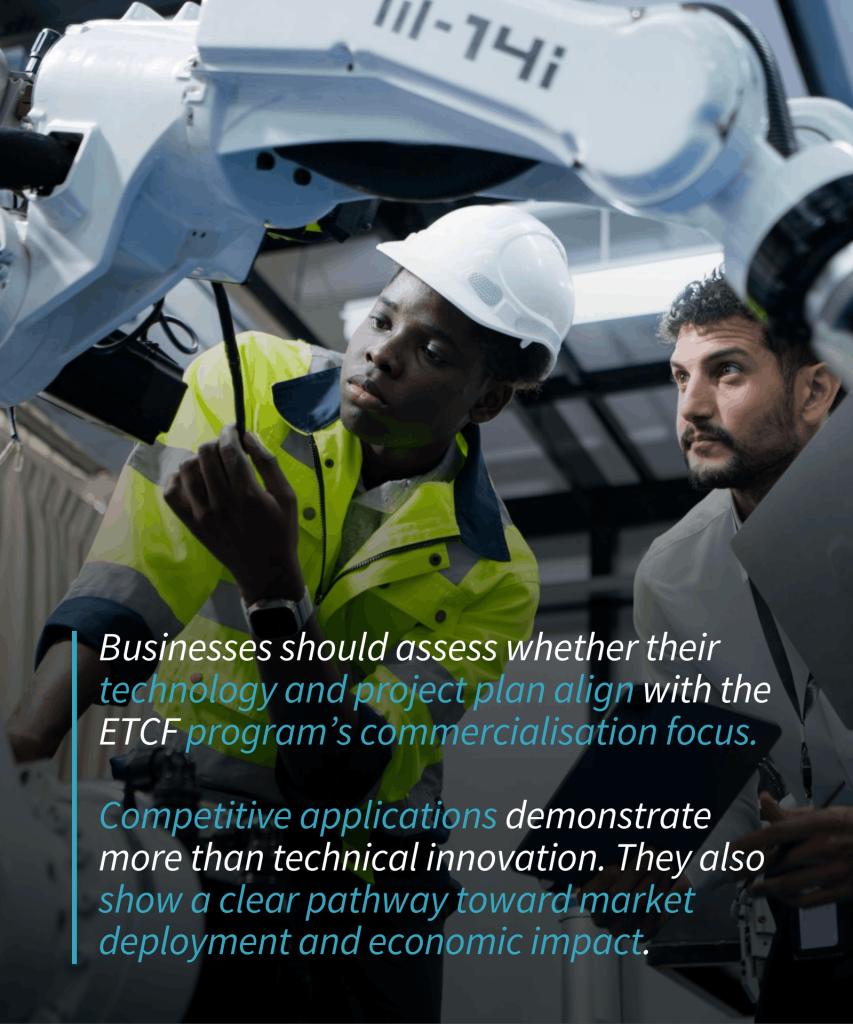
Before preparing an ETCF application, businesses should assess whether their technology and project plan align with the program’s commercialisation focus. 

Competitive applications typically demonstrate more than technical innovation. They also show a clear pathway toward market deployment and economic impact. 


When evaluating whether the program is the right fit, businesses should consider:

  • whether the technology has progressed beyond early research and proof of concept 
  • whether there is a defined market need or commercial opportunity 
  • whether the project can realistically progress the technology toward deployment within the proposed timeframe 
  • whether the team has the capability to deliver the project successfully 

Taking time to assess these elements early can help determine whether ETCF is the right funding pathway for your business. 


7 – How ETCF fits into Australia’s broader innovation funding landscape 

The ETCF is part of a broader ecosystem of government initiatives designed to support innovation and commercialisation. 

For example, businesses developing new technologies may also benefit from programs such as the R&D Tax Incentive (R&DTI), which supports eligible research and development activities across Australia. Many emerging technology companies combine commercialisation grants like ETCF with the R&D Tax Incentive to support innovation across different stages of development. 

Combining different funding mechanisms can help businesses support innovation across multiple stages. 


8 – How FundFindrs helps businesses navigate emerging technology funding 

Securing government funding for innovation often requires more than simply meeting eligibility criteria. 

For the ETCF program specifically, the Stage 1 application involves submitting a short pitch video outlining the technology, the problem it solves, and the commercial opportunity. The video is expected to address the key assessment criteria and clearly communicate the strength of the project. 

Preparing a compelling pitch requires careful planning. In many cases, this means developing a clear storyline, structured messaging, and a concise script that demonstrates both the innovation and the commercial potential.
 

Successful applications typically require: 

  • clear technical and commercial narratives
  • strong financial planning
  • evidence of market opportunity and scalability
  • well-structured project documentation
  • a clear and compelling pitch narrative for the Stage 1 video submission


At FundFindrs, our team works with innovative companies across Australia to identify and secure funding opportunities aligned with their growth strategy. 

This includes: 

  • identifying relevant grant opportunities
  • assessing eligibility and program fit
  • supporting application strategy and documentation
  • assisting with storyboarding and scripting for pitch video submissions
  • integrating grants with programs such as the R&D Tax Incentive as part of a broader funding roadmap 

If your company is developing an emerging technology and considering applying for the ETCF, our team can help assess whether the program is the right fit for your innovation. 


Book a FREE consultation to discuss your project and explore potential funding opportunities. 


Advancing Renewables Program (ARENA): Most asked questions and insights

Last reviewed: July 03, 2026 

For businesses considering an application to the Advancing Renewables Program (ARENA), understanding how the assessment process works is just as important as meeting eligibility criteria.
 

While our Funding Guide explains the program structure and funding mechanics, this article answers the most common questions businesses ask about applying for ARENA funding under the Advancing Renewables Program — from assessment criteria and timelines to commercial readiness and competitiveness. 

If you’re evaluating whether your project is ready for submission, these answers provide practical clarity before going ahead. 


Key takeaways 

  • Technical merit alone won’t win funding. ARENA assesses commercial viability, market pathway and system-level impact.
  • Projects typically need to be at TRL 6–9. Early-stage research and concept development are not supported.
  • Matched funding is required. Applicants must contribute at least 50% of total project costs.
  • Applications follow a two-stage process: EOI first, then a full application covering financials, milestones and commercialisation strategy.
  • There are no fixed response timelines. Assessment is rolling and can extend across several months, so co-funding commitments should be secured early.
  • ARP and R&DTI can work together to support both commercialisation and ongoing R&D investment.


1 – What is Advancing Renewables Program (ARENA) looking for in applications?

Beyond technical merit, ARENA assesses proposals on their ability to deliver measurable, system-wide and commercial outcomes. 

Competitive projects clearly demonstrate: 

  • A credible pathway to commercial deployment at scale 
  • Strong co-funding commitments and financial robustness 
  • Clear milestones linked to outcomes, not just activities 
  • Alignment between technology performance, market demand and national energy priorities 


FundFindrs’ Tip: Projects that clearly link technical performance to commercial deployment and measurable system impact are typically more competitive. 


2 – What are Advancing Renewables Program assessment criteria?

Applications are typically evaluated across several core areas, including: 

  • Technical feasibility and innovation 
  • Commercial viability and market pathway 
  • Alignment with ARENA’s investment priorities 
  • Value for money 
  • Broader system and national energy benefits 


FundFindrs’ Tip: Strong submissions integrate technical, financial and market elements into one clear narrative rather than presenting them as separate sections. 


3 – Does arena fund early-stage research?

Under the Advancing Renewables Program, projects are generally expected to be at Technology Readiness Levels (TRL) 6–9. 

Projects focused solely on early-stage research, student training or concept development are typically not supported under ARP. Applicants must demonstrate readiness for demonstration, deployment or commercial scale-up.  


4 – What is the EOI and full application process?

Many projects under the Advancing Renewables Program progress through a staged process: 

  1. Expression ofinterest (EOI)
    An initial submission outlining the project concept, objectives and strategic alignment. 
  2. Fullapplication
    A detailed submission including technical documentation, financial modelling, milestone plans and commercialisation strategy. 


FundFindrs’ Tip: Treat the EOI as the foundation of your strategy. Weak positioning at this stage can make progression to full application significantly harder.


ARENA applications require clarity across technical, financial and commercial elements. FundFindrs helps bring these together into a strong submission strategy.


5 – What are common challenges with Advancing Renewables Program 

Common challenges include: 

  • Interpreting complex guidelines and assessment criteria 
  • Building robust financial models and co-contribution structures 
  • Defining milestones that satisfy both technical and commercial expectations 
  • Clearly articulating national and system-level benefits 

Early planning and expert guidance can significantly improve application strength. 


6 – How competitive is Advancing Renewables Program funding? 

Advancing Renewables Program funding is highly competitive and assessed on merit and value for money by Australian Renewable Energy Agency (ARENA). Funding is provided on a matched basis, meaning applicants must contribute at least 50% of total project costs.


FundFindrs’ Tip: P Projects that rely solely on innovation, without clear commercial and financial framing, often struggle to progress.
 

7 – How long does it take to hear back from ARENA? 

ARENA does not publish fixed response timeframes for the Advancing Renewables Program. 

Applications are assessed on a rolling basis, with timing influenced by pipeline volume and project complexity. In practice, applicants may experience several months between stages, with full assessment and negotiation extending across multiple months depending on scope and workload. 


FundFindrs’ Tip: Because timelines can extend across multiple months, businesses should ensure internal resources and co-funding commitments are secured early. 


8 – Can startups apply for ARENA funding? 

Yes — provided they: 

  • Are Australian-incorporated entities with an ABN 
  • Meet co-contribution requirements 
  • Demonstrate sufficient financial capacity 
  • Have projects at appropriate TRL levels 

However, startups that are still in early concept or research stages may find it difficult to qualify under ARP.


9 – What makes an Advancing Renewables Program application stand out? 

From our experience supporting complex Federal funding programs, the strongest applications are not always the most technically advanced — they are the most strategically framed. 

Projects that succeed typically: 

  • Translate technical innovation into commercial and economic value 
  • Clearly articulate why ARENA support is critical to deployment 
  • Balance ambition with delivery certainty 
  • Demonstrate long-term impact beyond the grant period 


FundFindrs’ Tip: Clear positioning of risk management and delivery certainty often differentiates competitive applications from technically similar projects. 


Advancing Renewables Program ARENA Most asked questions and insights FundFindrs Tips


How FundFindrs supports ARENA grant applications

FundFindrs works with businesses at every stage of the ARENA journey: from early eligibility assessment through to full application management. 

Our support includes: 

  • Eligibility and strategic fit assessment 
  • Interpreting ARENA guidelines and priorities 
  • Clarifying project scope, milestones and measurable outcomes 
  • Developing grant-ready budgets and financial models 
  • Strengthening commercialisation and deployment narratives 
  • End-to-end application management 


Where appropriate, we also help businesses align with Advancing Renewables Program complementary funding opportunities such as the  R&D Tax Incentive (R&DTI)  to support ongoing innovation and commercialisation. 


Considering an ARENA application? 

The Advancing Renewables Program supports renewable energy projects ready to move toward large-scale deployment, but competitiveness depends on more than technical capability. 

Strategic positioning, financial credibility and measurable impact all influence assessment outcomes. 

If you would like an independent view on your project’s readiness, FundFindrs offers a FREE consultation to help clarify eligibility and next steps.