Grant Funding Tips Archives - FundFindrs

Start Smart: Leveraging the New Financial Year for Grant Success

The start of the financial year can feel like a deep breath after the sprint to June 30. But it’s not just a moment to pause, it’s a chance to reset. If you lead a, July is one of the most strategic times to get your house in order, especially if grants are part of your funding mix this year.


July is more than just a new ledger

While you’re refreshing your financials, budget, or operations plan, many funders are doing the same. Government departments have confirmed allocations and corporate programs are finalising the grants they’ll offer in the coming months.

If you wait until grants open to start preparing, you’re already behind. Now is the time to be proactive.


Your grant readiness mid-year reset

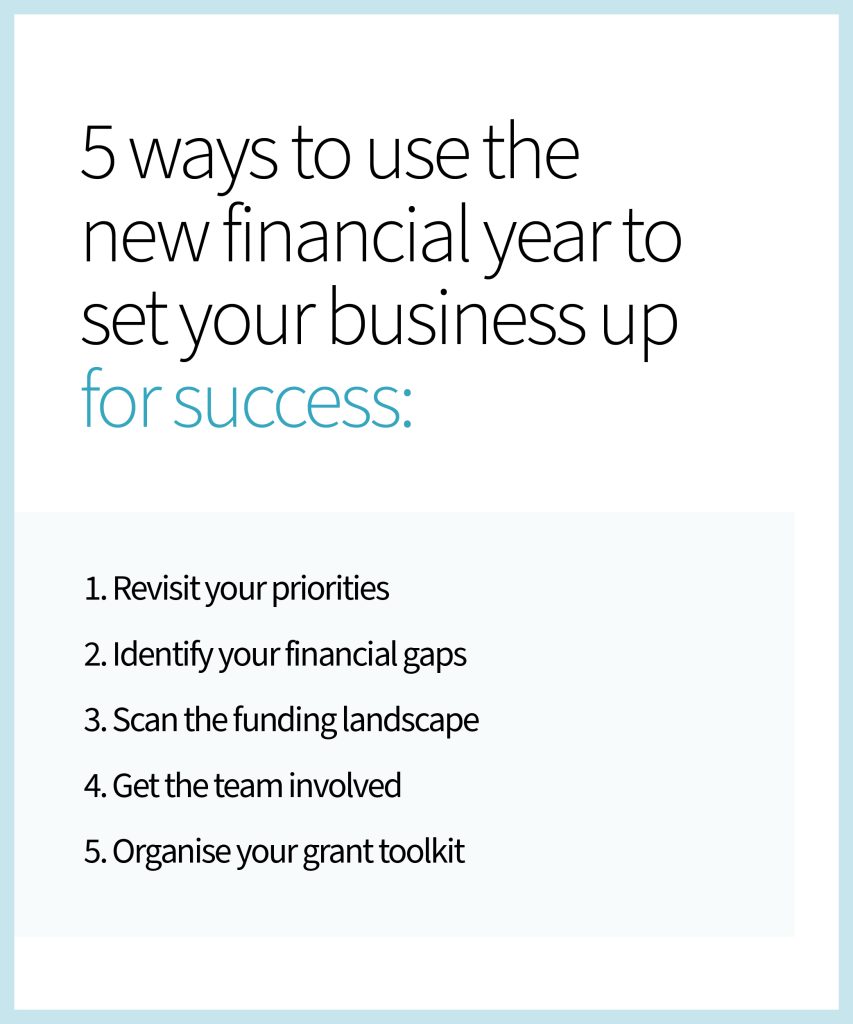
Here are five ways to use the new financial year to set your business up for success:

       1. Revisit your priorities:

What are you aiming to grow, test or expand this year? What matters most to your organisation right now? Funders respond best to clearly articulated goals.

      2. Identify your financial gaps:

Grants should fill specific funding needs, not general shortfalls. Clarify which projects need support and how much you’ll need. If budgeting isn’t your strong suit, now’s a good time to seek advice.


Need help identifying grants or shaping your funding budget? We’ve got you covered.


     3. Scan the funding landscape:

Look ahead 3–6 months. What’s likely to open based on recent budgets or government announcements? Which funders back your kind of work? Keep an eye on programs that require longer preparation or partner engagement.

     4. Get the team involved:

Whether it’s your staff, board, or co-founders, set time aside to review priorities and assign owners for grant opportunities. If you’re a solo operator, connect with other founders and support each other.

    5. Organise your grant toolkit:

Refresh or pull together the basics: a clear business plan, project budgets, your ABN and compliance docs, previous success stories, and any evaluation data you have. Having this on hand saves time when grants land.


FundFindrs - New Financial Year Success


Be proactive, not predictive

One of the biggest myths in grant-seeking is that you can wait for the “ideal” window. In reality, every funder works on their own timeline.

Government grants often align with federal and state budgets, but rollout dates vary while larger infrastructure or multi-year grants can take months to prepare.

Emergency or rapid-response funding appears without warning, but if you’re organised, you’ll be ready to apply quickly.

A clear takeaway? Don’t wait to act. Instead, build habits that keep you ready year-round.


FundFindrs - Janine Owens Biggest Myths Quote


Why you need a grants calendar

A 12-month grants calendar isn’t just a list of deadlines – it’s a practical tool that:

  • Keeps your team aligned
  • Flags key dates well in advance
  • Helps you balance internal project timing with external opportunities
  • Reduces stress and improves quality through better planning

You can use a basic spreadsheet, a whiteboard, or a digital tool. Grant’d offers an integrated calendar that updates as new grants are added. Whatever you choose, consistency is key.


Final thought

A new financial year doesn’t have to mean more hustle. It can be a chance to lead with intention.

Reassess. Reset. Get ahead of the curve. When you build the systems early, applying for grants becomes easier, faster, and far more strategic.


Want to start the new financial year right? The Grant’d grants calendar is a free way to plan smarter this year.


Ready to put your grants calendar into action?

At FundFindrs, we’re here to turn your mid-year planning into funding success.

Whether you’re identifying the right grants, preparing your documentation, or navigating the R&D Tax Incentive eligibility requirements, our experienced consultants are by your side. We simplify the application process, reduce stress, and boost your chances of success by applying for grants and tax incentives.

Book your FREE consultation with the FundFindrs team today and take the next step toward funding your future.

The Essential Grants Glossary: 10 Must-Know Terms Explained

Last reviewed: July 28, 2026


Writing a grant can sometimes feel like translating another language. Funders have their own terminology, and getting familiar with it can save you time, improve your applications, and help you avoid common mistakes. 

Here are ten key terms every grant seeker should know, with deeper context and real-world insight: 

  1. Eligibility criteria
  2. Assessment criteria
  3. Co-contribution 
  4. In-kind support 
  5. Funding agreement
  6. Milestone reporting
  7. Acquittal 
  8. Letters of support
  9. Matched funding
  10. Auspicing 


Key takeaways 


  • Eligibility criteria determine whether you can apply for a grant, making them the first section to review before investing time in an application.
  • Assessment criteria explain how applications are scored, helping applicants align their responses with funder priorities.
  • Co-contributions and matched funding often require applicants to share project costs, demonstrating commitment and reducing funder risk.
  • In-kind support refers to non-cash contributions, but not all grant programs allow these contributions to count towards funding requirements.
  • Milestone reporting and acquittals are important post-award obligations, requiring recipients to demonstrate how grant funds were used and what outcomes were achieved.
  • Letters of support and auspicing arrangements can strengthen funding applications, particularly for organisations that need partnerships, endorsements or administrative support.


1. Eligibility criteria

The non-negotiables. These are the rules that define who can apply. They might relate to your business structure, size, location, turnover, tax status (like DGR or TCC), or the purpose of the funding. 

Example: 

A regional small business grant may only accept applications from ABN-holding businesses operating outside metropolitan areas with under 20 full time employees (FTEs). Some require applicants to have been trading for a certain number of years, or to have a minimum revenue. 

Why it matters: 

If you don’t meet the core eligibility, your application won’t even be assessed. Even strong projects will be knocked out early if the box can’t be ticked. 

Expert’s tip: 

Always read eligibility before anything else. If something’s unclear, call the funder. And if you’re unsure, don’t assume – ask. 


Need support understanding grant eligibility?
Chat with our team to get clarity before you apply.


2. Assessment criteria

This is how your application will be scored. Every funder has assessment criteria that reflect what matters to them. Your job is to write directly to these points. 

Common criteria include: 

    • How well your project aligns with the funder’s goals or priorities 
    • The strength and clarity of your project plan 
    • Organisational capacity to deliver what you’re proposing 
    • Value for money and efficient use of funds 
    • Expected outcomes and how they’ll be measured
       

Expert’s tip:  

Use each criterion as a heading or structure in your responses. Don’t make assessors go hunting for the information – make it easy and obvious. 


3. Co-contribution

Some grants require you to contribute to the project financially. This might be a dollar-for-dollar match, or a percentage of the total cost. 

Example:  

If you’re applying for a $50,000 grant with a 50% co-contribution requirement, you need to put in $50,000 of your own (or sourced) funds. 

Why it matters:  

Co-contributions demonstrate buy-in, lower the funder’s risk, and are often seen as a measure of your commitment. 

Expert’s tip:  

Some grants don’t allow in-kind contributions to count toward the match. Always check the guidelines carefully and confirm the source of your match is eligible.


4. In-kind support

In-kind support refers to non-cash resources that contribute value to your project. These are goods or services provided either by your organisation or by partners, volunteers, or sponsors, without a direct financial transaction. 

Examples include: 

    • Donated venue or meeting space
       
    • Volunteer hours (often calculated using a standard hourly rate)
       
    • Loaned equipment or technology
       
    • Pro bono professional services, like legal advice, graphic design, or evaluation support
       
    • Advertising or promotional support at no cost
       

Why it matters: 

In-kind contributions demonstrate that your project has support beyond the grant. They show resourcefulness, partnership, and a broader commitment to success. In many cases, in-kind support can also be included in your project budget to reflect the true value of the initiative — and in some grant programs, it may count toward your co-contribution. 

Expert’s tip: 

Always estimate the value of in-kind support accurately and explain how you calculated it. Where possible, include a letter of confirmation or a memorandum of understanding (MOU) from the person or organisation providing the support.  

This strengthens your application and builds trust with the funder.


5. Funding agreement

If your application is successful, you’ll be asked to sign a funding agreement: a legal contract that outlines how the grant must be used and what you’re committing to deliver. This document covers everything from project timelines and approved budget items to reporting obligations and branding requirements. 

Why it matters: 

Once signed, you’re legally responsible for meeting the terms of the agreement. That includes hitting your milestones, delivering on promised outcomes, and using the funds exactly as stated. 

Expert’s tip:  

Take the time to read every clause carefully. If you’re unsure about anything, get legal or financial advice before signing. 


6. Milestone reporting

Most grants don’t just hand over funds and walk away. You’ll usually need to submit progress reports at key points throughout the project. These are called milestone reports, and they demonstrate how the work is tracking. 

What’s included: 

    • Financial updates
       
    • Project activity summaries
       
    • KPI or outcome tracking
       
    • Photos, testimonials or case studies
       

Expert’s Tip:  

As soon as you sign the funding agreement, enter all milestone dates into your calendar. Missing deadlines or submitting incomplete reports can delay payments or impact future funding. 
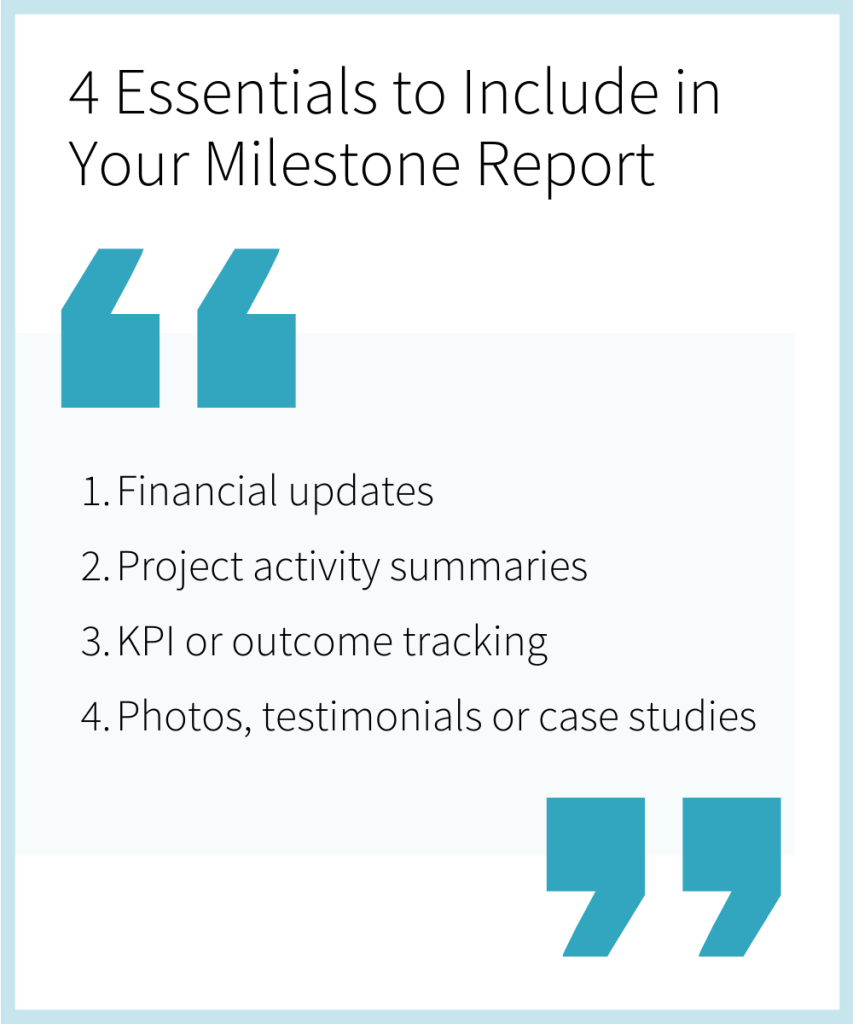
 

Four Essentials to Include in your Milestone Report


7. Acquittal

The acquittal is the final report you submit after your project is complete. It shows how the grant money was spent and what was achieved.
 

What to expect: 

    • A full financial breakdown matching your approved budget
       
    • A report on project outcomes and impacts
       
    • Evidence such as receipts, media, photos, or evaluations
       

Expert’s tip:  

Don’t leave this to the last minute. Start collecting data and documentation from day one so your acquittal is accurate, thorough, and stress-free. 


8. Letters of support

These are written endorsements from individuals, organisations, or stakeholders who back your project. They show that others believe in your idea, are willing to partner with you, or will benefit from the outcome. 

Example:

A local council might provide a letter confirming they’ll offer a venue, help promote the program, or provide referrals. 

Expert’s tip:

Tailor each letter to the funder and the project. Generic or copy-paste letters won’t carry much weight. Ask for letters early and provide key points to make it easy for your supporters to write something strong. 


9. Matched funding

This is where you’re required to contribute an amount equal (or proportional) to the grant you’re applying for. It could be through your own funds, other grants, or investment

Why it matters:

Funders use matched funding to stretch their resources further and to see that you’re equally committed to the project’s success

Expert’s tip:

Some grants will only accept external sources for your matched funding, for example investment capital or a confirmed co-funder. Internal revenue or in-kind contributions might not count. Always read the guidelines closely. 


10. Auspicing

Auspicing is when an eligible organisation applies for and manages a grant on behalf of a group or business that doesn’t meet the funder’s eligibility criteria. 

How it works: 

    • The auspice organisation takes legal and financial responsibility
       
    • You deliver the project under their oversight
       
    • Both parties sign a formal agreement defining who does what
       

Example: 

A grassroots creative collective without legal status might partner with an established not-for-profit to auspice a grant for an arts festival. 

Expert’s tip:

Choose your auspice partner carefully. Trust, clear communication, and strong governance are essential. Always have a written agreement outlining roles, reporting, and how funds will be managed


Final thought 
Understanding the language of grants gives you power. It helps you write better, present stronger, and stay confident through the process. 

Bookmark this glossary. Share it with your team. The more fluent you are, the fewer roadblocks you’ll hit. 


Need support turning all this grant knowledge into action? 

At FundFindrs, we help businesses simplify and manage the entire grant process: from identifying the right opportunity to submitting a standout application. 

Contact us for a FREE consultation and let’s get your funding journey underway. 

Why Grant Applications Get Rejected (and What to Do About It)

Last reviewed: July 28, 2026


So much work goes into applying for a grant. That’s why rejection stings. But it’s often not about the strength of your idea, it’s about how well you followed the brief. 

Below are ten of the most common reasons grant applications miss the mark, and how you can avoid the same fate next time.


  1. Ignoring eligibility
  2. A weak or wandering story
  3. Unclear budgets
  4. No evidence or outcomes
  5. Missing governance or compliance info
  6. Not following instructions
  7. No risk or sustainability plan
  8. Submitting at the last minute
  9. No community buy-in
  10. Weak reporting plan


Key takeaways 


  • Grant applications are often rejected because they do not meet eligibility requirements, making the initial eligibility check one of the most important steps.
  • A clear project narrative matters. Funders want to understand what the project will achieve, why it matters and how it will be delivered.
  • Budgets should be detailed and transparent, with costs clearly explained and aligned to project activities.
  • Evidence and measurable outcomes strengthen applications, helping demonstrate the need for funding and how success will be evaluated.
  • Governance, compliance and supporting documents are essential, as missing information can affect eligibility and assessment.
  • Strong applications include risk, sustainability and reporting plans, showing how the project will be managed and measured beyond the funding period.


1. Ignoring eligibility

Always check the basics. If you’re not eligible, you’re out from the start. Don’t waste your time on grants that don’t fit.


2.  A weak or wandering story

Funders need clarity. If you can’t explain what your project does, why it matters, and how it will be delivered – quickly and clearly – it will cost you.


3. Unclear budgets

Avoid vague terms like “miscellaneous”. Break down your numbers and explain them. Funders want transparency.


4. No evidence or outcomes

Back up your case. Use data to show the need, and outline how you’ll measure success.


5. Missing governance or compliance info

Many grants require proof of insurance, board details, policies or financials. Make sure your documents are current and ready.


6. Not following instructions

Stick to word counts. Use the right templates. Upload the correct file types. A great application can still be ruled ineligible for admin errors.


7. No risk or sustainability plan

Funders want to know your project is viable — even if something goes wrong or funding ends. Spell that out.


8. Submitting at the last minute

Leave time for reviews, tech issues, and final polish. Rushing means mistakes.


9. No community buy-in

If the project serves a community, show how they’ve been involved. Add letters of support or quote conversations and feedback.


10. Weak reporting plan

Funders expect to see how you’ll track and report on progress. It’s a core part of grant accountability.


Final thought 

Grants are competitive. But most rejections happen for predictable reasons. By planning ahead, tightening your narrative, and double-checking the details, you’ll improve your chances dramatically. 

Get grant ready – not just application ready!


Ready to avoid these common pitfalls?

At FundFindrs, we specialise in making sure your grant application doesn’t fall at the avoidable hurdles. From checking eligibility and strengthening your story, to building clear budgets and managing compliance, we partner with you through the entire process. Our team knows what funders are looking for and how to help you stand out. 

Book a FREE consultation today and take the guesswork out of your next grant application. 


Industry Growth Program (IGP):what’s changed, what matters, and who should apply

Last reviewed: July 02, 2026


The Industry Growth Program (IGP) is one of the Federal Government’s key funding pathways for Australian SMEs looking to commercialise innovation and scale their businesses. 

However, the program has shifted significantly. 

Following the Federal Government’s $102 million funding reduction (MYEFO), the IGP is no longer a broadly accessible grant. It is now a highly competitive program focused on commercially viable projects with clear economic impact. 

For businesses, this changes the approach entirely. The question is no longer: “Are we eligible?” but it should be: “Are we competitive enough to be funded?”.

In this article, we break down how the program works today, what has changed, and, most importantly, how to assess whether your business is genuinely positioned to succeed. 


IMPORTANT NOTE: Following the announcement of the Federal Budget 2026-27, the Industry Growth program has been put on hold affecting both new applicants and those already in the pipeline. At this stage, it hasn’t been confirmed if it will re-commence, be replaced or be cancelled. We will update as further information comes to light.


Key takeaways 

  • The IGP is currently paused. Following the 2026–27 Federal Budget, the program is on hold for new applicants and those already in the pipeline.
  • Funding was reduced by $102 million. The IGP is no longer a broadly accessible grant and is now focused on highly competitive, commercially viable projects.
  • Competitiveness matters more than eligibility. Being eligible does not guarantee funding in the current assessment environment.
  • The program has two stages: Advisory support to strengthen commercialisation strategy, followed by grant funding for the strongest projects.
  • Innovation alone is not enough. Successful applications must demonstrate commercial readiness, execution capability and measurable economic impact.
  • IGP and R&DTI serve different purposes. R&DTI supports eligible R&D activities retrospectively, while IGP supports future commercialisation and growth.
  • Application quality is critical. Strong positioning and commercial evidence play a major role in funding outcomes.


1 – What is the Industry Growth Program  

The IGP, delivered through business.gov.au, combines advisory support and matched grant funding to help businesses move from innovation to commercialisation. 


In practice, the program operates as a two-stage process: 

  1. Advisory stage – designed to assess and strengthen your commercial strategy  
  1. Grant stage – where funding is awarded to the most competitive projects  


This structure reflects a clear objective from government: to fund outcomes, not just ideas. The program prioritises businesses that can demonstrate a clear pathway to market, the ability to execute, and the capacity to generate measurable economic outcomes. As a result, technical innovation alone is not enough, applications must show how that innovation translates into commercial impact. 


2 – What’s changed in the Industry Growth Program: funding cuts and increased competition 

Recent funding reductions have reshaped the Industry Growth Program. 

Businesses should expect: 

  • Fewer grants awarded  
  • Greater scrutiny on applications  
  • Stronger focus on commercial readiness  
  • Increased importance of financial capability and co-investment  

As a result, application quality and positioning now play a critical role in success. 


Stronger competition means greater emphasis on commercial positioning, financial capacity and delivery readiness. FundFindrs helps businesses strengthen these areas before applying.


3 – How the program works 

Step 1: Advisory Service (mandatory) 

All applicants must begin with the IGP Advisory Service. 

This involves submitting an application that assesses your: 

  • Business model  
  • Innovation viability  
  • Commercialisation pathway  


If eligible, you will work with an Industry Growth Program Adviser to: 

  • Test your strategy  
  • Identify risks and gaps  
  • Define a clear pathway to market  


It’s important to know this stage is mandatory once you cannot access grant funding without completing it. 


Step 2: Grant Funding 

Businesses that successfully progress may be eligible for one of two streams: 

Early-Stage commercialisation grants
– Funding available: $50,000 – $250,000
– Objective: Supporting businesses moving toward market readiness 

Commercialisation and growth grants
– Funding available: $100,000 – $5 million
– Objective: Supporting businesses ready to scale 

Both streams require: 

  • Matched funding (co-contribution)  
  • Demonstrated financial capability  
  • Clear commercial outcomes  

Funding is awarded on merit, and competition is strong.


Industry Growth program Tip


4 – Industry Growth Program eligibility overview 

To be eligible, businesses must generally: 

  • Be an Australian SME  
    • Fewer than 200 employees  
    • Turnover under $20 million (last three financial years) 
       
    • Value-add in resources  
    • Agriculture, forestry and fisheries  
    • Transport  
    • Medical science  
    • Renewables and low emissions technologies  
    • Defence capability  
    • Enabling technologies (e.g. AI, robotics, biotech)  
  • Demonstrate:  
    • Commercial potential and scalability  
    • IP ownership or access rights  
    • Financial capacity to co-invest  


5 – What makes a competitive application in 5-steps 

With increased competition, successful applications typically demonstrate: 

1 – Clear commercial outcomes
A defined pathway to revenue, market adoption, or industry impact 

2 – Strong market and technical positioning
Evidence of demand, traction, or validated development 

3 – Financial readiness
Capacity to fund your share of the project, supported by evidence and an Accountant Declaration 

4 – Structured project planning
Clear milestones, timelines, budgets, and risk considerations 

5 – Alignment with government priorities
A direct link to NRF sectors and broader economic outcomes 


6 – A common misconception 

One of the most common mistakes is treating the IGP as a standard grant application. 

In reality, it functions as a commercial assessment process. That’s why eligibility alone does not determine outcome success. Applications are assessed on quality, clarity, and commercial viability — which is why many businesses consider working with a grant writing consultant to strengthen their approach and overall submission strategy. 

Is the Industry Growth Program right for your business? 

The IGP is best suited to businesses that: 

  • Are developing commercially viable innovations  
  • Have a clear pathway to market  
  • Can co-invest in their growth  
  • Are ready to compete in a merit-based funding environment  

If your business is still validating early-stage ideas or lacks financial readiness, it may be worth exploring alternative pathways first. 


7 – Where IGP fits within your funding strategy 

The Industry Growth Program (IGP) is often considered alongside programs such as the R&D Tax Incentive (R&DTI). 

While both support innovation, they serve different purposes: 

  • R&DTI supports eligible R&D activities retrospectively  
  • IGP supports forward-looking commercialisation and growth  

For many businesses, these programs can be complementary when used strategically. 


8 – How FundFindrs can support your application 

Navigating programs like the IGP requires more than understanding eligibility criteria. If you’re considering apply to it, the first step is understanding your position — not just your eligibility. 

At FundFindrs, we work with businesses to: 

  • Assess whether the program is the right fit  
  • Strengthen commercial positioning before applying  
  • Prepare clear, compliant applications  
  • Support both advisory and funding stages  

Our approach is grounded in practical experience across multiple funding programs and industries.  


Book a FREE consultation with FundFindrs to assess your suitability for the Industry Growth Program and build a clear strategy before applying. 


Advancing Renewables Program (ARENA): Most asked questions and insights

Last reviewed: July 03, 2026 

For businesses considering an application to the Advancing Renewables Program (ARENA), understanding how the assessment process works is just as important as meeting eligibility criteria.
 

While our Funding Guide explains the program structure and funding mechanics, this article answers the most common questions businesses ask about applying for ARENA funding under the Advancing Renewables Program — from assessment criteria and timelines to commercial readiness and competitiveness. 

If you’re evaluating whether your project is ready for submission, these answers provide practical clarity before going ahead. 


Key takeaways 

  • Technical merit alone won’t win funding. ARENA assesses commercial viability, market pathway and system-level impact.
  • Projects typically need to be at TRL 6–9. Early-stage research and concept development are not supported.
  • Matched funding is required. Applicants must contribute at least 50% of total project costs.
  • Applications follow a two-stage process: EOI first, then a full application covering financials, milestones and commercialisation strategy.
  • There are no fixed response timelines. Assessment is rolling and can extend across several months, so co-funding commitments should be secured early.
  • ARP and R&DTI can work together to support both commercialisation and ongoing R&D investment.


1 – What is Advancing Renewables Program (ARENA) looking for in applications?

Beyond technical merit, ARENA assesses proposals on their ability to deliver measurable, system-wide and commercial outcomes. 

Competitive projects clearly demonstrate: 

  • A credible pathway to commercial deployment at scale 
  • Strong co-funding commitments and financial robustness 
  • Clear milestones linked to outcomes, not just activities 
  • Alignment between technology performance, market demand and national energy priorities 


FundFindrs’ Tip: Projects that clearly link technical performance to commercial deployment and measurable system impact are typically more competitive. 


2 – What are Advancing Renewables Program assessment criteria?

Applications are typically evaluated across several core areas, including: 

  • Technical feasibility and innovation 
  • Commercial viability and market pathway 
  • Alignment with ARENA’s investment priorities 
  • Value for money 
  • Broader system and national energy benefits 


FundFindrs’ Tip: Strong submissions integrate technical, financial and market elements into one clear narrative rather than presenting them as separate sections. 


3 – Does arena fund early-stage research?

Under the Advancing Renewables Program, projects are generally expected to be at Technology Readiness Levels (TRL) 6–9. 

Projects focused solely on early-stage research, student training or concept development are typically not supported under ARP. Applicants must demonstrate readiness for demonstration, deployment or commercial scale-up.  


4 – What is the EOI and full application process?

Many projects under the Advancing Renewables Program progress through a staged process: 

  1. Expression ofinterest (EOI)
    An initial submission outlining the project concept, objectives and strategic alignment. 
  2. Fullapplication
    A detailed submission including technical documentation, financial modelling, milestone plans and commercialisation strategy. 


FundFindrs’ Tip: Treat the EOI as the foundation of your strategy. Weak positioning at this stage can make progression to full application significantly harder.


ARENA applications require clarity across technical, financial and commercial elements. FundFindrs helps bring these together into a strong submission strategy.


5 – What are common challenges with Advancing Renewables Program 

Common challenges include: 

  • Interpreting complex guidelines and assessment criteria 
  • Building robust financial models and co-contribution structures 
  • Defining milestones that satisfy both technical and commercial expectations 
  • Clearly articulating national and system-level benefits 

Early planning and expert guidance can significantly improve application strength. 


6 – How competitive is Advancing Renewables Program funding? 

Advancing Renewables Program funding is highly competitive and assessed on merit and value for money by Australian Renewable Energy Agency (ARENA). Funding is provided on a matched basis, meaning applicants must contribute at least 50% of total project costs.


FundFindrs’ Tip: P Projects that rely solely on innovation, without clear commercial and financial framing, often struggle to progress.
 

7 – How long does it take to hear back from ARENA? 

ARENA does not publish fixed response timeframes for the Advancing Renewables Program. 

Applications are assessed on a rolling basis, with timing influenced by pipeline volume and project complexity. In practice, applicants may experience several months between stages, with full assessment and negotiation extending across multiple months depending on scope and workload. 


FundFindrs’ Tip: Because timelines can extend across multiple months, businesses should ensure internal resources and co-funding commitments are secured early. 


8 – Can startups apply for ARENA funding? 

Yes — provided they: 

  • Are Australian-incorporated entities with an ABN 
  • Meet co-contribution requirements 
  • Demonstrate sufficient financial capacity 
  • Have projects at appropriate TRL levels 

However, startups that are still in early concept or research stages may find it difficult to qualify under ARP.


9 – What makes an Advancing Renewables Program application stand out? 

From our experience supporting complex Federal funding programs, the strongest applications are not always the most technically advanced — they are the most strategically framed. 

Projects that succeed typically: 

  • Translate technical innovation into commercial and economic value 
  • Clearly articulate why ARENA support is critical to deployment 
  • Balance ambition with delivery certainty 
  • Demonstrate long-term impact beyond the grant period 


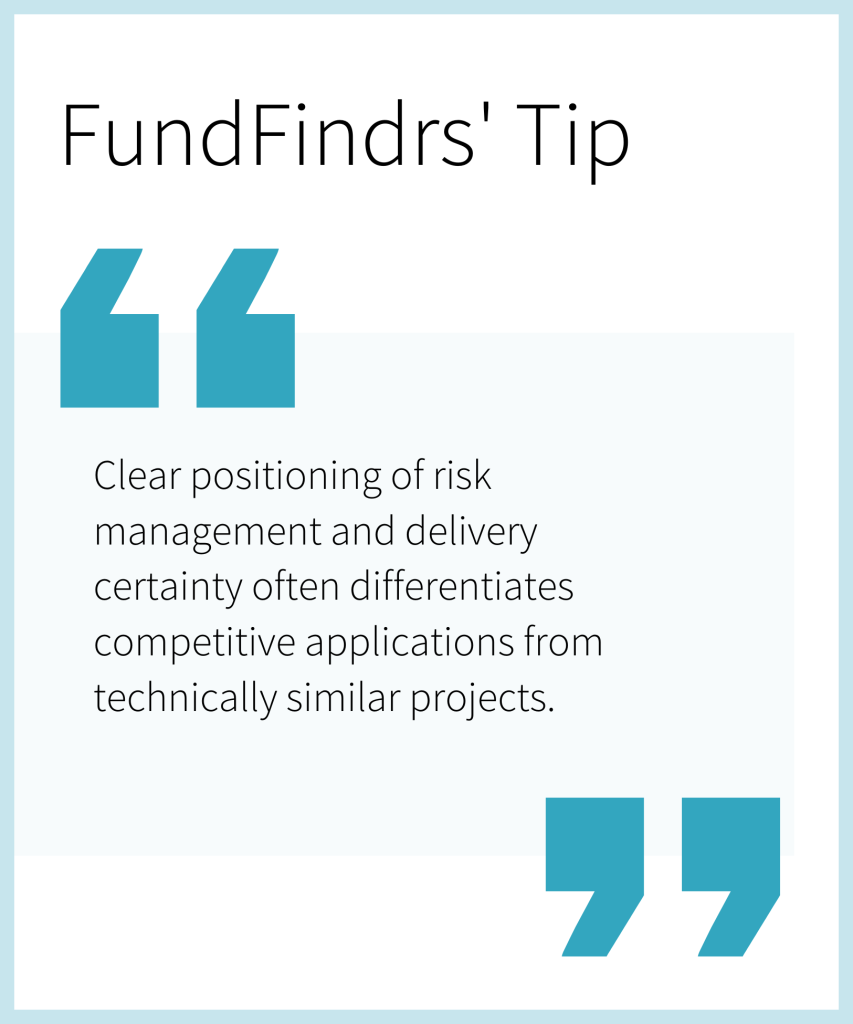
FundFindrs’ Tip: Clear positioning of risk management and delivery certainty often differentiates competitive applications from technically similar projects. 


Advancing Renewables Program ARENA Most asked questions and insights FundFindrs Tips


How FundFindrs supports ARENA grant applications

FundFindrs works with businesses at every stage of the ARENA journey: from early eligibility assessment through to full application management. 

Our support includes: 

  • Eligibility and strategic fit assessment 
  • Interpreting ARENA guidelines and priorities 
  • Clarifying project scope, milestones and measurable outcomes 
  • Developing grant-ready budgets and financial models 
  • Strengthening commercialisation and deployment narratives 
  • End-to-end application management 


Where appropriate, we also help businesses align with Advancing Renewables Program complementary funding opportunities such as the  R&D Tax Incentive (R&DTI)  to support ongoing innovation and commercialisation. 


Considering an ARENA application? 

The Advancing Renewables Program supports renewable energy projects ready to move toward large-scale deployment, but competitiveness depends on more than technical capability. 

Strategic positioning, financial credibility and measurable impact all influence assessment outcomes. 

If you would like an independent view on your project’s readiness, FundFindrs offers a FREE consultation to help clarify eligibility and next steps. 


Advancing Renewables Program (ARENA): Funding Guide for Australian Businesses

Last reviewed: July 03, 2026

Australia’s transition to net zero relies heavily on the commercialisation and large-scale deployment of renewable energy technologies. The Advancing Renewables Program (ARP), administered by the Australian Renewable Energy Agency (ARENA), is one of the Federal Government’s flagship funding programs supporting this shift. 

Designed to back mid to late-stage renewable energy projects, the program provides flexible, milestone-based grant funding to help innovative businesses demonstrate, deploy and scale technologies that can materially reduce emissions and strengthen Australia’s clean energy system. 

This guide explains how the Advancing Renewables Program works, who it’s for, what it funds, and how Australian businesses can get support to position themselves for a competitive application.  


Key takeaways 


  • ARP is ARENA’s flagship grant program for mid to late-stage renewable energy projects focused on demonstration, deployment and commercial scale-up.
  • ARENA funding supports projects with a clear pathway to deployment and scale, not early-stage concepts or research-only activities.
  • Funding is milestone-based, with payments typically linked to agreed project outcomes and delivery progress.
  • Co-contribution is an important requirement, with applicants expected to demonstrate financial capacity and strong project backing.
  • Commercial readiness matters as much as innovation. Strong applications show a clear market pathway, financial discipline and measurable energy system impact.
  • ARENA supports projects that help accelerate Australia’s transition to net zero by improving renewable energy deployment, performance, integration or adoption.


1 – What is the Advancing Renewables Program (ARENA)? 

The Advancing Renewables Program is ARENA’s primary grant initiative focused on accelerating Australia’s transition to net zero through renewable energy innovation, demonstration and deployment. 

The program supports projects that move beyond early-stage research and are ready for real-world application and commercial scale-up. Program priorities and guidelines are maintained by ARENA and updated periodically to reflect national energy policy and market needs. 

Projects supported under the program typically aim to: 

  • Demonstrate or deploy renewable energy technologies at commercial or near-commercial scale 
  • Reduce costs and improve the performance of renewable energy generation 
  • Enable system integration, flexibility and reliability 
  • Address technical, regulatory or financial barriers to renewable energy uptake


2 – What types of projects does ARENA fund?

ARENA funding is targeted at projects with a clear pathway to deployment and scale. 

Supported project types commonly include: 

  • Renewable energy demonstration and deployment
    Projects that validate performance, reliability or cost improvements of renewable energy technologies in real-world conditions.
  • Enabling technologies for renewable energy integration
    Solutions that improve system flexibility, integration, storage, transmission or reliability across the energy network.
  • Commercial-scale clean energy solutions
    Projects focused on scaling proven technologies and accelerating market adoption.


3 – Who is the program designed for?

The program is best suited to:

  • Mid to late-stage clean energy innovators 
  • Technology developers ready for commercial deployment 
  • Energy companies implementing new or improved renewable solutions 
  • Businesses seeking to scale proven renewable technologies 

A strong application demonstrates not only innovation, but also commercial readiness, financial discipline and measurable impact. 


ARENA applications are assessed on more than technical innovation. FundFindrs supports businesses to interpret program requirements.


Eligibility criteria 

To be eligible for ARENA funding, applicants must meet both entity and project requirements.

Eligible entities must: 

  • Hold an Australian Business Number (ABN) 
  • Be an Australian-incorporated entity

Eligible project types: 

Projects must involve renewable energy technologies aligned with ARENA’s priorities and objectives.

Technology readiness requirements: 

  • Projects focused solely on early-stage research or student training are generally not supported 

Applicants must also provide a detailed project budget, financial model and milestone plan. 


ARENA - FundFindrs Tip


4 – How much funding is available through ARENA?

Grant funding structure

  • Funding is provided as milestone-based grant payments 
  • Payments are linked to the achievement of agreed project outcomes 

Grant amounts 

  • No fixed upper funding limit 
  • Previous ARENA grants have ranged from $100,000 to over $50 million, depending on scope and impact 

Co-contribution requirements 

  • Applicants must contribute a minimum of 50% of total project costs 
  • Contributions may include cash and eligible in-kind support


Application status
 

The Advancing Renewables Program operates on an open, year-round basis, rather than fixed funding rounds. 

Applications can be submitted when a project is ready, provided it aligns with ARENA’s current priorities and assessment criteria. 


Get expert support with your ARENA application
 

Excited about ARP but unsure if your project is the right fit or how competitive your application would be? 

Early preparation makes a measurable difference for complex, high-value grants like ARENA. If you want to assess eligibility, clarify next steps and build a funding strategy book a FREE consultation with FundFindrs today.