Business Funds Archives - FundFindrs

The R&D Tax Incentive Unpacked: All your burning questions answered.

Last reviewed: July 28, 2026


What’s the buzz around the Research and Development Tax Incentive (R&DTI)? Is it just another grant, or is there more to it?

For over four decades, the R&DTI has been a game-changer for Australian businesses, offering tax credits to cut down on research and development costs. It’s not just for the big players; startups and established companies in tech, manufacturing, pharma, agriculture and other industries can all benefit. By providing tax offsets for eligible R&D activities, the incentive fuels innovation and helps businesses grow and compete globally.

Let’s break it down with some practical insights and examples from experts to help you get the most out of the R&DTI.


In the next 8 minutes or so, we’ll comprehensively cover:


Key takeaways 


  • The R&D Tax Incentive (R&DTI) is a government program that provides tax offsets for eligible R&D activities, helping businesses reduce the cost of innovation.
  • The program is available to businesses of all sizes and across a wide range of industries, including technology, manufacturing, agriculture and pharmaceuticals.
  • Eligible businesses may be able to offset up to 43.5% of their R&D expenditure, improving cash flow and reducing financial risk.
  • The R&DTI is designed to encourage innovation, supporting businesses that invest in developing new or improved products, processes, services or technologies.
  • Understanding eligibility, claimable costs and application requirements is critical to maximising the value of the program.
  • R&DTI funding can be reinvested into future projects and business growth, helping companies continue innovating and scaling.


R&D Tax Incentive

1 – What is the R&D Tax Incentive?

The Research and Development Tax Incentive (R&DTI) is a government program that provides a tax offset to Australian businesses that are engaged or planning to invest in eligible R&D activities. The primary aim of the program is to encourage innovation by reducing the financial risks associated with R&D projects, thereby stimulating advancements across various industries.


By participating, businesses like yours can significantly recover some of their investments, offsetting a portion of the costs associated with their R&D endeavours. This incentive stimulates innovation across various industries by reducing the financial risks associated with R&D projects while allowing business owners to make ambitious projects more feasible and less financially daunting.


2 – Why Should You Apply for the R&DTI and Is It Worth It?

Wondering why you should apply for the R&DTI and what its benefits are? The Research & Development Tax Incentive can become much more than just a financial incentive for your business in Australia. It’s an opportunity to propel your company forward and ensure long-term success.


Here are just 3 reasons why you should seriously consider it:

  • Financial Relief: You can offset up to 43.5% of your R&D costs, providing a substantial reduction in your overall expenses.
  • Growth Potential: The financial benefits can be reinvested into your business, fuelling further innovation and expansion.
  • Collaboration: Partnering with registered Research Service Providers can enhance your R&D efforts and outcomes, driving your projects to new heights.


3 – What R&D Costs Can Be Claimed?

The R&D tax benefits cover a variety of costs associated with research and development activities, making it easier for businesses to manage their expenses.


Some examples of eligible costs could include:

  • Employee Wages: Salaries and associated costs (such as superannuation) for employees directly involved in R&D activities.
  • Materials and Equipment: Costs of materials and equipment used specifically for R&D projects.
  • Testing Expenses: Expenditures related to testing and experiments conducted as part of your R&D.
  • Overheads: Relevant overhead costs that can be attributed to R&D activities such as subscriptions, phone and internet bills and even rent.
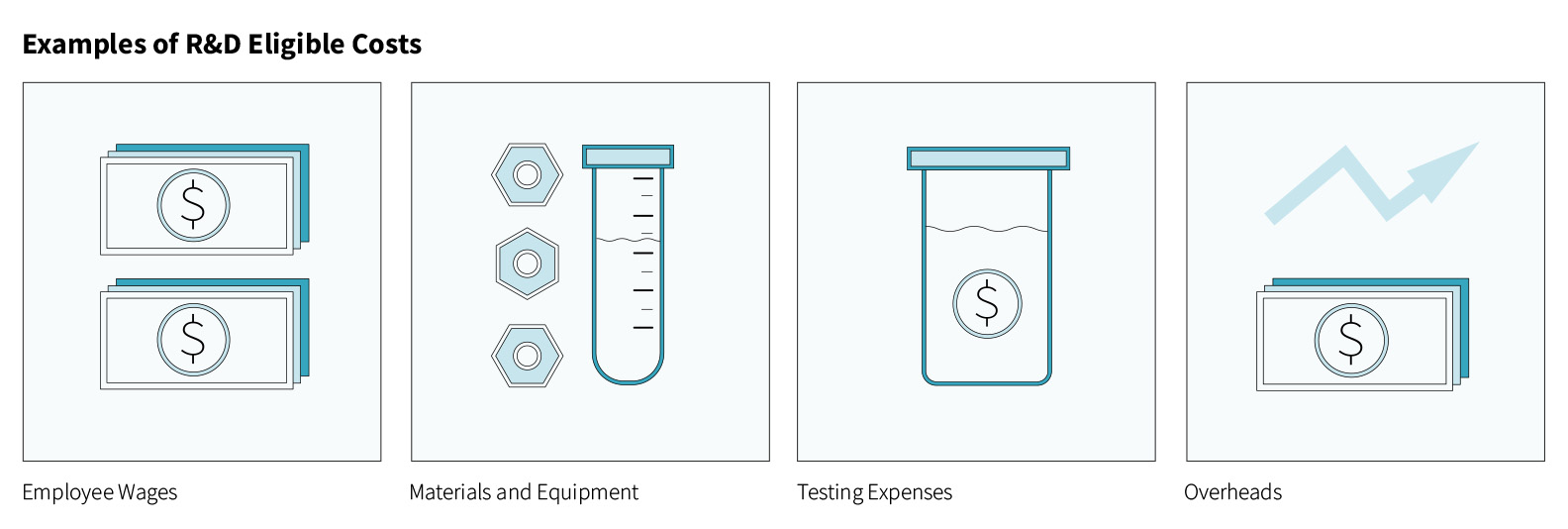
 

Examples of eligible R&D costs


A careful examination of each eligible cost ensures that businesses make the most of this opportunity, enhancing the financial benefits derived from R&D activities.


4 – How Much Can You Claim?

The golden question: how much can you receive under the R&DTI?


The answer is – up to 43.5% of your Research and Development costs from the previous financial year. The exact amount you can claim through varies based on your business’s turnover:

  • Businesses with less than $20 million turnover: The refundable R&D tax offset is your corporate tax rate plus an 18.5% premium.
  • Businesses with more than $20 million turnover: The non-refundable R&D tax offset is your corporate tax rate plus an incremental premium.


Let’s look at two examples:

  • A business with a $5 million turnover spending $250,000 on R&D in one financial year with a corporate tax rate of 30%, could be eligible for a $121,250 refund.
  • A business with a $25 million turnover spending $500,000 on R&D in the last financial year with a 30% corporate tax rate, could be eligible for $192,500 to $232,500, depending on their R&D intensity which informs the incremental premium.


To get a rough indication of the amount your business can receive, utilise this free R&D Tax Incentive calculator.


Not sure if you’re eligible for the R&D Tax Incentive?
Our free Blueprint breaks it down with an eligibility checklist, examples, and expert tips from the FundFindrs team.


5 – Is There a Minimum Spending Requirement?

Currently, businesses need to have a minimum R&D spend of $20,000 to qualify for this valuable incentive. This spending threshold is a key factor to consider as you explore the potential benefits and opportunities that the R&D Tax Incentive can bring to your business. Collaboration with registered Research Service Providers (RSPs) is often beneficial, as you don’t have to reach the minimum spend threshold to claim the R&DTI if you use an RSP.


6 – Are You Eligible?

If you’ve made it this far, you might be considering: “Is my business eligible for this Incentive?” Let’s find out.


Eligibility for the R&D Tax Incentive is designed to be accessible to a wide range of businesses. To qualify, your business must be:

  • Incorporated in Australia: Alternatively, if your business is under foreign law but conducts eligible R&D activities in Australia, you may still qualify.
  • Meeting the Spending Threshold: Your business must spend over $20,000 on eligible R&D activities in a financial year. This ensures that the incentive supports substantial and impactful research and development efforts.
  • Conducting R&D Activities: Your company needs to be conducting or planning to conduct at least one eligible R&D activity. Those activities can attempt to generate new/improved products, services, and processes or can be conducted to support them.


There are other main criteria and requirements to determine your eligibility and guide you through the identification of a Core or Supporting R&D Activity. To find out if your business could be eligible for the R&DTI get in contact with our team of experts to book a FREE meeting.


7 – What are the most common industries that typically apply for the R&DTI?

Companies from many industries can benefit from the R&D Tax Incentive to drive innovation and growth to their business. It’s common to see technology and software development companies leverage the incentive to fund advancements in digital solutions, enhancing efficiency and user experience.


Other frequent examples are engineering and manufacturing companies which also heavily invest in innovation through the incentive, fostering the development of new products and processes that improve productivity and competitiveness. Additionally, companies from agriculture, mining, biotechnology, renewables, and other sectors typically submit their applications to the R&D Tax Incentive to help them innovate and create new services/products.
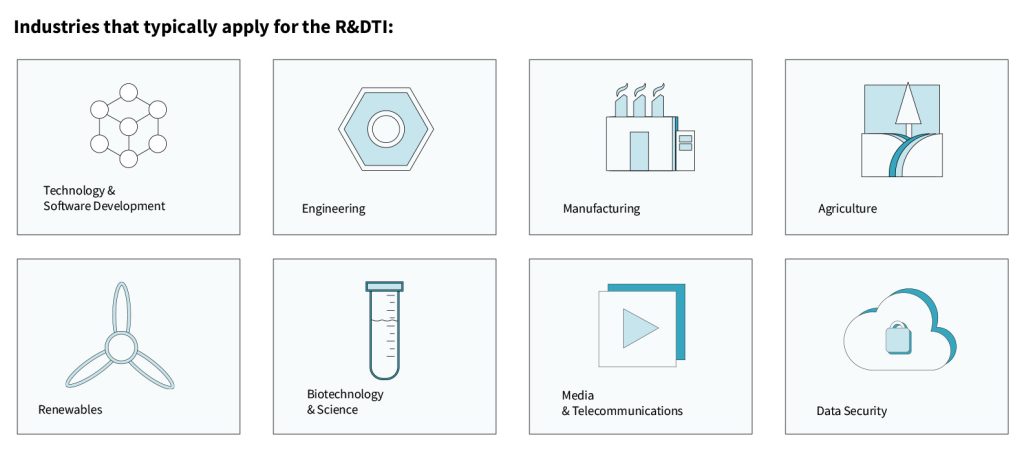
 

Common industries applying for R&DTI


While these industries have traditionally been prominent users of the program, the scope of eligible activities is broad, inviting exploration from other sectors keen on advancing through research and development. The R&D Tax Incentive boasts a substantial fund exceeding $1 billion, offering an expansive resource for all types of businesses.


8 – How simple is the R&DTI Application Process?

Applying for the R&D Tax Incentive involves several key steps to ensure that your application is thorough and accurate and can look like the following:

  1. Assess Eligibility: Review the program’s criteria to confirm that your business qualifies, and your R&D activities are eligible.
  2. Prepare Documentation: Compile detailed records of the nature and scope of your R&D activities, including financial statements and project descriptions.
  3. Submit Application: Submit your completed application to the Australian Taxation Office (ATO) and the Department of Industry, Innovation, and Science. You must submit your application within 10 months after the end of the financial year.


Maybe you are thinking: “There are too many steps involved in this process and I don’t have time to do so, so should I bother applying?”


Although there are a handful of steps involved in applying for the R&D Tax Incentive, keep in mind all the potential benefits quite outweigh the time spent doing so. Additionally, we can relieve the pressure from your shoulders. One way to boost your chances of success is by letting our team of experts handle the entire process for you. Book a free consultation to get the information and support you need to confidently complete your R&DTI claim.


9 – What’s the Timeline from Applying to Receiving the R&DTI Funds?

Now that we’ve covered the details of the Research and Development Tax Incentive, the next question naturally revolves around understanding the timeline and all its steps—from the day you apply to the moment the refund lands in your account. This understanding is crucial to effectively plan your finances and, possibly, bring forward your plans to growth and (re)invest.


Applications typically run from 1 July to 30 April of the following financial year. For instance, if you’re claiming for the financial year 1 July 2023 – 30 June 2024, you can apply from 1 July 2024 to 30 April 2025. Once approved, funds usually reach your account within a few weeks to a couple of months, providing timely financial support to your business.


You can streamline this process and strategically optimise your outcome by count with our support. The FundFindrs team is ready to assist you through this process, allowing you to reinvest funds into your business as quickly as possible.


10 – How to Maximise Your R&DTI Claim?

Are you ready to take most advantage of the Research & Development Tax Incentive (RDTI)? there a several ways to maximise your claim and make sure your process is thorough and solid. Here are some tips:

  1. Stay abreast of any changes to the program. Any recent changes that may impact your eligibility or the benefits you can receive will be carefully considered in your unique strategy. An easy way to stay on top is signing up for our Newsletter and following us on LinkedIn, Facebook and Instagram. We stay informed, so you don’t have to.
  2. Keep your records organised in a systematic way. Having well-organised documentation not only strengthens your claim but simplifies the RDTI process.
  3. Examine your expenditure with maximum attention to allocate all possible expenses to streamline your claim.
  4. Use a checklist to ensure you are claiming the R&DTI correctly according to the legislation minimising compliance risks. The catch to better securing this grant? Nailing your application.
  5. Navigate the complex process with an expert team like FundFindrs. We’ll handle the application pressure and ensure you get the most out of your R&D efforts.
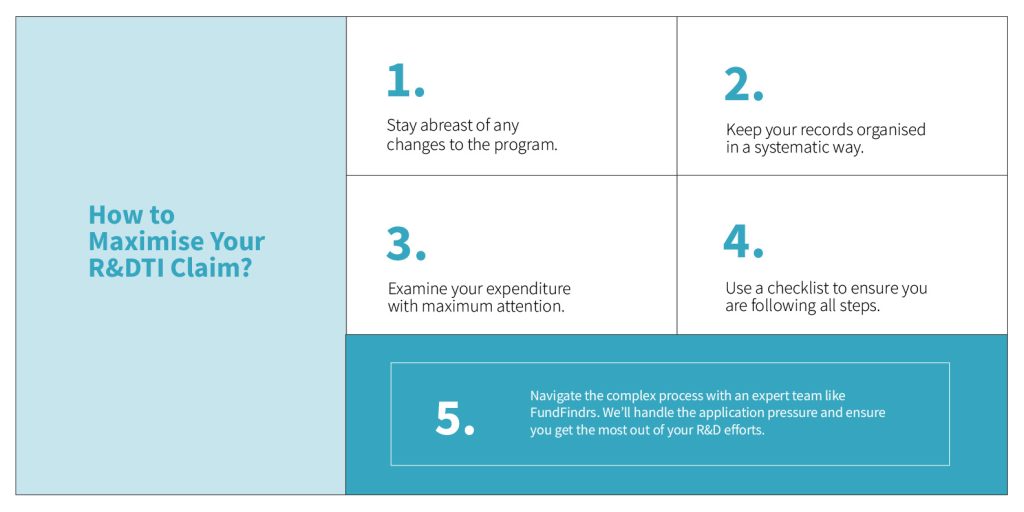
 

How to maximise your R&DTI claim


Book your FREE 30 minute starter chat with us


Before You Go

Don’t let your innovation go unrewarded. Unlock your next phase of growth with the Australian R&D Tax Incentives by reaping its countless benefits. Whilst the application process is detailed, the returns are well worth the investment.


So do your business (and yourself) a favour and get applying! And as always, the FundFindrs team is here to assist you through the entire process as well as any other queries or questions.


Simply send us an email or give us a call at (02) 9072 1720 at anytime and we’ll get back to you ASAP.

Leading Together: Jen & Kate on Two Years as General Managers of FundFindrs

Jen Manuel and Kate Downing share the role of General Manager of FundFindrs, a role in which they celebrate their two-year anniversary. Here they reflect on their partnership and what they’ve achieved together. 


  1. A unique partnership
  2. Driving growth with agility
  3. Making impact for clients
  4. A team built to thrive
  5. Looking ahead


1. A unique partnership 

Their story began seven years ago, when both were looking for flexible work arrangements after having children. With broad and differing business backgrounds, it was a chance meeting over coffee that revealed a shared work ethic, ambition, and complementary skills. Their first experience of a job share was as Marketing Managers, which later evolved into senior roles where they built strategies and led teams. They continued to work together across a range of industries, moving from managing existing functions to creating new ones, establishing departments, setting direction, and driving change on the way. What started as a job share became a leadership style — two strategic minds tackling every business challenge. 

Then two years ago, Jen and Kate stepped into the shared role as General Manager of FundFindrs. Since then, the duo’s successful leadership partnership has strengthened and helped build a business that continues to thrive, adapt and deliver meaningful impact for Australian businesses. 

“Collaboration is second nature,” Jen explains. “One of us has an idea and the other springboards it further. It gives us built-in validation and allows us to see challenges from multiple angles.” 

Kate adds: “Our team gets the benefit of two different perspectives, and clients get leaders who truly understand the diversity of industries they work in.” 


2. Driving growth with agility 

In their time, FundFindrs has welcomed new clients and expanded its team. For Jen and Kate, success has come from a clear people strategy; hiring individuals who not only understand business but are passionate about contributing to others’ success. 

They also credit their growth to a “fail fast” mentality. “We test, we learn, and we pivot,” says Kate. “Sometimes weekly. The funding landscape changes quickly, and our agility helps us adapt.” 

“Real-time financial insight and forecasting underpin everything we do and the decisions we make. We’ve always been data-driven,” Jen says. This combination of strong people, constant feedback loops, and data at the core is what lets FundFindrs move fast without losing precision. 


3. Making impact for clients 

At its heart, FundFindrs helps businesses access growth funding while retaining control. Jen notes: “Often clients don’t realise what funding they’re eligible for. When they see what’s possible, the excitement builds and all of a sudden they’re planning new projects and seeing bigger opportunities.” 

Unlike consultants who appear once a year to process an R&D claim, FundFindrs takes a deeper, ongoing role. “Although we do support clients with R&D Tax Incentive, we do much more than that; we get to know businesses, their goals and innovation plans. This is what FundFindrs is all about and why we love what we do,” Kate explains. “And knowing their business helps us unlock a range funding strategies, award submissions, and greater opportunities for support and growth, more broadly than R&DTI submissions,” adds Jen. 


4. A team built to thrive 

Jen and Kate are upfront about the realities of startup life. “It requires a level of comfort with uncertainty, which we’re transparent about throughout the hiring process, because you need to thrive in an environment where things change quickly,” says Jen. “We’ve come from different corporate backgrounds, and we too have needed to adjust and adapt. We love being able to make quick decisions and give the team ownership to drive the business forward as well,” adds Kate. 

Onboarding and empowerment are key. “We want people set up to succeed from day one, and given the space to use their strengths,” says Jen, and Kate adds “We make sure we give people the best chance to succeed. It’s so important and getting it right means you see people flourish here, and that’s what makes FundFindrs special.” 

Technology plays a big part in this too. “We invest heavily in giving the team the right tools and training,” says Jen. “Exploring AI is a good example, not because it’s novel, but because it amplifies what our team can do, helping them work smarter and produce better outcomes for clients.” 


5. Looking ahead  

As for the future, both are excited about continuing to expand services and evolve with client needs. “We want to be a real partner that businesses come to for support, to grow their business, and who want to succeed together. We will cater to the needs of our clients and expand our services accordingly.” Kate says. 

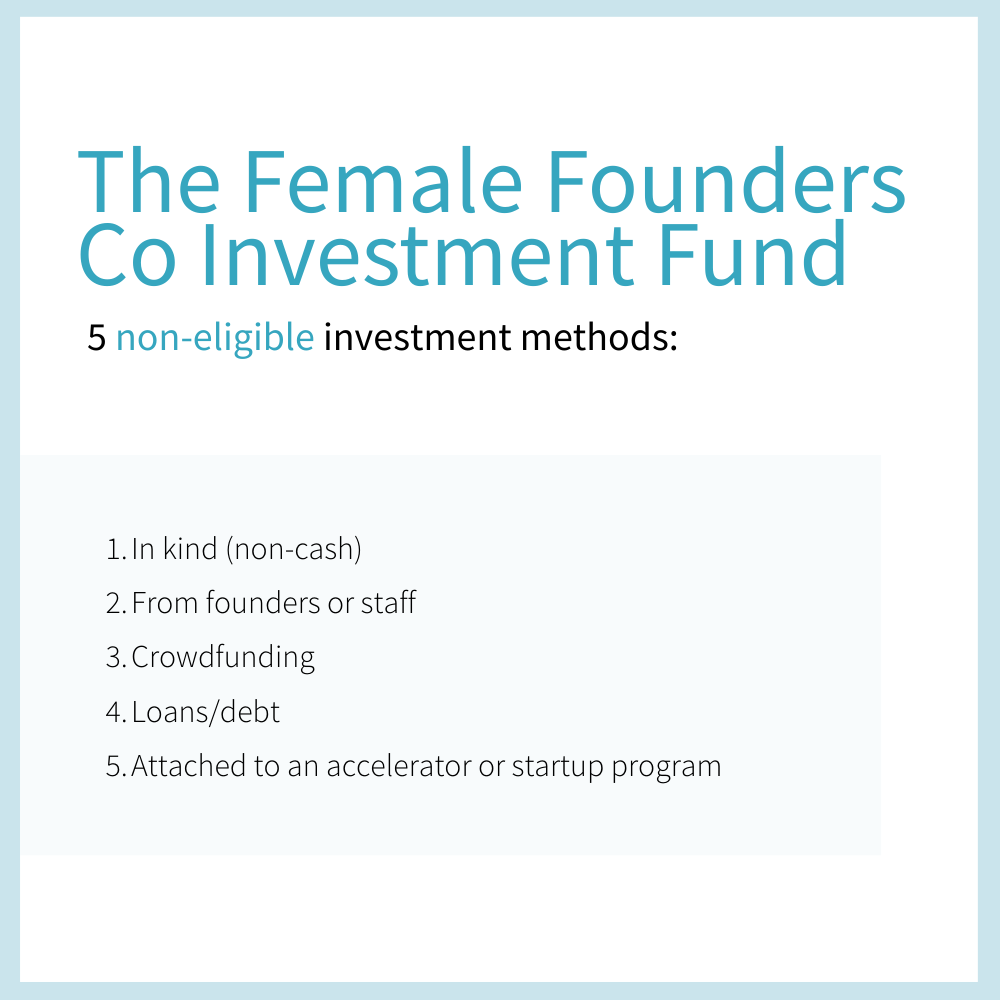
The Female Founders Co Investment Fund: Everything You Need to Know

Last reviewed: July 28, 2026


Securing initial capital remains a significant hurdle for female-led organisations in Australia. 

Recent reporting from the State of Australia’s Startup Funding reinforced this disparity, showing that from a $4 billion funding pool, only 2% was allocated to businesses founded entirely by women, 15% went to ventures with at least one female founder, while a staggering 70% was directed toward male-founded startups. 

This is why initiatives like the Female Founders Co Investment fund provided by the Queensland Government have been introduced to reduce the support gap that female innovators often face. 

In this article, we break down the Co Investment structure and what you need to know before applying. We also cover some features that can help increase the strength of your application. 


      1. What is the Female Founders Co Investment Fund?
      2. Program funding available
      3. How can I secure the Female Founders Fund
      4. Co-investment breakdown
      5. Timings and deadlines
      6. Uses of funding
      7. Expenditure not covered by funding
      8. What is the closing date for applications?
      9. Application status


Key takeaways 


  • The Female Founders Co-Investment Fund provides $50,000 to $200,000 in matched funding for eligible Queensland businesses raising early-stage investment capital.
  • Businesses must be female-founded and female-led, including at least 51% female ownership and female executive leadership.
  • The Female Founders Co-Investment Fund is available to innovation-driven businesses developing or commercialising innovative products or services.
  • Applicants must be headquartered in Queensland, have an active ABN and GST registration, and employ no more than 50 full-time equivalent staff.
  • Businesses that have previously raised more than $500,000 in capital are not eligible for the Female Founders Co-Investment Fund.
  • Private investment is required, as the fund operates through a co-investment model rather than a standalone grant.


1. What is the Female Founders Co Investment Fund? 

The Female Founders Co-Investment Fund was launched to support female-led, innovation-driven businesses in Queensland that are raising early-stage capital. The goal is to increase the volume and quality of private investment flowing to women-founded businesses with high-growth potential. 

The program offers matched grant funding to support qualifying capital raises. 


2. Program funding available 

The Female Founders Co-Investment Fund QLD is open to businesses looking at securing early investment. This grant has a threshold of $50,000 minimum to a maximum grant of $200,000 (1:3 matched with private investment) 


3. How can I secure the Female Founders Fund 

  1. Must be headquartered in Queensland, with an active ABN and GST registration 
  2. Be a female-founded and female-led business for at least six months prior to applying: 
    • Majority female-owned: at least 51% of shares held by a woman or women
    • Female-led: at least one woman holds a primary executive role (e.g. CEO, CFO, CTO, CSO)
    • If shares are held via a trust, the business must still demonstrate compliance
  3. Be an innovation-driven enterprise (IDE) developing or commercialising innovative products or services 
  4. Have no more than 50 full-time equivalent employees 
  5. Not be a subsidiary of a larger group 
  6. Not have previously raised more than $500,000 in capital.


Book a FREE consultation to find out if your business matches the application criteria.


4. Co-investment breakdown  

This fund adopts an alternative approach in government support by utilising a co-investment method. Rather than providing individual grants, the program is designed to work together with private investors.  

For every $3 raised from eligible external investors, the fund contributes $1 as a grant, up to a maximum of $200,000 (excluding GST), paid over a 12-month period. 


What does this mean? 

  Here’s an example of how the 1:3 ratio works: 

    • A startup led by a female founder secures $180,000 from eligible investors. 
    • The government fund will contribute $60,000 as a grant. 

That means the total funds available to the startup become: 

$180,000 (investors) + $60,000 (grant) = $240,000 


To qualify for a minimum grant of $50,000, the organisation must secure at least $150,000 in external investment. 

If this grant isn’t the one for you, check out our Top 5 Queensland Government Business Grants.


5. Timings and deadlines  

An important aspect of the Female Founders Co-Investment Fund is timing. Businesses that are provisionally approved for funding do not receive the grant immediately.  

Instead, they are given 180 calendar days (six months) to secure the required private investment from eligible investors. 


Application timeline: 

    • Apply: Your application is assessed. 
    • If provisionally approved: That means the fund likes your application in principle, but you don’t get the money right away. 
    • Clock starts: From the date of your provisional approval, you have 180 calendar days to secure your external private investment.  
    • If you succeed: Once you show proof of investment, the grant is confirmed and paid out. 
    • Unsuccessful: If you can’t secure the private investment in that timeframe, the grant funding offer lapses.


6. Uses of funding 

In the application, the use of funds must be specified. The grant must be used for projects to grow the business, such as:  

    • R&D 
    • marketing and advertising  
    • acquiring new customers 
    • expanding to new markets  
    • scaling production 
    • salary expenditure – subject to terms  


7. Expenditure not covered by funding  

    • construction of physical or IT infrastructure  
    • employee benefits 
    • seminar fees 
    • travel costs  
    • legal or licences fees 
    • general business operating costs 


8. What is the closing date for applications? 

The Program will remain open until all funds have been allocated. 

Applicants who meet the eligibility criteria will be assessed competitively and notified of the outcome by email within approximately 6-10 weeks. 

Not sure where to start, find out how a grant expert can help you:  What Does a Grant Consultant Do? | Comprehensive Guide by FundFindrs 


9. Application status 

Great news, submissions are now OPEN. Make sure your application is ready; remember you only have 6 months to secure funding once approved.  

If your business is currently raising or preparing to, this program can significantly boost your capital support. The FundFindrs team of experts can help you prepare the funding strategy, validate eligibility, and align your investment narrative to meet requirements.  

Maybe the Female Founders Co Investment Fund is not suitable to you, check out alternative supports available to Women In Business.


While self-assessment is possible, it’s easy to miss opportunities or make simple mistakes that will result in your application been rejected. Working with FundFindrs can help increase your chances of approval and ensure you optimise your time attracting external investment.   

Book a FREE consultation with our team today. 


Who’s Winning Grants – and What They’re Doing Differently

Last reviewed: July 28, 2026


Every year, billions of dollars in grants are distributed across Australia – from federal and state programs to corporate, philanthropic, and regional funding. Yet for every successful application, there are hundreds (and sometimes thousands) that don’t make it through. 

So, who’s actually winning grants right now? And what are they doing that others aren’t? 

I’ve seen thousands of applications, from community organisations and social enterprises to startups and larger businesses, and clear patterns emerge. The organisations and founders who consistently win funding don’t just write better applications. They think strategically, align with funding priorities, and treat grants as part of a long-term growth strategy.

Here’s what sets them apart.


  1. They build before they apply
  2. They align their mission with the funder’s agenda
  3. They measure what matters
  4. They use technology to stay ahead
  5. They think long-term 


Key takeaways 


  • Successful grant applicants prepare before opportunities open, with clear project plans, budgets, evidence and measurable outcomes already in place.
  • Winning grants requires strong alignment with funder priorities, demonstrating how a project supports outcomes such as innovation, sustainability, regional growth or job creation.
  • Funders assess outcomes, not just activities. Strong applications explain the impact a project will deliver and how success will be measured.
  • Funding-ready organisations maintain core application materials, including organisation profiles, financial information, project plans and capability statements.
  • Government priorities influence future funding opportunities, making it important to monitor policy, budget and industry trends.
  • Grant success is part of a long-term strategy, not a one-off application process.


1. They build before they apply 

The most successful applicants start long before they hit “submit.” They’re not waiting for the perfect opportunity to appear; they’re already funding-ready. 

That means: 

  • Clear goals and measurable outcomes 
  • A well-defined project plan 
  • A realistic budget 
  • Evidence of capability and delivery
     

When a grant opens, they can quickly align their work to the funder’s criteria. Meanwhile, less-prepared applicants scramble to retrofit their ideas into opportunities that don’t quite fit. 

Grant’d tip: Build a funding readiness kit — your go-to folder with your organisation profile, ABN/financials, capability statement, project plan, and team bios. It’ll save you hours later. 


2. They align their mission with the funder’s agenda

Winning grants means more than good writing. It’s about strategic alignment. 

Funders have agendas. Their job is to distribute money that achieves specific outcomes, like innovation, sustainabilitydigital transformation, inclusion, or regional growth.

Your job is to show how your project contributes to those outcomes. 

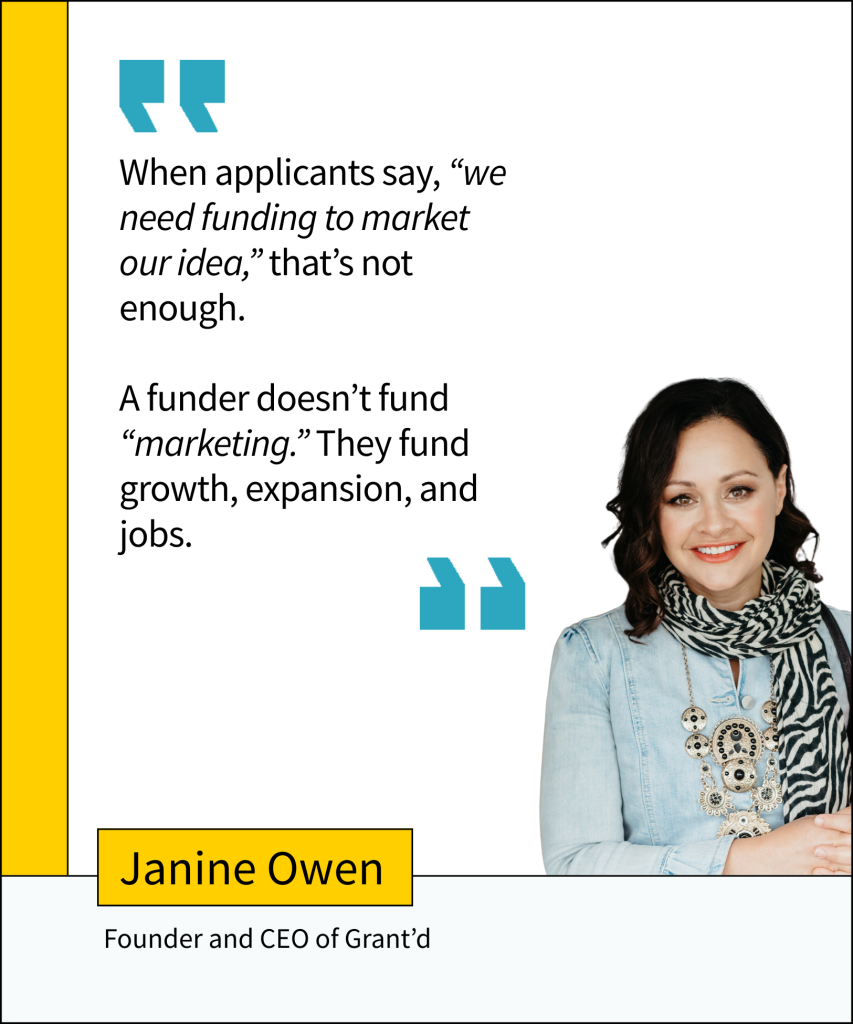
When applicants say, “we need funding to market our idea,” that’s not enough. A funder doesn’t fund “marketing.” They fund growth, expansion, and jobs. 

For example: 

  • “Marketing” → “Driving export growth and new market entry” 
  • “Software development” → “Digitising operations and enhancing industry productivity” 
  • “Community workshops” → “Building local resilience and creating pathways to employment”
     

Winners speak the language of impact, not just activity. 

Grant’d tip: Every funding opportunity is shaped by policy. If you follow the Federal Budget, state strategies, and ministerial priorities, you’ll see where funding is headed 6–12 months before programs launch. 


Janine Owen Founder and CEO of Grant'd RDTI quote


3. They measure what matters

The best applications go beyond outputs (“we’ll deliver 10 workshops”) to outcomes (“we’ll train 100 people and help 30 into new jobs”). 

Funders want to see tangible social or economic value, and confidence that you can track and report on it. 

The most competitive organisations integrate data collection and impact reporting from the start. They can easily quantify their outcomes when applying or acquitting.


4. They use technology to stay ahead

 Successful applicants don’t rely on luck or late-night research; they use systems and tools to keep their funding pipeline organised and opportunities visible.

Whether it’s tracking upcoming programs, setting alerts for new grants, or managing documentation in one central place, they make technology work for them.   

This gives them more time to focus on what really matters: refining their strategy, building strong partnerships, and demonstrating impact.  

Grant’d tip: Explore tools that help you centralise your grant search and management. The goal isn’t just efficiency — it’s freeing up time to focus on the strategic work that drives funding success. 


5. They think long-term

Winning one grant is great. But the real magic happens when organisations create a funding pipeline, planning 6–12 months ahead and aligning multiple grants across growth stages. 

That’s how small projects become sustainable programs and startups scale faster without relying entirely on investors.


Need help building your funding strategy?

Chat with our team to explore how we can help you plan, prepare, and position your next grant application.


Takeaway

The businesses winning grants aren’t chasing everything; they’re choosing strategically. They understand policy, stay prepared, and align their projects with the outcomes funders care about most. 

And the result? Less chasing, more winning.


About Grant’d  

Our mission is to make that process easier – giving you the AI tools, insights, and community to find, manage, and win grants with confidence.  

Learn more at grantd.com.au


From Mistakes to Mastery: Learning from Grant Application Errors

Last reviewed: July 28, 2026


If you’ve ever submitted a grant and received the dreaded “unsuccessful” email, you’re not alone. Every organisation that applies for funding experiences rejection at some point, even the best. 

The difference between those who give up and those who grow is what they do next. 

At Grant’d, we believe unsuccessful applications aren’t failures – they’re feedback. Every “no” is a data point you can learn from. 

Here’s how to turn mistakes into mastery.

  1. Most grant rejections are fixable
  2. Treat feedback as data, not emotion
  3. Build reusable system
  4. Remember: timing is everything
  5. Learn from others 


Key takeaways 


  • Most grant rejections are fixable, with common issues including poor alignment, unclear outcomes, weak evidence and unrealistic budgets.
  • Grant feedback should be treated as a learning opportunity, helping applicants identify gaps and improve future submissions.
  • Tracking lessons from previous applications can strengthen future results, making it easier to identify recurring weaknesses and opportunities for improvement.
  • Reusable grant content can improve efficiency, including organisation overviews, impact statements, team biographies and budget templates.
  • Timing matters. A strong project may be unsuccessful if it does not align with current funding priorities or program objectives.
  • Learning from other applicants and industry networks can improve grant readiness, helping businesses refine their approach and increase future funding success.


1. Most grant rejections are fixable 

When we unpack unsuccessful applications, the reasons are usually predictable, and solvable.

Common Mistake How to Fix It
Poor alignment Ensure your project directly advances the funder’s stated goals.
Vague outcomes Define clear deliverables and measurable impact.
Budget mismatches Keep figures realistic and consistent with the project scope.
Weak evidence Add supporting data, testimonials, or case studies.
Timing Sometimes, it’s just not the right round or focus – try again later.


Each of these can be addressed with better preparation and reflection. 


2. Treat feedback as data, not emotion

It’s easy to take rejection personally, but funders are assessing fit, not worth. When you receive feedback, analyses it systematically:
 

  • What keywords or themes do they use in the rejection? 
  • Which parts of your proposal might not have aligned? 
  • Were you clear about your outcomes and beneficiaries?
     

Document it. Build a “grant lessons” folder where you record what you learn from each submission. Over time, you’ll start to see patterns and strengths.


3. Build reusable system

Grant applications can be repetitive, but that’s an opportunity. Create templates for your: 

  • Organisation overview 
  • Impact statement 
  • Key team bios 
  • Budget structure
     

Then adapt them per grant. Tools like Grant’d help centralise this, so you can reuse winning language and track performance metrics over time.


Want expert eyes on your next grant or R&DTI submission? 
FundFindrs’ experts help you refine, align, and get funding-ready.


4. Remember: timing is everything


Sometimes, your project is excellent, but the funding cycle just doesn’t match. Government priorities shift annually. If your project wasn’t funded this round, it might be perfect next quarter when new programs open. 

The key is to stay funding-ready, your project brief, budget, and outcomes clear, so you can move fast when the right opportunity appears. 


5. Learn from others

Don’t learn in isolation. Join communities like Grant’d and FundFindrs to find other founders and learn from their experiences what have worked, what didn’t, and what changed their success rates. 

You’ll learn that every successful applicant has a history of rejection and every rejection made their next win stronger.

Takeaway 

Rejection isn’t the end of your funding journey; it’s part of the process. Every “no” gives you insight, clarity, and direction for the next “yes.”


About Grant’d  

Grant’d helps you build repeatable success, with smart matching, application tracking, and insights that evolve with you.  

 Learn more at grantd.com.au 


The Australian Business Funding Roadmap: 7 Funding Pathways and How to Combine Them

Australian businesses have access to a wide range of funding pathways, each designed to support different stages of growth and business objectives. These can include founder capital, government grants, the R&D Tax Incentive, business loans and other forms of non-equity finance, angel investment, venture capital, and export funding programs. The most appropriate funding pathway will depend on what a business is trying to achieve, whether that is developing a new product, commercialising innovation, scaling operations, improving cash flow or expanding into international markets. 

The right pathway depends on what you are trying to fund. A founder validating an idea will need something different from a manufacturer scaling production, a software company solving technical uncertainty, or an exporter entering a new overseas market. 

At FundFindrs, we work with Australian businesses to identify and access government grants and the R&D Tax Incentive. These are often powerful non-dilutive funding options because they can support innovation, commercialisation and growth without requiring founders to give away equity. But they rarely sit in isolation. In many cases, grants and R&D support work best when they are part of a broader funding roadmap. 


In this article, we will examine seven of the different funding pathways available to Australian businesses.


Key takeaways 


  • There is no single best funding option for every business. The right pathway depends on the business stage, growth objectives and the type of project being funded. 
  • Government grants and the R&D Tax Incentive can provide valuable non-dilutive funding for businesses investing in innovation, commercialisation, manufacturing capability and growth. 
  • Different funding pathways serve different purposes, from founder capital and debt funding through to angel investment, venture capital and export support. 
  • Many grant programs require businesses to contribute part of the project cost, making funding strategy, timing and co-contribution planning important. 
  • Grants and the R&D Tax Incentive do not need to replace investment or debt. They can often work alongside other funding sources as part of a broader funding roadmap. 
  • Businesses that understand their funding roadmap early are often better positioned to prepare evidence, align projects with eligibility requirements and identify future opportunities. 
  • The strongest funding outcomes occur when funding is aligned with business strategy rather than pursued as a standalone goal. 


Finding the right funding strategy


Australian businesses have more funding options available than ever before, from government grants and the R&D Tax Incentive through to loans, angel investment, venture capital and export funding. 

However, each funding pathway is designed to support different business objectives. Some are suited to innovation and product development. Others are designed to support commercialisation, international expansion, manufacturing capability or rapid scale. 

Understanding which funding options align with your business goals is an important first step in building a sustainable growth strategy. 


How the R&D Tax Incentive can support growth:

  • What funding options are available now 
  • What funding options may become available later 
  • Which grant programs require matched funding 
  • How to avoid relying too heavily on one source of capital 
  • How to preserve equity while still funding growth 
  • How to build the evidence needed for future applications 


7 funding pathways at a glance


Each funding pathway plays a different role in a business’s growth journey. The table below provides a high-level overview of the most common funding options available to Australian businesses, including when they are typically used and the key considerations associated with each. 


Funding pathway Best suited to Key benefit Key consideration
1. Founder capital Early validation Control and speed Personal risk and limited capacity
2. R&D Tax Incentive Eligible R&D activity Can help recover innovation costs Requires eligible activities, records and compliance
3. Government grants Defined projects Non-dilutive project funding Competitive and often requires co-contribution
4. Debt finance Working capital, equipment, bridging Avoids dilution Must be repaid
5. Angel investment Early growth and traction Capital plus expertise Equity dilution
6. Venture capital High-growth scaleups Large growth capital Dilution and growth expectations
7. Export funding International market expansion Supports export marketing and promotion Eligibility and timing vary by round


1. Founder capital


Founder capital is often the first funding pathway. It may come from personal savings, early shareholder contributions, director loans or money reinvested into the business by the founding team. 

It is useful because it gives founders control and can move quickly. There is no application round, no lender approval and no investor negotiation. But it also has limits. Founder capital can place personal pressure on the business owners and may not be enough to fund larger commercialisation, manufacturing, R&D or export projects. 


Best for:

Early validation, initial product development, customer discovery, small pilots and bridging gaps before external funding is available.


2. The R&D Tax Incentive


The R&D Tax Incentive (R&DTI) is one of the most important funding pathways for innovative Australian businesses. It is not a grant. It is a tax offset designed to encourage eligible companies to conduct research and development activities in Australia. 

According to the Australian Taxation Office (ATO), approximately 16,000 companies claim the R&D Tax Incentive each year, highlighting just how widely the program is used across the Australian innovation ecosystem. 

For many founders, CFOs and business leaders, the R&D Tax Incentive is overlooked because they do not describe their work as “research”. They may call it product development, engineering, testing, software development, process improvement or technical problem solving. But if the business is undertaking systematic experimentation to resolve technical uncertainty, it may be worth assessing whether the activity could qualify.
 

How the R&D Tax Incentive can support growth:

  • It can help recover part of eligible R&D costs. 
  • It can support reinvestment into future development. 
  • It can improve cash flow for eligible companies. 
  • It can sit alongside grants, investment and debt when structured correctly. 
  • It encourages businesses to keep better records of technical activities, experimentation and expenditure. 


The R&D Tax Incentive can be especially relevant for businesses developing software, engineering solutions, manufacturing processes, medical technology, clean technology, mining technology, agtech, robotics, AI or other innovation-led products and systems. 

Understanding what qualifies as an eligible R&D activity is often one of the most challenging aspects of preparing an R&D Tax Incentive claim. 


Best for:

Businesses developing new or improved products, processes, software, services or technologies through systematic experimentation, and seeking to reduce the cost of innovation through a tax offset or cash refund.


Not sure if you’re eligible for the R&D Tax Incentive?
Our FREE R&DTI Blueprint breaks it down with an eligibility checklist, examples, and expert tips from the FundFindrs team.


3. Government grants


Government grants can be powerful, but they are often misunderstood. The strongest grant candidates are not simply businesses that need money. They are businesses undertaking defined projects that align with government priorities, such as innovation, commercialisation, manufacturing capability, export growth, regional development, sustainability or productivity improvement.


What grants commonly support: 

  • Commercialising a new product, process or service 
  • Progressing a prototype or pilot into market readiness 
  • Scaling manufacturing capability 
  • Building sovereign capability in priority sectors 
  • Export promotion and international market development 
  • Sustainability, clean energy or emissions reduction projects 
  • Research collaborations and pre-commercialisation activities
     

What grants usually do not support:

  • General operating costs 
  • Undefined business growth 
  • Ordinary payroll expenses 
  • Business survival or cash flow gaps 
  • Projects with no clear innovation, commercial or economic outcome 


This is why eligibility is usually project-based. A business may be a strong company but still not have a suitable grant project. Conversely, a smaller business with a clearly defined innovation or commercialisation project may be better placed than it first assumes. 


Stronger grant candidates Less suitable candidates
Have a defined project Only have a general business idea
Have a prototype, proof of concept, pilot or commercialisation pathway Are at concept stage only
Can show economic, technical or commercial outcomes Need general operating funds
Can contribute matched funding where required Cannot fund their contribution
Have evidence, milestones and a delivery plan Have limited documentation or unclear scope


4. Business loans and non-equity finance


Loans and debt funding can support business growth without requiring founders to give away ownership. Options may include traditional bank loans, equipment finance, working capital facilities, invoice finance, venture debt and alternative lending products. Unlike grants or the R&D Tax Incentive, debt funding must be repaid, but it can provide faster access to capital for businesses with a clear repayment pathway, predictable revenue or an identifiable asset being funded. 


Businesses now have access to a broad range of funding providers, including:

  • Major banks 
  • Specialist and alternative lenders 
  • Equipment finance providers 
  • Invoice and debtor finance providers 
  • Venture debt and revenue-based finance providers 


Each provider will have different lending criteria, security requirements, repayment structures and risk appetites, so it’s important to understand which solution best aligns with your business objectives and cash flow position. 


Before taking on debt, businesses should consider:

  • Repayment capacity 
  • Interest costs and fees 
  • Security requirements and personal guarantees 
  • Cash flow impacts 
  • How debt integrates with grants, the R&D Tax Incentive and other funding sources 


The most effective funding strategies typically use debt as one component of a broader funding mix rather than as a standalone solution. 


FundFindrs insight:  

Debt funding and grants are often viewed as separate funding pathways, but they frequently work together. Many grant programs require businesses to contribute a portion of project costs through matched funding. Depending on the program rules and business circumstances, debt funding may help fund that contribution, allowing the business to undertake a larger project than would be possible using available cash alone. 


 5. Angel investment


Angel investors typically provide early-stage capital to startups and scaleups, often before a business is ready for institutional venture capital. Unlike loans, angel investment does not need to be repaid. In exchange, investors receive an ownership stake in the business and become invested in its future success. 

For many founders, the value of angel investment extends beyond the capital itself. The right investor may bring industry knowledge, founder experience, strategic guidance, commercial introductions and access to networks that can help accelerate growth. 

Angel investment can also work well alongside grants and the R&D Tax Incentive. A founder may use angel capital to support product development, fund the business contribution required for a matched grant, or extend runway while eligible R&D activities are underway. When combined effectively, these funding pathways can help businesses progress faster without relying on a single source of capital. 

Not all angel investors bring the same value, so it is important to look beyond funding and consider the experience, networks, and support they can offer. 


When evaluating potential investors, founders should consider:

  • Relevant industry knowledge and experience 
  • Access to customers, partners or industry networks 
  • A track record of supporting growing businesses 
  • Alignment with the founder’s vision and long-term goals 
  • The ability to support future fundraising activities 


Many experienced founders will tell you that choosing the right investor can be just as important as securing the investment itself. FundFindrs partners with Angel Investing  business Impactiv to support clients at the right time. 


Best for:

Early and growth-stage businesses seeking capital, strategic advice and industry connections from experienced investors who are willing to back high-potential growth opportunities.


6. Venture capital


Venture capital (VC) is a funding pathway used by high-growth businesses looking to scale quickly. Unlike grants, debt funding or the R&D Tax Incentive, venture capital involves exchanging equity in the business for investment capital. 

VC funding is typically suited to businesses with large market opportunities, scalable business models and ambitious growth plans. Beyond capital, investors may also provide strategic advice, industry expertise, customer introductions and support with future fundraising activities. 

However, venture capital is not the right pathway for every business at every stage. Many founders assume they need investment immediately, when there may be opportunities to build value first through grants, the R&D Tax Incentive or other non-dilutive funding sources. 


Non-dilutive funding pathways such as grants and the R&D Tax Incentive may help businesses:

  • Fund technical development before valuation discussions 
  • Build commercialisation evidence that investors want to see 
  • Extend runway without immediate dilution 
  • Demonstrate the ability to secure and manage external funding 
  • Reach key milestones before entering fundraising conversations 
  • Perhaps most importantly, grants and the R&D Tax Incentive do not need to replace investment. They can often work alongside venture capital to support specific projects, reduce cash burn and help businesses achieve more with the capital they raise. 


Best for:

High-growth businesses with a scalable business model that need significant capital to accelerate expansion, enter new markets or achieve rapid growth.


7. Export funding and market expansion support


Export funding becomes relevant once a business is ready to sell, promote or expand into international markets. Programs such as the Export Market Development Grants program have historically supported eligible Australian businesses with export marketing and promotional activities. 

Export funding is different from R&D or commercialisation funding. It generally does not fund the development of the product itself. Instead, it helps eligible businesses promote Australian goods, services, software, IP or know-how into international markets. 


Best for:

Businesses that have a market-ready product or service, a clear export strategy and eligible export promotion activity.


How these funding pathways work together


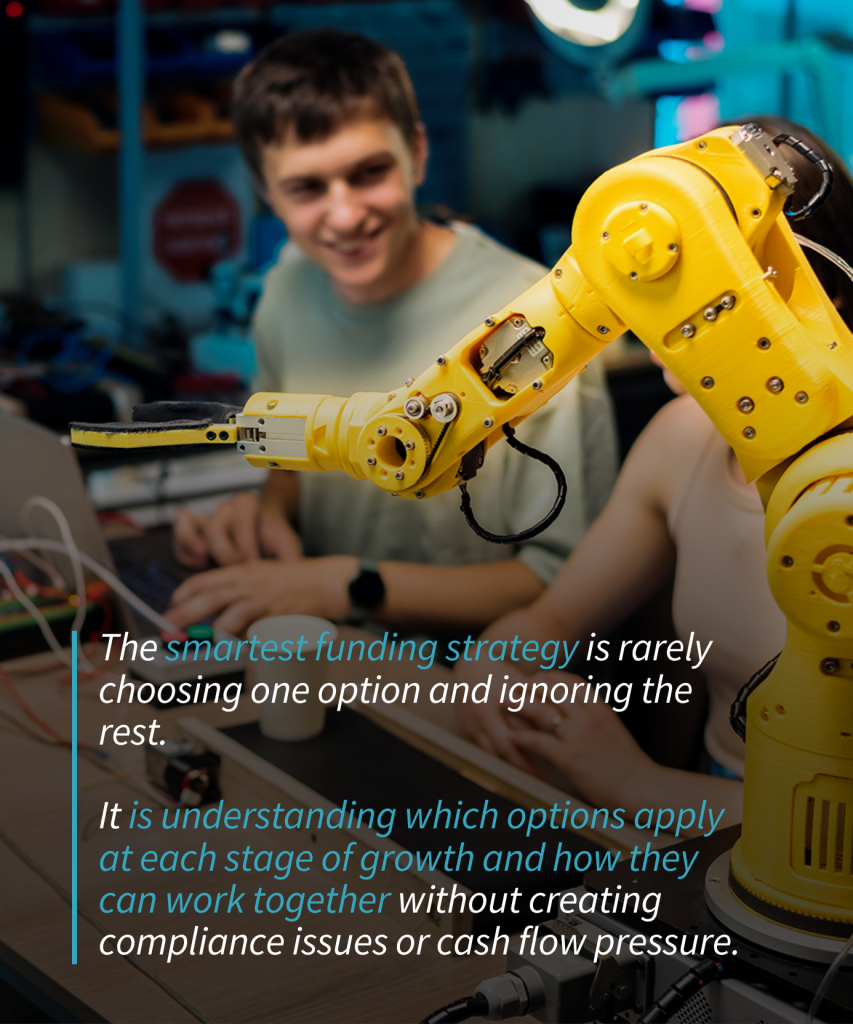
The smartest funding strategy is rarely choosing one option and ignoring the rest. It is understanding which options apply at each stage of growth and how they can work together without creating compliance issues or cash flow pressure. 


Business stage Likely funding need Relevant pathways Funding strategy question
Validate Prove the problem, develop early product, test demand Founder capital, angel investment, early R&D assessment What evidence do we need before applying for external funding?
Innovate Solve technical problems, build or improve product, test uncertainty R&D Tax Incentive, founder/angel capital Are we documenting eligible R&D as we go?
Commercialise Move from prototype or pilot toward market Government grants, angel investment, debt, R&D Tax Incentive Do we have a defined project, budget, milestones and matched funding?
Scale Grow production, hire, enter new markets, improve capability Grants, debt, VC, R&D Tax Incentive What capital mix gives us speed without unnecessary dilution?
Expand Export, international marketing, larger partnerships Export funding, VC, debt, grants Is our export plan well evidenced and timed with funding rounds?


Example funding stacks


Example 1: Early-stage technology startup 

  • Founder capital funds early validation and proof of concept. 
  • Angel investment supports the first team members and product development. 
  • The R&D Tax Incentive is assessed for eligible technical development work. 
  • A commercialisation grant is explored once the project, budget and market pathway are clearer. 


Example 2: Innovative manufacturer

  • Internal cash funds planning and early design work. 
  • Equipment finance supports new machinery or production capability. 
  • Government grants are explored for eligible manufacturing capability or commercialisation projects. 
  • The R&D Tax Incentive is assessed for technical experimentation and eligible development activity.
     

Example 3: Export-ready business

  • Revenue or working capital funds core operations. 
  • Export funding supports eligible international marketing or promotion. 
  • R&D Tax Incentive may support ongoing product or technology development. 
  • Debt or investment may fund inventory, staffing or market-entry costs that grants do not cover.


funding pathways article


Key considerations before choosing a funding pathway


1. What are you funding? 

A funding pathway should map to a specific need. Are you developing technology, commercialising a product, buying equipment, funding export marketing, covering working capital or hiring a team? The answer changes which options are relevant. 


2. Are you eligible now, or preparing for later? 

Some funding options are available only at certain stages. For example, many grants require evidence of a prototype, pilot, market demand or matched funding. If you are not eligible now, the right strategy may be to prepare your documentation and timing for a future round. 


3. Do you have the evidence?

For grants, evidence may include project plans, budgets, quotes, customer demand, IP ownership, financial capacity and commercialisation milestones. For the R&D Tax Incentive, evidence usually relates to activities, technical uncertainty, experimentation, records and expenditure. 


4. What is the true cost of capital? 

A grant may be non-dilutive, but it may require a co-contribution and reporting. Debt avoids dilution, but it must be repaid. Equity can accelerate growth, but it reduces ownership. The right answer depends on the business model and risk profile. 


5. Can the funding sources be combined properly?

Some funding pathways can complement each other. Others may create issues if the same expenditure is claimed twice or if program rules restrict the use of other funding. This is why a funding roadmap matters. The goal is not to chase every opportunity. It is to understand what fits and when. 


Final thoughts: funding should follow strategy


The most successful businesses do not chase funding for the sake of it. They understand what they are building, what stage they are at, what capital they need, and which funding pathways can support their next move. 

 For innovative Australian businesses, grants and the R&D Tax Incentive should be core considerations. They can support product development, commercialisation, manufacturing capability, export growth and reinvestment into future innovation. But they work best when considered alongside the full funding mix, including founder capital, debt, angel investment and venture capital. 

 If you are building, testing, commercialising or scaling something new, FundFindrs can help you understand what funding pathways may be available and how grants and the R&D Tax Incentive could fit into your broader growth strategy. 

Speak with FundFindrs about grants, R&D Tax Incentive eligibility and funding opportunities aligned with your growth plans. 


Advancing Renewables Program (ARENA): Funding Guide for Australian Businesses

Last reviewed: July 03, 2026

Australia’s transition to net zero relies heavily on the commercialisation and large-scale deployment of renewable energy technologies. The Advancing Renewables Program (ARP), administered by the Australian Renewable Energy Agency (ARENA), is one of the Federal Government’s flagship funding programs supporting this shift. 

Designed to back mid to late-stage renewable energy projects, the program provides flexible, milestone-based grant funding to help innovative businesses demonstrate, deploy and scale technologies that can materially reduce emissions and strengthen Australia’s clean energy system. 

This guide explains how the Advancing Renewables Program works, who it’s for, what it funds, and how Australian businesses can get support to position themselves for a competitive application.  


Key takeaways 


  • ARP is ARENA’s flagship grant program for mid to late-stage renewable energy projects focused on demonstration, deployment and commercial scale-up.
  • ARENA funding supports projects with a clear pathway to deployment and scale, not early-stage concepts or research-only activities.
  • Funding is milestone-based, with payments typically linked to agreed project outcomes and delivery progress.
  • Co-contribution is an important requirement, with applicants expected to demonstrate financial capacity and strong project backing.
  • Commercial readiness matters as much as innovation. Strong applications show a clear market pathway, financial discipline and measurable energy system impact.
  • ARENA supports projects that help accelerate Australia’s transition to net zero by improving renewable energy deployment, performance, integration or adoption.


1 – What is the Advancing Renewables Program (ARENA)? 

The Advancing Renewables Program is ARENA’s primary grant initiative focused on accelerating Australia’s transition to net zero through renewable energy innovation, demonstration and deployment. 

The program supports projects that move beyond early-stage research and are ready for real-world application and commercial scale-up. Program priorities and guidelines are maintained by ARENA and updated periodically to reflect national energy policy and market needs. 

Projects supported under the program typically aim to: 

  • Demonstrate or deploy renewable energy technologies at commercial or near-commercial scale 
  • Reduce costs and improve the performance of renewable energy generation 
  • Enable system integration, flexibility and reliability 
  • Address technical, regulatory or financial barriers to renewable energy uptake


2 – What types of projects does ARENA fund?

ARENA funding is targeted at projects with a clear pathway to deployment and scale. 

Supported project types commonly include: 

  • Renewable energy demonstration and deployment
    Projects that validate performance, reliability or cost improvements of renewable energy technologies in real-world conditions.
  • Enabling technologies for renewable energy integration
    Solutions that improve system flexibility, integration, storage, transmission or reliability across the energy network.
  • Commercial-scale clean energy solutions
    Projects focused on scaling proven technologies and accelerating market adoption.


3 – Who is the program designed for?

The program is best suited to:

  • Mid to late-stage clean energy innovators 
  • Technology developers ready for commercial deployment 
  • Energy companies implementing new or improved renewable solutions 
  • Businesses seeking to scale proven renewable technologies 

A strong application demonstrates not only innovation, but also commercial readiness, financial discipline and measurable impact. 


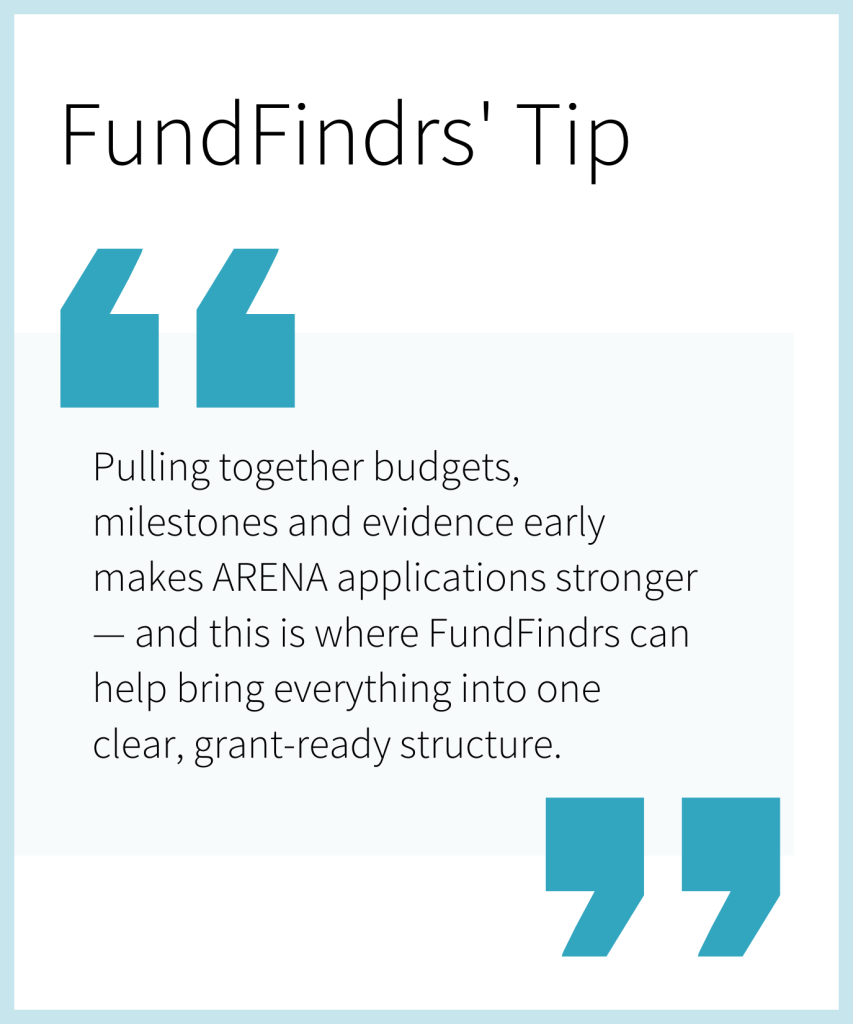
ARENA applications are assessed on more than technical innovation. FundFindrs supports businesses to interpret program requirements.


Eligibility criteria 

To be eligible for ARENA funding, applicants must meet both entity and project requirements.

Eligible entities must: 

  • Hold an Australian Business Number (ABN) 
  • Be an Australian-incorporated entity

Eligible project types: 

Projects must involve renewable energy technologies aligned with ARENA’s priorities and objectives.

Technology readiness requirements: 

  • Projects focused solely on early-stage research or student training are generally not supported 

Applicants must also provide a detailed project budget, financial model and milestone plan. 


ARENA - FundFindrs Tip


4 – How much funding is available through ARENA?

Grant funding structure

  • Funding is provided as milestone-based grant payments 
  • Payments are linked to the achievement of agreed project outcomes 

Grant amounts 

  • No fixed upper funding limit 
  • Previous ARENA grants have ranged from $100,000 to over $50 million, depending on scope and impact 

Co-contribution requirements 

  • Applicants must contribute a minimum of 50% of total project costs 
  • Contributions may include cash and eligible in-kind support


Application status
 

The Advancing Renewables Program operates on an open, year-round basis, rather than fixed funding rounds. 

Applications can be submitted when a project is ready, provided it aligns with ARENA’s current priorities and assessment criteria. 


Get expert support with your ARENA application
 

Excited about ARP but unsure if your project is the right fit or how competitive your application would be? 

Early preparation makes a measurable difference for complex, high-value grants like ARENA. If you want to assess eligibility, clarify next steps and build a funding strategy book a FREE consultation with FundFindrs today. 


What Government Will Be Funding in 2026

Last reviewed: July 03, 2026 


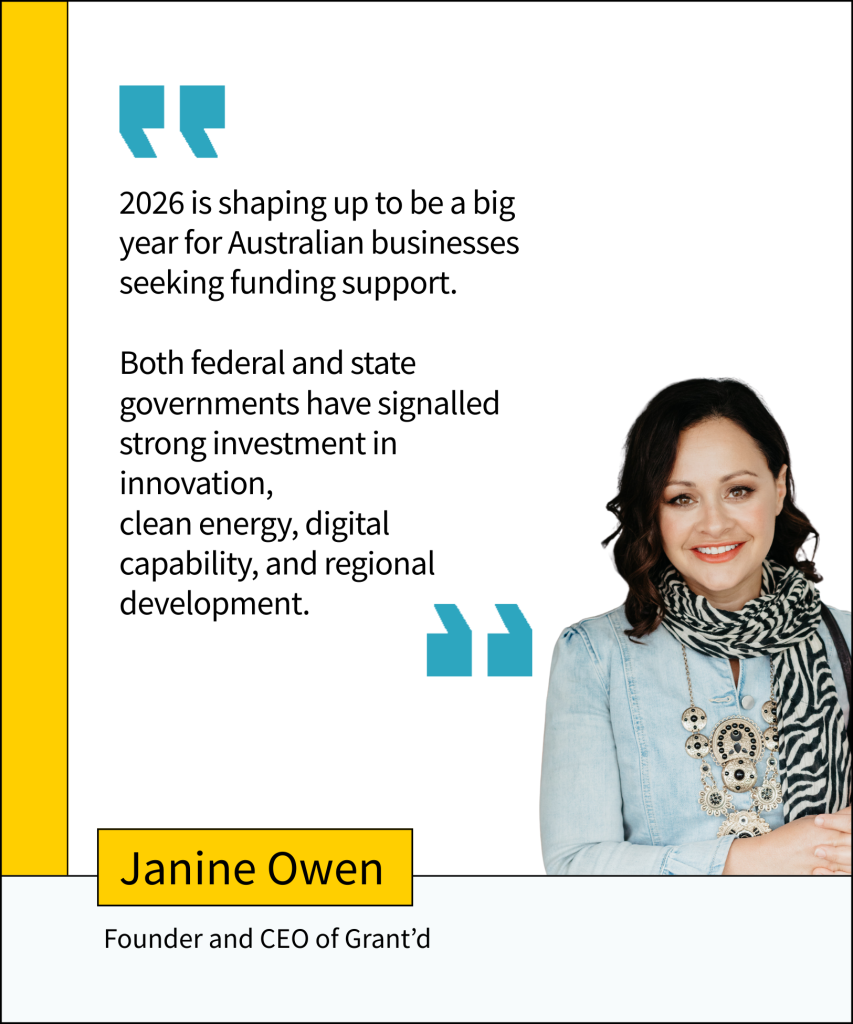
2026 is shaping up to be a big year for Australian businesses seeking funding support.
 Both federal and state governments have signalled strong investment in innovation, clean energy, digital capability, and regional development.

But with more money also comes more competition. The real advantage goes to businesses that understand where government priorities sit and prepare early.

Here’s what’s driving funding decisions in 2026 and how to get access to the grants that are on your radar. 


Key takeaways 

  • Six sectors dominate government funding in 2026: clean energy, R&D and commercialisation, digital capability, manufacturing and critical minerals, workforce development, and regional growth.
  • The R&DTI remains a key national funding mechanism and is expected to remain a stable source of support for eligible R&D activities.
  • Co-funding requirements are increasing. More programs are expected to require matched contributions from applicants.
  • Outcomes matter more than ever. Governments are increasingly prioritising projects that demonstrate jobs growth, economic impact, emissions reduction and export opportunities.
  • Competition is intensifying. Growing demand and capped budgets mean businesses need to be prepared to act quickly when opportunities arise.
  • Preparation is the real advantage. Businesses that align projects with government priorities and prepare early are better positioned for funding success.


Where the money goes: an industry breakdown 

1 – Clean energy and decarbonisation 

Achieving net zero remains a national priority. Expect strong funding for clean energy projects, emissions reduction, electrification, and circular economy solutions. This includes everything from battery manufacturing to energy-efficient infrastructure. 


2 – R&D and commercial innovation 

Innovation continues to be a core pillar of Australia’s productivity push. Programs that support R&D, commercialisation, prototypes and pilot trials will remain active. The R&DTax Incentive continues to anchor this space and is expected to stay stable. 

 
3 – Digital capability and cybersecurity 

Cyber threats and digital adoption gaps remain major risks for SMEs. Governments are likely to support initiatives that help businesses adopt new technologies, improve resilience, and lift digital productivity. 


4 – Manufacturing and critical minerals 

Federal and state governments want more value-adding done in Australia. High-tech manufacturing, critical minerals processing, and advanced materials are key areas where funding is expected to grow. 

 
5 – Workforce and skills development 

Skills shortages aren’t going away. Funding for apprentices, traineeships, workforce retraining and clean energy skills development will remain strong in 2026.


6 – Regional and export development 

Regional funding continues to help businesses expand, innovate and hire locally. 


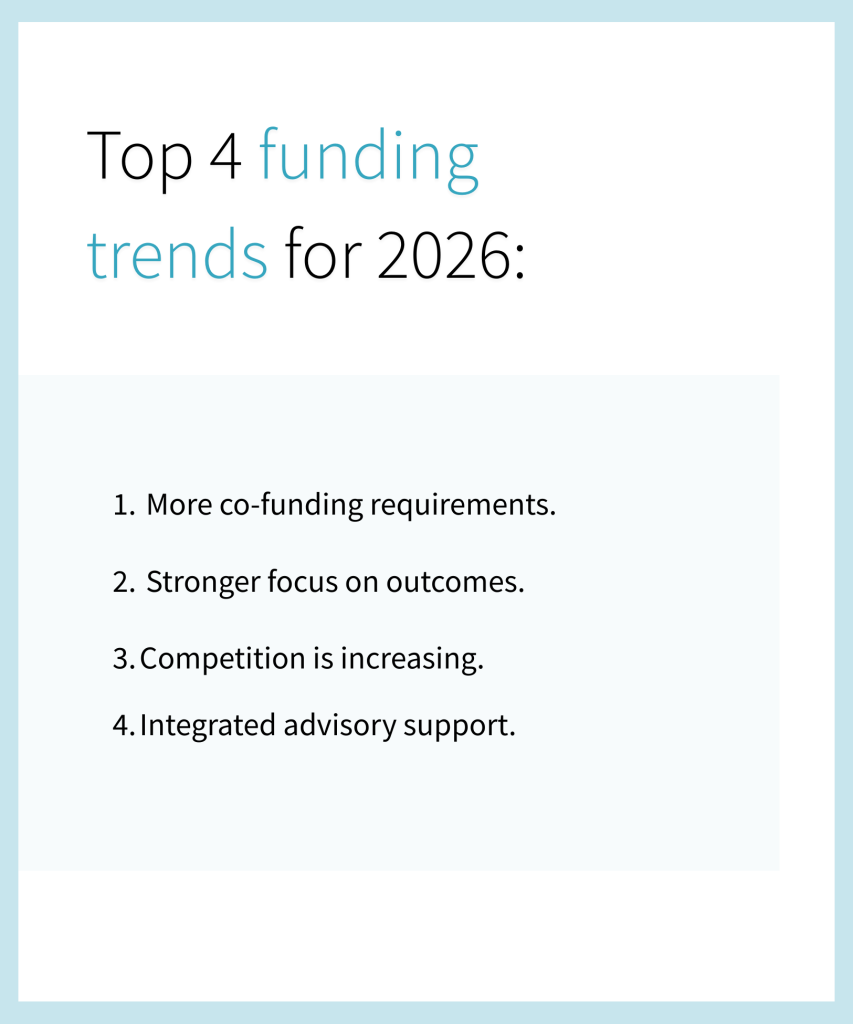
Top 4 funding trends for 2026 

 1 – More co-funding requirements 

Expect more programs to require matched contributions. It ensures businesses share the risk and are invested in the project. 


2 – Stronger focus on outcomes 

Governments want measurable impact. Jobs, economic uplift, emissions reduction and export growth are high on the list. 


3 – Competition is increasing 

With more demand and capped budgets, programs are becoming more competitive and sometimes first-come, first-served. Preparing early is critical


4 – Integrated advisory support 

More grants now come with mentoring or capability-building components. This builds stronger businesses and increases project success. 


How to get grant ready for 2026 

Step 1 | Align your projects with priority areas 

Frame your work in a way that connects clearly to government priorities like net zero, digital transformation or advanced manufacturing. 


Step 2 | Organise your documents now 

Have your financials, business plan, project plan and budget ready. When a grant opens, you want to move fast. 


Step 3 | Track announcements and timelines 

Follow federal and state updates. Subscribe to business.gov.auGrantConnect, your state’s business email updates, and FundFindrs newsletter. 


Step 4 | Build relationships and seek advice 

Connect with industry groups, funding bodies, accelerators and universities. A strong partner can elevate your application.


The bottom line 

2026 will offer some solid opportunities for businesses that prepare early. Governments are funding innovation, clean energy, digital capability and economic growth, but competition will be strong. 

If you know what you need, align with the right priorities, and stay ready, grants can help you move faster and with far less risk. 

Start planning now, build your funding roadmap, and you’ll be in a strong position to apply with confidence in 2026.  


About Grant’d 

Grant’d is Australia’s first intelligent, end-to-end funding ecosystem for startups, SMEs and purpose-led organisations. 

The platform helps you: 

  • find the right grants in under a minute
  • understand eligibility instantly
  • build a proactive funding roadmap
  • track deadlines and manage applications in one place

Grant’d takes the guesswork out of grants so you can focus on building, scaling and delivering impact. Learn more at grantd.com.au.

Eligible R&D Activities: What It Means for the R&D Tax Incentive in Australia

Last reviewed: July 17, 2026


The R&D Tax Incentive (R&DTI) is one of Australia’s most valuable programs for innovative businesses, but many companies still struggle with one core question: “What actually counts as eligible R&D activities?” 

Understanding what the legislation means by eligible R&D activities, and how to distinguish core from supporting activities, is essential for maximising your claim and reducing compliance risk. This guide breaks it down in clear, practical terms to help you assess eligibility with confidence.  


Key takeaways 


  • Eligible R&D activities must address a technical uncertainty through a structured process of experimentation.
  • Not all innovative work qualifies for the R&D Tax Incentive. Activities must satisfy specific legislative requirements.
  • Core R&D activities require an unknown outcome, a systematic progression of work, and the generation of new knowledge.
  • Supporting R&D activities may also be claimable when they are directly related to eligible core R&D activities.
  • Correct classification is critical, helping businesses maximise eligible claims while reducing compliance risk.
  • Good documentation is essential, including evidence of hypotheses, testing, results and conclusions.


What “eligible R&D activities” means 


Under Australian law (Income Tax Assessment Act 1997), eligible R&D activities are activities that involve experimentation, carried out for the purpose of creating new knowledge or developing new or improved products, processes, materials or services. 

To be eligible, activities must meet specific legal criteria, not simply feel “innovative” or “new to your business”. 

In simple terms: Eligible R&D must try to solve a technical uncertainty using a structured, experimental approach. 


Core R&D activities. Definition and requirements 


Core R&D activities are the heart of your claim. According to business.gov.au and the legislation, a core R&D activity must meet all of the following: 


1. The Outcome cannot be known in advance

There must be technological or scientific uncertainty, and you genuinely do not know whether something will work until you test it. 


Example: 

  • Developing a new process to convert agricultural waste into a stable biofuel where no proven methodology exists. 
  • Attempting to improve battery performance beyond known industry baselines using a novel electrolyte formula. 


2. Conducted using a systematic progression of work

This means you must follow an experimental method, such as: 

  • Defining a hypothesis 
  • Designing an experiment 
  • Observing results 
  • Evaluating findings 
  • Drawing conclusions 


Example: 

  • A robotics startup documents assumptions, test parameters, failure modes, modifications, and retesting cycles while prototyping a new autonomous navigation system. 


3. Based on established principles of science, engineering or computer science

You don’t need to be developing a world-first invention, but your work must use a recognised technical discipline. 


4. For the purpose of generating new knowledge

This includes new or improved materials, products, devices, processes or services.


Not sure if you’re eligible for the R&D Tax Incentive?
Our FREE R&DTI Blueprint breaks it down with an eligibility checklist, examples, and expert tips from the FundFindrs team.


Supporting R&D activities. What qualifies? 


Supporting R&D activities are activities that directly relate to a core R&D activity or, in some cases, are undertaken for the main purpose of supporting core R&D. 


Key requirement:
 

 Supporting activities must not stand alone. They only become eligible because they enable, assist or provide necessary input into the core experiments. 


Examples of supporting R&D activities:

  • Designing prototypes required for testing 
  • Software coding that implements the algorithm being experimentally tested 
  • Data cleaning or dataset preparation for machine learning model experiments 
  • Engineering drawings for test rigs 
  • Technical research to inform experiment design 
  • Testing materials, components, or code modules to isolate variables 


Activities requiring the “dominant purpose” test
 

 Some tasks could be everyday business activities unless they exist solely to support R&D. These must pass the dominant purpose test. 


Examples include: 

  • Project management of an R&D project 
  • Feasibility studies 
  • Compliance testing required to characterise experimental outcomes (not regulatory approval testing) 
  • Technical analysis outside of normal production work 


What is NOT considered eligible R&D (common exclusions) 


Many activities feel innovative but do not meet legislative requirements for eligible R&D. 

 Here are some of the most common exclusions: 


Routine activities

  • Routine testing or quality assurance 
  • Debugging that follows known solutions 
  • Cosmetic changes to products 


Market-focused or business activities

  • Market research 
  • Consumer testing for preferences 
  • Branding, UI/UX work that isn’t technically experimental 
  • Sales activities or customer discovery interviews 


Software exclusions 

  • Software developed for internal administration, such as: 
  • Payroll systems 
  • CRMs 
  • Inventory management 
  • Scheduling systems 


Commercial or regulatory tasks 

  • Product certification 
  • Compliance testing for approval 
  • Beta testing by customers 


Replicating known technology

If the method, solution or approach is publicly available or already proven, it cannot be claimed as core R&D. 


Assess your activities


Here’s your FundFindrs handy checklist to help you more easily decide which activities are eligible R&D activities and which are not. Note, this advice is general in nature. 


Core R&D eligibility checklist 

 Your activity likely qualifies as core R&D if: 

  • You faced a technical problem with no known solution 
  • Your team could not predict the outcome using existing knowledge 
  • You ran structured experiments (hypothesis → test → evaluate → iterate) 
  • You recorded observations, failures, data, and conclusions 
  • The work involved scientific/engineering/computer science principles 
  • The purpose was to create new knowledge or capability 


Supporting R&D eligibility checklist 

Your activity may qualify as supporting R&D if: 

  • It enabled, assisted or directly related to a core R&D experiment 
  • The activity would not have been undertaken if the R&D project didn’t exist 
  • Technical staff or engineers were required to perform it 
  • Documentation exists linking the activity to the core R&D timeline 
  • If the “dominant purpose” test is necessary, it’s established that the dominant purpose was to support experimentation 


Exclusion red flags

If any of these apply, you may need to rethink your activities’ eligibility: 

  • The work was commercially focused, not experimentally focused 
  • The outcome was known before testing 
  • The work followed standard testing or debugging processes 
  • Activities were administrative, operational or design-only without experimentation


To discuss the eligibility of R&D activities you are conducting (even if you are unsure), book a FREE consultation with a FundFindrs expert.


Evidence requirements. What documentation should you keep? 


Good record-keeping is essential for demonstrating eligible R&D activities in Australia. 

Required evidence includes: 

  • Technical project plans and hypotheses 
  • Experiment logs, test plans and test results 
  • Version control logs (Git, JIRA, Confluence, etc.) 
  • Data sets and analysis outputs 
  • Photographs or videos of prototypes 
  • Lab notes or engineering notebooks 
  • Time tracking for R&D personnel 
  • Invoices for materials, prototypes and contractors 
  • Minutes from technical meetings 
  • Failure analysis and iteration notes 


FundFindrs’ tip

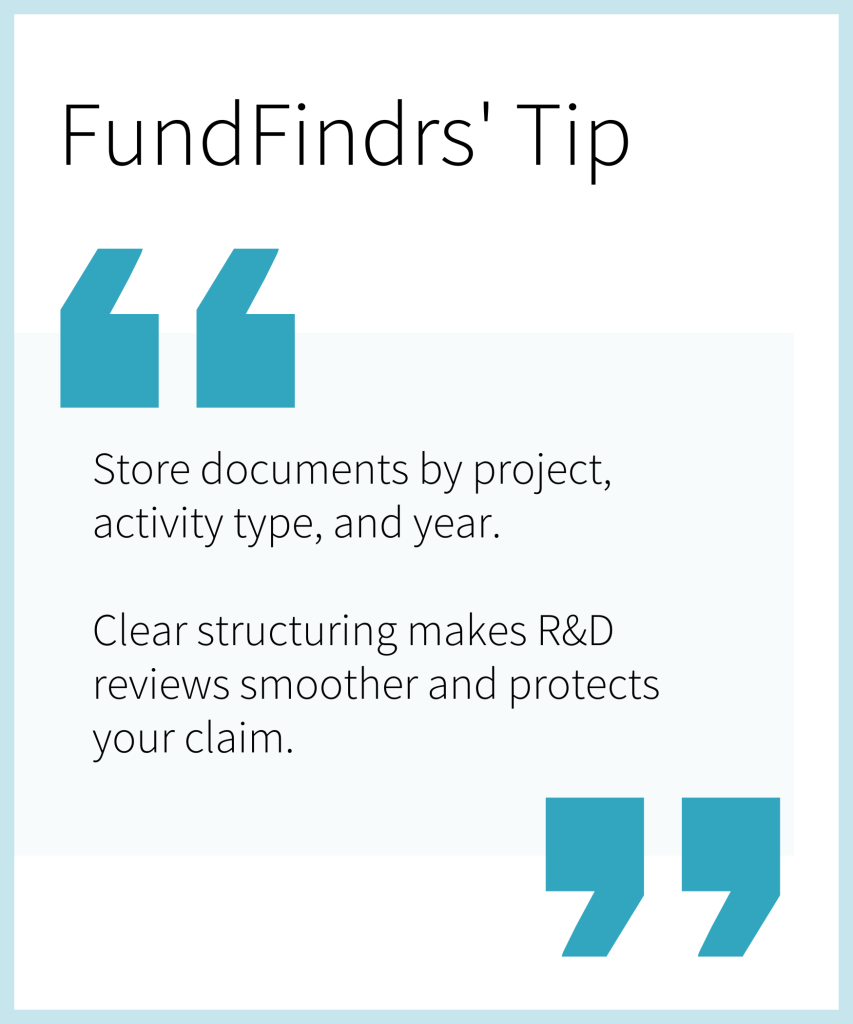
 Store documents by project, activity type, and year. Clear structuring makes R&D reviews smoother and protects your claim. 


Why correct classification matters

Incorrectly claiming activities as R&D can lead to: 

  • Claims being denied 
  • Audits 
  • Repayment of offsets 
  • Penalties 


Correctly identifying core vs supporting R&D activities is the foundation of an eligible, defensible R&D Tax Incentive claim. 


Thinking about your R&D eligibility? FundFindrs can help.

Assessing eligible R&D activities in Australia can be complex, especially when innovation overlaps with day-to-day operations.  

Our team specialises in helping founders, business leaders and technical teams: 

  • Identify eligible core and supporting R&D activities 
  • Build defendable documentation 
  • Align financials and technical work 
  • Maximise R&D returns while reducing compliance risk 


If you’d like clarity on how to assess R&D eligibility or you need support with preparing your claim, book a FREE consultation with FundFindrs today.