Last reviewed: July 03, 2026
The Emerging Technology Commercialisation Fund (ETCF) 2026 is a new NSW Government program designed to help innovative startups and SMEs move promising technologies closer to market.
With $20 million in funding available, the program aims to support businesses developing emerging technologies that need further development before they are ready for commercial deployment.
For companies working on breakthrough solutions, understanding how the ETCF works — and whether your project could be eligible — may open valuable opportunities to accelerate innovation and growth.
- What is the Emerging Technology Commercialisation Fund (ETCF)?
- How much funding is available?
- What types of projects are eligible for ETCF funding?
- Who is eligible to apply?
- What might an ETCF-supported project look like?
- Strategic considerations before applying
- How ETCF fits into Australia’s broader innovation funding landscape?
- How fundfindrs helps businesses navigate emerging technology funding?
Key takeaways
- $20 million is available through the NSW Government’s ETCF, administered by the Office of the Chief Scientist and Engineer.
- Grants range from $500,000 to $2 million per project and are structured as repayable grants once EBITDA exceeds $500,000.
- The program targets technologies at TRL 3–7, supporting projects that have moved beyond early research but are not yet commercially deployed.
- Applicants must meet NSW-based eligibility requirements, including headquarters and workforce location criteria.
- Stage 1 includes a pitch video, meaning the commercial narrative is just as important as the technology itself.
- ETCF and R&DTI are complementary programs, supporting different stages of the innovation and commercialisation journey.
1 – What is the Emerging Technology Commercialisation Fund (ETCF)?
The Emerging Technology Commercialisation Fund (ETCF) is a NSW Government program administered by the Office of the Chief Scientist and Engineer.
The program provides funding to help innovative companies advance emerging technologies toward commercial readiness, supporting projects that require further development before entering the market.
The fund was first announced in the 2025–26 NSW Budget and forms part of the government’s Innovation Blueprint, a broader strategy aimed at strengthening innovation and research commercialisation across NSW. The first funding round includes a $7 million allocation.
ETCF focuses on technologies progressing along the Technology Readiness Level (TRL) scale, helping businesses move from prototype or proof-of-concept toward commercial demonstration.
Key objectives of the program include:
- accelerating the commercialisation of emerging technologies
- reducing financial risk during late-stage research and development
- strengthening NSW’s innovation capability and industry competitiveness
2 – How much funding is available?
The ETCF provides significant financial support for eligible companies progressing emerging technologies.
Grant amount
- Between $500,000 and $2,000,000 per project
Total funding pool
- $20 million allocated to the program
Grant structure
- The ETCF is structured as a repayable grant. Repayments are typically made in instalments and commence in the financial year when the recipient’s EBITDA exceeds $500,000, as outlined in the program guidelines.
Application timeline
- Applications open: 6 March 2026
- Applications close: 29 April 2026
Projects funded through the program are typically expected to be completed within two years, helping accelerate development timelines and support commercial deployment.
Exploring the ETCF opportunity?
Our team can help you assess eligibility and plan your funding strategy.
3 – What types of projects are eligible for ETCF funding?
The ETCF focuses on technologies that have already reached an early validation stage but require further development before commercial deployment.
Eligible projects generally fall within Technology Readiness Levels (TRL) 3–7, which may include activities such as:
- prototype development and engineering refinement
- pilot programs or demonstration trials
- regulatory approvals and product testing
- scaling early-stage manufacturing processes
- intellectual property protection and commercialisation planning
The program supports technologies across both physical sciences and biological sciences, including sectors such as:
- advanced manufacturing
- biotechnology and life sciences
- clean energy and net-zero technologies
- housing and construction innovation
- advanced materials and engineering systems
These sectors align with NSW priorities to strengthen innovation capability and industry competitiveness.
4 – Who is eligible to apply?
To apply for the ETCF, businesses must meet several key eligibility criteria.
Applicants must:
- be a for-profit company incorporated in Australia
- be headquartered in NSW
- have an active ABN
- employ more than 65% of staff in NSW
- have annual revenue under $2.5 million
- own or hold exclusive rights to commercialise the relevant intellectual property
5 – What might an ETCF-supported project look like?
To illustrate the types of innovations the ETCF aims to support, the following examples show projects that could align with the program’s commercialisation focus.
Examples of projects that may align with the program include:
- AI-driven platforms improving safety or productivity in infrastructure and construction
- biotechnology innovations progressing toward clinical or regulatory validation
- advanced battery or energy storage technologies moving from prototype to pilot production
- new materials or construction technologies designed to improve sustainability
- robotics or automation systems developed for advanced manufacturing
6 – Strategic considerations before applying
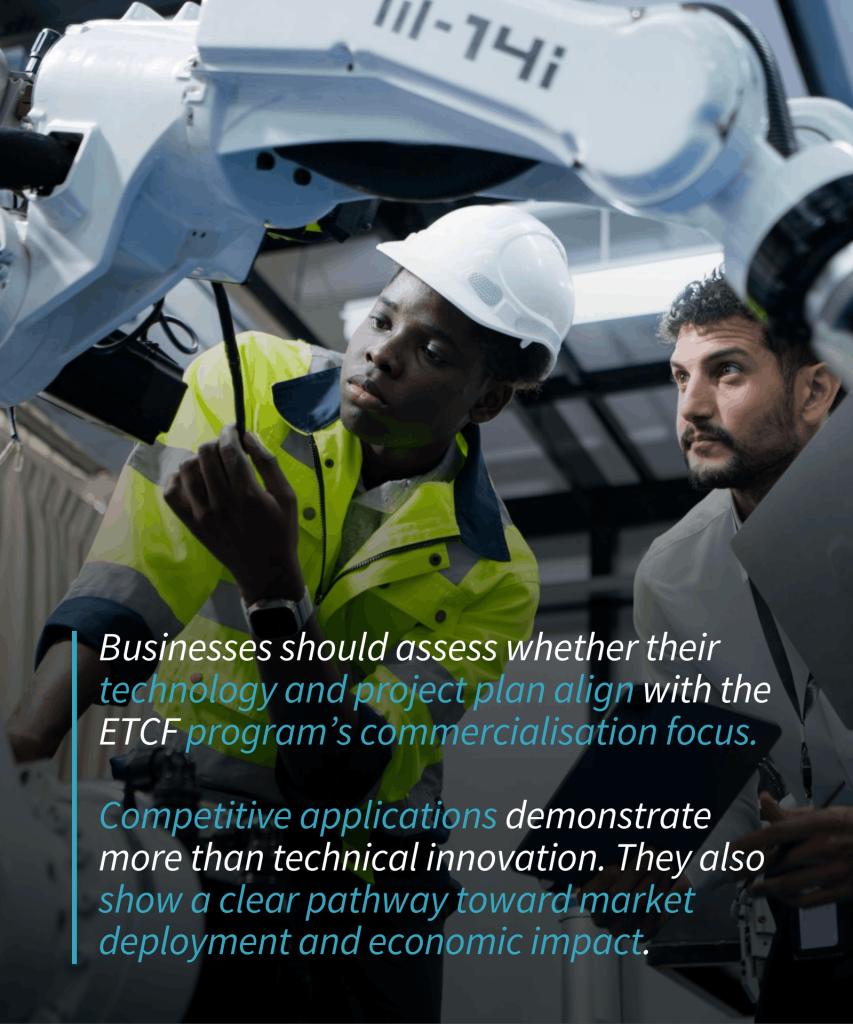
Before preparing an ETCF application, businesses should assess whether their technology and project plan align with the program’s commercialisation focus.
Competitive applications typically demonstrate more than technical innovation. They also show a clear pathway toward market deployment and economic impact.
When evaluating whether the program is the right fit, businesses should consider:
- whether the technology has progressed beyond early research and proof of concept
- whether there is a defined market need or commercial opportunity
- whether the project can realistically progress the technology toward deployment within the proposed timeframe
- whether the team has the capability to deliver the project successfully
Taking time to assess these elements early can help determine whether ETCF is the right funding pathway for your business.
7 – How ETCF fits into Australia’s broader innovation funding landscape
The ETCF is part of a broader ecosystem of government initiatives designed to support innovation and commercialisation.
For example, businesses developing new technologies may also benefit from programs such as the R&D Tax Incentive (R&DTI), which supports eligible research and development activities across Australia. Many emerging technology companies combine commercialisation grants like ETCF with the R&D Tax Incentive to support innovation across different stages of development.
Combining different funding mechanisms can help businesses support innovation across multiple stages.
8 – How FundFindrs helps businesses navigate emerging technology funding
Securing government funding for innovation often requires more than simply meeting eligibility criteria.
For the ETCF program specifically, the Stage 1 application involves submitting a short pitch video outlining the technology, the problem it solves, and the commercial opportunity. The video is expected to address the key assessment criteria and clearly communicate the strength of the project.
Preparing a compelling pitch requires careful planning. In many cases, this means developing a clear storyline, structured messaging, and a concise script that demonstrates both the innovation and the commercial potential.
Successful applications typically require:
- clear technical and commercial narratives
- strong financial planning
- evidence of market opportunity and scalability
- well-structured project documentation
- a clear and compelling pitch narrative for the Stage 1 video submission
At FundFindrs, our team works with innovative companies across Australia to identify and secure funding opportunities aligned with their growth strategy.
This includes:
- identifying relevant grant opportunities
- assessing eligibility and program fit
- supporting application strategy and documentation
- assisting with storyboarding and scripting for pitch video submissions
- integrating grants with programs such as the R&D Tax Incentive as part of a broader funding roadmap
If your company is developing an emerging technology and considering applying for the ETCF, our team can help assess whether the program is the right fit for your innovation.
Book a FREE consultation to discuss your project and explore potential funding opportunities.