Grants for Innovation Archives - FundFindrs

Top 5 Government Grants for Australian Manufacturing Companies to Boost Innovation in 2024-25

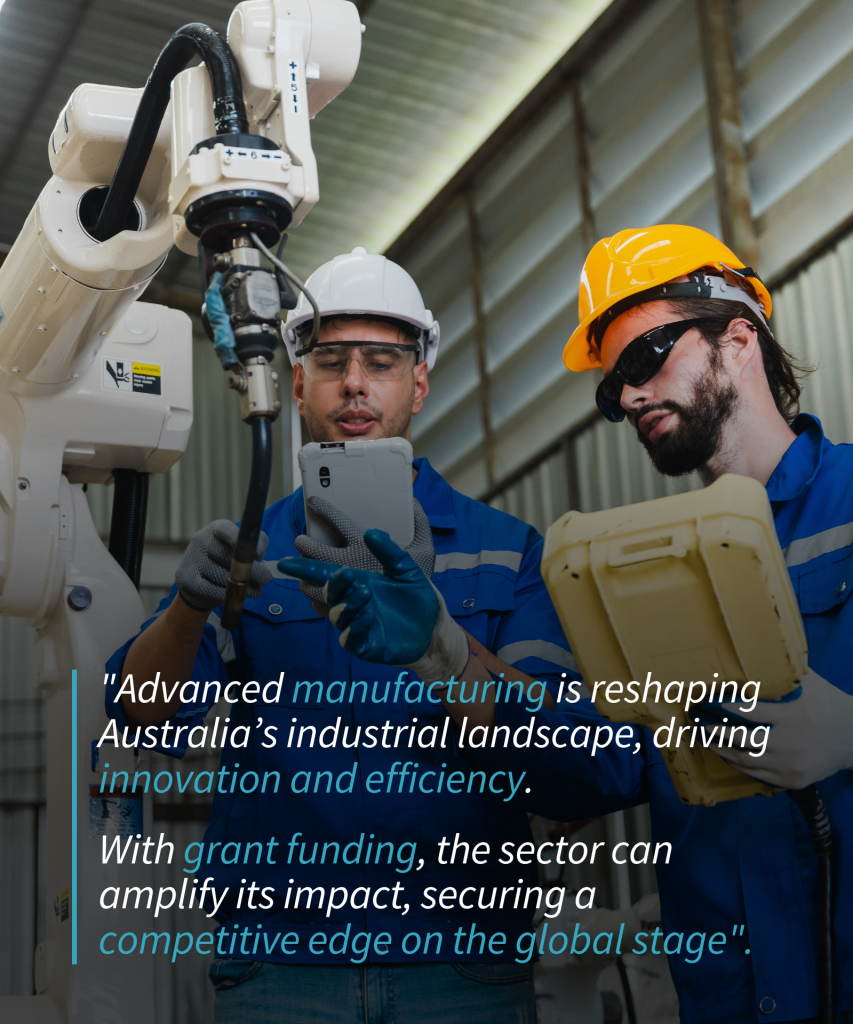
There is no doubt that Government grants offer vital support to drive innovation, improve competitiveness, and strengthen the nation’s economic growth. As advanced manufacturing emerges as a core pillar of Australia’s industrial future, businesses in this industry are increasingly embracing cutting-edge technologies such as automation, robotics, and data-driven processes. This transformation not only boosts productivity and efficiency but also positions Australian manufacturers to excel on a global scale.


However, the journey to becoming globally competitive is not without challenges. Scaling up, integrating new technologies, and navigating industry shifts require both strategic guidance and financial backing. Recognising this, it’s essential for manufacturing leaders to take advantage of the right grants, break down their requirements, and execute successful applications to maximise growth potential and drive long-term success.


In this article, we’ll explore five key grants available to Australian manufacturers, providing crucial financial resources to foster innovation, build capacity, and propel industry advancement.


  1. Made in Queensland (MIQ) Grant
  2. Advanced Manufacturing Accelerating Growth Program (TAS)
  3. Advanced Manufacturing Ecosystem Fund (AME)
  4. Manufacturing Hubs Grant Program (MHGP)
  5. Research and Development (R&D) Tax Incentive


1. Made in Queensland (MIQ) Grant

Matched funding to boost Queensland manufacturers’ competitiveness


Key Details

  • Closing by: 24 January 2025
  • Funding Available: Matched funding ranging from $50,000 to $2.5 million
  • Target Recipients: Queensland-based small to medium manufacturers


Overview

The MIQ grant supports Queensland manufacturers in adopting advanced equipment, technologies, and innovative processes. The focus includes energy efficiency, export growth, reshoring initiatives, supply chain enhancements, sustainability measures, and decarbonisation.


This $121.5 million program aims to drive productivity, international competitiveness, and high-skill job creation within the manufacturing sector. Since its inception in 2017, MIQ has backed 160 manufacturing projects statewide.


Eligibility Criteria

Businesses must:

  • Be based in Queensland with primary revenue derived from manufacturing
  • Have an active Australian Business Number (ABN) and be registered for goods and services tax (GST)
  • Be a small to medium enterprise employing 5-200 full-time equivalent (FTE) staff, with at least five FTEs in Queensland
  • Propose a project meeting program guideline
  • Cover at least 50% of the project costs


2. Advanced Manufacturing Accelerating Growth Program (TAS)

Support for capital equipment purchases by Tasmanian manufacturers


Key Details

  • Closing by: 6 January 2025
  • Funding Available: Up to $100,000
  • Grants will be provided on a co-contribution basis of 50% (grant), 50% minimum (applicant)
  • Target Recipients: Tasmanian-based advanced manufacturing enterprises


Overview

This program provides funding assistance to Tasmanian advanced manufacturers, enabling them to purchase capital equipment that boosts productivity and business growth. By fostering innovation, the initiative aims to strengthen Tasmania’s manufacturing industry and elevate its competitive edge.


The matched funding available is competitively based and assessed on the stated criterion. Eligible expenditure can cover commissioning costs, as well as plant and equipment to be used in the manufacturing process.


Eligibility Criteria

Businesses must:

  • Operate within Tasmania’s advanced manufacturing sector
  • Demonstrate project alignment with program objectives
  • Have an active Australian Business Number (ABN) and be registered for goods and services tax (GST)
  • Have annual sales turnover greater than $500,000 and less than $55 million


3 – Advanced Manufacturing Ecosystem Fund (AME)

Promoting the Northern Territory’s advanced manufacturing capacity


Key Details

  • Closing by: 30 June 2026
  • Funding Available: Matched funding of between $25,000 and $500,000
  • Eligible Businesses: Northern Territory-based manufacturers


Overview

This fund supports projects that enhance the Northern Territory’s advanced manufacturing ecosystem. The initiative seeks to drive local industry growth, foster collaboration, and develop a skilled workforce, focusing on sustainable and innovative manufacturing solutions.


Support is available for NT projects that are focused in commercialise new products, including transition innovations from prototype to full-scale operations (Stream 1), and advance early-stage or pilot research in advanced manufacturing (Stream 2).


Eligibility Criteria

Businesses must:

  • Be based in the Northern Territory
  • Present projects that significantly contribute to regional advancement advanced
  • Have an active Australian Business Number (ABN), an Australian company number (ACN) and be registered for goods and services tax (GST)
  • Be an Australian manufacturing enterprise with up to 199 employees
  • Be non-tax-exempt


Top 5 Grants for Australian Manufacturing Companies in 2024-25


4 – Manufacturing Hubs Grant Program (MHGP)

Funding to boost Queensland’s regional manufacturing capabilities


Key Details

  • Closing by: 30 June 2025, or until all funding is allocated
  • Funding Available: Matched funding between $10,000 and $500,000
  • Eligible Businesses: Small to medium Queensland-based manufacturers


Overview

This program supports manufacturers in key Queensland regions by providing funding to enhance competitiveness, productivity, and innovation. Grants focus on skills development, technology adoption, and business development, driving regional manufacturing growth.


The $33.5 million Manufacturing Hub Grant Program (MHGP) offers grants to eligible businesses in the Cairns, Central Queensland, Gold Coast, Mackay, and Townsville SA4 regions.


Eligibility Criteria

Businesses must:

  • Be a Queensland-based SME
  • Have the main operations located in one of the eligible Queensland SA4 regions
  • Have an active Australian Business Number (ABN) and be registered for goods and services tax (GST)
  • Have been operating in Queensland for at least 3 consecutive years before applying


5 – Research and Development (R&D) Tax Incentive

Tax support for Australian companies undertaking R&D


Key Details

  • Closing by: 30 April 2025 for FY24 claims (reopens on 1 July 2025 for FY25 claims)
  • Funding Available: Tax offset (refundable or non-refundable) for eligible R&D expenses, with varying rates depending on company size and annual turnover
  • Eligible Businesses: Australian entities engaging in Research and Development activities


Overview

The R&D Tax Incentive offers up to 43.5% tax offsets to support Australian companies investing in R&D. It aims to encourage businesses to undertake innovative projects, develop new products or processes, and enhance competitiveness on a global scale. The program covers a range of eligible R&D activities aligned with government guidelines.


Eligibility Criteria

To qualify, businesses must conduct eligible R&D activities as defined by program requirements and be incorporated in Australia.


Want to learn more about the R&D Tax Incentive? Fill out the form below to explore program details, eligibility requirements, and find out how our team of experts can help your business claim up to 43.5% of your research and development costs.


By leveraging these grants, Australian manufacturers can drive economic diversification, job creation, and technological advancement — positioning Australia as a global manufacturing leader. Navigating complex eligibility requirements and maximising grant outcomes can be challenging, which is why having a knowledgeable partner is essential.


This is where FundFindrs excels. As experts in manufacturing grants, we provide comprehensive support — from identifying the best funding opportunities to crafting impactful applications and offering ongoing strategic guidance. With FundFindrs by your side, you can confidently secure essential funding, foster innovation, and elevate your business within the advanced manufacturing sector. Let us help unlock your potential and achieve lasting success. Contact us to get started.



Mastering the R&D Tax Incentive: expert tips for eligibility, air-tight applications and claim success

Last reviewed: July 17, 2026


Bruce Murray, FundFindrs R&D Consultant, shares key insights on qualifying, capturing eligible costs, and ensuring your business is ready to successfully claim the R&DTI


Navigating the Research and Development Tax Incentive (R&DTI) program can be complex, but with the right guidance, it is an invaluable funding opportunity to support business innovation and growth. According to the Australian Taxation Office, in the 2021–22 income year, over 11,500 companies in Australia claimed R&D expenditures totalling $11.2 billion, highlighting the program’s significant role in fostering innovation across various industries.


To help businesses better understand how to maximise this opportunity, we’re tapping into the expertise and knowledge of Bruce Murray, the lead for our R&D Team, who holds extensive experience both with the program itself and in guiding businesses through successful claims.


In this first interview, Bruce shares practical insights on aligning R&D strategies with long-term business goals, common challenges first-time claimants face, and effective methods to ensure all eligible costs are captured.


  1. Background & Experience
  2. Aligning R&D Strategy with Business Goals
  3. Key Industries & Sectors for R&D Tax Incentive
  4. Advice for First Time Applicants
  5. Advice for Repeat Applicants
  6. Working with Companies & Role of Collaboration


Key takeaways 


  • The R&D Tax Incentive can help businesses reinvest in innovation, supporting ongoing R&D activities and growth.
  • Aligning R&D activities with business objectives can help maximise the value of the program.
  • Understanding what qualifies as eligible R&D is critical, particularly when planning projects and preparing a claim.
  • Capturing all eligible expenditure is important, requiring accurate tracking and documentation throughout the year.
  • First-time and repeat claimants face different challenges, making a clear understanding of the program essential.
  • Strong collaboration between technical and financial teams can improve claim quality and support compliance with program requirements.


1. Could you please share a bit about your background and experience in guiding businesses through the R&D Tax Incentive program?

Certainly. I hold a Bachelor of Commerce with a major in accounting and a sub major in law, along with a Graduate Diploma of Applied Corporate Governance from the Governance Institute of Australia.


I have previously worked within the Department of Industry, Science and Resources (AusIndustry), where I was directly involved in the R&DTI program — reviewing applications and assisting businesses in understanding eligibility criteria and regulatory requirements. This hands-on experience has given me a deep, practical understanding of the program and how businesses can leverage it effectively. Since then, I have been applying this experience to support FundFindrs clients to ensure their claims air-tight and meet the legislative requirements.


Outside of this, I have spent part of my career in corporate governance, compliance and risk management, which are also valuable skills that I bring to the R&DTI process.


2. Can you provide examples of how a company can align its R&D strategy with its overall business goals to leverage the R&D Tax Incentive effectively?

Overall, the R&DTI program provide significant tax rebates for eligible R&D expenditure, allowing businesses to reinvest in innovation and contribute to strategic growth. R&DTI rebates provide companies with the financial flexibility to pursue advancements that not only drive progress but also support their long-term business objectives.


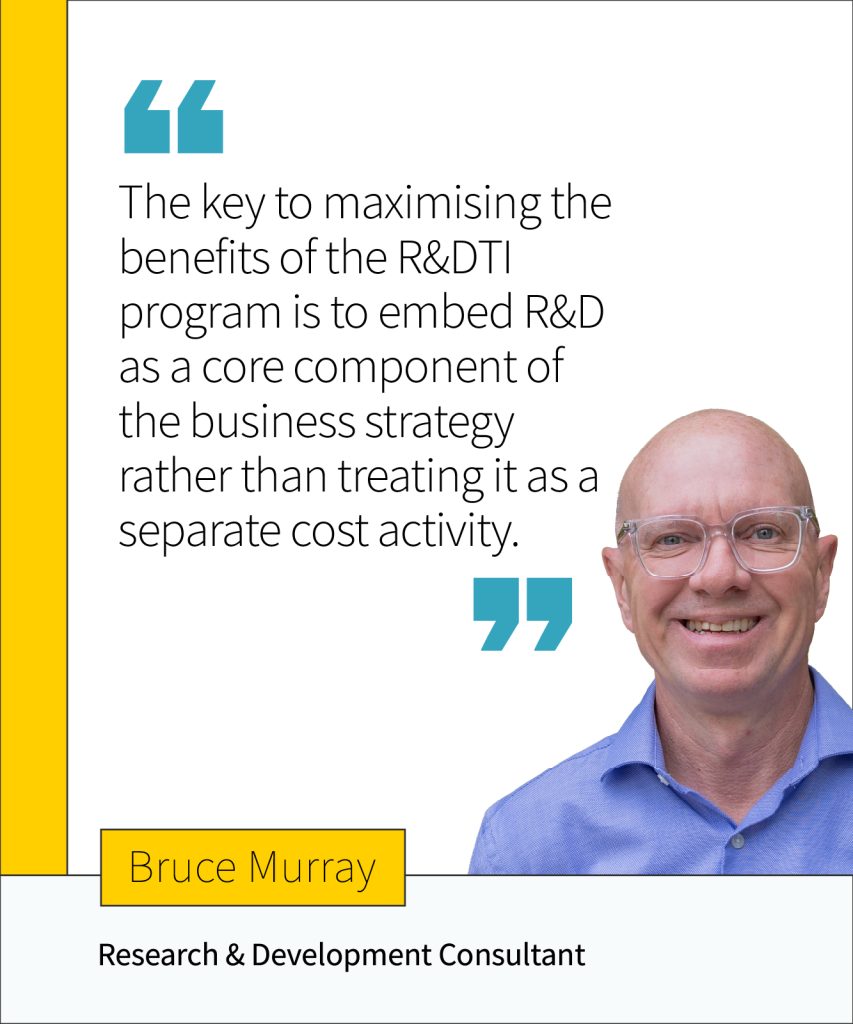
For example, a manufacturing company could use the R&DTI program to explore more efficient production techniques, reducing waste and improving sustainability — all of which may align with broader corporate goals. The key to maximising the benefits of the government program is to embed R&D as a core component of the business strategy rather than treating it as a separate cost activity.


Bruce Murray's key tip on the R&D Tax Incentive


3. Are there particular industries or sectors that you believe can benefit more significantly from the R&D Tax Incentive, and why?

Yes, while the R&DTI program is industry-agnostic and open to businesses of varying sizes and sectors, certain industries tend to benefit more due to the nature of their operations. Sectors such as pharmaceuticals, biotechnology, software development, renewable energy, agriculture, and advanced manufacturing often have innovation embedded in their core activities. For instance, the pharmaceutical and biotech industries are heavily involved in product development and clinical trials, which naturally align with R&DTI criteria. Similarly, software companies engaged in developing new technologies or platforms often qualify.


However, the program isn’t limited to high-tech fields — innovative practices in agriculture, construction, and food production can also qualify. From small startups and SMEs to significant major corporations, a range of businesses can be eligible for the program. It’s a matter of understanding and establishing eligibility.


4. What advice would you give to a company considering applying for the R&D Tax Incentive for the first time?

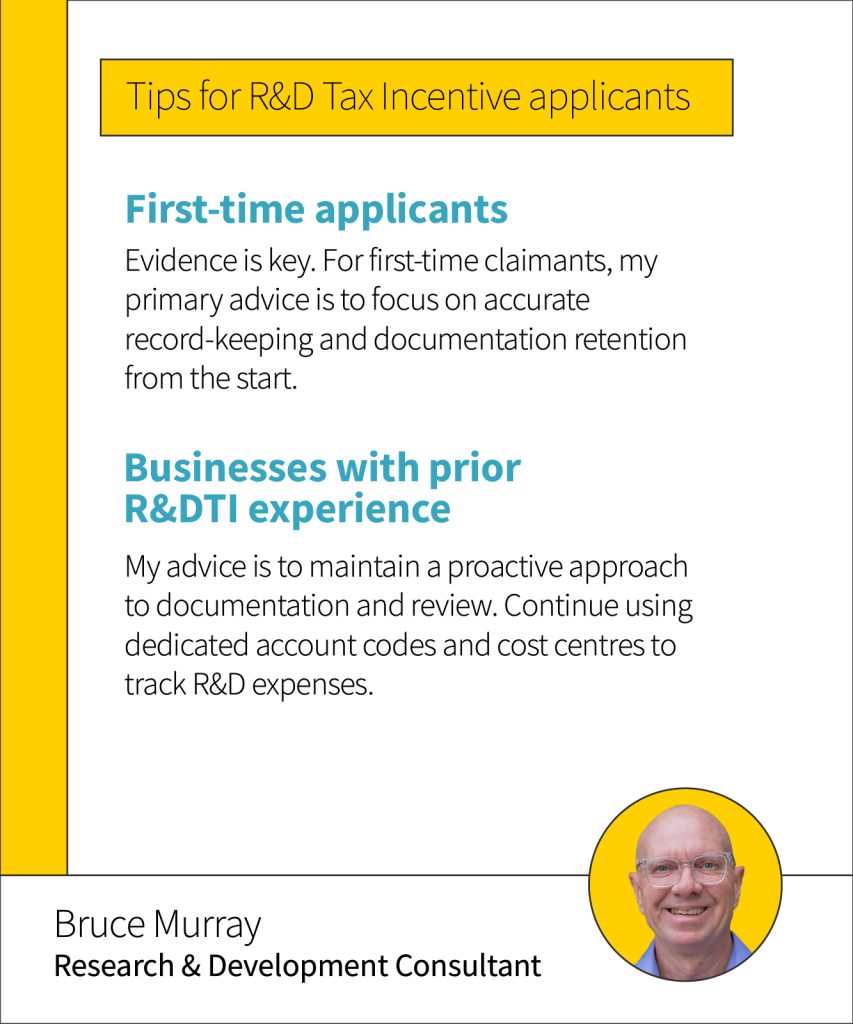
For first-time claimants, my primary advice is to focus on accurate record-keeping and documentation retention from the start. Capturing eligible R&D costs throughout the year can be challenging if not planned properly. Businesses may set up dedicated project codes or a unique cost centre in their accounting system to distinguish R&D expenses from general operational expenses.


Evidence is key. Maintaining detailed financial records — such as timesheets, depreciation schedules, and invoices — will make it significantly easier to compile the required documentation when finalising a claim. Clear and well organised proof of evidence are crucial to demonstrate compliance with the R&DTI program’s requirements and maximise the rebate.


Bruce Murray's top tips for first-time and repeat R&DTI applicants


5. For businesses already familiar with the program, how can they improve or optimise their claims?

For businesses with prior R&DTI experience, my advice is to maintain a proactive approach to documentation and review. Continue using dedicated account codes and cost centres to track R&D expenses. However, to further optimise claims, consider implementing periodic reviews throughout the financial year rather than waiting until year-end. This assists in allowing to identify any gaps in documentation early and ensures all eligible activities and expenses are captured. Additionally, staying informed about any regulatory updates to the R&DTI program is essential to maintain compliance and maximise claim value.


Maximise Your R&D Tax Incentive Claim. FundFindrs’ specialist consultants can help identify all eligible expenses and optimise your application.


6. How do you typically work with companies, and what role does collaboration play in ensuring a successful application?

When it comes to financials, close collaboration ensures that all eligible R&D costs are identified, documented, and factored into the application, minimising the risk of missing out on valuable rebates. We also emphasise the importance of maintaining thorough records and evidence throughout the year, making the claims process smoother and more effective due to our regular communication.


Keeping an open dialogue is paramount in the way the FundFindrs’ team collaborates with businesses. Our role goes beyond simply preparing the application — we focus on truly understanding our clients’ business and projects through open, transparent discussions. This collaborative approach allows us not only to build a compelling case that accurately reflects the innovative work being conducted but also allows us to give valuable advice on an ongoing basis. Further, the better we know our clients, the more we are able to assist with identifying additional grants and funding opportunities that are suitable to help drive growth.


Not sure if you’re eligible for the R&D Tax Incentive?
Our free Blueprint breaks it down with an eligibility checklist, examples, and expert tips from the FundFindrs team.


At FundFindrs, we’re dedicated to making the R&D Tax Incentive application straightforward and stress-free for businesses like yours. From identifying eligible R&D activities to accurately capturing costs and preparing fully compliant applications, we help you focus on what matters most —innovation — while we handle the complexities behind the scenes. If you’re considering an R&DTI claim or simply want to ensure you’re maximising your return, Bruce together with our expert team are here to guide you. Take advantage of our FREE initial consultation.

Why Grant Applications Get Rejected (and What to Do About It)

Last reviewed: July 28, 2026


So much work goes into applying for a grant. That’s why rejection stings. But it’s often not about the strength of your idea, it’s about how well you followed the brief. 

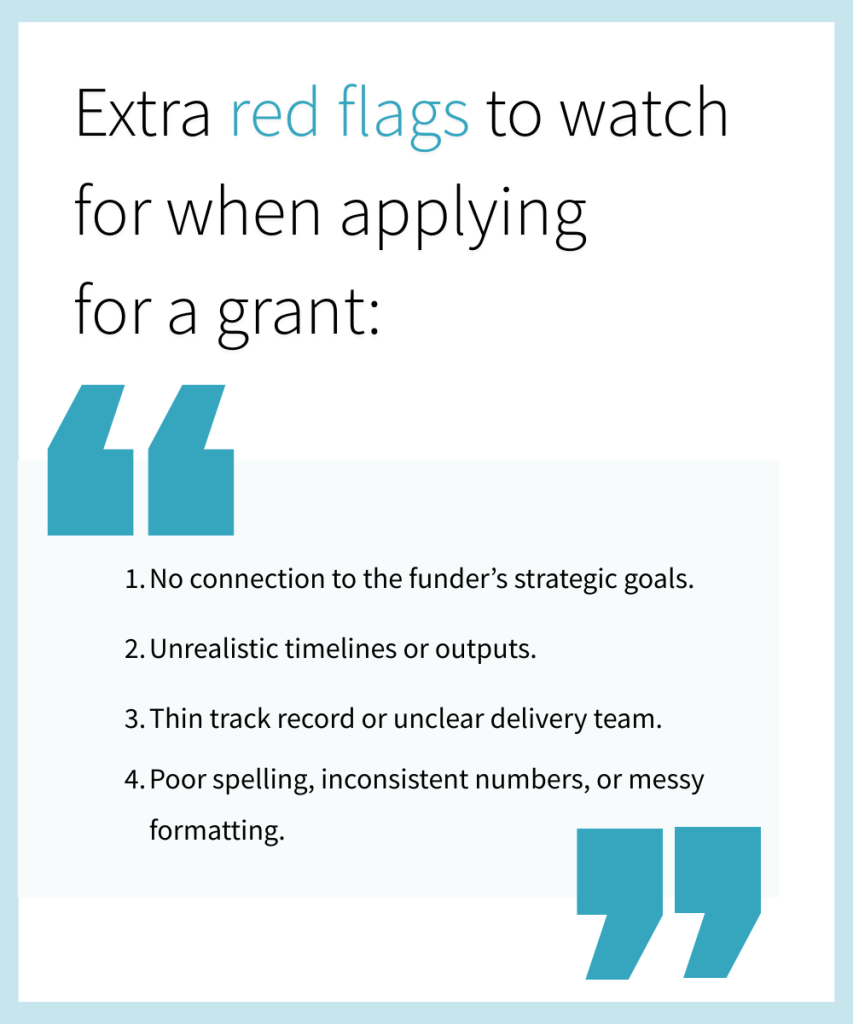
Below are ten of the most common reasons grant applications miss the mark, and how you can avoid the same fate next time.


  1. Ignoring eligibility
  2. A weak or wandering story
  3. Unclear budgets
  4. No evidence or outcomes
  5. Missing governance or compliance info
  6. Not following instructions
  7. No risk or sustainability plan
  8. Submitting at the last minute
  9. No community buy-in
  10. Weak reporting plan


Key takeaways 


  • Grant applications are often rejected because they do not meet eligibility requirements, making the initial eligibility check one of the most important steps.
  • A clear project narrative matters. Funders want to understand what the project will achieve, why it matters and how it will be delivered.
  • Budgets should be detailed and transparent, with costs clearly explained and aligned to project activities.
  • Evidence and measurable outcomes strengthen applications, helping demonstrate the need for funding and how success will be evaluated.
  • Governance, compliance and supporting documents are essential, as missing information can affect eligibility and assessment.
  • Strong applications include risk, sustainability and reporting plans, showing how the project will be managed and measured beyond the funding period.


1. Ignoring eligibility

Always check the basics. If you’re not eligible, you’re out from the start. Don’t waste your time on grants that don’t fit.


2.  A weak or wandering story

Funders need clarity. If you can’t explain what your project does, why it matters, and how it will be delivered – quickly and clearly – it will cost you.


3. Unclear budgets

Avoid vague terms like “miscellaneous”. Break down your numbers and explain them. Funders want transparency.


4. No evidence or outcomes

Back up your case. Use data to show the need, and outline how you’ll measure success.


5. Missing governance or compliance info

Many grants require proof of insurance, board details, policies or financials. Make sure your documents are current and ready.


6. Not following instructions

Stick to word counts. Use the right templates. Upload the correct file types. A great application can still be ruled ineligible for admin errors.


7. No risk or sustainability plan

Funders want to know your project is viable — even if something goes wrong or funding ends. Spell that out.


8. Submitting at the last minute

Leave time for reviews, tech issues, and final polish. Rushing means mistakes.


9. No community buy-in

If the project serves a community, show how they’ve been involved. Add letters of support or quote conversations and feedback.


10. Weak reporting plan

Funders expect to see how you’ll track and report on progress. It’s a core part of grant accountability.


Final thought 

Grants are competitive. But most rejections happen for predictable reasons. By planning ahead, tightening your narrative, and double-checking the details, you’ll improve your chances dramatically. 

Get grant ready – not just application ready!


Ready to avoid these common pitfalls?

At FundFindrs, we specialise in making sure your grant application doesn’t fall at the avoidable hurdles. From checking eligibility and strengthening your story, to building clear budgets and managing compliance, we partner with you through the entire process. Our team knows what funders are looking for and how to help you stand out. 

Book a FREE consultation today and take the guesswork out of your next grant application. 


Emerging Technology Commercialisation Fund (ETCF) 2026: A new $20M opportunity for NSW innovators

Last reviewed: July 03, 2026 
The Emerging Technology Commercialisation Fund (ETCF) 2026 is a new NSW Government program designed to help innovative startups and SMEs move promising technologies closer to market. 

With $20 million in funding available, the program aims to support businesses developing emerging technologies that need further development before they are ready for commercial deployment. 

For companies working on breakthrough solutions, understanding how the ETCF works — and whether your project could be eligible — may open valuable opportunities to accelerate innovation and growth.


Key takeaways 

  • $20 million is available through the NSW Government’s ETCF, administered by the Office of the Chief Scientist and Engineer.
  • Grants range from $500,000 to $2 million per project and are structured as repayable grants once EBITDA exceeds $500,000.
  • The program targets technologies at TRL 3–7, supporting projects that have moved beyond early research but are not yet commercially deployed.
  • Applicants must meet NSW-based eligibility requirements, including headquarters and workforce location criteria.
  • Stage 1 includes a pitch video, meaning the commercial narrative is just as important as the technology itself.
  • ETCF and R&DTI are complementary programs, supporting different stages of the innovation and commercialisation journey.


1 – What is the Emerging Technology Commercialisation Fund (ETCF)? 

The Emerging Technology Commercialisation Fund (ETCF) is a NSW Government program administered by the Office of the Chief Scientist and Engineer. 

The program provides funding to help innovative companies advance emerging technologies toward commercial readiness, supporting projects that require further development before entering the market.

The fund was first announced in the 2025–26 NSW Budget and forms part of the government’s Innovation Blueprint, a broader strategy aimed at strengthening innovation and research commercialisation across NSW. The first funding round includes a $7 million allocation. 

ETCF focuses on technologies progressing along the Technology Readiness Level (TRL) scale, helping businesses move from prototype or proof-of-concept toward commercial demonstration.  


Key objectives of the program include:
 

  • accelerating the commercialisation of emerging technologies 
  • reducing financial risk during late-stage research and development 
  • strengthening NSW’s innovation capability and industry competitiveness 


2 – How much funding is available? 

The ETCF provides significant financial support for eligible companies progressing emerging technologies. 


Grant amount 

  • Between $500,000 and $2,000,000 per project 


Total funding pool
 

  • $20 million allocated to the program 


Grant structure

  • The ETCF is structured as a repayable grant. Repayments are typically made in instalments and commence in the financial year when the recipient’s EBITDA exceeds $500,000, as outlined in the program guidelines.


Application timeline
 

  • Applications open: 6 March 2026 
  • Applications close: 29 April 2026  

Projects funded through the program are typically expected to be completed within two years, helping accelerate development timelines and support commercial deployment.


Exploring the ETCF opportunity? 
Our team can help you assess eligibility and plan your funding strategy.


3 – What types of projects are eligible for ETCF funding?  

The ETCF focuses on technologies that have already reached an early validation stage but require further development before commercial deployment.


Eligible projects generally fall within Technology Readiness Levels (TRL) 3–7, which may include activities such as: 

  • prototype development and engineering refinement 
  • pilot programs or demonstration trials 
  • regulatory approvals and product testing 
  • scaling early-stage manufacturing processes 
  • intellectual property protection and commercialisation planning 


The program supports technologies across both physical sciences and biological sciences, including sectors such as:
 

  • advanced manufacturing 
  • biotechnology and life sciences 
  • clean energy and net-zero technologies 
  • housing and construction innovation 
  • advanced materials and engineering systems 


These sectors align with NSW priorities to strengthen innovation capability and industry competitiveness. 


4 – Who is eligible to apply? 

To apply for the ETCF, businesses must meet several key eligibility criteria.
 

Applicants must: 

  • be a for-profit company incorporated in Australia 
  • be headquartered in NSW 
  • have an active ABN 
  • employ more than 65% of staff in NSW 
  • have annual revenue under $2.5 million 
  • own or hold exclusive rights to commercialise the relevant intellectual property 


5 – What might an ETCF-supported project look like? 

To illustrate the types of innovations the ETCF aims to support, the following examples show projects that could align with the program’s commercialisation focus.


Examples of projects that may align with the program include:

  • AI-driven platforms improving safety or productivity in infrastructure and construction 
  • biotechnology innovations progressing toward clinical or regulatory validation 
  • advanced battery or energy storage technologies moving from prototype to pilot production 
  • new materials or construction technologies designed to improve sustainability 
  • robotics or automation systems developed for advanced manufacturing 


6 – Strategic considerations before applying 

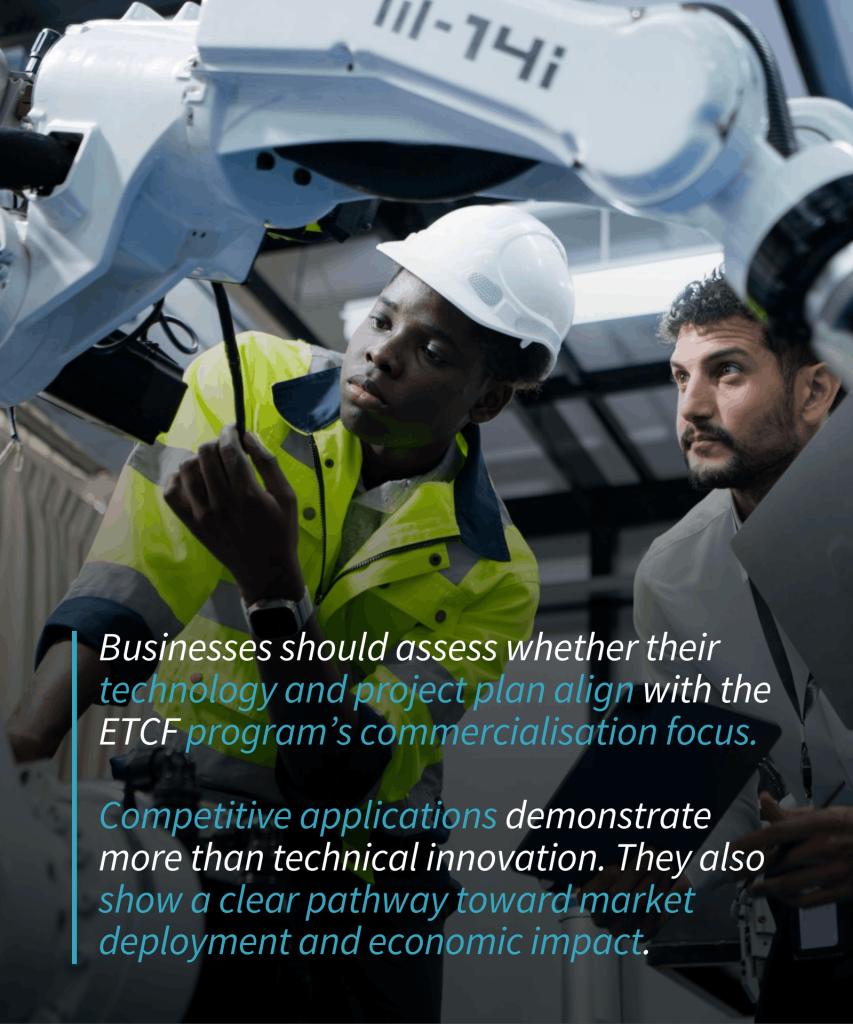
Before preparing an ETCF application, businesses should assess whether their technology and project plan align with the program’s commercialisation focus. 

Competitive applications typically demonstrate more than technical innovation. They also show a clear pathway toward market deployment and economic impact. 


When evaluating whether the program is the right fit, businesses should consider:

  • whether the technology has progressed beyond early research and proof of concept 
  • whether there is a defined market need or commercial opportunity 
  • whether the project can realistically progress the technology toward deployment within the proposed timeframe 
  • whether the team has the capability to deliver the project successfully 

Taking time to assess these elements early can help determine whether ETCF is the right funding pathway for your business. 


7 – How ETCF fits into Australia’s broader innovation funding landscape 

The ETCF is part of a broader ecosystem of government initiatives designed to support innovation and commercialisation. 

For example, businesses developing new technologies may also benefit from programs such as the R&D Tax Incentive (R&DTI), which supports eligible research and development activities across Australia. Many emerging technology companies combine commercialisation grants like ETCF with the R&D Tax Incentive to support innovation across different stages of development. 

Combining different funding mechanisms can help businesses support innovation across multiple stages. 


8 – How FundFindrs helps businesses navigate emerging technology funding 

Securing government funding for innovation often requires more than simply meeting eligibility criteria. 

For the ETCF program specifically, the Stage 1 application involves submitting a short pitch video outlining the technology, the problem it solves, and the commercial opportunity. The video is expected to address the key assessment criteria and clearly communicate the strength of the project. 

Preparing a compelling pitch requires careful planning. In many cases, this means developing a clear storyline, structured messaging, and a concise script that demonstrates both the innovation and the commercial potential.
 

Successful applications typically require: 

  • clear technical and commercial narratives
  • strong financial planning
  • evidence of market opportunity and scalability
  • well-structured project documentation
  • a clear and compelling pitch narrative for the Stage 1 video submission


At FundFindrs, our team works with innovative companies across Australia to identify and secure funding opportunities aligned with their growth strategy. 

This includes: 

  • identifying relevant grant opportunities
  • assessing eligibility and program fit
  • supporting application strategy and documentation
  • assisting with storyboarding and scripting for pitch video submissions
  • integrating grants with programs such as the R&D Tax Incentive as part of a broader funding roadmap 

If your company is developing an emerging technology and considering applying for the ETCF, our team can help assess whether the program is the right fit for your innovation. 


Book a FREE consultation to discuss your project and explore potential funding opportunities.