Last reviewed: July 17, 2026
Bruce Murray, FundFindrs R&D Consultant, shares key insights on qualifying, capturing eligible costs, and ensuring your business is ready to successfully claim the R&DTI
Navigating the Research and Development Tax Incentive (R&DTI) program can be complex, but with the right guidance, it is an invaluable funding opportunity to support business innovation and growth. According to the Australian Taxation Office, in the 2021–22 income year, over 11,500 companies in Australia claimed R&D expenditures totalling $11.2 billion, highlighting the program’s significant role in fostering innovation across various industries.
To help businesses better understand how to maximise this opportunity, we’re tapping into the expertise and knowledge of Bruce Murray, the lead for our R&D Team, who holds extensive experience both with the program itself and in guiding businesses through successful claims.
In this first interview, Bruce shares practical insights on aligning R&D strategies with long-term business goals, common challenges first-time claimants face, and effective methods to ensure all eligible costs are captured.
- Background & Experience
- Aligning R&D Strategy with Business Goals
- Key Industries & Sectors for R&D Tax Incentive
- Advice for First Time Applicants
- Advice for Repeat Applicants
- Working with Companies & Role of Collaboration
Key takeaways
- The R&D Tax Incentive can help businesses reinvest in innovation, supporting ongoing R&D activities and growth.
- Aligning R&D activities with business objectives can help maximise the value of the program.
- Understanding what qualifies as eligible R&D is critical, particularly when planning projects and preparing a claim.
- Capturing all eligible expenditure is important, requiring accurate tracking and documentation throughout the year.
- First-time and repeat claimants face different challenges, making a clear understanding of the program essential.
- Strong collaboration between technical and financial teams can improve claim quality and support compliance with program requirements.
1. Could you please share a bit about your background and experience in guiding businesses through the R&D Tax Incentive program?
Certainly. I hold a Bachelor of Commerce with a major in accounting and a sub major in law, along with a Graduate Diploma of Applied Corporate Governance from the Governance Institute of Australia.
I have previously worked within the Department of Industry, Science and Resources (AusIndustry), where I was directly involved in the R&DTI program — reviewing applications and assisting businesses in understanding eligibility criteria and regulatory requirements. This hands-on experience has given me a deep, practical understanding of the program and how businesses can leverage it effectively. Since then, I have been applying this experience to support FundFindrs clients to ensure their claims air-tight and meet the legislative requirements.
Outside of this, I have spent part of my career in corporate governance, compliance and risk management, which are also valuable skills that I bring to the R&DTI process.
2. Can you provide examples of how a company can align its R&D strategy with its overall business goals to leverage the R&D Tax Incentive effectively?
Overall, the R&DTI program provide significant tax rebates for eligible R&D expenditure, allowing businesses to reinvest in innovation and contribute to strategic growth. R&DTI rebates provide companies with the financial flexibility to pursue advancements that not only drive progress but also support their long-term business objectives.
For example, a manufacturing company could use the R&DTI program to explore more efficient production techniques, reducing waste and improving sustainability — all of which may align with broader corporate goals. The key to maximising the benefits of the government program is to embed R&D as a core component of the business strategy rather than treating it as a separate cost activity.
3. Are there particular industries or sectors that you believe can benefit more significantly from the R&D Tax Incentive, and why?
Yes, while the R&DTI program is industry-agnostic and open to businesses of varying sizes and sectors, certain industries tend to benefit more due to the nature of their operations. Sectors such as pharmaceuticals, biotechnology, software development, renewable energy, agriculture, and advanced manufacturing often have innovation embedded in their core activities. For instance, the pharmaceutical and biotech industries are heavily involved in product development and clinical trials, which naturally align with R&DTI criteria. Similarly, software companies engaged in developing new technologies or platforms often qualify.
However, the program isn’t limited to high-tech fields — innovative practices in agriculture, construction, and food production can also qualify. From small startups and SMEs to significant major corporations, a range of businesses can be eligible for the program. It’s a matter of understanding and establishing eligibility.
4. What advice would you give to a company considering applying for the R&D Tax Incentive for the first time?
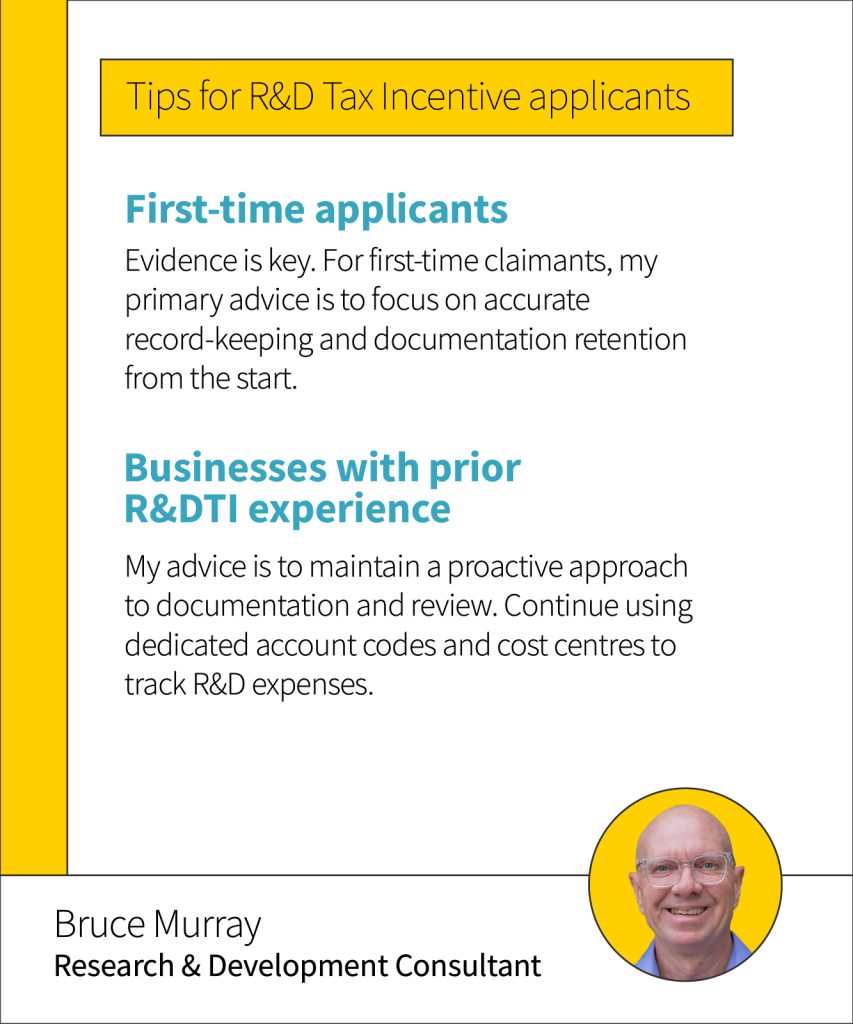
For first-time claimants, my primary advice is to focus on accurate record-keeping and documentation retention from the start. Capturing eligible R&D costs throughout the year can be challenging if not planned properly. Businesses may set up dedicated project codes or a unique cost centre in their accounting system to distinguish R&D expenses from general operational expenses.
Evidence is key. Maintaining detailed financial records — such as timesheets, depreciation schedules, and invoices — will make it significantly easier to compile the required documentation when finalising a claim. Clear and well organised proof of evidence are crucial to demonstrate compliance with the R&DTI program’s requirements and maximise the rebate.
5. For businesses already familiar with the program, how can they improve or optimise their claims?
For businesses with prior R&DTI experience, my advice is to maintain a proactive approach to documentation and review. Continue using dedicated account codes and cost centres to track R&D expenses. However, to further optimise claims, consider implementing periodic reviews throughout the financial year rather than waiting until year-end. This assists in allowing to identify any gaps in documentation early and ensures all eligible activities and expenses are captured. Additionally, staying informed about any regulatory updates to the R&DTI program is essential to maintain compliance and maximise claim value.
Maximise Your R&D Tax Incentive Claim. FundFindrs’ specialist consultants can help identify all eligible expenses and optimise your application.
6. How do you typically work with companies, and what role does collaboration play in ensuring a successful application?
When it comes to financials, close collaboration ensures that all eligible R&D costs are identified, documented, and factored into the application, minimising the risk of missing out on valuable rebates. We also emphasise the importance of maintaining thorough records and evidence throughout the year, making the claims process smoother and more effective due to our regular communication.
Keeping an open dialogue is paramount in the way the FundFindrs’ team collaborates with businesses. Our role goes beyond simply preparing the application — we focus on truly understanding our clients’ business and projects through open, transparent discussions. This collaborative approach allows us not only to build a compelling case that accurately reflects the innovative work being conducted but also allows us to give valuable advice on an ongoing basis. Further, the better we know our clients, the more we are able to assist with identifying additional grants and funding opportunities that are suitable to help drive growth.
Not sure if you’re eligible for the R&D Tax Incentive?
Our free Blueprint breaks it down with an eligibility checklist, examples, and expert tips from the FundFindrs team.
At FundFindrs, we’re dedicated to making the R&D Tax Incentive application straightforward and stress-free for businesses like yours. From identifying eligible R&D activities to accurately capturing costs and preparing fully compliant applications, we help you focus on what matters most —innovation — while we handle the complexities behind the scenes. If you’re considering an R&DTI claim or simply want to ensure you’re maximising your return, Bruce together with our expert team are here to guide you. Take advantage of our FREE initial consultation.