Grants Archives - FundFindrs

Boost Your grant funding success with FundFindrs: A four-step guide

Securing grant funding relies not just on clear ideas, robust business plans, and exceptional teams. The importance lies in how you present these elements. With increasing competition, professional grant writing has never been more critical. This is where FundFindrs steps in, streamlining the process and enhancing your chances of success. Ready to embark on a rewarding funding journey with us? Here’s how:

Step 1: Maximise value from your initial consultation

The first step in our collaboration begins with a thorough consultation meeting. During this session, we will discuss the range of grants your business might qualify for, based on preliminary research. This is your opportunity to brief us on your organisation’s specific needs and objectives. Expect to discuss the following:

  • Innovation: what sets your product or service apart?
  • Business goals: what are your immediate and long-term milestones?
  • Business plan highlights: What are the core strategies and expected outcomes?
  • Community impact: how does your business contribute to local, environmental, or social objectives?
  • Unique practices: what workplace or business practices make you stand out?
  • Specific initiatives: do you have any specific initiatives planned that are suitable for grant funding? 

As the business owner, your insights are valuable to us. The more information you share, the better we can identify suitable grant opportunities.

Step 2: Collaborate closely with us

The direction for funding needs to be clear. Whether you seek funds for a specific project, manufacturing, research and development (R&S), or technical support, being transparent is key. When collaborating with us, consider the following:

  • Need: why is the grant necessary?
  • Eligibility: what makes you a worthy candidate?
  • Measurable outcomes: how will success be assessed?
  • Objectives: what outcomes will the grant facilitate?
  • Timeline: what is the project schedule?
  • Budget: what are the financial requirements?

Supplying us with comprehensive information, including sales and financial documents, ensures that we can craft an unbeatable grant application tailored for you.


Step 3: Establish consistent communication channels

Clear communication is vital during the grant application process. Unforeseen requirements often arise, particularly for essential documents or clarification on project details. 

We recommend designating a single point of contact within your organisation. This streamlined approach ensures that crucial information is neither duplicated nor missed, enhancing the effectiveness and speed of our collaborative efforts.

Whilst FundFindrs takes care of all steps in the process, collaboration is till essential to ensure we have everything we need to put your best foot forward and to secure you the vital grant funding you need.  

Step 4: Prepare essential documents in advance

Preparation is vital in the fast-paced world of grant applications. Timelines can be tight, and unexpected hiccups are common. Begin your application process well ahead of deadlines. If there are gaps in your essential documentation, FundFindrs may be able to assist, however it’s important that we know early on in the process. Consider if you are ready with documents such as:

  • Business plan
  • Financial statements such as a cash flow forecast
  • Budget outline
  • Project description

Ready to fuel your business growth?

Contact FundFindrs now and gain access to a wide variety of grants worth up to $70.5 billion. Start your journey with us by booking a complimentary appointment. Together, let’s make your grant application outstanding.


Crafting a grant budget: the key to funding success

In the competitive landscape of grants and funding, businesses often find themselves struggling to secure financial aid. The key to turning the tide in your favour could lie in crafting an efficient grant budget. Here is our advice on how to define a budget that will support application.

  1. Understanding expectations

A lack of clarity on what the funding body is specifically looking for can undermine your application. The budget must be aligned with the project or program you are applying for – if not, your application might end up being discarded.

Contact the funding body to clarify any ambiguities regarding the funding requirements. If overhead expenses are covered by the grant, consider adding a 10% margin to cater for costs like office space, computer equipment, and website maintenance.

  1. Engage your project team in cost determination

Estimating costs without input from your project team can result in a budget that does not reflect the true costs of the project. This could put your entire grant application at risk, not to mention leave you short of being able to execute.

Collaborate with your project team to identify the cost of each item. Make sure to break down costs into as much detail as possible. Use historical and current data and invest the time in researching and gathering accurate price information.

  1. Data consistency

Your budget must be consistent with the narrative in your application. A discrepancy between the two can confuse funding bodies and make your application less appealing.

Ensure that key milestones and activities listed in your grant application narrative are fully represented in the budget. Make it clear how the budget aligns with project time frames and covers all costs associated with the project.


  1. Be Transparent and Realistic

Over-inflating or underestimating costs might seem like a strategic move, but funding bodies are keen-eyed and can spot inconsistencies or unrealistic figures. Submitting a budget that isn’t genuine can be a red flag.

Always base your budget on real-world estimates. If a particular expense seems high, provide a brief justification. Remember, it’s not just about getting the grant; it’s about maintaining trust. When your application is clear, transparent, and grounded in reality, it not only stands a better chance of approval but also builds credibility for future endeavours.

Remember, trust is invaluable in the world of funding. Show that you respect the grant process and those evaluating it by presenting an honest, well-researched budget.

Don’t do it alone

The importance of a well-crafted budget in your grant application cannot be overstated. It could very well be the factor that tips the scale in your favour when it comes to funding approval. So, invest the time and resources to get it right, and your efforts could yield significant dividends for your business.

Preparing a grant application is a significant undertaking, and a thorough, watertight budget is essential for success. If you find yourself struggling with this aspect, professional help is available. FundFindrs offers specialised assistance for businesses and organisations across Australia in securing R&D Tax Incentive funding, grants and awards. Click here to book your FREE appointment.


Five reasons your business should apply for awards today

If you are a business owner, you know that applying for grants is a crucial path to funding an exciting new venture or project. However, many business owners often overlook the importance of applying for awards.

Awards can bring you the exposure necessary to expand into different markets and audiences. They reward your business for the work you have done, such as whether it is socially beneficial or has promoted excellence in business or export.

FundFindrs has come up with the top five reasons why your business should consider applying for awards.


  • Get rewarded  

Generally, awards are associated with certificates and recognition. However, some awards provide funds that will boost your business growth and allow you to further develop your vision. Additionally, awards are a great tool for your marketing and communication. They build trust and credibility in your brand. 

When you win an award, be sure to ask the awarding body to provide you with any materials you might need – award descriptions, logos, press releases. Make a plan around how you will deploy the news about your award win. Think about every touchpoint you have – website, social media channels, email signature, newsletters, proposal templates etc. Anywhere your clients or potential clients come into contact with you will be worth mentioning your award(s). 

  •  Share your journey  

During the application process, you will be required to explain the story of how your business started, giving a breakdown of its product/service architecture and the key audiences you are targeting. You will need to grab the attention of the funding body, which provides a great opportunity to outline the hard work you have put into building your business, as well as listing any achievements. 

As you work through the award submission, you can reflect on your achievements and take the time to “stop and smell the roses”. It’s not often in the world of a busy business owner that there is time to reflect. Don’t forget to include your employees too – they are an important part of your journey and will be proud to be a part of your award application and/or win. They may even feel additional motivation in their daily work. 

  • Set your business apart from others with a unique advantage  

Winning an award or even becoming a finalist will give your business a unique advantage over your competitors and sets a handy benchmark for your business. You will stand out among your competitors. Broadening the types of awards you apply for will help demonstrate you strength across different business areas and give potential clients the confidence that you can meet their various needs. Be humble, but use this competitive advantage.

  • Expand your audience and reach  

Businesses that enter the running for awards have a generally higher chance of increasing the opportunities available to them. Your business will be introduced to other companies, providing a chance to gain new insights as well as a new customer base.  Award opportunities often come with networking events that allow you to meet other like-minded businesses owners – who might even require your services. Additionally, the list of award winners will be published on websites, used in PR and sometimes published in print material. All of these are additional ways for your business to be found. 

  • Opportunity to audit your business  

The application process for an award typically includes explaining the societal contribution of your business, as well as your business vision success. During this process, you can carry out a critical organisational analysis, evaluating your strengths and weaknesses as well as core competencies. Take the time to document any gaps that arise from your application and consider how you might address them. 

Finding the time and resources to apply for an award can be difficult – but FundFindrs can help you! We can find the words to explain your unique business story, highlight your team’s achievements and give you something to brag about. You deserve the recognition – so what’s stopping you? Book a free appointment with us today.


Business Grants in Australia: Navigating Startup Funding and Financial Management

Starting a business in Australia is an exciting venture, but one that often comes with its fair share of financial challenges. To alleviate the burden and foster entrepreneurial growth, many startups turn to grants, awards and traineeships.

Let’s explore how Australian businesses can secure funding and manage their finances effectively to ensure sustainable growth.

Understanding the Landscape of Startup Funding

Australia boasts a robust ecosystem that supports startup growth. Entrepreneurs have access to a variety of funding options, each tailored to different stages of business development. One of the primary sources of financial support for startups comes in the form of government grants.

Government Grants for Startups

Various government bodies in Australia offer grants to support innovation, research and development. The federal government, as well as state and territory governments, provide a range of grants targeting different industries and sectors. These grants are instrumental in helping startups bring their ideas to fruition.

  • Innovation Connections: The Innovation Connections program, administered by the Department of Industry, Science, Energy, and Resources, is designed to facilitate collaboration between small and medium-sized enterprises (SMEs) and research organisations. Through this program, startups can access matched funding to engage with research experts, driving innovation in their businesses.
  • Entrepreneur’s Program: The Entrepreneur’s Program is another initiative by the Australian government aimed at assisting startups. It provides financial support, including grants and funding, to businesses looking to improve their productivity, competitiveness, and commercialisation efforts.

Navigating Grant Applications

Securing a grant is a competitive process, and successful applications require careful execution. Startups should focus on articulating their unique value proposition, outlining a clean business plan, and demonstrating the potential impact of their project. It’s crucial to align the grant proposal with the specific objectives and criteria outlined by the granting body.

Professional Assistance

Many startups enlist the help of professionals to ensure their grant applications are well-prepared and meet all requirements. Grant consultants and business advisors can provide valuable insights and assistance in navigating the complexities of the application process. Ready to elevate your business? Explore the benefits of professional assistance with us. Let’s unlock your full potential together. Start your journey now!

Awards as a Recognition of Excellence

Apart from government grants, startups in Australia can also benefit from participating in business awards. These awards not only provide recognition for achievements but also open doors to networking opportunities and increased visibility within the industry.

Telstra Business Awards
The Telstra Business Awards are among the most prestigious in Australia, recognising excellence across various business industries. Winning a Telstra Business Award can significantly elevate a startup’s profile and attract attention from potential investors and clients.

Australian Small Business Champion Awards

The Australian Small Business Champion Awards celebrate the achievements of small businesses across the country. Participating in these awards not only provides recognition but also offers a platform for startups to share their success stories and gain credibility in the business community.

FundFindrs not only excels at curating outstanding submissions for a variety of business awards but also specialise in identifying the right programs tailored for your business. Our expertise extends beyond the pursuit of accolades; it’s about creating a lasting testament to your company’s excellence, innovation, and unwavering dedication. We understand that awards are more than trophies on a shelf; they represent the pinnacle of your organisation’s achievements and showcase its standout qualities. Let us guide you through the award landscape, helping you identify and seize the opportunities that elevate your business. Start your journey with us today and witness your achievements being celebrated on a broader stage.


Investing in Talent

In addition to grants and awards, startups can leverage traineeships and internships to tap into emerging talent pools. This not only helps businesses access skilled individuals but also provides a platform for nurturing future leaders within the organisation. 

Traineeships

Many government organisations, offer traineeship programs to support the development of skills and provide practical experience for individual employees for their businesses. Startups can benefit from these programs by bringing in fresh perspectives and fostering a culture of continuous learning.

Traineeships present businesses with a valuable opportunity to foster skill development, enhance knowledge, and boost the capabilities and productivity of their staff. 

Tips for Financial Success

While securing funding is crucial for startup survival, effective financial management is equally important for long-term success. Startups should focus on budgeting, cash flow management, and strategic financial planning to ensure sustainability.

Budgeting and Forecasting

Developing a comprehensive budget and financial forecast is essential for startups to understand their financial needs and plan accordingly. This involves projecting future income and expenses, allowing businesses to make informed decisions and identify potential financial challenges.

Cash Flow Management

Cash flow is the lifeblood of any business, and startups must carefully manage their cash flow to avoid liquidity issues. Implementing effective invoicing, monitoring payment terms, and negotiating favorable terms with suppliers can contribute to a healthy cash flow.

Strategic Financial Planning

Strategic financial planning involves aligning financial goals with overall business objectives. This includes making informed investment decisions, managing debt responsibly, and planning for future growth. Startups should regularly review and adapt their financial strategies to stay agile in a dynamic business environment.

To sum it up

Navigating startup funding and financial management in Australia involves a multi-faceted approach. By tapping into government grants, tax incentive opportunities and participating in awards, startups can create a solid foundation for growth. Coupled with effective financial management practices, these initiatives contribute to the long-term success and sustainability of Australian businesses. As the entrepreneurial landscape continues to evolve, staying informed and leveraging available resources will remain key to thriving in the competitive business environment.


Funding To Support Women In Business

In a significant stride towards fostering gender equality in the business landscape, the New South Wales government has allocated a substantial $500,000 investment across three impactful programs. These initiatives, operating under the Women in Business Network (WIBN), are designed to bolster the efforts of women entrepreneurs in various sectors. Providing them with the necessary tools and support to thrive as entrepreneurs and as scaling business owners.

Women with businesses and those who want to establish a business will be connected with resources and opportunities through these programs, which include training, workshops, networking and, most importantly, industry mentoring.


Resources and Programs for Women in NSW

FundFindrs advises female business owners in NSW to concentrate on key areas for thriving success. Prioritise these recommendations to enhance your business growth and overall success.


1. Grants and Funding:

Explore financial support for women entrepreneurs in New South Wales, whether they are managing existing businesses or aspiring to launch one. Utilise tools like GrantGuru.com, a platform we proudly partner with, to streamline the process and discover valuable resources for funding and business development.

Alternatively, partner with experts like FundFindrs, who can conduct research and tailor a bespoke funding proposal for your business, saving you time and effort.


  •  Explore Funding Resources

Utilise interactive online tools to explore various grants and funding programs tailored to support the operation and expansion of your business. Effortlessly filter available programs based on your specific circumstances, generating a comprehensive list of initiatives currently open for applications or anticipated in the future.


  • Australians Investing in Women (AIIW)

Engage with Australians Investing in Women (AIIW), a non-profit organisation dedicated to encouraging increased funding for women and girls. Collaborate with philanthropic, corporate, or community leaders interested in contributing to impactful projects benefiting women and girls both in Australia and internationally.

  • R&D Tax Incentive (R&DTI)

While not exclusive to women-led businesses, the Australian Government’s R&D Tax Incentive is one of the most powerful funding mechanisms available to innovative businesses — including those founded or led by women.

If your business is developing new products, processes, software, or improving existing technologies, you may be eligible to receive a refundable tax offset or tax reduction for eligible R&D activities.

At FundFindrs, R&DTI is a core area of expertise. We support businesses end-to-end — from eligibility assessment and documentation through to submission — helping founders maximise their claim while staying compliant with program requirements.


2. Training and Education:

The Women in Business initiative by the NSW government provides an affordable online study program for women aiming to launch a micro or small business, as well as those already engaged in business activities. Tailor your learning experience by selecting from a diverse range of online topics, allowing you to create a program that addresses your unique needs. Additionally, take advantage of opportunities to participate in local small business events to enhance your networking and skills.

3. Networking and Mentoring:

The Australian Resource Directory for Women Entrepreneurs is a valuable compilation of essential resources, including programs, funding sources, networks, mentors, and tools dedicated to supporting women entrepreneurs. This directory serves as a complement to the Boosting Female Founders Initiative, an initiative with the primary goal of aiding women entrepreneurs in the growth of their startup businesses. Together, these initiatives strive to provide a comprehensive ecosystem of support to empower and facilitate the success of women in entrepreneurship.

Additionally, consider exploring Mentor Walks, a female-focused program. Our founder, Nicola Mills, actively mentors this initiative, further enhancing support for women in their entrepreneurial journey.

4. Business Resources:

For women seeking to run or initiate their businesses, the NSW Council for Women’s Economic Opportunity serves as a pivotal resource hub. This council offers crucial business support resources aimed at enhancing the financial security of women and fostering flexible working opportunities for women and girls. By providing advice to the NSW Government, the council actively contributes to initiatives that promote economic empowerment, creating an environment conducive to the success and sustainability of women-led businesses.


The Role of Women in Business Networks (WIBN):

According to Jodie Harrison, Minister for Women, the NSW government’s commitment to empowering female business owners is demonstrated by the financing for the WIBN initiative.

“It will help women successfully access, navigate, and leverage formal networks for the purposes of business growth or provide them with access to finance, leading to increased turnover, profit or employment,” she said in a formal statement. 

The Women in Business Networks (WIBN) grant serves as the overarching framework that unites these three programs, emphasising the importance of collaboration and a holistic approach to supporting women in business. WIBN aims to create a network where women can share their experiences, access mentorship and leverage resources to overcome barriers in entrepreneurship.

The $500,000 investment by the NSW government reflects a commitment to fostering inclusive economic growth and recognising the valuable contributions of women entrepreneurs. WIBN provides a platform for these women to connect, learn from one another, and access the necessary tools to navigate the complexities of business ownership.


To Sum Up

In essence, the $500,000 investment by the NSW government across the three WIBN grant programs—Work of Art, Empowering Women in Farming Businesses, and Yinaar Ngaambi-li—represents a crucial step towards empowering and supporting women in their entrepreneurial journey. By addressing the unique challenges faced by women in the creative, agricultural, and Indigenous entrepreneurship sectors, these programs aim to create a more inclusive and diverse business landscape.

The significance of these initiatives goes beyond mere financial support; they symbolise a commitment to breaking down barriers, fostering equal opportunities, and creating a conducive environment for women to thrive in business. As these programs unfold, it is anticipated that the ripple effects will be felt not only by the individual women entrepreneurs but also by the communities and industries they contribute to, fostering a more equitable and vibrant business ecosystem in New South Wales.

If you’re a female business owner located outside of NSW, reach out to our team to explore government support options available in your region. We’re here to provide information and assistance tailored to your specific location and business needs.

Securing the time and resources to apply for financial assistance may pose challenges, but with FundFindrs, assistance is within reach! Allow us to articulate the narrative of your unique business, accentuate your team’s accomplishments, and provide you with compelling content that gives you a reason to boast. You rightfully deserve recognition, so what’s holding you back? Schedule a FREE appointment with us today, and let’s navigate the path to financial assistance together.


The Eco Shift: Sustainability and Environmental Focus in Business Grants

There’s an undeniable shift towards sustainability in the business world—a shift that transcends mere trends and buzzwords, becoming a cornerstone for long-term success and societal well-being. It’s about creating a better future while ensuring businesses thrive in the modern world. This transformation isn’t just driven by ethical considerations but also by the increasing demand from consumers, investors, and regulatory bodies for responsible environmentally friendly practices.

Businesses worldwide are integrating environmental sustainability practices into their operations, from reducing carbon footprints to adopting renewable energy sources. This integration isn’t just an ethical choice; it’s recognised as essential for creating value, mitigating risks, and enhancing reputation. 

Central to this transformation are grants and funding opportunities tailored to support environmentally focused projects, which drive innovation and sustainability. For instance, the Sustainable Business Practices Fund, administered by the Australian Government, provides financial assistance for initiatives like energy efficiency upgrades and waste reduction measures. Similarly, state governments and environmental agencies offer programs like the Green Innovation Grants, aimed at fostering innovation in green technologies.

These grants play a crucial role in supporting businesses at different stages of their sustainability journey, whether they’re startups integrating sustainable practices from inception or established companies transitioning towards eco-conscious models. Furthermore, initiatives like business traineeships in environmental sustainability provide funding support for upskilling workforces, empowering businesses to drive sustainable change from within.

Governments and organisations recognise businesses’ pivotal role in advancing sustainability goals and offer financial support through grants and funding programs. These initiatives incentivise eco-friendly practices, support research in green technologies, and assist businesses in meeting regulatory standards. Moreover, they prioritise support for small and medium-sized enterprises (SMEs), fostering innovation and economic growth.


How to Find Sustainable Business Grants in Australia

  1. Australian Government’s Business Grants and Assistance: This comprehensive portal provides information on various grants and programs available to Australian businesses across different sectors, including those focused on sustainability and environmental conservation.
  2. Clean Energy Finance Corporation (CEFC): The CEFC offers funding and finance solutions to accelerate Australia’s transition to a low-carbon economy. Their grants support projects related to renewable energy, energy efficiency, and low-emission technologies.
  3. Department of Agriculture, Water and the Environment: This government department offers grants to support sustainable agriculture practices, land conservation, and biodiversity conservation. These grants enable farmers and landholders to implement eco-friendly practices that enhance the resilience and sustainability of their operations.
  4. Local Council Websites: Many local councils across Australia offer grants and funding opportunities to businesses that implement waste reduction, recycling, and environmental conservation initiatives. Businesses can explore their respective council websites for information on available grants and eligibility criteria.


Advancing Careers in Sustainability: Traineeships

The shift towards sustainability creates opportunities for career advancement and professional development. As businesses increasingly prioritise sustainability, there is a growing demand for skilled professionals with expertise in areas such as renewable energy, sustainable supply chain management, and environmental consulting. This demand has led to the emergence of specialised training programs, certifications, and educational opportunities for individuals looking to pursue careers in sustainability-related fields. By investing in their skills and knowledge, professionals can position themselves for lucrative career opportunities and contribute to driving positive change towards a more sustainable future.

Business traineeships and educational programs play a vital role in preparing individuals for careers in sustainability. These programs provide hands-on experience, industry insights, and networking opportunities, empowering individuals to become leaders in driving sustainable change within their organisations and communities. Additionally, they foster collaboration and knowledge sharing among professionals from diverse backgrounds, creating a supportive ecosystem for innovation and continuous learning. By equipping individuals with the skills and expertise needed to address complex sustainability challenges, these programs contribute to building a workforce capable of navigating the transition towards a more sustainable and resilient future.

Specific traineeships can vary by region, but here’s a list of sustainability traineeships focus areas today in Australia:

  1. Sustainability in Business and Administration: Typically focused on integrating sustainability practices within business operations, including but not limited to sustainable resource management, environmental sustainability projects, and green business practices. This is a key one that is available to the majority of businesses, across industries, not just those operating in water, waste or the environmental sectors.
  2. Renewable Energy and Energy Efficiency: Encompassing renewable energy projects, energy efficiency measures, and sustainable energy practices. Trainees may work with technologies related to solar, wind, hydro, and other renewable energy sources.
  3. Waste Management and Recycling: Traineeships support those working in waste management facilities, recycling centers, and related projects to improve waste processing, recycling rates, and sustainability in waste management practices.
  4. Water Management and Conservation: Available for businesses specialising in water management, or focusing on sustainable water use, water conservation techniques, and the management of water resources in urban and rural environments.
  5. Environmental Management and Conservation: For business projects related to the conservation of natural resources, wildlife management, and environmental protection. If your business employs or needs to employ positions such as Environmental Advisors, Conservation Officers, and Park Rangers, then this could be a great resource for you.


Embracing the Eco Shift

The transition towards sustainability is no longer optional; it’s essential for the survival and prosperity of businesses and society as a whole. Grants and funding opportunities are now enabling businesses to implement sustainable practices, reduce their environmental footprint, and contribute to a greener future. These resources provide crucial financial support and incentives for businesses to invest in renewable energy, eco-friendly technologies, and sustainable business models. Moreover, they facilitate collaboration and knowledge exchange among stakeholders, fostering innovation and driving systemic change across industries.

Drive change with sustainable business practices: reduce environmental impact, support communities, and foster long-term success. Together, let’s harness the power of grants and collective action to build a more sustainable and prosperous world. It’s inspiring to see how businesses can make a real impact on environmental issues through collaboration, innovation, and a dedication to sustainability. Together, we can shape a better future for our planet. Let’s discuss how your business can contribute. Book a chat with our team today.


Unleashing Innovation: The Role of the R&D Tax Incentive & Other Business Grants

Among the key business grants available in Australia, the Research and Development (R&D) Tax Incentive stands out as a significant driver of innovation and competitiveness. The R&D Tax Incentive is a targeted program that provides tax offsets or cash refunds to eligible entities engaged in eligible R&D activities. It aims to encourage businesses to invest in research and development, drive technological advancements, and stimulate economic growth. By incentivising innovation, the R&D Tax Incentive fosters a culture of experimentation and discovery, positioning Australia as a global leader in research and development.

How your Business Could Utilise this Incentive

Refundable Tax Offsets: Are available for eligible businesses with aggregated turnover of less than AUD 20 million, at a rate of 43.5% of their total R&D expenditure. Startups and SME’s (small to medium businesses) particularly benefit from a cash refund if the company is in a tax loss position.

Non-Refundable Tax Offsets: Available for all other eligible businesses, at a rate of 38.5% of their total R&D expenditure. The key benefit provided is the potential to reduce the amount of tax the company is required to pay, with any unused offset amount being carried forward into future income years. 

Eligibility Criteria

  • Must engage in eligible R&D activities. These are defined as either Core R&D activities, which are experimental activities whose outcome cannot be known or determined in advance, or Supporting R&D activities, which are directly related to core R&D activities.
  • Register your R&D activities with the Australian Government’s Department of Industry, Science, Energy and Resources before applying.
  • Must be Australian Incorporated, or be an Australian resident for income tax purposes. 

Potential Benefits Provided

  1. Business Acceleration: Your financial risk of R&D activities significantly reduces, making innovation more accessible and affordable for you than it is for your competitors. 
  2. Innovation Focus: Additional financial support enables development of new products, processes and services, driving growth and competitive advantage.
  3. Competitive Growth: Your newly enabled point-of-difference or first-to-market approach enables you to compete on a larger scale, and even advance to a global scale. 
  4. Scalable, Long-Term Growth: Companies that continually invest in R&D are better positioned to adapt to market changes, pressures, and technological advancements. This proactive approach not only fosters innovation but also fuels business growth. However, navigating the financial landscape of R&D can be daunting. That’s where the R&D Tax Incentive comes into play. It serves as a gateway to a fund with limitless potential. By leveraging this incentive, businesses can offset some of the costs associated with their R&D endeavors and gain a strategic financial advantage. But is it worth it? Are you eligible? We address these burning questions, cutting through the noise to reveal why applying for the R&D Tax Incentive is essential for unlocking the funding secrets your business needs in this article. 

The R&D Tax Incentive is a pivotal tool for fostering innovation within Australian businesses, offering both refundable and non-refundable tax offsets to support eligible research and development activities. By reducing the financial risk associated with R&D, this incentive makes it more accessible for startups and SMEs to invest in innovation, ultimately driving technological advancements and economic growth. Leveraging the R&D Tax Incentive allows businesses to offset significant costs, positioning them competitively on a global scale. However, navigating this financial landscape requires strategic insight and a thorough understanding of eligibility criteria, where tailored advisory services can be invaluable. Expert guidance helps businesses identify and apply for the right grants, ensuring alignment with their strategic objectives and maximising the potential for scalable, long-term growth. By integrating the R&D Tax Incentive into their financial strategies, companies unlock substantial funding and cultivate a culture of continuous innovation and market adaptation, essential for sustained success.

Identifying Other Grants for Your Business

The R&D Tax Incentive is just one way to inject non-equity funding into your business to help propel growth. In the dynamic landscape of business grants, success hinges on identifying the grants that align closely with your business goals and objectives. With a multitude of grant opportunities available, navigating through the sea of options can be daunting. However, by understanding the key essentials and leveraging available resources, businesses can maximise their chances of securing funding that propels them towards success. Consider exploring our tailored advisory services to streamline your grant search process and unlock its growth potential.

Finding the Perfect Match

Achieving funding success begins with pinpointing the grants whose objectives resonate with your business’s strategic vision. It’s not just about securing any grant but about securing the right grant—one that complements your goals, values, and aspirations. To do this effectively, consider the following:

Clarify Your Objectives: Before delving into the world of grants, take the time to clearly define your business objectives, including your short-term and long-term goals. Understanding what you aim to achieve will guide your search for grants that align with your priorities. 

Research Thoroughly: Conduct extensive research to identify grant programs that cater to your industry, sector, and specific needs. Explore government websites, industry associations, and grant databases to uncover opportunities that match your business’s focus areas.

Review Eligibility Criteria: Pay close attention to the eligibility criteria outlined in each grant program. Ensure that your business meets the requirements and criteria stipulated by the grant provider before investing time and effort into the application process.

Assess Potential Impact: Evaluate the potential impact of your project or initiative on your industry, community, and stakeholders. Grants often prioritise projects with demonstrable positive outcomes and significant societal or economic benefits.

Utilising Government Grant Resources

The Australian Government provides a wealth of resources and information online to assist businesses in accessing grant funding. These resources serve as valuable tools for navigating the grant landscape and identifying suitable opportunities. Some key government grant resource links available today include:

Community Grants Hub: https://www.communitygrants.gov.au/grants

Research Grants Services (RGS): https://www.researchgrants.gov.au/

Business Grants Hub: https://business.gov.au/grants-and-programs?resultsNum=10

GrantConnect https://www.grants.gov.au/

Australian Government Grants and Programs https://www.australia.gov.au/information-and-services/business-and-industry/grants-and-financial-assistance

Expert Guidance from Grant Consultants

Navigating the complexities of grant applications requires expertise and strategic insight. Grant consultants like our FundFindrs team, possess the knowledge and experience necessary to guide businesses through the intricacies of the grant landscape. With a deep understanding of grant requirements, evaluation criteria, and industry best practices, they can help businesses identify innovative aspects of their projects and articulate the potential impact on their respective industries.

The expertise of grant consultants can provide a significant competitive advantage in grant applications. By leveraging their insights and guidance, businesses can enhance the quality of their proposals, effectively communicate their value proposition, and increase their chances of securing funding. We offer tailored support and personalised assistance to businesses seeking grant funding, ensuring that they navigate the process with confidence and success.

Identifying the right grants for your business is a critical step towards achieving funding success and realising your strategic objectives. By leveraging available resources, conducting thorough research, and seeking expert guidance, businesses can position themselves as strong contenders in the competitive grant landscape, unlocking opportunities for growth, innovation, and impact.


Key Strategies for Grant Application Success

Securing grant funding requires a strategic approach that aligns with the expectations and priorities of grant reviewers. By implementing key strategies and avoiding common pitfalls, businesses can enhance their chances of success and maximise their impact. Here are six essential factors for grant success, insider advice on what grant reviewers look for, and common pitfalls to avoid.

  1. Clear Aligned Objectives:

Clearly articulate your project’s objectives and how they align with the goals of the grant program. Ensure that your objectives are specific, measurable, achievable, relevant, and time-bound (SMART), demonstrating a clear understanding of what you aim to achieve and how it fits within the broader context of the grant’s objectives.

  1. Measurable Outcomes:

Define measurable outcomes that illustrate the anticipated impact of your project. Quantifiable metrics allow grant reviewers to assess the effectiveness and success of your initiative, providing tangible evidence of its value and potential benefits to stakeholders.

  1. Demonstration of Need:

Provide compelling evidence to support the need for your project or initiative. Clearly articulate the problem or challenge you seek to address, backed by data, research, and stakeholder feedback. Demonstrating a clear understanding of the underlying need strengthens your case and underscores the significance of your proposed solution.

  1. Innovative and Unique Approach:

Differentiate your proposal by presenting an innovative and unique approach to addressing the identified need. Highlight any and all novel methods, technologies, or strategies that set your project apart and offer a fresh perspective on solving the problem statement at hand. Creativity and originality can capture the attention of grant reviewers and distinguish your proposal from others.

  1. Community Engagement:

Engage stakeholders and the broader community in the planning and development of your project. Demonstrate collaboration, partnership, and community involvement to showcase the relevance and importance of your initiative. Engaging stakeholders early on can foster support, build credibility, and enhance the sustainability of your project over the long term.

  1. Adequate Time and Planning:

Allocate sufficient time and resources to plan, develop, and submit a successful grant application. Rushed and hastily prepared applications are more likely to contain errors, overlook key details, and fail to effectively communicate the value proposition. Plan ahead, adhere to deadlines, and prioritise quality over quantity to maximise your chances of success.

Insider Advice from Grant Reviewers:

  • Budget Transparency: Ensure that your budget is transparent, realistic, and accurately reflects the costs associated with your project. Grant reviewers look for clarity and accuracy in budgeting to assess the feasibility and financial sustainability of your proposal.
  • Research and Due Diligence: Conduct thorough research and due diligence to support your proposal with credible data, evidence, and references. Demonstrating a solid understanding of the subject matter and existing research enhances the credibility and validity of your application.
  • Clear, Concise Application: Present your proposal in a clear, concise, and well-organised manner. Avoid jargon, unnecessary technical language, and verbosity. Grant reviewers appreciate clarity, coherence, and brevity in applications, making it easier for them to evaluate and assess your proposal.

Common Pitfalls to Avoid:

  • Insufficient Documentation: Ensure that your application is supported by adequate documentation, including project plans, financial statements, and supporting materials. Incomplete or missing documentation can undermine the credibility and reliability of your proposal.
  • Generic Proposals Without a Point-of-Difference: Tailor your proposal to the specific requirements and objectives of the grant program. Avoid submitting generic proposals that lack a clear point-of-difference or fail to address the unique needs and priorities outlined in the grant guidelines.
  • Lacking Client testimonials and Data: Incorporate client testimonials, case studies, and data-driven evidence to substantiate your claims and demonstrate the impact of your business achievements and goals. Quantifiable results and real-world examples strengthen your proposal and provide concrete evidence of your organisation’s capabilities and track record.

Implementing these key strategies, heeding insider advice, and avoiding common pitfalls can significantly enhance your chances of success in grant applications. By presenting a compelling case for funding, demonstrating alignment with grant objectives, and adhering to best practices in proposal development, businesses can secure the financial support needed to drive positive change, innovation, and growth.

Unlock a significant opportunity for your business with the R&D Tax Incentive. FundFindrs provides expert guidance for your businesses to navigate and capitalise on business funding growth opportunities. Book a free chat with our team to learn more about how this works.


Key Business Grants in Australia in 2024

In 2024, the landscape of business grants in Australia continues to evolve. In an increasingly competitive market, these financial incentives provide a critical resource to enable expansion, innovation, and competitive pressure navigation. Grants can serve as economic empowerment and accelerators, offering vital support to navigate the challenges of today’s dynamic market and embrace opportunities for the future. Here, we delve into the foundational understanding of how business grants enable enterprises, provide an overview of available grants for all-size businesses, and highlight 2024’s focus on technology, sustainability, and traineeships.

Understanding Business Grants

Business grants play a pivotal role in fostering economic growth by providing financial assistance to eligible enterprises. Whether it’s funding for research and development, expansion into new markets, or adoption of innovative technologies or processes, grants offer crucial resources that can accelerate business initiatives. By reducing financial barriers and incentivising investment in strategic areas, grants empower businesses to innovate, compete, and thrive in a rapidly changing environment.

Moreover, business grants contribute to the broader goals of governments and policymakers, driving job creation, fostering industry competitiveness, and addressing societal challenges. As such, they represent a mutually beneficial partnership between the public and private sectors, with the ultimate aim of fostering sustainable economic development.

Overview of Available Grants for All Size Businesses

The Australian government, both at the federal and state levels, alongside various private foundations, offers a wide array of grants tailored to different industries, objectives, and company sizes. Economic empowerment can be critical during periods of strategic growth or pivoting, and also in the infancy of your business lifecycle. 

Common Business Grant Areas to Consider

  • Innovation and R&D Grants: Encouraging businesses to develop new technologies, products, and processes that enrich and enhance society. Innovation drives economic vitality and long-term business success. Innovation Accelerator grants reduce your innovation financial risk. Being at the forefront of creating new advancements enables businesses to develop unique products and services that redefine markets. Explore the possibilities of your research and development with FundFindrs. Let’s innovate together to give your business a brighter future.
  • Export and International Trade Grants: Supporting companies looking to expand their market reach beyond Australian borders, growing Australia’s global footprint. This enables competitive enhancement in both domestic and international markets. In turn, such grants help diverse businesses contribute to and benefit from global economies. 
  • Sustainability and Environmental Projects Grants: Funding initiatives that aim to reduce environmental impact and promote sustainability. Adopting eco-friendly operations, renewable energy, or waste reduction measures not only helps businesses align with evolving regulatory environments and consumer preferences but also contributes to global goals of sustainable development.
  • Employment Training and Skills Development Grants: Providing funds to enhance workforce skills and create new job opportunities. These grants can be pivotal in fostering equality and inclusion. A diverse-skilled and inclusive workforce enables businesses to serve more of the market through understanding more customer needs and enabling a ‘voice of your customer’ culture. Investing in human capital is crucial for business success, and necessary in the rapidly evolving labour market. 
  • Manufacturing and Infrastructure Grants: Assisting in the upgrade of facilities, equipment, and operational efficiencies, which can in turn drive sustainable practices. Infrastructure grants play a direct role in improving the quality of life for communities by enhancing access to essential services such as clean water, reliable energy, and efficient transportation. These improvements not only make daily life more convenient but also contribute to better health outcomes, greater educational opportunities, and increased economic mobility.
  • Technology Grants: Recognising the transformative power of technology, these grants support businesses in adopting digital solutions, implementing automation, enhancing cybersecurity measures, and harnessing emerging technologies like artificial intelligence and blockchain. This focus on innovation not only makes companies more competitive but also drives industry-wide advancements. Infrastructure grants can also support the integration of smart technologies into traditional systems, such as smart grids in energy distribution or intelligent transportation systems, enhancing efficiency and sustainability.

The landscape of business grants is both fast and varied, offering opportunities tailored to the specific needs and stages of business growth. However, navigating this landscape requires a clear understanding of the available grants, their eligibility criteria, and application processes. If you’re ready to explore how grants can support your business endeavors, consider reaching out to our expert team for personalised guidance and support.


Not sure if you’re eligible for the R&D Tax Incentive?
Our free Blueprint breaks it down with an eligibility checklist, examples, and expert tips from the FundFindrs team.


2024 Focus Areas: Technology, Sustainability, Adaptability and Traineeships

As businesses navigate the complexities of the modern economy, several key focus areas are emerging for grant funding in 2024. These include:

Technology Adoption: With digitalisation driving significant change across industries, businesses are encouraged to embrace technology adoption to enhance efficiency, productivity, and competitiveness. Grants supporting digital transformation initiatives, such as cloud computing, data analytics, and e-commerce platforms, are in high demand.

Sustainability Initiatives: Addressing environmental challenges and promoting sustainable practices are top priorities in 2024. Grants supporting renewable energy projects, circular economy initiatives, waste management solutions, and carbon reduction strategies are available to businesses committed to environmental stewardship.

Traineeships: Recognising the importance of investing in human capital, traineeship grants provide opportunities for individuals to gain valuable skills, industry experience, and career pathways through structured training programs, apprenticeships, and vocational education initiatives. Traineeships grant funding improves employability and supports your business in developing a skilled workforce. Furthermore, evident investment and interest in your people supports your talent retention. 

By combining work with training, you can reduce your training costs whilst nurturing your talent. Your talent can then drive efficiency to your business. This can also boost your brand recognition in the market as you offer employment opportunities and inclusion. Furthermore your business supports the economy by addressing skills shortages. 

Businesses can benefit from Traineeships grand funding for:

  1. Wage Subsidies: Governments or organisations cover a portion of the wages paid to trainees during their training period.
  2. Training Costs: Course fees, or qualification fees undertaken can be covered.
  3. Support Services: Additional services of mentoring, coaching, training equipment assistance can also be funded by certain grants. 

To benefit from any of the above you will need to submit a detailed training program, outlining the number of trainees, funding utilisation, and your eligibility and commitment to supporting the trainee through their development. 

Business grants in Australia are essential for fostering economic growth and innovation. FundFindrs fuels the growth of your business by securing grants. You’re accessing various services designed to maximise your business’s success with us.


The R&D Tax Incentive Unpacked: All your burning questions answered.

Last reviewed: July 28, 2026


What’s the buzz around the Research and Development Tax Incentive (R&DTI)? Is it just another grant, or is there more to it?

For over four decades, the R&DTI has been a game-changer for Australian businesses, offering tax credits to cut down on research and development costs. It’s not just for the big players; startups and established companies in tech, manufacturing, pharma, agriculture and other industries can all benefit. By providing tax offsets for eligible R&D activities, the incentive fuels innovation and helps businesses grow and compete globally.

Let’s break it down with some practical insights and examples from experts to help you get the most out of the R&DTI.


In the next 8 minutes or so, we’ll comprehensively cover:


Key takeaways 


  • The R&D Tax Incentive (R&DTI) is a government program that provides tax offsets for eligible R&D activities, helping businesses reduce the cost of innovation.
  • The program is available to businesses of all sizes and across a wide range of industries, including technology, manufacturing, agriculture and pharmaceuticals.
  • Eligible businesses may be able to offset up to 43.5% of their R&D expenditure, improving cash flow and reducing financial risk.
  • The R&DTI is designed to encourage innovation, supporting businesses that invest in developing new or improved products, processes, services or technologies.
  • Understanding eligibility, claimable costs and application requirements is critical to maximising the value of the program.
  • R&DTI funding can be reinvested into future projects and business growth, helping companies continue innovating and scaling.


R&D Tax Incentive

1 – What is the R&D Tax Incentive?

The Research and Development Tax Incentive (R&DTI) is a government program that provides a tax offset to Australian businesses that are engaged or planning to invest in eligible R&D activities. The primary aim of the program is to encourage innovation by reducing the financial risks associated with R&D projects, thereby stimulating advancements across various industries.


By participating, businesses like yours can significantly recover some of their investments, offsetting a portion of the costs associated with their R&D endeavours. This incentive stimulates innovation across various industries by reducing the financial risks associated with R&D projects while allowing business owners to make ambitious projects more feasible and less financially daunting.


2 – Why Should You Apply for the R&DTI and Is It Worth It?

Wondering why you should apply for the R&DTI and what its benefits are? The Research & Development Tax Incentive can become much more than just a financial incentive for your business in Australia. It’s an opportunity to propel your company forward and ensure long-term success.


Here are just 3 reasons why you should seriously consider it:

  • Financial Relief: You can offset up to 43.5% of your R&D costs, providing a substantial reduction in your overall expenses.
  • Growth Potential: The financial benefits can be reinvested into your business, fuelling further innovation and expansion.
  • Collaboration: Partnering with registered Research Service Providers can enhance your R&D efforts and outcomes, driving your projects to new heights.


3 – What R&D Costs Can Be Claimed?

The R&D tax benefits cover a variety of costs associated with research and development activities, making it easier for businesses to manage their expenses.


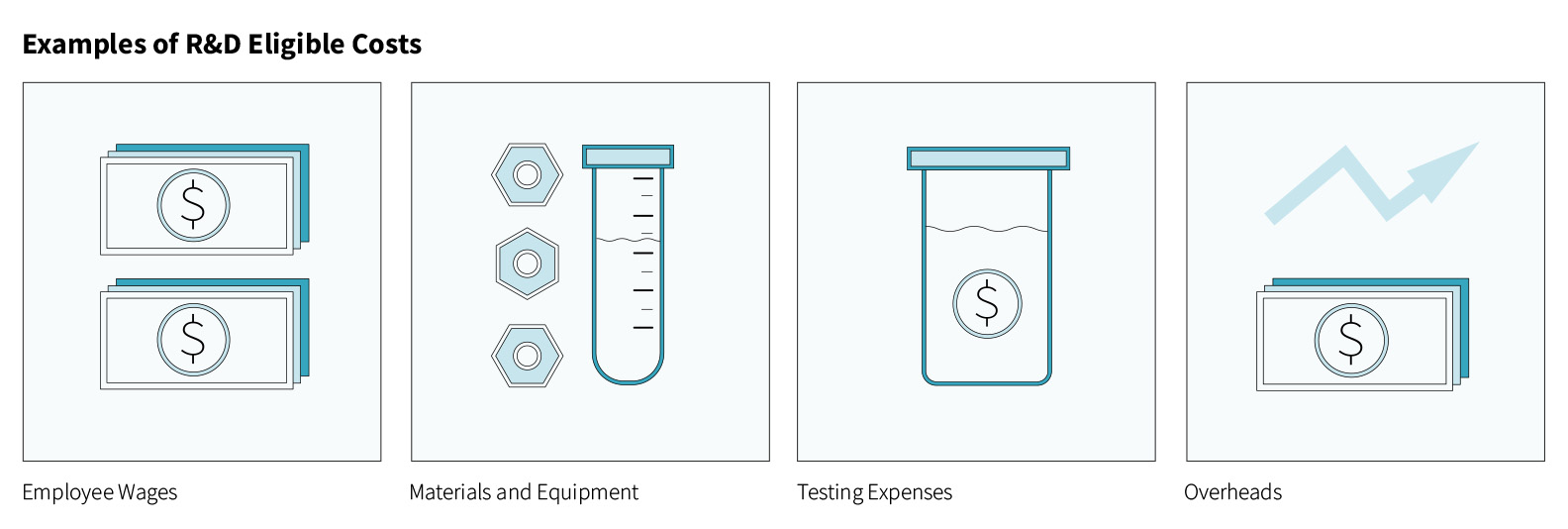
Some examples of eligible costs could include:

  • Employee Wages: Salaries and associated costs (such as superannuation) for employees directly involved in R&D activities.
  • Materials and Equipment: Costs of materials and equipment used specifically for R&D projects.
  • Testing Expenses: Expenditures related to testing and experiments conducted as part of your R&D.
  • Overheads: Relevant overhead costs that can be attributed to R&D activities such as subscriptions, phone and internet bills and even rent.


Examples of eligible R&D costs


A careful examination of each eligible cost ensures that businesses make the most of this opportunity, enhancing the financial benefits derived from R&D activities.


4 – How Much Can You Claim?

The golden question: how much can you receive under the R&DTI?


The answer is – up to 43.5% of your Research and Development costs from the previous financial year. The exact amount you can claim through varies based on your business’s turnover:

  • Businesses with less than $20 million turnover: The refundable R&D tax offset is your corporate tax rate plus an 18.5% premium.
  • Businesses with more than $20 million turnover: The non-refundable R&D tax offset is your corporate tax rate plus an incremental premium.


Let’s look at two examples:

  • A business with a $5 million turnover spending $250,000 on R&D in one financial year with a corporate tax rate of 30%, could be eligible for a $121,250 refund.
  • A business with a $25 million turnover spending $500,000 on R&D in the last financial year with a 30% corporate tax rate, could be eligible for $192,500 to $232,500, depending on their R&D intensity which informs the incremental premium.


To get a rough indication of the amount your business can receive, utilise this free R&D Tax Incentive calculator.


Not sure if you’re eligible for the R&D Tax Incentive?
Our free Blueprint breaks it down with an eligibility checklist, examples, and expert tips from the FundFindrs team.


5 – Is There a Minimum Spending Requirement?

Currently, businesses need to have a minimum R&D spend of $20,000 to qualify for this valuable incentive. This spending threshold is a key factor to consider as you explore the potential benefits and opportunities that the R&D Tax Incentive can bring to your business. Collaboration with registered Research Service Providers (RSPs) is often beneficial, as you don’t have to reach the minimum spend threshold to claim the R&DTI if you use an RSP.


6 – Are You Eligible?

If you’ve made it this far, you might be considering: “Is my business eligible for this Incentive?” Let’s find out.


Eligibility for the R&D Tax Incentive is designed to be accessible to a wide range of businesses. To qualify, your business must be:

  • Incorporated in Australia: Alternatively, if your business is under foreign law but conducts eligible R&D activities in Australia, you may still qualify.
  • Meeting the Spending Threshold: Your business must spend over $20,000 on eligible R&D activities in a financial year. This ensures that the incentive supports substantial and impactful research and development efforts.
  • Conducting R&D Activities: Your company needs to be conducting or planning to conduct at least one eligible R&D activity. Those activities can attempt to generate new/improved products, services, and processes or can be conducted to support them.


There are other main criteria and requirements to determine your eligibility and guide you through the identification of a Core or Supporting R&D Activity. To find out if your business could be eligible for the R&DTI get in contact with our team of experts to book a FREE meeting.


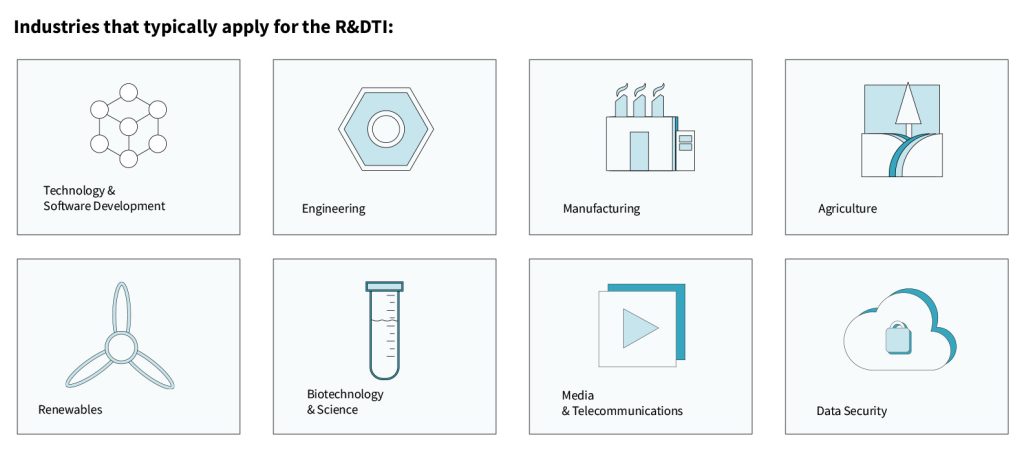
7 – What are the most common industries that typically apply for the R&DTI?

Companies from many industries can benefit from the R&D Tax Incentive to drive innovation and growth to their business. It’s common to see technology and software development companies leverage the incentive to fund advancements in digital solutions, enhancing efficiency and user experience.


Other frequent examples are engineering and manufacturing companies which also heavily invest in innovation through the incentive, fostering the development of new products and processes that improve productivity and competitiveness. Additionally, companies from agriculture, mining, biotechnology, renewables, and other sectors typically submit their applications to the R&D Tax Incentive to help them innovate and create new services/products.


Common industries applying for R&DTI


While these industries have traditionally been prominent users of the program, the scope of eligible activities is broad, inviting exploration from other sectors keen on advancing through research and development. The R&D Tax Incentive boasts a substantial fund exceeding $1 billion, offering an expansive resource for all types of businesses.


8 – How simple is the R&DTI Application Process?

Applying for the R&D Tax Incentive involves several key steps to ensure that your application is thorough and accurate and can look like the following:

  1. Assess Eligibility: Review the program’s criteria to confirm that your business qualifies, and your R&D activities are eligible.
  2. Prepare Documentation: Compile detailed records of the nature and scope of your R&D activities, including financial statements and project descriptions.
  3. Submit Application: Submit your completed application to the Australian Taxation Office (ATO) and the Department of Industry, Innovation, and Science. You must submit your application within 10 months after the end of the financial year.


Maybe you are thinking: “There are too many steps involved in this process and I don’t have time to do so, so should I bother applying?”


Although there are a handful of steps involved in applying for the R&D Tax Incentive, keep in mind all the potential benefits quite outweigh the time spent doing so. Additionally, we can relieve the pressure from your shoulders. One way to boost your chances of success is by letting our team of experts handle the entire process for you. Book a free consultation to get the information and support you need to confidently complete your R&DTI claim.


9 – What’s the Timeline from Applying to Receiving the R&DTI Funds?

Now that we’ve covered the details of the Research and Development Tax Incentive, the next question naturally revolves around understanding the timeline and all its steps—from the day you apply to the moment the refund lands in your account. This understanding is crucial to effectively plan your finances and, possibly, bring forward your plans to growth and (re)invest.


Applications typically run from 1 July to 30 April of the following financial year. For instance, if you’re claiming for the financial year 1 July 2023 – 30 June 2024, you can apply from 1 July 2024 to 30 April 2025. Once approved, funds usually reach your account within a few weeks to a couple of months, providing timely financial support to your business.


You can streamline this process and strategically optimise your outcome by count with our support. The FundFindrs team is ready to assist you through this process, allowing you to reinvest funds into your business as quickly as possible.


10 – How to Maximise Your R&DTI Claim?

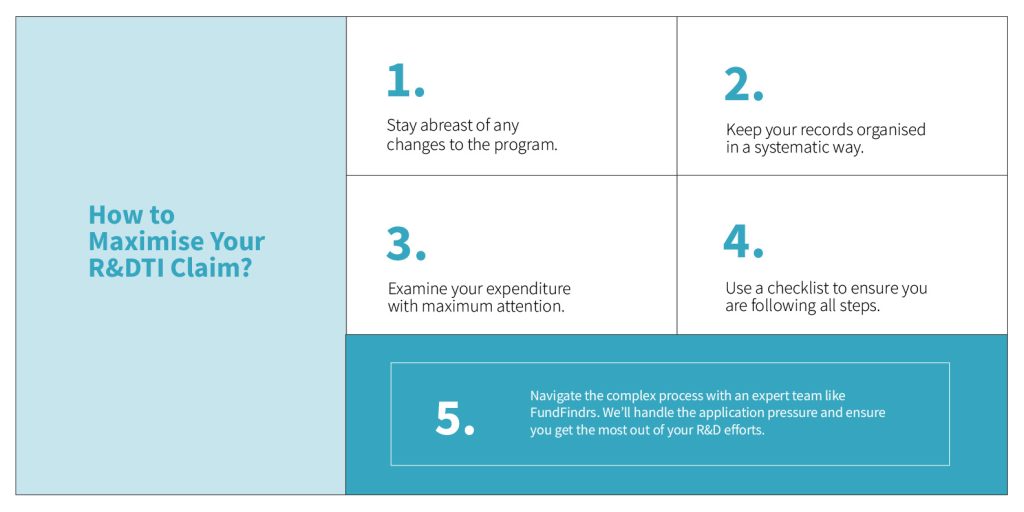
Are you ready to take most advantage of the Research & Development Tax Incentive (RDTI)? there a several ways to maximise your claim and make sure your process is thorough and solid. Here are some tips:

  1. Stay abreast of any changes to the program. Any recent changes that may impact your eligibility or the benefits you can receive will be carefully considered in your unique strategy. An easy way to stay on top is signing up for our Newsletter and following us on LinkedIn, Facebook and Instagram. We stay informed, so you don’t have to.
  2. Keep your records organised in a systematic way. Having well-organised documentation not only strengthens your claim but simplifies the RDTI process.
  3. Examine your expenditure with maximum attention to allocate all possible expenses to streamline your claim.
  4. Use a checklist to ensure you are claiming the R&DTI correctly according to the legislation minimising compliance risks. The catch to better securing this grant? Nailing your application.
  5. Navigate the complex process with an expert team like FundFindrs. We’ll handle the application pressure and ensure you get the most out of your R&D efforts.


How to maximise your R&DTI claim


Book your FREE 30 minute starter chat with us


Before You Go

Don’t let your innovation go unrewarded. Unlock your next phase of growth with the Australian R&D Tax Incentives by reaping its countless benefits. Whilst the application process is detailed, the returns are well worth the investment.


So do your business (and yourself) a favour and get applying! And as always, the FundFindrs team is here to assist you through the entire process as well as any other queries or questions.


Simply send us an email or give us a call at (02) 9072 1720 at anytime and we’ll get back to you ASAP.

From Proposal to Funding: How a Grant Writing Consultant Can Support Your Business

A simplified guide to the grant application process and the role of a grant writing consultant

Applying for grants can be a challenging task for business owners. If you’ve written a grant application (or attempted to), you know how hard and tedious it can become. However, many people are still unaware of what a grant consultant does.


When someone lures you in with the promise of free funding for your organisation, it sounds appealing (and it’s often true!), but reaching that point involves several steps. These steps require a substantial investment of time, resources, and know-how.


Many businesses have given up on their grant applications because the process is so time-consuming. That’s where grant consultants and writers can add value and help propel your business forward.


Grant writing specialists make the process easier by assisting businesses throughout the entire application journey. They offer crucial insights, direction, experience and expertise to improve the chances of a successful outcome.


What Does a Grant Writing Consultant Do?

Whether you decide to hire your own employee or contact a fund finding agency, grant specialist services include everything from researching grant opportunities, to writing and submitting applications for your business and guiding you through compliance requirements.


Often, when engaging an external consultant, the agreement typically covers all aspects of the process, including preparation, research, writing, and application.


At first, it might appear that the tasks are simple and easy to manage yourself. However, within these tasks there are multiple smaller steps such as participating in debriefs with foundations on funding guidelines or rejected proposals and researching through a database that lists thousands of possible funding opportunities and selecting the ones that are best for you.


What-Does-a-Grant-Consultant-Do-Comprehensive-Guide-by-FundFindrs-quote


Here is a basic blueprint of how a grant writing agency supports businesses through the process of finding suitable fundings:


1 – Investigating Relevant Grants for Your Business

It all begins with pinpointing grants that match your business objectives and aligns with your planned programs and initiatives. It’s crucial to comprehend the eligibility criteria, submission deadlines, and specific prerequisites for each grant opportunity.

This first step helps ensure that the applied efforts are directed towards the most appropriate funding sources with the best chance for success.


2 – Collecting All Necessary Documentation

Before starting the application process, the grants specialist will orient you on the necessary steps and gather all required documents. These may include business registration details, financial statements, tax returns, and business plans.

Additionally, they will collect strategic documents, proof of eligibility such as industry certifications or licenses, and any other documentation required by the grant guidelines. This ensures that all the requirements are thoroughly covered.


3 – Help Organising Financial Statements

Providing clear and detailed financial statements, such as profit and loss statements, balance sheets, and cash flow statements, is mandatory.

A focused grant consultant can guide your business in demonstrating strong financial health, which enhances your credibility and strengthens your application.


4 – Formulating a Detailed Business Plan

An expert grant services company can also assist you in developing a comprehensive business plan that outlines your company’s goals, strategies, and the specific project or initiative for which you need funding.

Tailored support can help you clearly describe how the grant will contribute to your business’s growth, innovation, or sustainability and also how it will impact the broader community or economy. A grant consultant can even support you with the design of projects to target specific grant programs.


5 – Drafting an In-Depth Project Proposal

Most grants require a project proposal, and a grant consultant can assist you in preparing a thorough and well-organised document. This document should include project objectives and goals, methodology and approach, timeline and key milestones, a detailed budget highlighting the use of grant funds, and measurable outcomes and anticipated impact.


6 – Making Sure you Meet the Eligibility Requirements

Carefully examining and addressing each eligibility requirement specified in the grant guidelines is part of a grant writer’s role. Clearly illustrating how your business meets these criteria is crucial, as overlooking any requirement could lead to your application being rejected. Having specialist support increases your chances of success.


7 – Developing a Compelling Story

Why should your business be selected over your competitor to win a grant? Crafting a compelling narrative that uses clear and concise language to tell your business’s story, highlighting its unique features and contributions, is fundamental.

A specialist writer has the expertise to create a proposal that clearly expresses the necessity for funding and the positive impact it will have on your business and the wider community.

Navigating the grant application process can be complex and time-consuming. Investing in grant consultants is a strategic decision that can yield significant returns for your business. By leveraging their expertise, insights, and networks, you gain a competitive edge in securing grants.

Grant companies can manage your federal, state, local government grant application as well as community or foundation grant applications, ensuring they are thorough yet concise to meet the highly competitive nature of the process, allowing you to concentrate on running and expanding your business.


How to Choose a Grant Writing Consultant

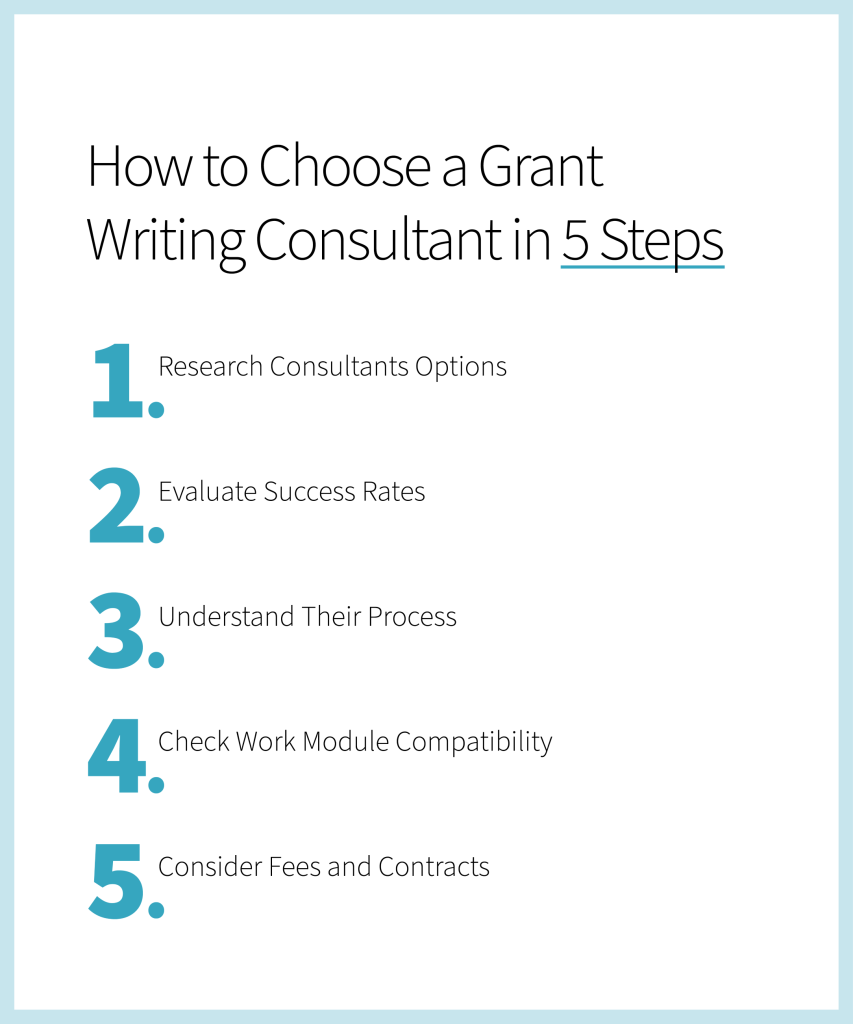
Choosing a grant writing consultant is crucial for securing funding for your project. Here’s a 5-steps streamlined approach to help you to make the best choice while searching for an expert support:


  1. Research Consultants: Look for experienced consultants with relevant qualifications and positive client testimonials.
  2. Evaluate Success Rates: Inquire about their track record in securing similar grants and the total funding they have obtained.
  3. Understand Their Process: Discuss their approach to gathering information, developing proposals, and ensuring timely submission.
  4. Check Compatibility: Ensure their communication style aligns with your expectations and that they understand your project.
  5. Consider Fees and Contracts: Understand their fee structure and review contract terms for clarity on deliverables and payment.


how-to-choose-a-Grant-Consultant-FundFindrs


Compare the options based on these criteria and choose the one you feel most confident in before making your decision.


How FundFindrs Can Streamline Applications and Save Time for Your Business

At FundFindrs, we simplify the grant application process into three manageable steps.


Step 1 | Tailored Consultation

We start by meeting with you to understand your business operations, goals, and aspirations. This allows us to create a bespoke proposal that aligns with your objectives.


Step 2 | Expert Application Management

Our experienced team takes charge of gathering the necessary documentation and crafting your application meticulously. We provide guidance on financial documentation and collaborate closely with you at every step.


Step 3 | Seamless Grant Approval

Upon successful approval, you receive your grant funding directly, with our support throughout the entire journey.


The FundFindrs edge includes a no-win, no-fee model on selected applications, saving you time by managing every aspect of the application. Our specialists in R&D Tax Incentives help you secure up to 43.% of your R&D expenses, and we partner closely with clients for long-term growth, managing all grants and awards applications.

Contact our team today to book a free consultation and discover how we can help your business secure the funding it needs.


Book your FREE 30 minute starter chat with us