Research and Development Tax Incentive Archives - FundFindrs

The R&D Tax Incentive Unpacked: All your burning questions answered.

Last reviewed: July 28, 2026


What’s the buzz around the Research and Development Tax Incentive (R&DTI)? Is it just another grant, or is there more to it?

For over four decades, the R&DTI has been a game-changer for Australian businesses, offering tax credits to cut down on research and development costs. It’s not just for the big players; startups and established companies in tech, manufacturing, pharma, agriculture and other industries can all benefit. By providing tax offsets for eligible R&D activities, the incentive fuels innovation and helps businesses grow and compete globally.

Let’s break it down with some practical insights and examples from experts to help you get the most out of the R&DTI.


In the next 8 minutes or so, we’ll comprehensively cover:


Key takeaways 


  • The R&D Tax Incentive (R&DTI) is a government program that provides tax offsets for eligible R&D activities, helping businesses reduce the cost of innovation.
  • The program is available to businesses of all sizes and across a wide range of industries, including technology, manufacturing, agriculture and pharmaceuticals.
  • Eligible businesses may be able to offset up to 43.5% of their R&D expenditure, improving cash flow and reducing financial risk.
  • The R&DTI is designed to encourage innovation, supporting businesses that invest in developing new or improved products, processes, services or technologies.
  • Understanding eligibility, claimable costs and application requirements is critical to maximising the value of the program.
  • R&DTI funding can be reinvested into future projects and business growth, helping companies continue innovating and scaling.


R&D Tax Incentive

1 – What is the R&D Tax Incentive?

The Research and Development Tax Incentive (R&DTI) is a government program that provides a tax offset to Australian businesses that are engaged or planning to invest in eligible R&D activities. The primary aim of the program is to encourage innovation by reducing the financial risks associated with R&D projects, thereby stimulating advancements across various industries.


By participating, businesses like yours can significantly recover some of their investments, offsetting a portion of the costs associated with their R&D endeavours. This incentive stimulates innovation across various industries by reducing the financial risks associated with R&D projects while allowing business owners to make ambitious projects more feasible and less financially daunting.


2 – Why Should You Apply for the R&DTI and Is It Worth It?

Wondering why you should apply for the R&DTI and what its benefits are? The Research & Development Tax Incentive can become much more than just a financial incentive for your business in Australia. It’s an opportunity to propel your company forward and ensure long-term success.


Here are just 3 reasons why you should seriously consider it:

  • Financial Relief: You can offset up to 43.5% of your R&D costs, providing a substantial reduction in your overall expenses.
  • Growth Potential: The financial benefits can be reinvested into your business, fuelling further innovation and expansion.
  • Collaboration: Partnering with registered Research Service Providers can enhance your R&D efforts and outcomes, driving your projects to new heights.


3 – What R&D Costs Can Be Claimed?

The R&D tax benefits cover a variety of costs associated with research and development activities, making it easier for businesses to manage their expenses.


Some examples of eligible costs could include:

  • Employee Wages: Salaries and associated costs (such as superannuation) for employees directly involved in R&D activities.
  • Materials and Equipment: Costs of materials and equipment used specifically for R&D projects.
  • Testing Expenses: Expenditures related to testing and experiments conducted as part of your R&D.
  • Overheads: Relevant overhead costs that can be attributed to R&D activities such as subscriptions, phone and internet bills and even rent.
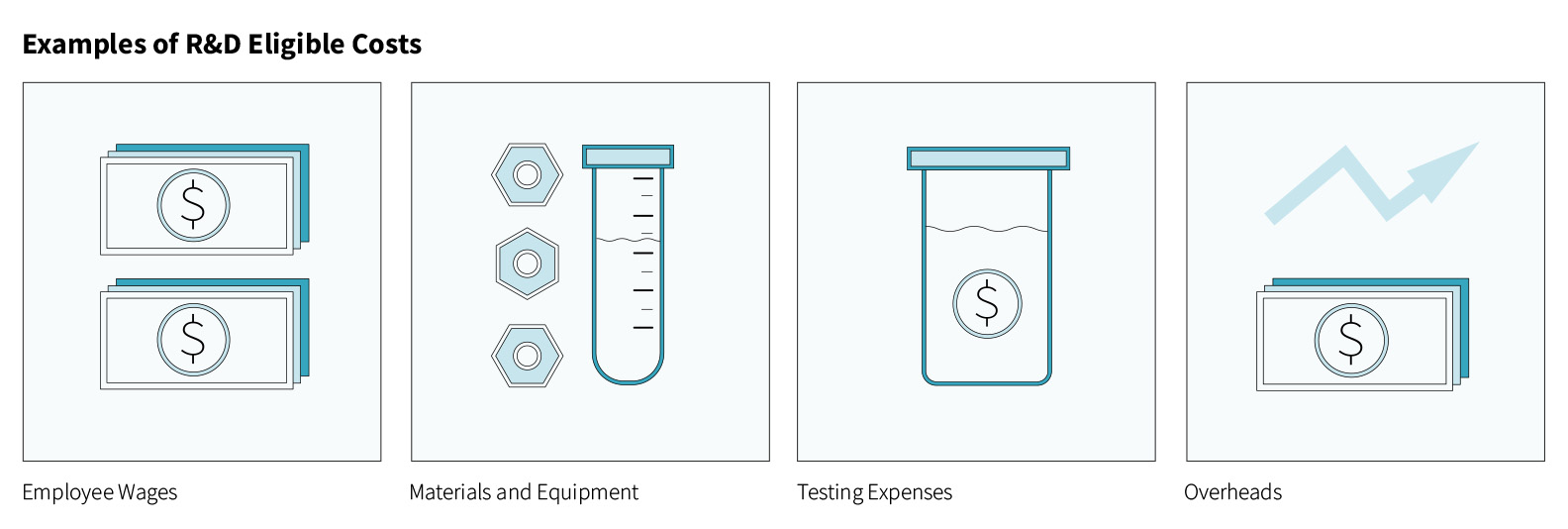
 

Examples of eligible R&D costs


A careful examination of each eligible cost ensures that businesses make the most of this opportunity, enhancing the financial benefits derived from R&D activities.


4 – How Much Can You Claim?

The golden question: how much can you receive under the R&DTI?


The answer is – up to 43.5% of your Research and Development costs from the previous financial year. The exact amount you can claim through varies based on your business’s turnover:

  • Businesses with less than $20 million turnover: The refundable R&D tax offset is your corporate tax rate plus an 18.5% premium.
  • Businesses with more than $20 million turnover: The non-refundable R&D tax offset is your corporate tax rate plus an incremental premium.


Let’s look at two examples:

  • A business with a $5 million turnover spending $250,000 on R&D in one financial year with a corporate tax rate of 30%, could be eligible for a $121,250 refund.
  • A business with a $25 million turnover spending $500,000 on R&D in the last financial year with a 30% corporate tax rate, could be eligible for $192,500 to $232,500, depending on their R&D intensity which informs the incremental premium.


To get a rough indication of the amount your business can receive, utilise this free R&D Tax Incentive calculator.


Not sure if you’re eligible for the R&D Tax Incentive?
Our free Blueprint breaks it down with an eligibility checklist, examples, and expert tips from the FundFindrs team.


5 – Is There a Minimum Spending Requirement?

Currently, businesses need to have a minimum R&D spend of $20,000 to qualify for this valuable incentive. This spending threshold is a key factor to consider as you explore the potential benefits and opportunities that the R&D Tax Incentive can bring to your business. Collaboration with registered Research Service Providers (RSPs) is often beneficial, as you don’t have to reach the minimum spend threshold to claim the R&DTI if you use an RSP.


6 – Are You Eligible?

If you’ve made it this far, you might be considering: “Is my business eligible for this Incentive?” Let’s find out.


Eligibility for the R&D Tax Incentive is designed to be accessible to a wide range of businesses. To qualify, your business must be:

  • Incorporated in Australia: Alternatively, if your business is under foreign law but conducts eligible R&D activities in Australia, you may still qualify.
  • Meeting the Spending Threshold: Your business must spend over $20,000 on eligible R&D activities in a financial year. This ensures that the incentive supports substantial and impactful research and development efforts.
  • Conducting R&D Activities: Your company needs to be conducting or planning to conduct at least one eligible R&D activity. Those activities can attempt to generate new/improved products, services, and processes or can be conducted to support them.


There are other main criteria and requirements to determine your eligibility and guide you through the identification of a Core or Supporting R&D Activity. To find out if your business could be eligible for the R&DTI get in contact with our team of experts to book a FREE meeting.


7 – What are the most common industries that typically apply for the R&DTI?

Companies from many industries can benefit from the R&D Tax Incentive to drive innovation and growth to their business. It’s common to see technology and software development companies leverage the incentive to fund advancements in digital solutions, enhancing efficiency and user experience.


Other frequent examples are engineering and manufacturing companies which also heavily invest in innovation through the incentive, fostering the development of new products and processes that improve productivity and competitiveness. Additionally, companies from agriculture, mining, biotechnology, renewables, and other sectors typically submit their applications to the R&D Tax Incentive to help them innovate and create new services/products.
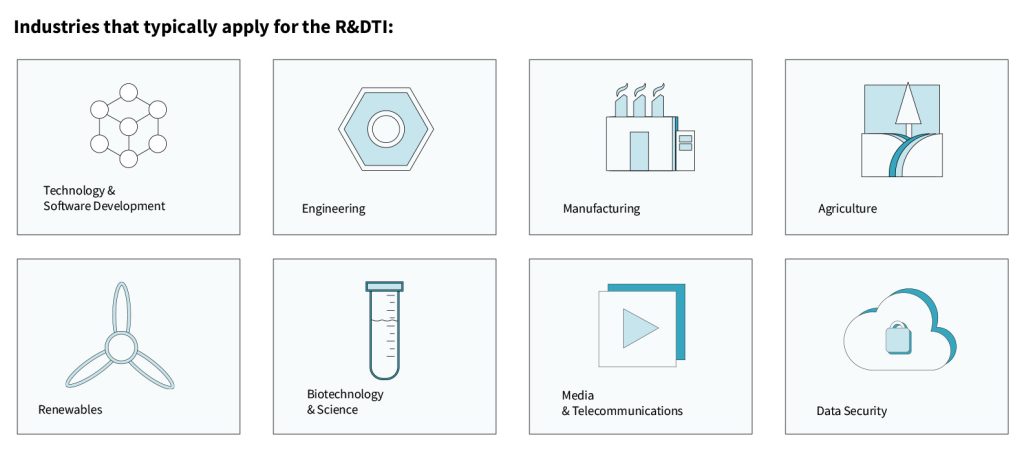
 

Common industries applying for R&DTI


While these industries have traditionally been prominent users of the program, the scope of eligible activities is broad, inviting exploration from other sectors keen on advancing through research and development. The R&D Tax Incentive boasts a substantial fund exceeding $1 billion, offering an expansive resource for all types of businesses.


8 – How simple is the R&DTI Application Process?

Applying for the R&D Tax Incentive involves several key steps to ensure that your application is thorough and accurate and can look like the following:

  1. Assess Eligibility: Review the program’s criteria to confirm that your business qualifies, and your R&D activities are eligible.
  2. Prepare Documentation: Compile detailed records of the nature and scope of your R&D activities, including financial statements and project descriptions.
  3. Submit Application: Submit your completed application to the Australian Taxation Office (ATO) and the Department of Industry, Innovation, and Science. You must submit your application within 10 months after the end of the financial year.


Maybe you are thinking: “There are too many steps involved in this process and I don’t have time to do so, so should I bother applying?”


Although there are a handful of steps involved in applying for the R&D Tax Incentive, keep in mind all the potential benefits quite outweigh the time spent doing so. Additionally, we can relieve the pressure from your shoulders. One way to boost your chances of success is by letting our team of experts handle the entire process for you. Book a free consultation to get the information and support you need to confidently complete your R&DTI claim.


9 – What’s the Timeline from Applying to Receiving the R&DTI Funds?

Now that we’ve covered the details of the Research and Development Tax Incentive, the next question naturally revolves around understanding the timeline and all its steps—from the day you apply to the moment the refund lands in your account. This understanding is crucial to effectively plan your finances and, possibly, bring forward your plans to growth and (re)invest.


Applications typically run from 1 July to 30 April of the following financial year. For instance, if you’re claiming for the financial year 1 July 2023 – 30 June 2024, you can apply from 1 July 2024 to 30 April 2025. Once approved, funds usually reach your account within a few weeks to a couple of months, providing timely financial support to your business.


You can streamline this process and strategically optimise your outcome by count with our support. The FundFindrs team is ready to assist you through this process, allowing you to reinvest funds into your business as quickly as possible.


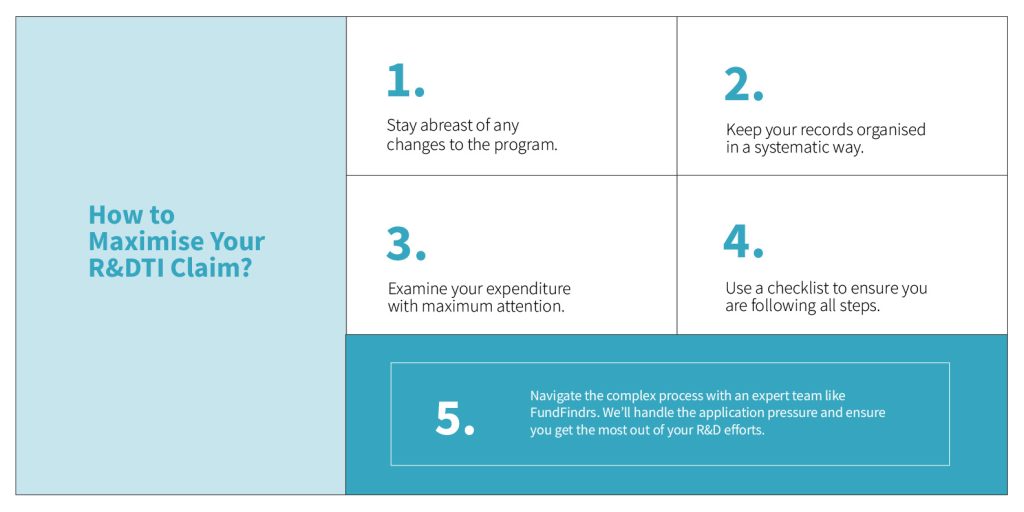
10 – How to Maximise Your R&DTI Claim?

Are you ready to take most advantage of the Research & Development Tax Incentive (RDTI)? there a several ways to maximise your claim and make sure your process is thorough and solid. Here are some tips:

  1. Stay abreast of any changes to the program. Any recent changes that may impact your eligibility or the benefits you can receive will be carefully considered in your unique strategy. An easy way to stay on top is signing up for our Newsletter and following us on LinkedIn, Facebook and Instagram. We stay informed, so you don’t have to.
  2. Keep your records organised in a systematic way. Having well-organised documentation not only strengthens your claim but simplifies the RDTI process.
  3. Examine your expenditure with maximum attention to allocate all possible expenses to streamline your claim.
  4. Use a checklist to ensure you are claiming the R&DTI correctly according to the legislation minimising compliance risks. The catch to better securing this grant? Nailing your application.
  5. Navigate the complex process with an expert team like FundFindrs. We’ll handle the application pressure and ensure you get the most out of your R&D efforts.
 

How to maximise your R&DTI claim


Book your FREE 30 minute starter chat with us


Before You Go

Don’t let your innovation go unrewarded. Unlock your next phase of growth with the Australian R&D Tax Incentives by reaping its countless benefits. Whilst the application process is detailed, the returns are well worth the investment.


So do your business (and yourself) a favour and get applying! And as always, the FundFindrs team is here to assist you through the entire process as well as any other queries or questions.


Simply send us an email or give us a call at (02) 9072 1720 at anytime and we’ll get back to you ASAP.

Key Grants for Food and Beverage Companies in Australia

Last reviewed: July 17, 2026


Government funding plays a fundamental role in driving growth, innovation, and operational improvements within Australia’s Food & Beverage sector. With a broad range of grants available, businesses can struggle to identify the opportunities that best align with their unique needs.


In this article, we outline several key grants selected specifically for Food & Beverage companies, covering initiatives from safety enhancements to strategic investment. Each program is designed to help businesses elevate their operations, expand their capabilities, and invest in critical infrastructure.


  1. Distillery Door Programs – Hazardous Areas and Dangerous Goods Rebate
  2. Wine Exports China Re-Engagement Support Program
  3. Value Add Investment Grants Program (VAIG) – Feasibility Stream


Key takeaways 


  • Government grants can help Food & Beverage businesses improve safety, expand operations and invest in growth initiatives.
  • Funding opportunities are available across multiple areas, including workplace safety, export market development and value-add manufacturing projects.
  • Many grants are highly targeted, with specific eligibility criteria based on industry, location and business activities.
  • Co-contributions are often required, meaning businesses should be prepared to invest alongside government funding.
  • Export-focused programs can support market expansion, helping businesses strengthen their presence in international markets.
  • Planning ahead is essential, as grant programs have different funding limits, application requirements and closing dates.


1. Distillery Door Program – Hazardous Areas and Dangerous Goods Rebate

Enhancing safety in Victoria’s distilleries with essential rebates


Key Details

  • Closing by: 30 June 2025
  • Funding Available: Up to $50,000
  • Target Recipients: Distillers of alcoholic beverages in Victoria


Overview

This program assists Victorian distillers in investing in essential equipment and infrastructure to enhance safety in their facilities. It offers a rebate on eligible expenditure — up to 70% or 80% (GST exclusive), capped at $50,000 — while requiring a cash co-contribution of 20% or 30% depending on production volumes.


As part of a $20 million initiative to support Victoria’s distillery industry, the program funds activities such as hazardous area assessments, equipment installation, and specialist training, ensuring that all upgrades comply with Australian Standards and regulatory requirements.


Eligibility Criteria

Businesses must:

  • Hold a current Australian Business Number (ABN) and be registered as a legal entity in Victoria.
  • Own at least one still with a capacity of 50 litres or more.
  • Possess a valid ATO Manufacturer’s Licence and a current Victorian General or Producer’s Liquor Licence.
  • Have completed a hazardous area assessment, dangerous goods audit, OHS Essentials Program, or equivalent assessment undertaken from 1 April 2023 until closing date.
  • Meet the required cash co-contribution based on their production level.
  • Agree to participate in future program evaluation activities and comply with relevant workplace and employment obligations.


2. Wine Exporters China Re-Engagement Support Program

Supporting SA wine exporters to re-access China’s market


Key Details

  • Closing by: Program runs until June 2026
  • Funding Available: Approximately $1.9 million total funding pool
  • Target Recipients: South Australian wine exporters


Overview

This program is designed to help South Australian wine exporters re-enter the Chinese market following the lifting of tariffs on Australian wine. It delivers strategic support through market insights, export advisory services, coordinated trade missions, and targeted marketing campaigns.


Implemented by the South Australian Government in partnership with the South Australian Wine Industry Association (SAWIA), the program aims to revitalise international trade relationships and strengthen the region’s wine sector.


Eligibility Criteria

Businesses must:

  • Be a registered South Australian wine exporters with a valid ABN.
  • Demonstrate active engagement in exporting wine internationally.


3. Value Add Investment Grants Program (VAIG) – Feasibility Stream

Empowering WA food and beverage businesses with feasibility funding


Key Details

  • Closing by: 30 June 2025
  • Funding Available: Individual grants from $15,000 to $100,000 (up to $500,000 per project; total pool of $6 million)
  • Target Recipients: Agriculture, food, and beverage businesses in Western Australia


Overview

The VAIG – Feasibility Stream supports WA-based agriculture, food, and beverage businesses planning to expand, diversify, or relocate their value-add processing operations. This program funds planning and feasibility studies that underpin investments in new manufacturing capabilities, technology upgrades, or plant modernisation. By reducing WA’s reliance on imported products, the initiative fosters innovation, enhances sustainability, and drives job creation. Applicants are required to provide a minimum cash co-contribution of 30%, with some flexibility available for Aboriginal businesses.


Eligibility Criteria

Businesses must:

  • Be a private sector entity (including incorporated trustees, public companies, or cooperatives) with a valid ABN and GST registration.
  • Plan a project located in or relocating to Western Australia.
  • Demonstrate the financial capacity to meet the minimum cash co-contribution.
  • Have been in operation for at least 12 months (or possess a similar established track record).
  • Be capable of entering into a legally binding agreement with the WA Government.
  • Regional and Aboriginal businesses are encouraged to apply.


Reminder: Don’t Miss the R&D Tax Incentive (R&DTI)


The Research and Development Tax Incentive is a powerful mechanism that offers significant tax offsets and cash refunds for eligible R&D activities, easing the financial risks of innovation. Despite its benefits, many Food & Beverage companies are overlooking this opportunity. Leveraging the R&D Tax Incentive not only reduces R&D costs but also positions your business to drive technological advancements and compete globally.


Ensure you assess your eligibility and consider expert advice to fully integrate this incentive into your financial strategy for sustained growth and market leadership. Learn more about the R&DTI Program by visiting our dedicated page.


Food and Beverage Funding Opportunities for Australian Businesses


The grants listed above represent just a snapshot of the funding opportunities available to support the growth and innovation of Food and Beverage companies in Australia. If you’re looking to explore these options further and strengthen your market position, our team of experts is here to help.


With the complexities of the application process, partnering with experienced advisors is essential. That’s where FundFindrs comes in — we support you every step of the way. Book a FREE chat today for a tailored consultation.


5 Benefits of Lodging Your R&DTI Claim Right Now


Last reviewed: July 17, 2026


Every year, thousands of Australian businesses benefit from the R&D Tax Incentive (R&DTI) — a government program offering up to 43.5% in tax offsets for eligible research and development activities. But many wait until the last minute to lodge their claim, which can slow cashflow, increase stress, and complicate tax lodgements.  

Whether you’ve claimed before or are exploring the R&DTI for the first time, FundFindrs is here to support you through the process, making it straightforward, simple and rewarding.

Early lodgement is the smart move and here are five reasons why.


  1. Access cash sooner  
  2. It’s easier to recall recent work
  3. Make all your lodgements seamless
  4. Avoid the seasonal bottlenecks 
  5. It gives you time to focus on your business
  6. FundFindrs makes it easy for everyone 


Key takeaways 


  • Early lodgement can improve cashflow, helping businesses access their R&D Tax Incentive refund sooner.
  • Claiming while activities are still recent makes it easier to capture accurate project details and supporting evidence.
  • Getting started early reduces administrative burden, helping avoid amendments and last-minute tax return adjustments.
  • Avoid seasonal bottlenecks caused by holiday periods and peak R&D Tax Incentive lodgement volumes.
  • Earlier access to funding may be possible through specialist lending solutions linked to expected R&D Tax Incentive refunds.
  • Taking action sooner provides greater certainty, allowing business owners to focus on growth rather than compliance deadlines.


1. Access cash sooner  

The sooner you lodge, the sooner you access your refund. That’s real money you can reinvest into your business, whether it’s hiring staff, launching a new product, or strengthening your financial position. For businesses new to the R&DTI, this can be a powerful funding boost to fuel innovation and growth. 


2. It’s easier to recall recent work

Your R&D activities for FY25 took place between 1 July 2024 and 30 June 2025. If you wait until the April 2026 deadline, that means you’ll be looking back nearly two years. Preparing now means the details are fresh, making it easier to gather accurate information and reducing the risk of missed or incomplete documentation. 


3. Make all your lodgements seamless

Your R&DTI Schedule and Company Tax Return (CTR) are separate but closely linked. Preparing your R&DTI claim early helps you or your accountant lodge your CTR with the correct R&D figures from the start. That means fewer amendments, less rework, and a smoother process for everyone involved. Even if you aren’t ready to submit your CTR yet, there are options available so you can still get the funding now.

We have partners who offer R&D loans, which are advances on your R&DTI refund, meaning you don’t have to wait until after you lodge your company tax return; you can access your refund and reinvest earlier. 


Looking for faster access to your R&D refund?

We work with specialist partners who can help you unlock your funds early


4. Avoid the seasonal bottlenecks 

There are two busy periods which can slow things down:

  • December/January means summertime, when some of your key staff may be on leave. 
  • March/April is when AusIndustry experiences peak R&DTI claim volumes because people didn’t get their claims in sooner.


5. It gives you time to focus on your business

Submitting your claim early gives you peace of mind, freeing up headspace to focus on your business. Instead of scrambling at the last minute, you’ll have confidence knowing your R&DTI refund is on its way — freeing up time and energy to focus on this year’s growth. 


Research and Development in the manufacturing sector.


6. FundFindrs makes it easy for everyone 

Whether you’ve claimed the R&DTI in the past, or you’re applying for the first time, FundFindrs supports you every step of the way to simplify what can often feel complex.

Our specialists work with you throughout the year to:  

  1. Identify and define eligible R&D activities with precision and clarity.  
  2. Strengthen documentation and evidence to support compliance.  
  3. Review previous claims for missed or under-claimed opportunities.  
  4. Provide guidance on structuring future projects for long-term benefit.  

This proactive, year-round partnership ensures your R&D claims are accurate, defensible, and optimised for value.


Let’s get your R&DTI started now 

 If you’re ready to get your refund sooner and make next year’s claim easier, our team can help you start today. Click here to book a FREE consultation. 

The Australian Business Funding Roadmap: 7 Funding Pathways and How to Combine Them

Australian businesses have access to a wide range of funding pathways, each designed to support different stages of growth and business objectives. These can include founder capital, government grants, the R&D Tax Incentive, business loans and other forms of non-equity finance, angel investment, venture capital, and export funding programs. The most appropriate funding pathway will depend on what a business is trying to achieve, whether that is developing a new product, commercialising innovation, scaling operations, improving cash flow or expanding into international markets. 

The right pathway depends on what you are trying to fund. A founder validating an idea will need something different from a manufacturer scaling production, a software company solving technical uncertainty, or an exporter entering a new overseas market. 

At FundFindrs, we work with Australian businesses to identify and access government grants and the R&D Tax Incentive. These are often powerful non-dilutive funding options because they can support innovation, commercialisation and growth without requiring founders to give away equity. But they rarely sit in isolation. In many cases, grants and R&D support work best when they are part of a broader funding roadmap. 


In this article, we will examine seven of the different funding pathways available to Australian businesses.


Key takeaways 


  • There is no single best funding option for every business. The right pathway depends on the business stage, growth objectives and the type of project being funded. 
  • Government grants and the R&D Tax Incentive can provide valuable non-dilutive funding for businesses investing in innovation, commercialisation, manufacturing capability and growth. 
  • Different funding pathways serve different purposes, from founder capital and debt funding through to angel investment, venture capital and export support. 
  • Many grant programs require businesses to contribute part of the project cost, making funding strategy, timing and co-contribution planning important. 
  • Grants and the R&D Tax Incentive do not need to replace investment or debt. They can often work alongside other funding sources as part of a broader funding roadmap. 
  • Businesses that understand their funding roadmap early are often better positioned to prepare evidence, align projects with eligibility requirements and identify future opportunities. 
  • The strongest funding outcomes occur when funding is aligned with business strategy rather than pursued as a standalone goal. 


Finding the right funding strategy


Australian businesses have more funding options available than ever before, from government grants and the R&D Tax Incentive through to loans, angel investment, venture capital and export funding. 

However, each funding pathway is designed to support different business objectives. Some are suited to innovation and product development. Others are designed to support commercialisation, international expansion, manufacturing capability or rapid scale. 

Understanding which funding options align with your business goals is an important first step in building a sustainable growth strategy. 


How the R&D Tax Incentive can support growth:

  • What funding options are available now 
  • What funding options may become available later 
  • Which grant programs require matched funding 
  • How to avoid relying too heavily on one source of capital 
  • How to preserve equity while still funding growth 
  • How to build the evidence needed for future applications 


7 funding pathways at a glance


Each funding pathway plays a different role in a business’s growth journey. The table below provides a high-level overview of the most common funding options available to Australian businesses, including when they are typically used and the key considerations associated with each. 


Funding pathway Best suited to Key benefit Key consideration
1. Founder capital Early validation Control and speed Personal risk and limited capacity
2. R&D Tax Incentive Eligible R&D activity Can help recover innovation costs Requires eligible activities, records and compliance
3. Government grants Defined projects Non-dilutive project funding Competitive and often requires co-contribution
4. Debt finance Working capital, equipment, bridging Avoids dilution Must be repaid
5. Angel investment Early growth and traction Capital plus expertise Equity dilution
6. Venture capital High-growth scaleups Large growth capital Dilution and growth expectations
7. Export funding International market expansion Supports export marketing and promotion Eligibility and timing vary by round


1. Founder capital


Founder capital is often the first funding pathway. It may come from personal savings, early shareholder contributions, director loans or money reinvested into the business by the founding team. 

It is useful because it gives founders control and can move quickly. There is no application round, no lender approval and no investor negotiation. But it also has limits. Founder capital can place personal pressure on the business owners and may not be enough to fund larger commercialisation, manufacturing, R&D or export projects. 


Best for:

Early validation, initial product development, customer discovery, small pilots and bridging gaps before external funding is available.


2. The R&D Tax Incentive


The R&D Tax Incentive (R&DTI) is one of the most important funding pathways for innovative Australian businesses. It is not a grant. It is a tax offset designed to encourage eligible companies to conduct research and development activities in Australia. 

According to the Australian Taxation Office (ATO), approximately 16,000 companies claim the R&D Tax Incentive each year, highlighting just how widely the program is used across the Australian innovation ecosystem. 

For many founders, CFOs and business leaders, the R&D Tax Incentive is overlooked because they do not describe their work as “research”. They may call it product development, engineering, testing, software development, process improvement or technical problem solving. But if the business is undertaking systematic experimentation to resolve technical uncertainty, it may be worth assessing whether the activity could qualify.
 

How the R&D Tax Incentive can support growth:

  • It can help recover part of eligible R&D costs. 
  • It can support reinvestment into future development. 
  • It can improve cash flow for eligible companies. 
  • It can sit alongside grants, investment and debt when structured correctly. 
  • It encourages businesses to keep better records of technical activities, experimentation and expenditure. 


The R&D Tax Incentive can be especially relevant for businesses developing software, engineering solutions, manufacturing processes, medical technology, clean technology, mining technology, agtech, robotics, AI or other innovation-led products and systems. 

Understanding what qualifies as an eligible R&D activity is often one of the most challenging aspects of preparing an R&D Tax Incentive claim. 


Best for:

Businesses developing new or improved products, processes, software, services or technologies through systematic experimentation, and seeking to reduce the cost of innovation through a tax offset or cash refund.


Not sure if you’re eligible for the R&D Tax Incentive?
Our FREE R&DTI Blueprint breaks it down with an eligibility checklist, examples, and expert tips from the FundFindrs team.


3. Government grants


Government grants can be powerful, but they are often misunderstood. The strongest grant candidates are not simply businesses that need money. They are businesses undertaking defined projects that align with government priorities, such as innovation, commercialisation, manufacturing capability, export growth, regional development, sustainability or productivity improvement.


What grants commonly support: 

  • Commercialising a new product, process or service 
  • Progressing a prototype or pilot into market readiness 
  • Scaling manufacturing capability 
  • Building sovereign capability in priority sectors 
  • Export promotion and international market development 
  • Sustainability, clean energy or emissions reduction projects 
  • Research collaborations and pre-commercialisation activities
     

What grants usually do not support:

  • General operating costs 
  • Undefined business growth 
  • Ordinary payroll expenses 
  • Business survival or cash flow gaps 
  • Projects with no clear innovation, commercial or economic outcome 


This is why eligibility is usually project-based. A business may be a strong company but still not have a suitable grant project. Conversely, a smaller business with a clearly defined innovation or commercialisation project may be better placed than it first assumes. 


Stronger grant candidates Less suitable candidates
Have a defined project Only have a general business idea
Have a prototype, proof of concept, pilot or commercialisation pathway Are at concept stage only
Can show economic, technical or commercial outcomes Need general operating funds
Can contribute matched funding where required Cannot fund their contribution
Have evidence, milestones and a delivery plan Have limited documentation or unclear scope


4. Business loans and non-equity finance


Loans and debt funding can support business growth without requiring founders to give away ownership. Options may include traditional bank loans, equipment finance, working capital facilities, invoice finance, venture debt and alternative lending products. Unlike grants or the R&D Tax Incentive, debt funding must be repaid, but it can provide faster access to capital for businesses with a clear repayment pathway, predictable revenue or an identifiable asset being funded. 


Businesses now have access to a broad range of funding providers, including:

  • Major banks 
  • Specialist and alternative lenders 
  • Equipment finance providers 
  • Invoice and debtor finance providers 
  • Venture debt and revenue-based finance providers 


Each provider will have different lending criteria, security requirements, repayment structures and risk appetites, so it’s important to understand which solution best aligns with your business objectives and cash flow position. 


Before taking on debt, businesses should consider:

  • Repayment capacity 
  • Interest costs and fees 
  • Security requirements and personal guarantees 
  • Cash flow impacts 
  • How debt integrates with grants, the R&D Tax Incentive and other funding sources 


The most effective funding strategies typically use debt as one component of a broader funding mix rather than as a standalone solution. 


FundFindrs insight:  

Debt funding and grants are often viewed as separate funding pathways, but they frequently work together. Many grant programs require businesses to contribute a portion of project costs through matched funding. Depending on the program rules and business circumstances, debt funding may help fund that contribution, allowing the business to undertake a larger project than would be possible using available cash alone. 


 5. Angel investment


Angel investors typically provide early-stage capital to startups and scaleups, often before a business is ready for institutional venture capital. Unlike loans, angel investment does not need to be repaid. In exchange, investors receive an ownership stake in the business and become invested in its future success. 

For many founders, the value of angel investment extends beyond the capital itself. The right investor may bring industry knowledge, founder experience, strategic guidance, commercial introductions and access to networks that can help accelerate growth. 

Angel investment can also work well alongside grants and the R&D Tax Incentive. A founder may use angel capital to support product development, fund the business contribution required for a matched grant, or extend runway while eligible R&D activities are underway. When combined effectively, these funding pathways can help businesses progress faster without relying on a single source of capital. 

Not all angel investors bring the same value, so it is important to look beyond funding and consider the experience, networks, and support they can offer. 


When evaluating potential investors, founders should consider:

  • Relevant industry knowledge and experience 
  • Access to customers, partners or industry networks 
  • A track record of supporting growing businesses 
  • Alignment with the founder’s vision and long-term goals 
  • The ability to support future fundraising activities 


Many experienced founders will tell you that choosing the right investor can be just as important as securing the investment itself. FundFindrs partners with Angel Investing  business Impactiv to support clients at the right time. 


Best for:

Early and growth-stage businesses seeking capital, strategic advice and industry connections from experienced investors who are willing to back high-potential growth opportunities.


6. Venture capital


Venture capital (VC) is a funding pathway used by high-growth businesses looking to scale quickly. Unlike grants, debt funding or the R&D Tax Incentive, venture capital involves exchanging equity in the business for investment capital. 

VC funding is typically suited to businesses with large market opportunities, scalable business models and ambitious growth plans. Beyond capital, investors may also provide strategic advice, industry expertise, customer introductions and support with future fundraising activities. 

However, venture capital is not the right pathway for every business at every stage. Many founders assume they need investment immediately, when there may be opportunities to build value first through grants, the R&D Tax Incentive or other non-dilutive funding sources. 


Non-dilutive funding pathways such as grants and the R&D Tax Incentive may help businesses:

  • Fund technical development before valuation discussions 
  • Build commercialisation evidence that investors want to see 
  • Extend runway without immediate dilution 
  • Demonstrate the ability to secure and manage external funding 
  • Reach key milestones before entering fundraising conversations 
  • Perhaps most importantly, grants and the R&D Tax Incentive do not need to replace investment. They can often work alongside venture capital to support specific projects, reduce cash burn and help businesses achieve more with the capital they raise. 


Best for:

High-growth businesses with a scalable business model that need significant capital to accelerate expansion, enter new markets or achieve rapid growth.


7. Export funding and market expansion support


Export funding becomes relevant once a business is ready to sell, promote or expand into international markets. Programs such as the Export Market Development Grants program have historically supported eligible Australian businesses with export marketing and promotional activities. 

Export funding is different from R&D or commercialisation funding. It generally does not fund the development of the product itself. Instead, it helps eligible businesses promote Australian goods, services, software, IP or know-how into international markets. 


Best for:

Businesses that have a market-ready product or service, a clear export strategy and eligible export promotion activity.


How these funding pathways work together


The smartest funding strategy is rarely choosing one option and ignoring the rest. It is understanding which options apply at each stage of growth and how they can work together without creating compliance issues or cash flow pressure. 


Business stage Likely funding need Relevant pathways Funding strategy question
Validate Prove the problem, develop early product, test demand Founder capital, angel investment, early R&D assessment What evidence do we need before applying for external funding?
Innovate Solve technical problems, build or improve product, test uncertainty R&D Tax Incentive, founder/angel capital Are we documenting eligible R&D as we go?
Commercialise Move from prototype or pilot toward market Government grants, angel investment, debt, R&D Tax Incentive Do we have a defined project, budget, milestones and matched funding?
Scale Grow production, hire, enter new markets, improve capability Grants, debt, VC, R&D Tax Incentive What capital mix gives us speed without unnecessary dilution?
Expand Export, international marketing, larger partnerships Export funding, VC, debt, grants Is our export plan well evidenced and timed with funding rounds?


Example funding stacks


Example 1: Early-stage technology startup 

  • Founder capital funds early validation and proof of concept. 
  • Angel investment supports the first team members and product development. 
  • The R&D Tax Incentive is assessed for eligible technical development work. 
  • A commercialisation grant is explored once the project, budget and market pathway are clearer. 


Example 2: Innovative manufacturer

  • Internal cash funds planning and early design work. 
  • Equipment finance supports new machinery or production capability. 
  • Government grants are explored for eligible manufacturing capability or commercialisation projects. 
  • The R&D Tax Incentive is assessed for technical experimentation and eligible development activity.
     

Example 3: Export-ready business

  • Revenue or working capital funds core operations. 
  • Export funding supports eligible international marketing or promotion. 
  • R&D Tax Incentive may support ongoing product or technology development. 
  • Debt or investment may fund inventory, staffing or market-entry costs that grants do not cover.


funding pathways article


Key considerations before choosing a funding pathway


1. What are you funding? 

A funding pathway should map to a specific need. Are you developing technology, commercialising a product, buying equipment, funding export marketing, covering working capital or hiring a team? The answer changes which options are relevant. 


2. Are you eligible now, or preparing for later? 

Some funding options are available only at certain stages. For example, many grants require evidence of a prototype, pilot, market demand or matched funding. If you are not eligible now, the right strategy may be to prepare your documentation and timing for a future round. 


3. Do you have the evidence?

For grants, evidence may include project plans, budgets, quotes, customer demand, IP ownership, financial capacity and commercialisation milestones. For the R&D Tax Incentive, evidence usually relates to activities, technical uncertainty, experimentation, records and expenditure. 


4. What is the true cost of capital? 

A grant may be non-dilutive, but it may require a co-contribution and reporting. Debt avoids dilution, but it must be repaid. Equity can accelerate growth, but it reduces ownership. The right answer depends on the business model and risk profile. 


5. Can the funding sources be combined properly?

Some funding pathways can complement each other. Others may create issues if the same expenditure is claimed twice or if program rules restrict the use of other funding. This is why a funding roadmap matters. The goal is not to chase every opportunity. It is to understand what fits and when. 


Final thoughts: funding should follow strategy


The most successful businesses do not chase funding for the sake of it. They understand what they are building, what stage they are at, what capital they need, and which funding pathways can support their next move. 

 For innovative Australian businesses, grants and the R&D Tax Incentive should be core considerations. They can support product development, commercialisation, manufacturing capability, export growth and reinvestment into future innovation. But they work best when considered alongside the full funding mix, including founder capital, debt, angel investment and venture capital. 

 If you are building, testing, commercialising or scaling something new, FundFindrs can help you understand what funding pathways may be available and how grants and the R&D Tax Incentive could fit into your broader growth strategy. 

Speak with FundFindrs about grants, R&D Tax Incentive eligibility and funding opportunities aligned with your growth plans. 


Top 10 Grants to Watch in 2026

Last reviewed: July 03, 2026 

What businesses need to know, where funding is heading, and how to get ready. 


As Australia moves toward 2026, founders and business owners are increasingly focused on understanding which government grants and funding opportunities will have the greatest impact on growth, innovation and scale. 

In our previous article, What Government Will Be Funding in 2026, we explored the broader policy and investment themes shaping future funding. This follow-up article focuses on the top grants to watch in 2026 highlighting specific programs already announced or expected to open that Australian startups, SMEs and scaling businesses should be preparing for now. 

Together, these government grants for 2026 offer a practical snapshot of where funding is heading and the types of businesses government is actively looking to support.


Key takeaways 


  • Funding opportunities are available across federal and state programs, supporting innovation, commercialisation and business growth.
  • Several programs target underrepresented founders, including female-led startups, First Nations businesses and Indigenous-owned enterprises.
  • Funding is available at every stage, from early R&D and proof-of-concept through to commercialisation and market scale-up.
  • The R&DTI remains one of the broadest national funding opportunities, supporting eligible R&D activities across all sectors.
  • State-based grants vary significantly, with different eligibility criteria, funding amounts and strategic priorities.
  • Preparation is the key differentiator. Businesses that plan early are better positioned to secure competitive funding opportunities.


1 – Female Founders Co-Investment Fund (QLD) 

Supports innovative women-led startups raising early-stage equity. 

Funding available: $50,000 to $200,000 matched 

Why it matters: Helps female founders overcome barriers to private investment and close stronger rounds.  


2 – New Industries and Innovation Fund – Innovation Pathways (WA) 

Funds accelerator, investor readiness and entrepreneurship programs that support WA’s innovation pipeline.

Funding available: Up to $300,000
Why it matters: Builds capability and prepares businesses for investment. 


3 – First Nations Innovation Acceleration Program (QLD) 

Supports established First Nations businesses ready to scale, with advisory support included.

Funding available: Up to $100,000 

Why it matters: Creates jobs, builds capability and strengthens Indigenous-led economic growth. 


4 – CSIRO Kick-Start Program (National) 

Supports R&D projects with CSIRO researchers.

Funding available: $10,000 to $50,000 vouchers (matched) 

Why it matters: Gives early-stage businesses access to world-class R&D at a fraction of the cost. 


5 – R&D Tax Incentive (National) 

Tax offset supports eligible R&D activities across all sectors.

Funding available: Up to 43.5% of eligible R&D costs 

Why it matters: Reduces financial risk and encourages sustained innovation. 


Not sure if you’re eligible for the R&D Tax Incentive?
Our FREE R&DTI Blueprint breaks it down with an eligibility checklist, examples, and expert tips from the FundFindrs team.


6 – Start-Up Finance Package (Indigenous Business Australia)

For majority-Indigenous-owned start-ups. 

Funding available: Up to $150,000 (loan plus grant component) 

Why it matters: Reduces early barriers so First Nations founders can establish and grow businesses. 


7 – Business Growth Fund Program (QLD) 

For high-growth small businesses investing in equipment to scale. 

Funding available: $50,000 to $75,000 matched 

Why it matters: Helps growing companies boost productivity and create jobs. 


8 – AEA Ignite Grants (National)

Funds early-stage university-industry proof-of-concept projects. 

Funding available: Up to $500,000 

Why it matters: Bridges the gap between research and commercial markets. 


9 – AEA Innovate Grants (National) 

Supports scaling innovations through prototypes, pilots and proof-of-scale. 

Funding available: Up to $5 million 

Why it matters: Serious capital for founders looking to take big steps fast. 


10 – MVP Ventures Program (NSW) 

Supports TRL 3-9 innovation with higher contributions for women-led, regional and First Nations founders. 

Funding available: $20,000 to $75,000 

Why it matters: Reduces early commercialisation costs and accelerates market readiness. 


What these grants mean for your business in 2026 

These top government grants to watch in 2026 reinforce a clear trend: funding is increasingly directed toward businesses that are prepared, strategically aligned and ready to move early. 

While each program has its own eligibility rules and timelines, the strongest outcomes typically come from businesses that embed grants into their broader growth and innovation strategy, rather than treating them as last-minute opportunities. 

FundFindrs works alongside founders and business owners to help them navigate Australia’s business grants and incentives landscape — from identifying relevant funding opportunities to ensure your work is aligned with the R&DTI criteria. 

If funding is part of your 2026 growth plans, now is the right time to understand what’s coming and ensure your business is positioned to act when opportunities open.  


About Grant’d 

Grant’d is Australia’s first intelligent, end-to-end funding ecosystem for startups, SMEs and purpose-led organisations. 


The platform helps you: 

  • find the right grants in under a minute
  • understand eligibility instantly
  • build a proactive funding roadmap
  • track deadlines and manage applications in one place


Grant’d takes the guesswork out of grants so you can focus on building, scaling and delivering impact. Learn more at  grantd.com.au.  

What Government Will Be Funding in 2026

Last reviewed: July 03, 2026 


2026 is shaping up to be a big year for Australian businesses seeking funding support.
 Both federal and state governments have signalled strong investment in innovation, clean energy, digital capability, and regional development.

But with more money also comes more competition. The real advantage goes to businesses that understand where government priorities sit and prepare early.

Here’s what’s driving funding decisions in 2026 and how to get access to the grants that are on your radar. 


Key takeaways 

  • Six sectors dominate government funding in 2026: clean energy, R&D and commercialisation, digital capability, manufacturing and critical minerals, workforce development, and regional growth.
  • The R&DTI remains a key national funding mechanism and is expected to remain a stable source of support for eligible R&D activities.
  • Co-funding requirements are increasing. More programs are expected to require matched contributions from applicants.
  • Outcomes matter more than ever. Governments are increasingly prioritising projects that demonstrate jobs growth, economic impact, emissions reduction and export opportunities.
  • Competition is intensifying. Growing demand and capped budgets mean businesses need to be prepared to act quickly when opportunities arise.
  • Preparation is the real advantage. Businesses that align projects with government priorities and prepare early are better positioned for funding success.


Where the money goes: an industry breakdown 

1 – Clean energy and decarbonisation 

Achieving net zero remains a national priority. Expect strong funding for clean energy projects, emissions reduction, electrification, and circular economy solutions. This includes everything from battery manufacturing to energy-efficient infrastructure. 


2 – R&D and commercial innovation 

Innovation continues to be a core pillar of Australia’s productivity push. Programs that support R&D, commercialisation, prototypes and pilot trials will remain active. The R&DTax Incentive continues to anchor this space and is expected to stay stable. 

 
3 – Digital capability and cybersecurity 

Cyber threats and digital adoption gaps remain major risks for SMEs. Governments are likely to support initiatives that help businesses adopt new technologies, improve resilience, and lift digital productivity. 


4 – Manufacturing and critical minerals 

Federal and state governments want more value-adding done in Australia. High-tech manufacturing, critical minerals processing, and advanced materials are key areas where funding is expected to grow. 

 
5 – Workforce and skills development 

Skills shortages aren’t going away. Funding for apprentices, traineeships, workforce retraining and clean energy skills development will remain strong in 2026.


6 – Regional and export development 

Regional funding continues to help businesses expand, innovate and hire locally. 


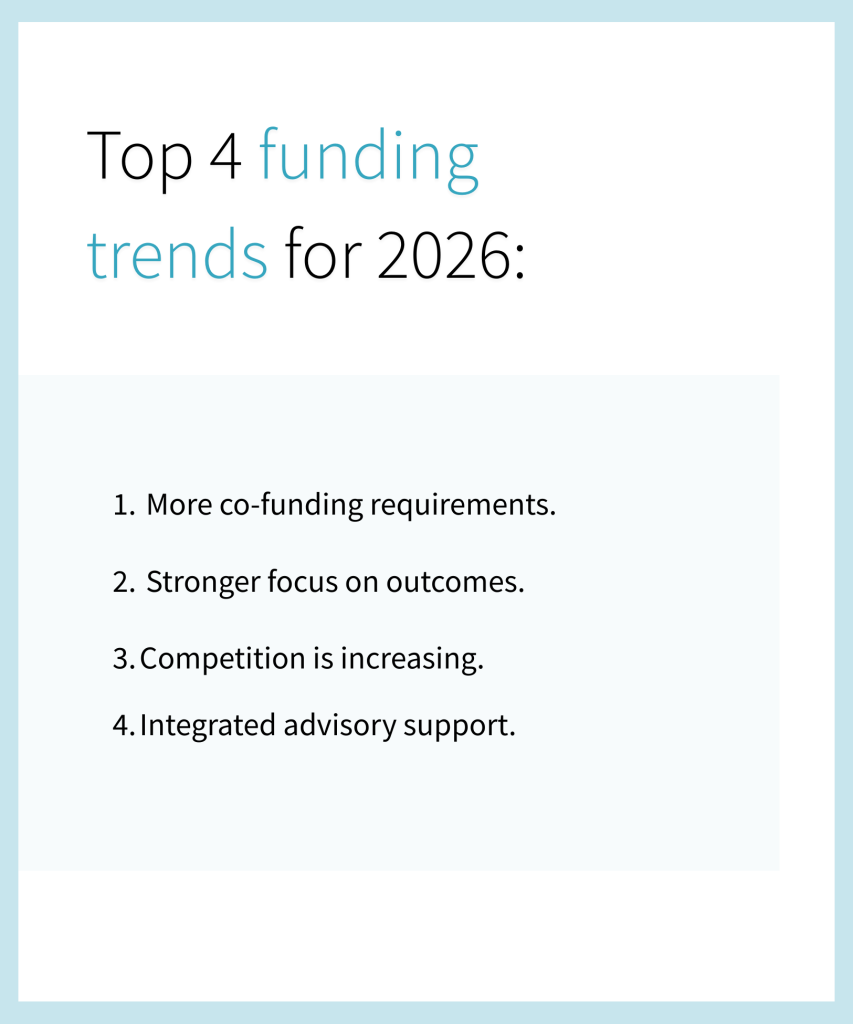
Top 4 funding trends for 2026 

 1 – More co-funding requirements 

Expect more programs to require matched contributions. It ensures businesses share the risk and are invested in the project. 


2 – Stronger focus on outcomes 

Governments want measurable impact. Jobs, economic uplift, emissions reduction and export growth are high on the list. 


3 – Competition is increasing 

With more demand and capped budgets, programs are becoming more competitive and sometimes first-come, first-served. Preparing early is critical


4 – Integrated advisory support 

More grants now come with mentoring or capability-building components. This builds stronger businesses and increases project success. 


How to get grant ready for 2026 

Step 1 | Align your projects with priority areas 

Frame your work in a way that connects clearly to government priorities like net zero, digital transformation or advanced manufacturing. 


Step 2 | Organise your documents now 

Have your financials, business plan, project plan and budget ready. When a grant opens, you want to move fast. 


Step 3 | Track announcements and timelines 

Follow federal and state updates. Subscribe to business.gov.auGrantConnect, your state’s business email updates, and FundFindrs newsletter. 


Step 4 | Build relationships and seek advice 

Connect with industry groups, funding bodies, accelerators and universities. A strong partner can elevate your application.


The bottom line 

2026 will offer some solid opportunities for businesses that prepare early. Governments are funding innovation, clean energy, digital capability and economic growth, but competition will be strong. 

If you know what you need, align with the right priorities, and stay ready, grants can help you move faster and with far less risk. 

Start planning now, build your funding roadmap, and you’ll be in a strong position to apply with confidence in 2026.  


About Grant’d 

Grant’d is Australia’s first intelligent, end-to-end funding ecosystem for startups, SMEs and purpose-led organisations. 

The platform helps you: 

  • find the right grants in under a minute
  • understand eligibility instantly
  • build a proactive funding roadmap
  • track deadlines and manage applications in one place

Grant’d takes the guesswork out of grants so you can focus on building, scaling and delivering impact. Learn more at grantd.com.au.

Eligible R&D Activities: What It Means for the R&D Tax Incentive in Australia

Last reviewed: July 17, 2026


The R&D Tax Incentive (R&DTI) is one of Australia’s most valuable programs for innovative businesses, but many companies still struggle with one core question: “What actually counts as eligible R&D activities?” 

Understanding what the legislation means by eligible R&D activities, and how to distinguish core from supporting activities, is essential for maximising your claim and reducing compliance risk. This guide breaks it down in clear, practical terms to help you assess eligibility with confidence.  


Key takeaways 


  • Eligible R&D activities must address a technical uncertainty through a structured process of experimentation.
  • Not all innovative work qualifies for the R&D Tax Incentive. Activities must satisfy specific legislative requirements.
  • Core R&D activities require an unknown outcome, a systematic progression of work, and the generation of new knowledge.
  • Supporting R&D activities may also be claimable when they are directly related to eligible core R&D activities.
  • Correct classification is critical, helping businesses maximise eligible claims while reducing compliance risk.
  • Good documentation is essential, including evidence of hypotheses, testing, results and conclusions.


What “eligible R&D activities” means 


Under Australian law (Income Tax Assessment Act 1997), eligible R&D activities are activities that involve experimentation, carried out for the purpose of creating new knowledge or developing new or improved products, processes, materials or services. 

To be eligible, activities must meet specific legal criteria, not simply feel “innovative” or “new to your business”. 

In simple terms: Eligible R&D must try to solve a technical uncertainty using a structured, experimental approach. 


Core R&D activities. Definition and requirements 


Core R&D activities are the heart of your claim. According to business.gov.au and the legislation, a core R&D activity must meet all of the following: 


1. The Outcome cannot be known in advance

There must be technological or scientific uncertainty, and you genuinely do not know whether something will work until you test it. 


Example: 

  • Developing a new process to convert agricultural waste into a stable biofuel where no proven methodology exists. 
  • Attempting to improve battery performance beyond known industry baselines using a novel electrolyte formula. 


2. Conducted using a systematic progression of work

This means you must follow an experimental method, such as: 

  • Defining a hypothesis 
  • Designing an experiment 
  • Observing results 
  • Evaluating findings 
  • Drawing conclusions 


Example: 

  • A robotics startup documents assumptions, test parameters, failure modes, modifications, and retesting cycles while prototyping a new autonomous navigation system. 


3. Based on established principles of science, engineering or computer science

You don’t need to be developing a world-first invention, but your work must use a recognised technical discipline. 


4. For the purpose of generating new knowledge

This includes new or improved materials, products, devices, processes or services.


Not sure if you’re eligible for the R&D Tax Incentive?
Our FREE R&DTI Blueprint breaks it down with an eligibility checklist, examples, and expert tips from the FundFindrs team.


Supporting R&D activities. What qualifies? 


Supporting R&D activities are activities that directly relate to a core R&D activity or, in some cases, are undertaken for the main purpose of supporting core R&D. 


Key requirement:
 

 Supporting activities must not stand alone. They only become eligible because they enable, assist or provide necessary input into the core experiments. 


Examples of supporting R&D activities:

  • Designing prototypes required for testing 
  • Software coding that implements the algorithm being experimentally tested 
  • Data cleaning or dataset preparation for machine learning model experiments 
  • Engineering drawings for test rigs 
  • Technical research to inform experiment design 
  • Testing materials, components, or code modules to isolate variables 


Activities requiring the “dominant purpose” test
 

 Some tasks could be everyday business activities unless they exist solely to support R&D. These must pass the dominant purpose test. 


Examples include: 

  • Project management of an R&D project 
  • Feasibility studies 
  • Compliance testing required to characterise experimental outcomes (not regulatory approval testing) 
  • Technical analysis outside of normal production work 


What is NOT considered eligible R&D (common exclusions) 


Many activities feel innovative but do not meet legislative requirements for eligible R&D. 

 Here are some of the most common exclusions: 


Routine activities

  • Routine testing or quality assurance 
  • Debugging that follows known solutions 
  • Cosmetic changes to products 


Market-focused or business activities

  • Market research 
  • Consumer testing for preferences 
  • Branding, UI/UX work that isn’t technically experimental 
  • Sales activities or customer discovery interviews 


Software exclusions 

  • Software developed for internal administration, such as: 
  • Payroll systems 
  • CRMs 
  • Inventory management 
  • Scheduling systems 


Commercial or regulatory tasks 

  • Product certification 
  • Compliance testing for approval 
  • Beta testing by customers 


Replicating known technology

If the method, solution or approach is publicly available or already proven, it cannot be claimed as core R&D. 


Assess your activities


Here’s your FundFindrs handy checklist to help you more easily decide which activities are eligible R&D activities and which are not. Note, this advice is general in nature. 


Core R&D eligibility checklist 

 Your activity likely qualifies as core R&D if: 

  • You faced a technical problem with no known solution 
  • Your team could not predict the outcome using existing knowledge 
  • You ran structured experiments (hypothesis → test → evaluate → iterate) 
  • You recorded observations, failures, data, and conclusions 
  • The work involved scientific/engineering/computer science principles 
  • The purpose was to create new knowledge or capability 


Supporting R&D eligibility checklist 

Your activity may qualify as supporting R&D if: 

  • It enabled, assisted or directly related to a core R&D experiment 
  • The activity would not have been undertaken if the R&D project didn’t exist 
  • Technical staff or engineers were required to perform it 
  • Documentation exists linking the activity to the core R&D timeline 
  • If the “dominant purpose” test is necessary, it’s established that the dominant purpose was to support experimentation 


Exclusion red flags

If any of these apply, you may need to rethink your activities’ eligibility: 

  • The work was commercially focused, not experimentally focused 
  • The outcome was known before testing 
  • The work followed standard testing or debugging processes 
  • Activities were administrative, operational or design-only without experimentation


To discuss the eligibility of R&D activities you are conducting (even if you are unsure), book a FREE consultation with a FundFindrs expert.


Evidence requirements. What documentation should you keep? 


Good record-keeping is essential for demonstrating eligible R&D activities in Australia. 

Required evidence includes: 

  • Technical project plans and hypotheses 
  • Experiment logs, test plans and test results 
  • Version control logs (Git, JIRA, Confluence, etc.) 
  • Data sets and analysis outputs 
  • Photographs or videos of prototypes 
  • Lab notes or engineering notebooks 
  • Time tracking for R&D personnel 
  • Invoices for materials, prototypes and contractors 
  • Minutes from technical meetings 
  • Failure analysis and iteration notes 


FundFindrs’ tip

 Store documents by project, activity type, and year. Clear structuring makes R&D reviews smoother and protects your claim. 


Why correct classification matters

Incorrectly claiming activities as R&D can lead to: 

  • Claims being denied 
  • Audits 
  • Repayment of offsets 
  • Penalties 


Correctly identifying core vs supporting R&D activities is the foundation of an eligible, defensible R&D Tax Incentive claim. 


Thinking about your R&D eligibility? FundFindrs can help.

Assessing eligible R&D activities in Australia can be complex, especially when innovation overlaps with day-to-day operations.  

Our team specialises in helping founders, business leaders and technical teams: 

  • Identify eligible core and supporting R&D activities 
  • Build defendable documentation 
  • Align financials and technical work 
  • Maximise R&D returns while reducing compliance risk 


If you’d like clarity on how to assess R&D eligibility or you need support with preparing your claim, book a FREE consultation with FundFindrs today.