tax offset Archives - FundFindrs

Research & Development Tax Incentive (R&DTI): What you really need to know

Last reviewed: June 30, 2026 


Answers to the most common questions about Australia’s R&DTI program

The Research and Development Tax Incentive (R&DTI) can be a valuable tool for Australian businesses investing in innovation, but it’s not always easy to navigate. To help business owners, founders, and finance teams get clear on how it works and who can benefit, we’ve answered the most common and relevant questions about the program.


Whether you’re just starting your first claim R&DTI or fine-tuning your process this financial year, this guide brings together key information in one place, broken down by topic.


Key takeaways 

  • The R&DTI is a federal tax offset (not a grant) offering either a 43.5% refundable or 38.5% non-refundable offset depending on your company’s turnover. 
  • Eligible activities must involve genuine experimentation to resolve a technical unknown. Routine development or work with a known outcome does not qualify. 
  • Registration with DISR is mandatory and must be lodged within 10 months of your income year end. There are no extensions. 
  • Poor record-keeping is one of the most common reasons claims are reduced or disallowed. Keeping detailed records throughout the year is as important as the activities themselves. 
  • The offset rate and whether it’s refundable depends on your turnover; understanding which bracket you fall into helps to define how much you can claim.


General Overview

1. What is the Research and Development Tax Incentive (R&DTI)?

The R&DTI is an Australian Government program designed to encourage companies to engage in research and development activities that benefit Australia. It provides tax offsets for eligible R&D activities, helping businesses recover some of the costs associated with innovation. The program is jointly administered by the ATO and the Department of Industry, Science and Resources (DISR).


Eligibility

2. Who is eligible for the R&DTI?

Eligible entities, known as R&D entities, include:

  • Corporations incorporated under Australian law
  • Corporations incorporated under foreign law but an Australian resident for income tax purposes, or
  • Corporations incorporated under foreign law and a resident of a country with which Australia has a double tax agreement, carrying out business in Australia through a permanent establishment.


Entities must also be liable to pay income tax in Australia and must engage in eligible R&D activities.


In addition, you must be:

  • Operating without a trust in your business structure
  • Attempting to develop new/improved materials, products, devices, processes or services
  • Conducting systematic experimentation for the purpose of creating new knowledge
  • Have spent at least AU$20,000 on R&D projects
  • Conducting the activities in Australia.


Activities and Structure

3. What are eligible R&D activities and how are they defined?

Eligible R&D activities are classified as:

  • Core R&D activities. These are experimental activities where the outcome cannot be known or determined in advance, They’re conducted through a systematic progression of work involving hypothesis, experiment, observation, evaluation, and drawing conclusions.
  • Supporting R&D activities. These are activities directly related to core R&D activities or undertaken for the dominant purpose of supporting core R&D activities.


Certain routine or excluded activities are not eligible as core R&D.


4. How can I structure and track my R&D activities to maximise eligibility?

To ensure your activities are eligible and make the most of your R&D claim:

  • Identify the innovative, experimental parts of your project (core R&D).
  • Separate routine development from genuine experimentation.
  • Maintain detailed records: hypotheses, experiments, iterations, and results.
  • Track costs in real-time, including salaries, materials, contractors, and overheads.
  • Collaborate with your accountant or R&D advisor to make sure your project structure supports a compliant claim.


Application Process and Deadlines

5. How do I apply for the R&DTI?

To apply:

  1. Register your R&D activities with AusIndustry within 10 months after the end of your company’s income year.
  2. Once registered, claim the tax offset by completing the R&D tax incentive schedule and relevant labels in your company tax return and lodging them with the ATO.


However, the best time to start your application is when you’re preparing your tax return, because you’ll have all your information to hand, so you can make the process more efficient and effective, meaning you have more time to spend on your core business.


Book a FREE consultation to find out how we can help you through the application process.


6. What is the deadline for registration?

You must register your R&D activities with AusIndustry within 10 months after the end of your company’s income year. For example, if your income year ends on 30 June, the deadline is 30 April of the following year.


Financial Benefits and Rates

7. How much can I claim through the R&DTI?

Typically, companies can claim up to 43.5% of their R&D spend. However, the amount you can claim depends on your company’s aggregated turnover.


For companies with annual turnover of less than $20 million, it’s the refundable tax offset equal to the company’s corporate tax rate plus an 18.5% premium.


For companies with annual turnover of $20 million or more, it’s the non-refundable tax offset equal to the corporate tax rate plus:

  • 8.5% premium for R&D expenditure up to 2% of total expenditure (R&D intensity).
  • 16.5% premium for R&D expenditure above 2% of total expenditure.
  • Note: The rate is reduced to the company tax rate for notional R&D deductions exceeding $150 million.


Not sure which offset rate applies to your business? Talk to our R&D specialists.


8. What’s the difference between refundable and non-refundable tax offsets?

  • Refundable tax offset is when the offset exceeds your tax liability, the excess is refunded. This is especially relevant for earlier-stage businesses or those in a loss position.
  • Non-refundable tax offset is when the excess offset can be carried forward to future income years but is not refunded


Overseas and Non-Australian Activities

9. Can I claim R&D activities performed overseas?

Generally, only R&D activities conducted in Australia qualify. However, you can claim overseas activities if you obtain an Advanced Overseas Finding from AusIndustry before conducting the activities and are able to demonstrate that:

  • The overseas activity is eligible R&D;
  • There is a scientific link to Australian core R&D;
  • It cannot be done in Australia for specific reasons; and
  • The cost of overseas activities is less than related Australian R&D activities.


Eligible Expenses

10. What expenses can I claim under the R&DTI?

Eligible expenditure includes:

  • Salaries and wages of employees engaged in R&D;
  • Contractor fees for R&D work;
  • Materials used in R&D;
  • Depreciation of R&D assets;
  • Overheads directly related to R&D;
  • Payments to Research Service Providers (RSPs).


Expenses must be incurred during the income year and directly related to eligible R&D activities.


11. What should companies with significant R&D spend consider before lodging? 

The R&DTI rewards careful preparation regardless of claim sizeAreas deserve extra attention before you lodge: 


  • Activity classification: Ensure the boundary between core and supporting R&D activities is clearly defined and documented.  
  • Documentation readiness: Audit-ready records should be in place before lodgement, not assembled after.  
  • Engaging a specialist early: The complexity of a large claim makes early specialist involvement valuable to maximise the claim and to ensure it withstands review. 


12. Some of our expenses were paid personally. Can we claim them through the R&DTI?

R&D claims must be for expenses paid by the company. Personally paid expenses or those paid outside a corporate structure generally aren’t eligible. To claim R&D, ensure the company incurs and pays for eligible expenses. 


Documentation and Compliance

13. What documentation should I keep?

Robust documentation is essential for compliance and audits. Maintain contemporaneous records that clearly show:

  • The nature and scope of your R&D activities;
  • Evidence of technical uncertainty and experimentation;
  • Expenditure records;
  • How costs are apportioned between R&D and non-R&D work.


14. What happens if I get audited?

If you’re audited and your documentation isn’t robust, you may have to repay the R&D offset plus penalties.


You can avoid this by aligning your workflows with ATO and AusIndustry requirements and maintaining audit-ready records from the outset. It’s important to work closely with your accountant or R&D consultant to make sure your documentation is fully robust.


Additional Considerations

15. What is the R&DTI Registration Number?

After registering your R&D activities with AusIndustry, you’ll receive a unique registration number. You must include this in your company’s R&D Tax Incentive schedule when lodging your tax return. This will link the two and help avoid any unnecessary delays.


16. Can I claim R&D expenses from previous years?

Unfortunately not. R&D tax offsets can only be claimed for eligible activities and expenditure incurred in the current income year. Each year’s activities must be registered separately within the 10-month timeframe. That’s another reason not to delay. When applications close, they are closed for that year.


17. What are common mistakes or risks in claiming the R&DTI?

Some common mistakes or challenges include:

  • Claiming routine or ineligible activities.
  • Poor documentation or tracking of activities.
  • Incorrectly allocating overhead costs.
  • Failing to register on time.
  • Not meeting the legislative definitions of core or supporting R&D activities.


It is critical to make sure you submit accurate, complete and well-documented claims to avoid delays, inefficiencies and even rejection.


Download the FundFindrs R&DTI Blueprintour practical guide to preparing an accurate and complete R&DTI application.


18. What’s the difference between a project, a core R&D activity, and a supporting activity?

This simple summary outlines the differences between the three.

  1. A Project is the overall effort to create or improve a product or process.
  2. Core R&D Activity is the experimental work undertaken to resolve technical uncertainty.
  3. Supporting Activity is any activity directly supporting core R&D (e.g., testing, data analysis).


Understanding these differences helps ensure your claim aligns with the program’s intent.


19. How do I know if my technology is innovative enough?

For it to qualify, your technology must involve experimentation and technical uncertainty. It needs to be something that hasn’t been proven or done before. Even if your product looks similar to others, it’s the underlying technology or algorithms that  determine eligibility.


20. What are the most common industries that typically apply for the R&DTI?

A broad mix of sectors take advantage of the R&DTI, but some appear more often than others. Technology and software businesses regularly use the program to support digital development work that improves tools, processes, or user outcomes.


We frequently see submissions from engineering and manufacturing firms. These businesses are often developing new systems or refining how things are made, which aligns well with the incentive’s criteria.


At FundFindrs, we work extensively across manufacturing, engineering, clean technologiespharma, agriculture, AI and softwareindustries where significant R&D investment is common and the incentive can return substantial value. 


Don’t leave money on the table

While self-assessment is possible, it’s easy to miss opportunities or make simple mistakes that delay or reduce your claim. Working with specialists like FundFindrs can help you get it right first time and save hours of unnecessary admin. If your work is eligible, the R&DTI allows you to offset a portion of those expenses. If you do not claim it when you’re able to, it’s like leaving money on the table.


Are ready to see how much you could claim or if your business is eligible?

Book a FREE consultation with our team today.



Start Smart: Leveraging the New Financial Year for Grant Success

The start of the financial year can feel like a deep breath after the sprint to June 30. But it’s not just a moment to pause, it’s a chance to reset. If you lead a, July is one of the most strategic times to get your house in order, especially if grants are part of your funding mix this year.


July is more than just a new ledger

While you’re refreshing your financials, budget, or operations plan, many funders are doing the same. Government departments have confirmed allocations and corporate programs are finalising the grants they’ll offer in the coming months.

If you wait until grants open to start preparing, you’re already behind. Now is the time to be proactive.


Your grant readiness mid-year reset

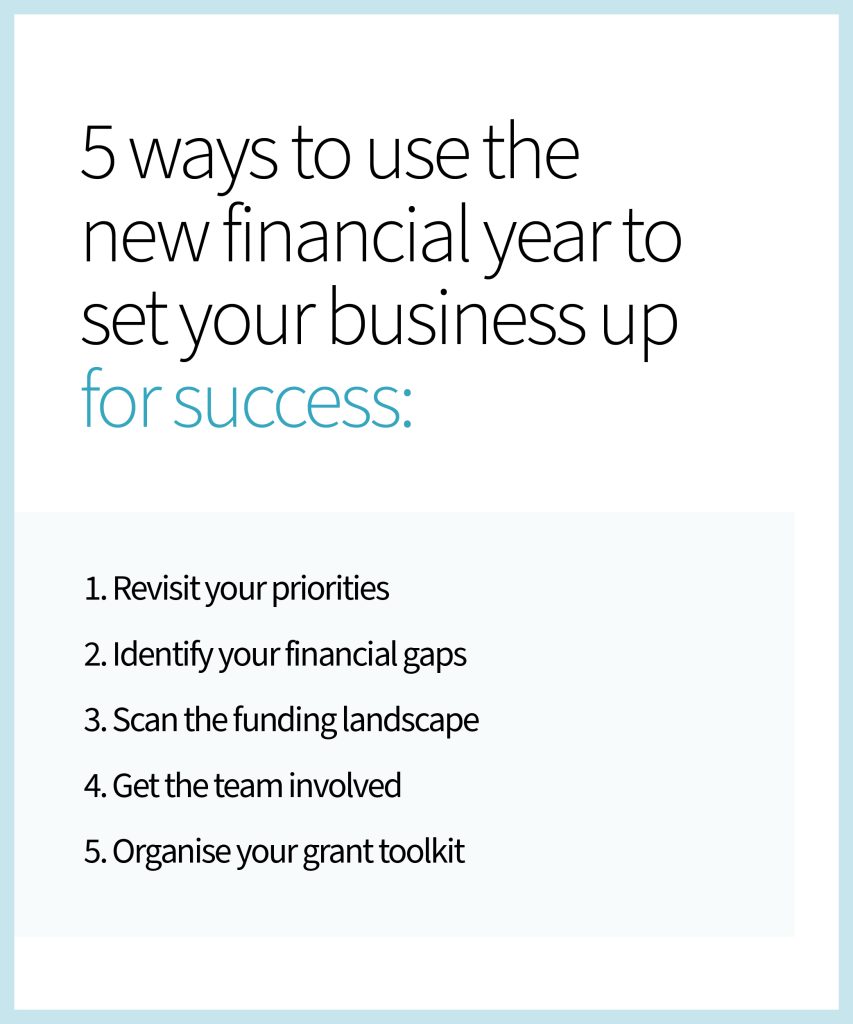
Here are five ways to use the new financial year to set your business up for success:

       1. Revisit your priorities:

What are you aiming to grow, test or expand this year? What matters most to your organisation right now? Funders respond best to clearly articulated goals.

      2. Identify your financial gaps:

Grants should fill specific funding needs, not general shortfalls. Clarify which projects need support and how much you’ll need. If budgeting isn’t your strong suit, now’s a good time to seek advice.


Need help identifying grants or shaping your funding budget? We’ve got you covered.


     3. Scan the funding landscape:

Look ahead 3–6 months. What’s likely to open based on recent budgets or government announcements? Which funders back your kind of work? Keep an eye on programs that require longer preparation or partner engagement.

     4. Get the team involved:

Whether it’s your staff, board, or co-founders, set time aside to review priorities and assign owners for grant opportunities. If you’re a solo operator, connect with other founders and support each other.

    5. Organise your grant toolkit:

Refresh or pull together the basics: a clear business plan, project budgets, your ABN and compliance docs, previous success stories, and any evaluation data you have. Having this on hand saves time when grants land.


FundFindrs - New Financial Year Success


Be proactive, not predictive

One of the biggest myths in grant-seeking is that you can wait for the “ideal” window. In reality, every funder works on their own timeline.

Government grants often align with federal and state budgets, but rollout dates vary while larger infrastructure or multi-year grants can take months to prepare.

Emergency or rapid-response funding appears without warning, but if you’re organised, you’ll be ready to apply quickly.

A clear takeaway? Don’t wait to act. Instead, build habits that keep you ready year-round.


FundFindrs - Janine Owens Biggest Myths Quote


Why you need a grants calendar

A 12-month grants calendar isn’t just a list of deadlines – it’s a practical tool that:

  • Keeps your team aligned
  • Flags key dates well in advance
  • Helps you balance internal project timing with external opportunities
  • Reduces stress and improves quality through better planning

You can use a basic spreadsheet, a whiteboard, or a digital tool. Grant’d offers an integrated calendar that updates as new grants are added. Whatever you choose, consistency is key.


Final thought

A new financial year doesn’t have to mean more hustle. It can be a chance to lead with intention.

Reassess. Reset. Get ahead of the curve. When you build the systems early, applying for grants becomes easier, faster, and far more strategic.


Want to start the new financial year right? The Grant’d grants calendar is a free way to plan smarter this year.


Ready to put your grants calendar into action?

At FundFindrs, we’re here to turn your mid-year planning into funding success.

Whether you’re identifying the right grants, preparing your documentation, or navigating the R&D Tax Incentive eligibility requirements, our experienced consultants are by your side. We simplify the application process, reduce stress, and boost your chances of success by applying for grants and tax incentives.

Book your FREE consultation with the FundFindrs team today and take the next step toward funding your future.

The Essential Grants Glossary: 10 Must-Know Terms Explained

Last reviewed: July 28, 2026


Writing a grant can sometimes feel like translating another language. Funders have their own terminology, and getting familiar with it can save you time, improve your applications, and help you avoid common mistakes. 

Here are ten key terms every grant seeker should know, with deeper context and real-world insight: 

  1. Eligibility criteria
  2. Assessment criteria
  3. Co-contribution 
  4. In-kind support 
  5. Funding agreement
  6. Milestone reporting
  7. Acquittal 
  8. Letters of support
  9. Matched funding
  10. Auspicing 


Key takeaways 


  • Eligibility criteria determine whether you can apply for a grant, making them the first section to review before investing time in an application.
  • Assessment criteria explain how applications are scored, helping applicants align their responses with funder priorities.
  • Co-contributions and matched funding often require applicants to share project costs, demonstrating commitment and reducing funder risk.
  • In-kind support refers to non-cash contributions, but not all grant programs allow these contributions to count towards funding requirements.
  • Milestone reporting and acquittals are important post-award obligations, requiring recipients to demonstrate how grant funds were used and what outcomes were achieved.
  • Letters of support and auspicing arrangements can strengthen funding applications, particularly for organisations that need partnerships, endorsements or administrative support.


1. Eligibility criteria

The non-negotiables. These are the rules that define who can apply. They might relate to your business structure, size, location, turnover, tax status (like DGR or TCC), or the purpose of the funding. 

Example: 

A regional small business grant may only accept applications from ABN-holding businesses operating outside metropolitan areas with under 20 full time employees (FTEs). Some require applicants to have been trading for a certain number of years, or to have a minimum revenue. 

Why it matters: 

If you don’t meet the core eligibility, your application won’t even be assessed. Even strong projects will be knocked out early if the box can’t be ticked. 

Expert’s tip: 

Always read eligibility before anything else. If something’s unclear, call the funder. And if you’re unsure, don’t assume – ask. 


Need support understanding grant eligibility?
Chat with our team to get clarity before you apply.


2. Assessment criteria

This is how your application will be scored. Every funder has assessment criteria that reflect what matters to them. Your job is to write directly to these points. 

Common criteria include: 

    • How well your project aligns with the funder’s goals or priorities 
    • The strength and clarity of your project plan 
    • Organisational capacity to deliver what you’re proposing 
    • Value for money and efficient use of funds 
    • Expected outcomes and how they’ll be measured
       

Expert’s tip:  

Use each criterion as a heading or structure in your responses. Don’t make assessors go hunting for the information – make it easy and obvious. 


3. Co-contribution

Some grants require you to contribute to the project financially. This might be a dollar-for-dollar match, or a percentage of the total cost. 

Example:  

If you’re applying for a $50,000 grant with a 50% co-contribution requirement, you need to put in $50,000 of your own (or sourced) funds. 

Why it matters:  

Co-contributions demonstrate buy-in, lower the funder’s risk, and are often seen as a measure of your commitment. 

Expert’s tip:  

Some grants don’t allow in-kind contributions to count toward the match. Always check the guidelines carefully and confirm the source of your match is eligible.


4. In-kind support

In-kind support refers to non-cash resources that contribute value to your project. These are goods or services provided either by your organisation or by partners, volunteers, or sponsors, without a direct financial transaction. 

Examples include: 

    • Donated venue or meeting space
       
    • Volunteer hours (often calculated using a standard hourly rate)
       
    • Loaned equipment or technology
       
    • Pro bono professional services, like legal advice, graphic design, or evaluation support
       
    • Advertising or promotional support at no cost
       

Why it matters: 

In-kind contributions demonstrate that your project has support beyond the grant. They show resourcefulness, partnership, and a broader commitment to success. In many cases, in-kind support can also be included in your project budget to reflect the true value of the initiative — and in some grant programs, it may count toward your co-contribution. 

Expert’s tip: 

Always estimate the value of in-kind support accurately and explain how you calculated it. Where possible, include a letter of confirmation or a memorandum of understanding (MOU) from the person or organisation providing the support.  

This strengthens your application and builds trust with the funder.


5. Funding agreement

If your application is successful, you’ll be asked to sign a funding agreement: a legal contract that outlines how the grant must be used and what you’re committing to deliver. This document covers everything from project timelines and approved budget items to reporting obligations and branding requirements. 

Why it matters: 

Once signed, you’re legally responsible for meeting the terms of the agreement. That includes hitting your milestones, delivering on promised outcomes, and using the funds exactly as stated. 

Expert’s tip:  

Take the time to read every clause carefully. If you’re unsure about anything, get legal or financial advice before signing. 


6. Milestone reporting

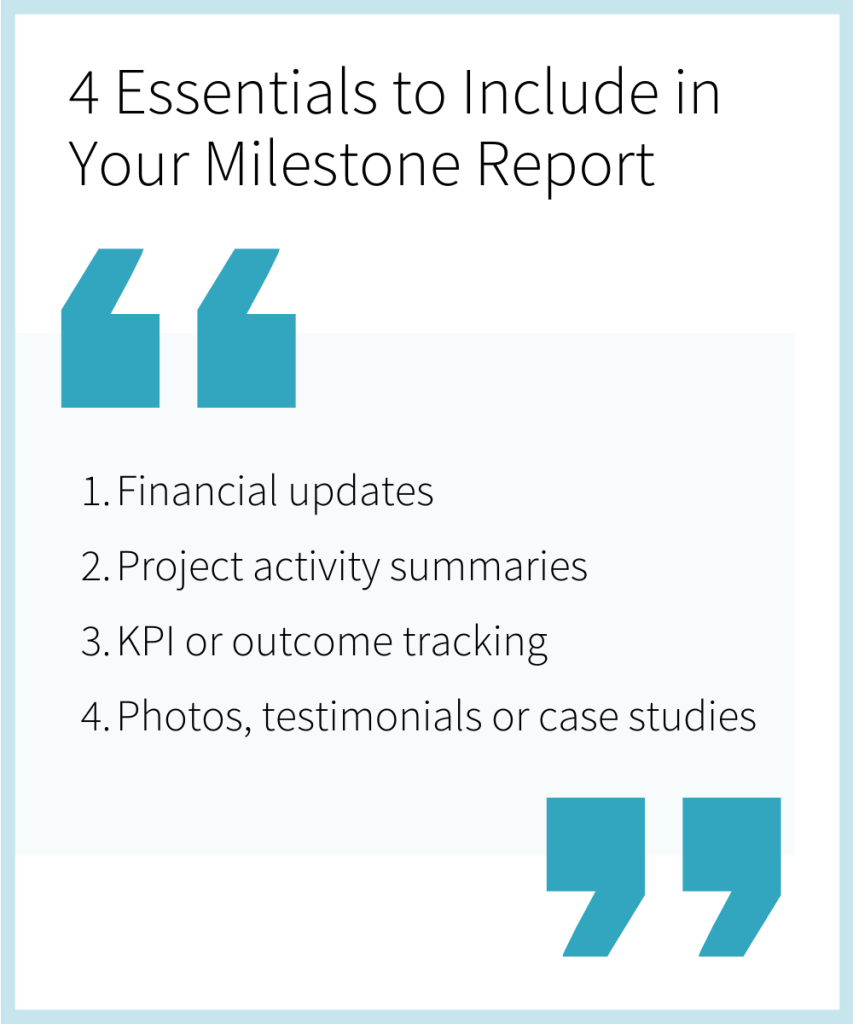
Most grants don’t just hand over funds and walk away. You’ll usually need to submit progress reports at key points throughout the project. These are called milestone reports, and they demonstrate how the work is tracking. 

What’s included: 

    • Financial updates
       
    • Project activity summaries
       
    • KPI or outcome tracking
       
    • Photos, testimonials or case studies
       

Expert’s Tip:  

As soon as you sign the funding agreement, enter all milestone dates into your calendar. Missing deadlines or submitting incomplete reports can delay payments or impact future funding. 


Four Essentials to Include in your Milestone Report


7. Acquittal

The acquittal is the final report you submit after your project is complete. It shows how the grant money was spent and what was achieved.
 

What to expect: 

    • A full financial breakdown matching your approved budget
       
    • A report on project outcomes and impacts
       
    • Evidence such as receipts, media, photos, or evaluations
       

Expert’s tip:  

Don’t leave this to the last minute. Start collecting data and documentation from day one so your acquittal is accurate, thorough, and stress-free. 


8. Letters of support

These are written endorsements from individuals, organisations, or stakeholders who back your project. They show that others believe in your idea, are willing to partner with you, or will benefit from the outcome. 

Example:

A local council might provide a letter confirming they’ll offer a venue, help promote the program, or provide referrals. 

Expert’s tip:

Tailor each letter to the funder and the project. Generic or copy-paste letters won’t carry much weight. Ask for letters early and provide key points to make it easy for your supporters to write something strong. 


9. Matched funding

This is where you’re required to contribute an amount equal (or proportional) to the grant you’re applying for. It could be through your own funds, other grants, or investment

Why it matters:

Funders use matched funding to stretch their resources further and to see that you’re equally committed to the project’s success

Expert’s tip:

Some grants will only accept external sources for your matched funding, for example investment capital or a confirmed co-funder. Internal revenue or in-kind contributions might not count. Always read the guidelines closely. 


10. Auspicing

Auspicing is when an eligible organisation applies for and manages a grant on behalf of a group or business that doesn’t meet the funder’s eligibility criteria. 

How it works: 

    • The auspice organisation takes legal and financial responsibility
       
    • You deliver the project under their oversight
       
    • Both parties sign a formal agreement defining who does what
       

Example: 

A grassroots creative collective without legal status might partner with an established not-for-profit to auspice a grant for an arts festival. 

Expert’s tip:

Choose your auspice partner carefully. Trust, clear communication, and strong governance are essential. Always have a written agreement outlining roles, reporting, and how funds will be managed


Final thought 
Understanding the language of grants gives you power. It helps you write better, present stronger, and stay confident through the process. 

Bookmark this glossary. Share it with your team. The more fluent you are, the fewer roadblocks you’ll hit. 


Need support turning all this grant knowledge into action? 

At FundFindrs, we help businesses simplify and manage the entire grant process: from identifying the right opportunity to submitting a standout application. 

Contact us for a FREE consultation and let’s get your funding journey underway. 

5 Benefits of Lodging Your R&DTI Claim Right Now


Last reviewed: July 17, 2026


Every year, thousands of Australian businesses benefit from the R&D Tax Incentive (R&DTI) — a government program offering up to 43.5% in tax offsets for eligible research and development activities. But many wait until the last minute to lodge their claim, which can slow cashflow, increase stress, and complicate tax lodgements.  

Whether you’ve claimed before or are exploring the R&DTI for the first time, FundFindrs is here to support you through the process, making it straightforward, simple and rewarding.

Early lodgement is the smart move and here are five reasons why.


  1. Access cash sooner  
  2. It’s easier to recall recent work
  3. Make all your lodgements seamless
  4. Avoid the seasonal bottlenecks 
  5. It gives you time to focus on your business
  6. FundFindrs makes it easy for everyone 


Key takeaways 


  • Early lodgement can improve cashflow, helping businesses access their R&D Tax Incentive refund sooner.
  • Claiming while activities are still recent makes it easier to capture accurate project details and supporting evidence.
  • Getting started early reduces administrative burden, helping avoid amendments and last-minute tax return adjustments.
  • Avoid seasonal bottlenecks caused by holiday periods and peak R&D Tax Incentive lodgement volumes.
  • Earlier access to funding may be possible through specialist lending solutions linked to expected R&D Tax Incentive refunds.
  • Taking action sooner provides greater certainty, allowing business owners to focus on growth rather than compliance deadlines.


1. Access cash sooner  

The sooner you lodge, the sooner you access your refund. That’s real money you can reinvest into your business, whether it’s hiring staff, launching a new product, or strengthening your financial position. For businesses new to the R&DTI, this can be a powerful funding boost to fuel innovation and growth. 


2. It’s easier to recall recent work

Your R&D activities for FY25 took place between 1 July 2024 and 30 June 2025. If you wait until the April 2026 deadline, that means you’ll be looking back nearly two years. Preparing now means the details are fresh, making it easier to gather accurate information and reducing the risk of missed or incomplete documentation. 


3. Make all your lodgements seamless

Your R&DTI Schedule and Company Tax Return (CTR) are separate but closely linked. Preparing your R&DTI claim early helps you or your accountant lodge your CTR with the correct R&D figures from the start. That means fewer amendments, less rework, and a smoother process for everyone involved. Even if you aren’t ready to submit your CTR yet, there are options available so you can still get the funding now.

We have partners who offer R&D loans, which are advances on your R&DTI refund, meaning you don’t have to wait until after you lodge your company tax return; you can access your refund and reinvest earlier. 


Looking for faster access to your R&D refund?

We work with specialist partners who can help you unlock your funds early


4. Avoid the seasonal bottlenecks 

There are two busy periods which can slow things down:

  • December/January means summertime, when some of your key staff may be on leave. 
  • March/April is when AusIndustry experiences peak R&DTI claim volumes because people didn’t get their claims in sooner.


5. It gives you time to focus on your business

Submitting your claim early gives you peace of mind, freeing up headspace to focus on your business. Instead of scrambling at the last minute, you’ll have confidence knowing your R&DTI refund is on its way — freeing up time and energy to focus on this year’s growth. 


Research and Development in the manufacturing sector.


6. FundFindrs makes it easy for everyone 

Whether you’ve claimed the R&DTI in the past, or you’re applying for the first time, FundFindrs supports you every step of the way to simplify what can often feel complex.

Our specialists work with you throughout the year to:  

  1. Identify and define eligible R&D activities with precision and clarity.  
  2. Strengthen documentation and evidence to support compliance.  
  3. Review previous claims for missed or under-claimed opportunities.  
  4. Provide guidance on structuring future projects for long-term benefit.  

This proactive, year-round partnership ensures your R&D claims are accurate, defensible, and optimised for value.


Let’s get your R&DTI started now 

 If you’re ready to get your refund sooner and make next year’s claim easier, our team can help you start today. Click here to book a FREE consultation.