Australian businesses have access to a wide range of funding pathways, each designed to support different stages of growth and business objectives. These can include founder capital, government grants, the R&D Tax Incentive, business loans and other forms of non-equity finance, angel investment, venture capital, and export funding programs. The most appropriate funding pathway will depend on what a business is trying to achieve, whether that is developing a new product, commercialising innovation, scaling operations, improving cash flow or expanding into international markets.
The right pathway depends on what you are trying to fund. A founder validating an idea will need something different from a manufacturer scaling production, a software company solving technical uncertainty, or an exporter entering a new overseas market.
At FundFindrs, we work with Australian businesses to identify and access government grants and the R&D Tax Incentive. These are often powerful non-dilutive funding options because they can support innovation, commercialisation and growth without requiring founders to give away equity. But they rarely sit in isolation. In many cases, grants and R&D support work best when they are part of a broader funding roadmap.
In this article, we will examine seven of the different funding pathways available to Australian businesses.
Key takeaways
- There is no single best funding option for every business. The right pathway depends on the business stage, growth objectives and the type of project being funded.
- Government grants and the R&D Tax Incentive can provide valuable non-dilutive funding for businesses investing in innovation, commercialisation, manufacturing capability and growth.
- Different funding pathways serve different purposes, from founder capital and debt funding through to angel investment, venture capital and export support.
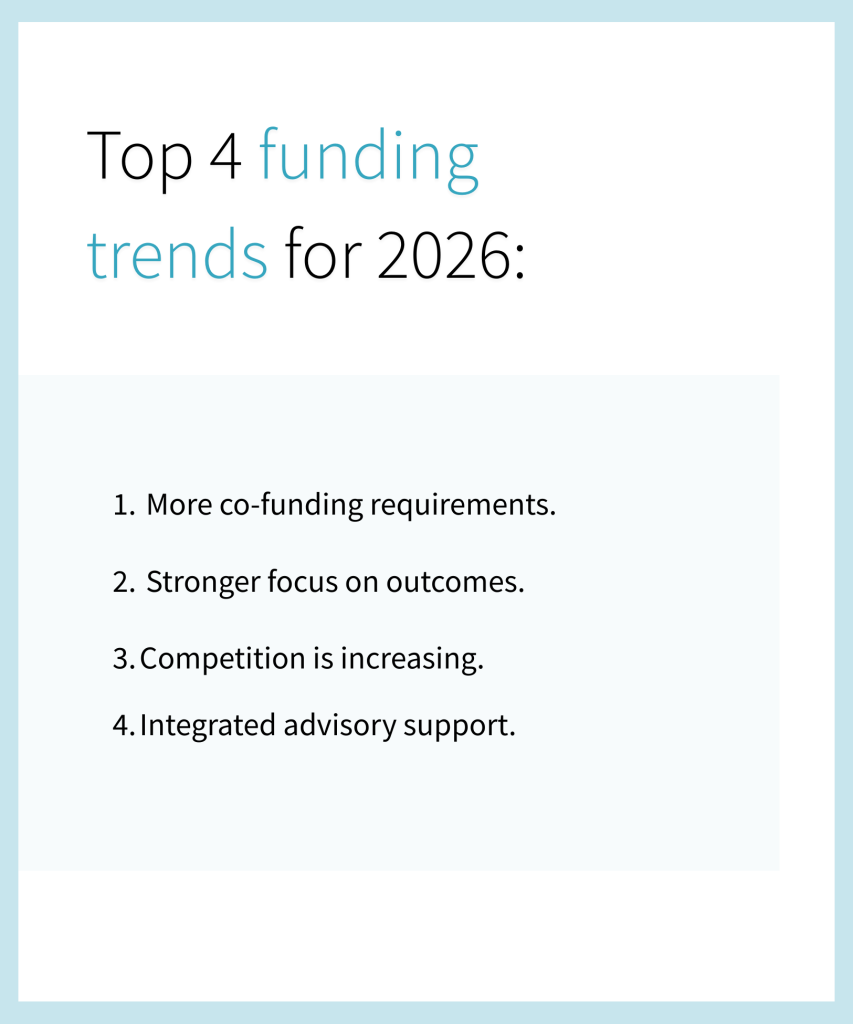
- Many grant programs require businesses to contribute part of the project cost, making funding strategy, timing and co-contribution planning important.
- Grants and the R&D Tax Incentive do not need to replace investment or debt. They can often work alongside other funding sources as part of a broader funding roadmap.
- Businesses that understand their funding roadmap early are often better positioned to prepare evidence, align projects with eligibility requirements and identify future opportunities.
- The strongest funding outcomes occur when funding is aligned with business strategy rather than pursued as a standalone goal.
Finding the right funding strategy
Australian businesses have more funding options available than ever before, from government grants and the R&D Tax Incentive through to loans, angel investment, venture capital and export funding.
However, each funding pathway is designed to support different business objectives. Some are suited to innovation and product development. Others are designed to support commercialisation, international expansion, manufacturing capability or rapid scale.
Understanding which funding options align with your business goals is an important first step in building a sustainable growth strategy.
How the R&D Tax Incentive can support growth:
- What funding options are available now
- What funding options may become available later
- Which grant programs require matched funding
- How to avoid relying too heavily on one source of capital
- How to preserve equity while still funding growth
- How to build the evidence needed for future applications
7 funding pathways at a glance
Each funding pathway plays a different role in a business’s growth journey. The table below provides a high-level overview of the most common funding options available to Australian businesses, including when they are typically used and the key considerations associated with each.
| Funding pathway |
Best suited to |
Key benefit |
Key consideration |
| 1. Founder capital |
Early validation |
Control and speed |
Personal risk and limited capacity |
| 2. R&D Tax Incentive |
Eligible R&D activity |
Can help recover innovation costs |
Requires eligible activities, records and compliance |
| 3. Government grants |
Defined projects |
Non-dilutive project funding |
Competitive and often requires co-contribution |
| 4. Debt finance |
Working capital, equipment, bridging |
Avoids dilution |
Must be repaid |
| 5. Angel investment |
Early growth and traction |
Capital plus expertise |
Equity dilution |
| 6. Venture capital |
High-growth scaleups |
Large growth capital |
Dilution and growth expectations |
| 7. Export funding |
International market expansion |
Supports export marketing and promotion |
Eligibility and timing vary by round |
1. Founder capital
Founder capital is often the first funding pathway. It may come from personal savings, early shareholder contributions, director loans or money reinvested into the business by the founding team.
It is useful because it gives founders control and can move quickly. There is no application round, no lender approval and no investor negotiation. But it also has limits. Founder capital can place personal pressure on the business owners and may not be enough to fund larger commercialisation, manufacturing, R&D or export projects.
Best for:
Early validation, initial product development, customer discovery, small pilots and bridging gaps before external funding is available.
2. The R&D Tax Incentive
The R&D Tax Incentive (R&DTI) is one of the most important funding pathways for innovative Australian businesses. It is not a grant. It is a tax offset designed to encourage eligible companies to conduct research and development activities in Australia.
According to the Australian Taxation Office (ATO), approximately 16,000 companies claim the R&D Tax Incentive each year, highlighting just how widely the program is used across the Australian innovation ecosystem.
For many founders, CFOs and business leaders, the R&D Tax Incentive is overlooked because they do not describe their work as “research”. They may call it product development, engineering, testing, software development, process improvement or technical problem solving. But if the business is undertaking systematic experimentation to resolve technical uncertainty, it may be worth assessing whether the activity could qualify.
How the R&D Tax Incentive can support growth:
- It can help recover part of eligible R&D costs.
- It can support reinvestment into future development.
- It can improve cash flow for eligible companies.
- It can sit alongside grants, investment and debt when structured correctly.
- It encourages businesses to keep better records of technical activities, experimentation and expenditure.
The R&D Tax Incentive can be especially relevant for businesses developing software, engineering solutions, manufacturing processes, medical technology, clean technology, mining technology, agtech, robotics, AI or other innovation-led products and systems.
Understanding what qualifies as an eligible R&D activity is often one of the most challenging aspects of preparing an R&D Tax Incentive claim.
Best for:
Businesses developing new or improved products, processes, software, services or technologies through systematic experimentation, and seeking to reduce the cost of innovation through a tax offset or cash refund.
Not sure if you’re eligible for the R&D Tax Incentive?
Our FREE R&DTI Blueprint breaks it down with an eligibility checklist, examples, and expert tips from the FundFindrs team.
3. Government grants
Government grants can be powerful, but they are often misunderstood. The strongest grant candidates are not simply businesses that need money. They are businesses undertaking defined projects that align with government priorities, such as innovation, commercialisation, manufacturing capability, export growth, regional development, sustainability or productivity improvement.
What grants commonly support:
- Commercialising a new product, process or service
- Progressing a prototype or pilot into market readiness
- Scaling manufacturing capability
- Building sovereign capability in priority sectors
- Export promotion and international market development
- Sustainability, clean energy or emissions reduction projects
- Research collaborations and pre-commercialisation activities
What grants usually do not support:
- Undefined business growth
- Ordinary payroll expenses
- Business survival or cash flow gaps
- Projects with no clear innovation, commercial or economic outcome
This is why eligibility is usually project-based. A business may be a strong company but still not have a suitable grant project. Conversely, a smaller business with a clearly defined innovation or commercialisation project may be better placed than it first assumes.
| Stronger grant candidates |
Less suitable candidates |
| Have a defined project |
Only have a general business idea |
| Have a prototype, proof of concept, pilot or commercialisation pathway |
Are at concept stage only |
| Can show economic, technical or commercial outcomes |
Need general operating funds |
| Can contribute matched funding where required |
Cannot fund their contribution |
| Have evidence, milestones and a delivery plan |
Have limited documentation or unclear scope |
4. Business loans and non-equity finance
Loans and debt funding can support business growth without requiring founders to give away ownership. Options may include traditional bank loans, equipment finance, working capital facilities, invoice finance, venture debt and alternative lending products. Unlike grants or the R&D Tax Incentive, debt funding must be repaid, but it can provide faster access to capital for businesses with a clear repayment pathway, predictable revenue or an identifiable asset being funded.
Businesses now have access to a broad range of funding providers, including:
- Specialist and alternative lenders
- Equipment finance providers
- Invoice and debtor finance providers
- Venture debt and revenue-based finance providers
Each provider will have different lending criteria, security requirements, repayment structures and risk appetites, so it’s important to understand which solution best aligns with your business objectives and cash flow position.
Before taking on debt, businesses should consider:
- Security requirements and personal guarantees
- How debt integrates with grants, the R&D Tax Incentive and other funding sources
The most effective funding strategies typically use debt as one component of a broader funding mix rather than as a standalone solution.
FundFindrs insight:
Debt funding and grants are often viewed as separate funding pathways, but they frequently work together. Many grant programs require businesses to contribute a portion of project costs through matched funding. Depending on the program rules and business circumstances, debt funding may help fund that contribution, allowing the business to undertake a larger project than would be possible using available cash alone.
5. Angel investment
Angel investors typically provide early-stage capital to startups and scaleups, often before a business is ready for institutional venture capital. Unlike loans, angel investment does not need to be repaid. In exchange, investors receive an ownership stake in the business and become invested in its future success.
For many founders, the value of angel investment extends beyond the capital itself. The right investor may bring industry knowledge, founder experience, strategic guidance, commercial introductions and access to networks that can help accelerate growth.
Angel investment can also work well alongside grants and the R&D Tax Incentive. A founder may use angel capital to support product development, fund the business contribution required for a matched grant, or extend runway while eligible R&D activities are underway. When combined effectively, these funding pathways can help businesses progress faster without relying on a single source of capital.
Not all angel investors bring the same value, so it is important to look beyond funding and consider the experience, networks, and support they can offer.
When evaluating potential investors, founders should consider:
- Relevant industry knowledge and experience
- Access to customers, partners or industry networks
- A track record of supporting growing businesses
- Alignment with the founder’s vision and long-term goals
- The ability to support future fundraising activities
Many experienced founders will tell you that choosing the right investor can be just as important as securing the investment itself. FundFindrs partners with Angel Investing business Impactiv to support clients at the right time.
Best for:
Early and growth-stage businesses seeking capital, strategic advice and industry connections from experienced investors who are willing to back high-potential growth opportunities.
6. Venture capital
Venture capital (VC) is a funding pathway used by high-growth businesses looking to scale quickly. Unlike grants, debt funding or the R&D Tax Incentive, venture capital involves exchanging equity in the business for investment capital.
VC funding is typically suited to businesses with large market opportunities, scalable business models and ambitious growth plans. Beyond capital, investors may also provide strategic advice, industry expertise, customer introductions and support with future fundraising activities.
However, venture capital is not the right pathway for every business at every stage. Many founders assume they need investment immediately, when there may be opportunities to build value first through grants, the R&D Tax Incentive or other non-dilutive funding sources.
Non-dilutive funding pathways such as grants and the R&D Tax Incentive may help businesses:
- Fund technical development before valuation discussions
- Build commercialisation evidence that investors want to see
- Extend runway without immediate dilution
- Demonstrate the ability to secure and manage external funding
- Reach key milestones before entering fundraising conversations
- Perhaps most importantly, grants and the R&D Tax Incentive do not need to replace investment. They can often work alongside venture capital to support specific projects, reduce cash burn and help businesses achieve more with the capital they raise.
Best for:
High-growth businesses with a scalable business model that need significant capital to accelerate expansion, enter new markets or achieve rapid growth.
7. Export funding and market expansion support
Export funding becomes relevant once a business is ready to sell, promote or expand into international markets. Programs such as the Export Market Development Grants program have historically supported eligible Australian businesses with export marketing and promotional activities.
Export funding is different from R&D or commercialisation funding. It generally does not fund the development of the product itself. Instead, it helps eligible businesses promote Australian goods, services, software, IP or know-how into international markets.
Best for:
Businesses that have a market-ready product or service, a clear export strategy and eligible export promotion activity.
How these funding pathways work together
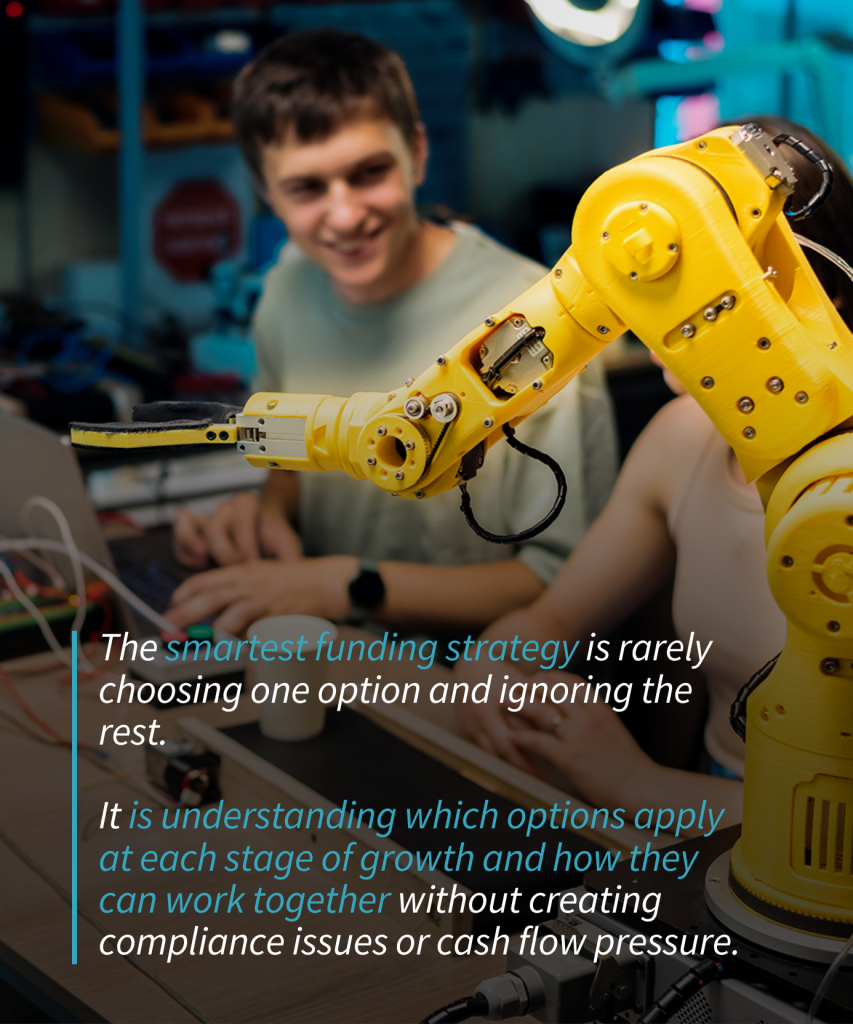
The smartest funding strategy is rarely choosing one option and ignoring the rest. It is understanding which options apply at each stage of growth and how they can work together without creating compliance issues or cash flow pressure.
| Business stage |
Likely funding need |
Relevant pathways |
Funding strategy question |
| Validate |
Prove the problem, develop early product, test demand |
Founder capital, angel investment, early R&D assessment |
What evidence do we need before applying for external funding? |
| Innovate |
Solve technical problems, build or improve product, test uncertainty |
R&D Tax Incentive, founder/angel capital |
Are we documenting eligible R&D as we go? |
| Commercialise |
Move from prototype or pilot toward market |
Government grants, angel investment, debt, R&D Tax Incentive |
Do we have a defined project, budget, milestones and matched funding? |
| Scale |
Grow production, hire, enter new markets, improve capability |
Grants, debt, VC, R&D Tax Incentive |
What capital mix gives us speed without unnecessary dilution? |
| Expand |
Export, international marketing, larger partnerships |
Export funding, VC, debt, grants |
Is our export plan well evidenced and timed with funding rounds? |
Example funding stacks
Example 1: Early-stage technology startup
- Founder capital funds early validation and proof of concept.
- Angel investment supports the first team members and product development.
- The R&D Tax Incentive is assessed for eligible technical development work.
- A commercialisation grant is explored once the project, budget and market pathway are clearer.
Example 2: Innovative manufacturer
- Internal cash funds planning and early design work.
- Equipment finance supports new machinery or production capability.
- Government grants are explored for eligible manufacturing capability or commercialisation projects.
- The R&D Tax Incentive is assessed for technical experimentation and eligible development activity.
Example 3: Export-ready business
- Revenue or working capital funds core operations.
- Export funding supports eligible international marketing or promotion.
- R&D Tax Incentive may support ongoing product or technology development.
- Debt or investment may fund inventory, staffing or market-entry costs that grants do not cover.
Key considerations before choosing a funding pathway
1. What are you funding?
A funding pathway should map to a specific need. Are you developing technology, commercialising a product, buying equipment, funding export marketing, covering working capital or hiring a team? The answer changes which options are relevant.
2. Are you eligible now, or preparing for later?
Some funding options are available only at certain stages. For example, many grants require evidence of a prototype, pilot, market demand or matched funding. If you are not eligible now, the right strategy may be to prepare your documentation and timing for a future round.
3. Do you have the evidence?
For grants, evidence may include project plans, budgets, quotes, customer demand, IP ownership, financial capacity and commercialisation milestones. For the R&D Tax Incentive, evidence usually relates to activities, technical uncertainty, experimentation, records and expenditure.
4. What is the true cost of capital?
A grant may be non-dilutive, but it may require a co-contribution and reporting. Debt avoids dilution, but it must be repaid. Equity can accelerate growth, but it reduces ownership. The right answer depends on the business model and risk profile.
5. Can the funding sources be combined properly?
Some funding pathways can complement each other. Others may create issues if the same expenditure is claimed twice or if program rules restrict the use of other funding. This is why a funding roadmap matters. The goal is not to chase every opportunity. It is to understand what fits and when.
Final thoughts: funding should follow strategy
The most successful businesses do not chase funding for the sake of it. They understand what they are building, what stage they are at, what capital they need, and which funding pathways can support their next move.
For innovative Australian businesses, grants and the R&D Tax Incentive should be core considerations. They can support product development, commercialisation, manufacturing capability, export growth and reinvestment into future innovation. But they work best when considered alongside the full funding mix, including founder capital, debt, angel investment and venture capital.
If you are building, testing, commercialising or scaling something new, FundFindrs can help you understand what funding pathways may be available and how grants and the R&D Tax Incentive could fit into your broader growth strategy.
Speak with FundFindrs about grants, R&D Tax Incentive eligibility and funding opportunities aligned with your growth plans.