R&DTI Archives - Page 2 of 2 - FundFindrs

5 Benefits of Lodging Your R&DTI Claim Right Now


Last reviewed: July 17, 2026


Every year, thousands of Australian businesses benefit from the R&D Tax Incentive (R&DTI) — a government program offering up to 43.5% in tax offsets for eligible research and development activities. But many wait until the last minute to lodge their claim, which can slow cashflow, increase stress, and complicate tax lodgements.  

Whether you’ve claimed before or are exploring the R&DTI for the first time, FundFindrs is here to support you through the process, making it straightforward, simple and rewarding.

Early lodgement is the smart move and here are five reasons why.


  1. Access cash sooner  
  2. It’s easier to recall recent work
  3. Make all your lodgements seamless
  4. Avoid the seasonal bottlenecks 
  5. It gives you time to focus on your business
  6. FundFindrs makes it easy for everyone 


Key takeaways 


  • Early lodgement can improve cashflow, helping businesses access their R&D Tax Incentive refund sooner.
  • Claiming while activities are still recent makes it easier to capture accurate project details and supporting evidence.
  • Getting started early reduces administrative burden, helping avoid amendments and last-minute tax return adjustments.
  • Avoid seasonal bottlenecks caused by holiday periods and peak R&D Tax Incentive lodgement volumes.
  • Earlier access to funding may be possible through specialist lending solutions linked to expected R&D Tax Incentive refunds.
  • Taking action sooner provides greater certainty, allowing business owners to focus on growth rather than compliance deadlines.


1. Access cash sooner  

The sooner you lodge, the sooner you access your refund. That’s real money you can reinvest into your business, whether it’s hiring staff, launching a new product, or strengthening your financial position. For businesses new to the R&DTI, this can be a powerful funding boost to fuel innovation and growth. 


2. It’s easier to recall recent work

Your R&D activities for FY25 took place between 1 July 2024 and 30 June 2025. If you wait until the April 2026 deadline, that means you’ll be looking back nearly two years. Preparing now means the details are fresh, making it easier to gather accurate information and reducing the risk of missed or incomplete documentation. 


3. Make all your lodgements seamless

Your R&DTI Schedule and Company Tax Return (CTR) are separate but closely linked. Preparing your R&DTI claim early helps you or your accountant lodge your CTR with the correct R&D figures from the start. That means fewer amendments, less rework, and a smoother process for everyone involved. Even if you aren’t ready to submit your CTR yet, there are options available so you can still get the funding now.

We have partners who offer R&D loans, which are advances on your R&DTI refund, meaning you don’t have to wait until after you lodge your company tax return; you can access your refund and reinvest earlier. 


Looking for faster access to your R&D refund?

We work with specialist partners who can help you unlock your funds early


4. Avoid the seasonal bottlenecks 

There are two busy periods which can slow things down:

  • December/January means summertime, when some of your key staff may be on leave. 
  • March/April is when AusIndustry experiences peak R&DTI claim volumes because people didn’t get their claims in sooner.


5. It gives you time to focus on your business

Submitting your claim early gives you peace of mind, freeing up headspace to focus on your business. Instead of scrambling at the last minute, you’ll have confidence knowing your R&DTI refund is on its way — freeing up time and energy to focus on this year’s growth. 


Research and Development in the manufacturing sector.


6. FundFindrs makes it easy for everyone 

Whether you’ve claimed the R&DTI in the past, or you’re applying for the first time, FundFindrs supports you every step of the way to simplify what can often feel complex.

Our specialists work with you throughout the year to:  

  1. Identify and define eligible R&D activities with precision and clarity.  
  2. Strengthen documentation and evidence to support compliance.  
  3. Review previous claims for missed or under-claimed opportunities.  
  4. Provide guidance on structuring future projects for long-term benefit.  

This proactive, year-round partnership ensures your R&D claims are accurate, defensible, and optimised for value.


Let’s get your R&DTI started now 

 If you’re ready to get your refund sooner and make next year’s claim easier, our team can help you start today. Click here to book a FREE consultation. 

Top 10 Grants to Watch in 2026

Last reviewed: July 03, 2026 

What businesses need to know, where funding is heading, and how to get ready. 


As Australia moves toward 2026, founders and business owners are increasingly focused on understanding which government grants and funding opportunities will have the greatest impact on growth, innovation and scale. 

In our previous article, What Government Will Be Funding in 2026, we explored the broader policy and investment themes shaping future funding. This follow-up article focuses on the top grants to watch in 2026 highlighting specific programs already announced or expected to open that Australian startups, SMEs and scaling businesses should be preparing for now. 

Together, these government grants for 2026 offer a practical snapshot of where funding is heading and the types of businesses government is actively looking to support.


Key takeaways 


  • Funding opportunities are available across federal and state programs, supporting innovation, commercialisation and business growth.
  • Several programs target underrepresented founders, including female-led startups, First Nations businesses and Indigenous-owned enterprises.
  • Funding is available at every stage, from early R&D and proof-of-concept through to commercialisation and market scale-up.
  • The R&DTI remains one of the broadest national funding opportunities, supporting eligible R&D activities across all sectors.
  • State-based grants vary significantly, with different eligibility criteria, funding amounts and strategic priorities.
  • Preparation is the key differentiator. Businesses that plan early are better positioned to secure competitive funding opportunities.


1 – Female Founders Co-Investment Fund (QLD) 

Supports innovative women-led startups raising early-stage equity. 

Funding available: $50,000 to $200,000 matched 

Why it matters: Helps female founders overcome barriers to private investment and close stronger rounds.  


2 – New Industries and Innovation Fund – Innovation Pathways (WA) 

Funds accelerator, investor readiness and entrepreneurship programs that support WA’s innovation pipeline.

Funding available: Up to $300,000
Why it matters: Builds capability and prepares businesses for investment. 


3 – First Nations Innovation Acceleration Program (QLD) 

Supports established First Nations businesses ready to scale, with advisory support included.

Funding available: Up to $100,000 

Why it matters: Creates jobs, builds capability and strengthens Indigenous-led economic growth. 


4 – CSIRO Kick-Start Program (National) 

Supports R&D projects with CSIRO researchers.

Funding available: $10,000 to $50,000 vouchers (matched) 

Why it matters: Gives early-stage businesses access to world-class R&D at a fraction of the cost. 


5 – R&D Tax Incentive (National) 

Tax offset supports eligible R&D activities across all sectors.

Funding available: Up to 43.5% of eligible R&D costs 

Why it matters: Reduces financial risk and encourages sustained innovation. 


Not sure if you’re eligible for the R&D Tax Incentive?
Our FREE R&DTI Blueprint breaks it down with an eligibility checklist, examples, and expert tips from the FundFindrs team.


6 – Start-Up Finance Package (Indigenous Business Australia)

For majority-Indigenous-owned start-ups. 

Funding available: Up to $150,000 (loan plus grant component) 

Why it matters: Reduces early barriers so First Nations founders can establish and grow businesses. 


7 – Business Growth Fund Program (QLD) 

For high-growth small businesses investing in equipment to scale. 

Funding available: $50,000 to $75,000 matched 

Why it matters: Helps growing companies boost productivity and create jobs. 


8 – AEA Ignite Grants (National)

Funds early-stage university-industry proof-of-concept projects. 

Funding available: Up to $500,000 

Why it matters: Bridges the gap between research and commercial markets. 


9 – AEA Innovate Grants (National) 

Supports scaling innovations through prototypes, pilots and proof-of-scale. 

Funding available: Up to $5 million 

Why it matters: Serious capital for founders looking to take big steps fast. 


10 – MVP Ventures Program (NSW) 

Supports TRL 3-9 innovation with higher contributions for women-led, regional and First Nations founders. 

Funding available: $20,000 to $75,000 

Why it matters: Reduces early commercialisation costs and accelerates market readiness. 


What these grants mean for your business in 2026 

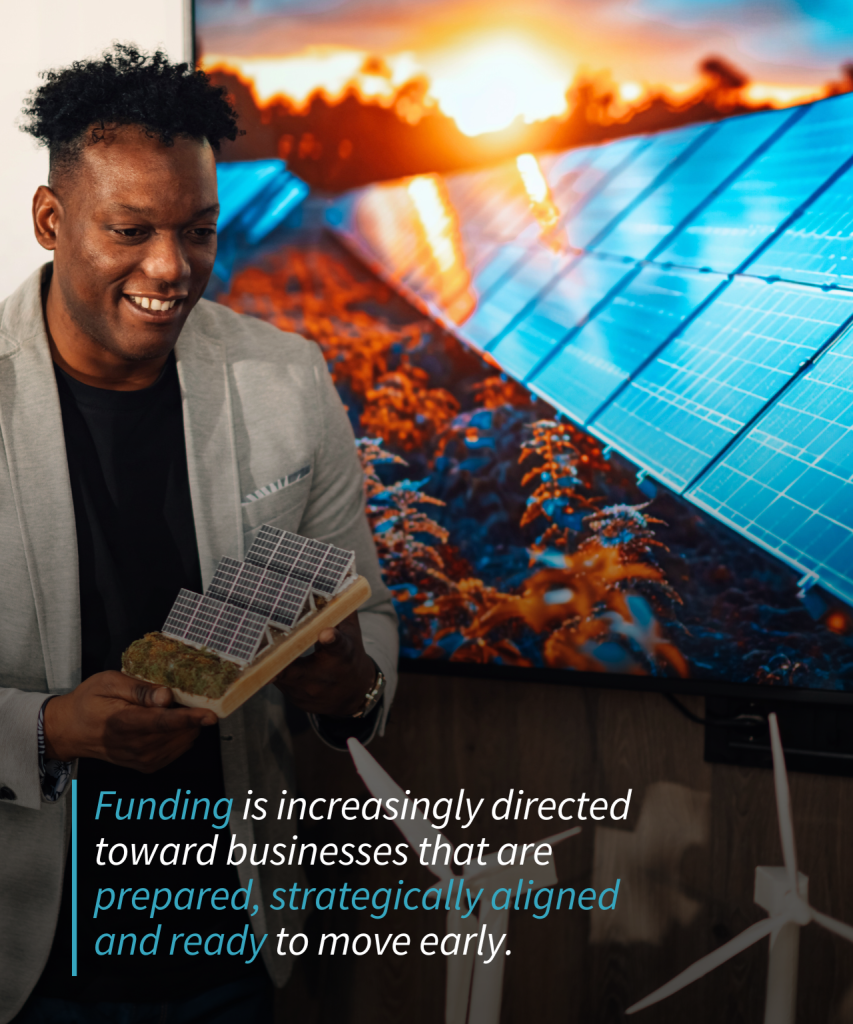
These top government grants to watch in 2026 reinforce a clear trend: funding is increasingly directed toward businesses that are prepared, strategically aligned and ready to move early. 

While each program has its own eligibility rules and timelines, the strongest outcomes typically come from businesses that embed grants into their broader growth and innovation strategy, rather than treating them as last-minute opportunities. 

FundFindrs works alongside founders and business owners to help them navigate Australia’s business grants and incentives landscape — from identifying relevant funding opportunities to ensure your work is aligned with the R&DTI criteria. 

If funding is part of your 2026 growth plans, now is the right time to understand what’s coming and ensure your business is positioned to act when opportunities open.  


About Grant’d 

Grant’d is Australia’s first intelligent, end-to-end funding ecosystem for startups, SMEs and purpose-led organisations. 


The platform helps you: 

  • find the right grants in under a minute
  • understand eligibility instantly
  • build a proactive funding roadmap
  • track deadlines and manage applications in one place


Grant’d takes the guesswork out of grants so you can focus on building, scaling and delivering impact. Learn more at  grantd.com.au.  

What Government Will Be Funding in 2026

Last reviewed: July 03, 2026 


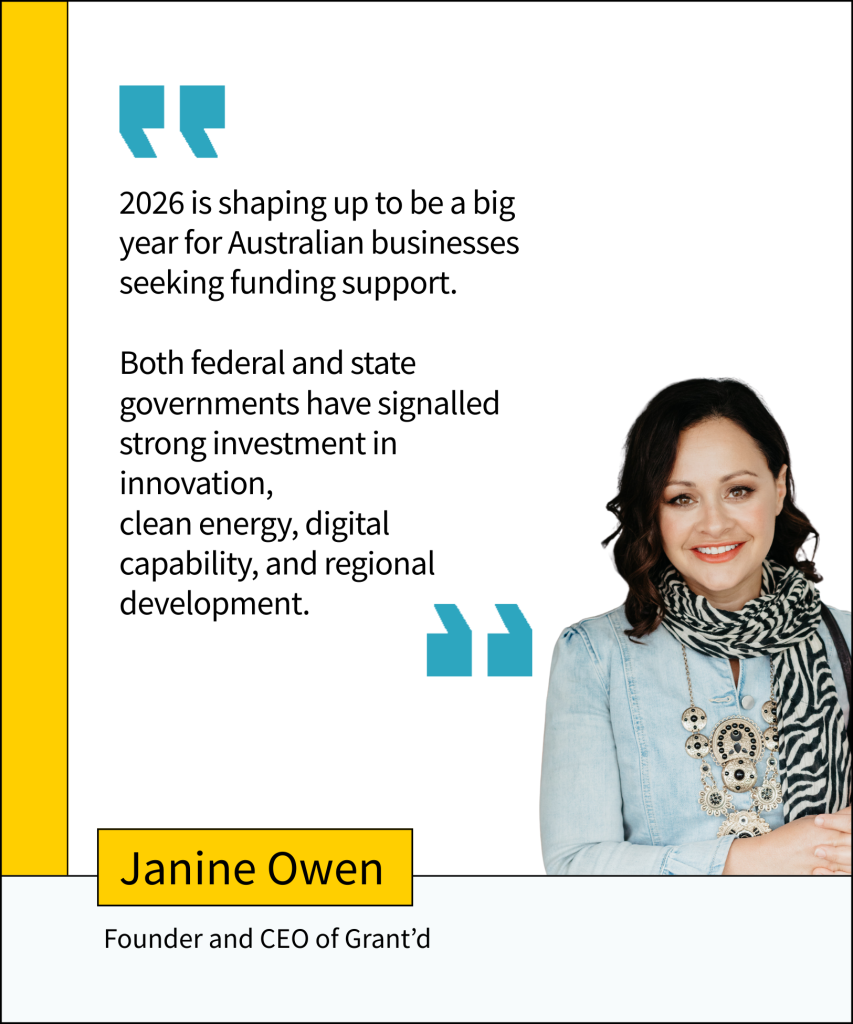
2026 is shaping up to be a big year for Australian businesses seeking funding support.
 Both federal and state governments have signalled strong investment in innovation, clean energy, digital capability, and regional development.

But with more money also comes more competition. The real advantage goes to businesses that understand where government priorities sit and prepare early.

Here’s what’s driving funding decisions in 2026 and how to get access to the grants that are on your radar. 


Key takeaways 

  • Six sectors dominate government funding in 2026: clean energy, R&D and commercialisation, digital capability, manufacturing and critical minerals, workforce development, and regional growth.
  • The R&DTI remains a key national funding mechanism and is expected to remain a stable source of support for eligible R&D activities.
  • Co-funding requirements are increasing. More programs are expected to require matched contributions from applicants.
  • Outcomes matter more than ever. Governments are increasingly prioritising projects that demonstrate jobs growth, economic impact, emissions reduction and export opportunities.
  • Competition is intensifying. Growing demand and capped budgets mean businesses need to be prepared to act quickly when opportunities arise.
  • Preparation is the real advantage. Businesses that align projects with government priorities and prepare early are better positioned for funding success.


Where the money goes: an industry breakdown 

1 – Clean energy and decarbonisation 

Achieving net zero remains a national priority. Expect strong funding for clean energy projects, emissions reduction, electrification, and circular economy solutions. This includes everything from battery manufacturing to energy-efficient infrastructure. 


2 – R&D and commercial innovation 

Innovation continues to be a core pillar of Australia’s productivity push. Programs that support R&D, commercialisation, prototypes and pilot trials will remain active. The R&DTax Incentive continues to anchor this space and is expected to stay stable. 

 
3 – Digital capability and cybersecurity 

Cyber threats and digital adoption gaps remain major risks for SMEs. Governments are likely to support initiatives that help businesses adopt new technologies, improve resilience, and lift digital productivity. 


4 – Manufacturing and critical minerals 

Federal and state governments want more value-adding done in Australia. High-tech manufacturing, critical minerals processing, and advanced materials are key areas where funding is expected to grow. 

 
5 – Workforce and skills development 

Skills shortages aren’t going away. Funding for apprentices, traineeships, workforce retraining and clean energy skills development will remain strong in 2026.


6 – Regional and export development 

Regional funding continues to help businesses expand, innovate and hire locally. 


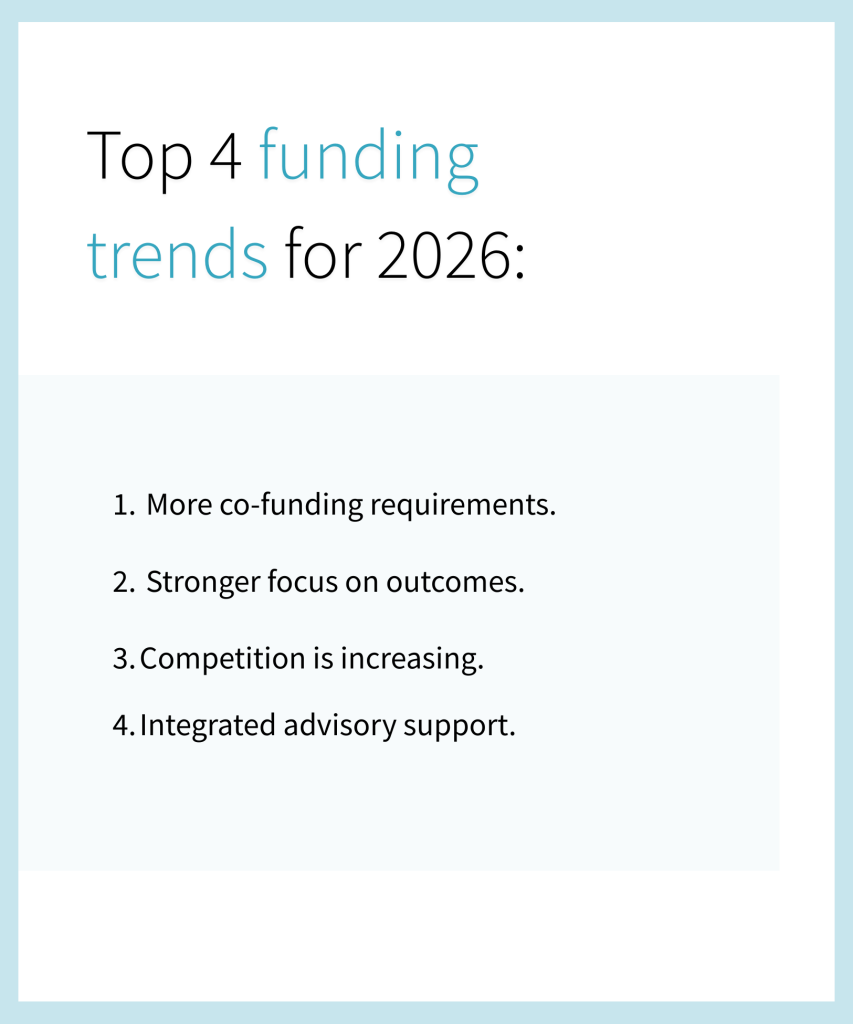
Top 4 funding trends for 2026 

 1 – More co-funding requirements 

Expect more programs to require matched contributions. It ensures businesses share the risk and are invested in the project. 


2 – Stronger focus on outcomes 

Governments want measurable impact. Jobs, economic uplift, emissions reduction and export growth are high on the list. 


3 – Competition is increasing 

With more demand and capped budgets, programs are becoming more competitive and sometimes first-come, first-served. Preparing early is critical


4 – Integrated advisory support 

More grants now come with mentoring or capability-building components. This builds stronger businesses and increases project success. 


How to get grant ready for 2026 

Step 1 | Align your projects with priority areas 

Frame your work in a way that connects clearly to government priorities like net zero, digital transformation or advanced manufacturing. 


Step 2 | Organise your documents now 

Have your financials, business plan, project plan and budget ready. When a grant opens, you want to move fast. 


Step 3 | Track announcements and timelines 

Follow federal and state updates. Subscribe to business.gov.auGrantConnect, your state’s business email updates, and FundFindrs newsletter. 


Step 4 | Build relationships and seek advice 

Connect with industry groups, funding bodies, accelerators and universities. A strong partner can elevate your application.


The bottom line 

2026 will offer some solid opportunities for businesses that prepare early. Governments are funding innovation, clean energy, digital capability and economic growth, but competition will be strong. 

If you know what you need, align with the right priorities, and stay ready, grants can help you move faster and with far less risk. 

Start planning now, build your funding roadmap, and you’ll be in a strong position to apply with confidence in 2026.  


About Grant’d 

Grant’d is Australia’s first intelligent, end-to-end funding ecosystem for startups, SMEs and purpose-led organisations. 

The platform helps you: 

  • find the right grants in under a minute
  • understand eligibility instantly
  • build a proactive funding roadmap
  • track deadlines and manage applications in one place

Grant’d takes the guesswork out of grants so you can focus on building, scaling and delivering impact. Learn more at grantd.com.au.

Eligible R&D Activities: What It Means for the R&D Tax Incentive in Australia

Last reviewed: July 17, 2026


The R&D Tax Incentive (R&DTI) is one of Australia’s most valuable programs for innovative businesses, but many companies still struggle with one core question: “What actually counts as eligible R&D activities?” 

Understanding what the legislation means by eligible R&D activities, and how to distinguish core from supporting activities, is essential for maximising your claim and reducing compliance risk. This guide breaks it down in clear, practical terms to help you assess eligibility with confidence.  


Key takeaways 


  • Eligible R&D activities must address a technical uncertainty through a structured process of experimentation.
  • Not all innovative work qualifies for the R&D Tax Incentive. Activities must satisfy specific legislative requirements.
  • Core R&D activities require an unknown outcome, a systematic progression of work, and the generation of new knowledge.
  • Supporting R&D activities may also be claimable when they are directly related to eligible core R&D activities.
  • Correct classification is critical, helping businesses maximise eligible claims while reducing compliance risk.
  • Good documentation is essential, including evidence of hypotheses, testing, results and conclusions.


What “eligible R&D activities” means 


Under Australian law (Income Tax Assessment Act 1997), eligible R&D activities are activities that involve experimentation, carried out for the purpose of creating new knowledge or developing new or improved products, processes, materials or services. 

To be eligible, activities must meet specific legal criteria, not simply feel “innovative” or “new to your business”. 

In simple terms: Eligible R&D must try to solve a technical uncertainty using a structured, experimental approach. 


Core R&D activities. Definition and requirements 


Core R&D activities are the heart of your claim. According to business.gov.au and the legislation, a core R&D activity must meet all of the following: 


1. The Outcome cannot be known in advance

There must be technological or scientific uncertainty, and you genuinely do not know whether something will work until you test it. 


Example: 

  • Developing a new process to convert agricultural waste into a stable biofuel where no proven methodology exists. 
  • Attempting to improve battery performance beyond known industry baselines using a novel electrolyte formula. 


2. Conducted using a systematic progression of work

This means you must follow an experimental method, such as: 

  • Defining a hypothesis 
  • Designing an experiment 
  • Observing results 
  • Evaluating findings 
  • Drawing conclusions 


Example: 

  • A robotics startup documents assumptions, test parameters, failure modes, modifications, and retesting cycles while prototyping a new autonomous navigation system. 


3. Based on established principles of science, engineering or computer science

You don’t need to be developing a world-first invention, but your work must use a recognised technical discipline. 


4. For the purpose of generating new knowledge

This includes new or improved materials, products, devices, processes or services.


Not sure if you’re eligible for the R&D Tax Incentive?
Our FREE R&DTI Blueprint breaks it down with an eligibility checklist, examples, and expert tips from the FundFindrs team.


Supporting R&D activities. What qualifies? 


Supporting R&D activities are activities that directly relate to a core R&D activity or, in some cases, are undertaken for the main purpose of supporting core R&D. 


Key requirement:
 

 Supporting activities must not stand alone. They only become eligible because they enable, assist or provide necessary input into the core experiments. 


Examples of supporting R&D activities:

  • Designing prototypes required for testing 
  • Software coding that implements the algorithm being experimentally tested 
  • Data cleaning or dataset preparation for machine learning model experiments 
  • Engineering drawings for test rigs 
  • Technical research to inform experiment design 
  • Testing materials, components, or code modules to isolate variables 


Activities requiring the “dominant purpose” test
 

 Some tasks could be everyday business activities unless they exist solely to support R&D. These must pass the dominant purpose test. 


Examples include: 

  • Project management of an R&D project 
  • Feasibility studies 
  • Compliance testing required to characterise experimental outcomes (not regulatory approval testing) 
  • Technical analysis outside of normal production work 


What is NOT considered eligible R&D (common exclusions) 


Many activities feel innovative but do not meet legislative requirements for eligible R&D. 

 Here are some of the most common exclusions: 


Routine activities

  • Routine testing or quality assurance 
  • Debugging that follows known solutions 
  • Cosmetic changes to products 


Market-focused or business activities

  • Market research 
  • Consumer testing for preferences 
  • Branding, UI/UX work that isn’t technically experimental 
  • Sales activities or customer discovery interviews 


Software exclusions 

  • Software developed for internal administration, such as: 
  • Payroll systems 
  • CRMs 
  • Inventory management 
  • Scheduling systems 


Commercial or regulatory tasks 

  • Product certification 
  • Compliance testing for approval 
  • Beta testing by customers 


Replicating known technology

If the method, solution or approach is publicly available or already proven, it cannot be claimed as core R&D. 


Assess your activities


Here’s your FundFindrs handy checklist to help you more easily decide which activities are eligible R&D activities and which are not. Note, this advice is general in nature. 


Core R&D eligibility checklist 

 Your activity likely qualifies as core R&D if: 

  • You faced a technical problem with no known solution 
  • Your team could not predict the outcome using existing knowledge 
  • You ran structured experiments (hypothesis → test → evaluate → iterate) 
  • You recorded observations, failures, data, and conclusions 
  • The work involved scientific/engineering/computer science principles 
  • The purpose was to create new knowledge or capability 


Supporting R&D eligibility checklist 

Your activity may qualify as supporting R&D if: 

  • It enabled, assisted or directly related to a core R&D experiment 
  • The activity would not have been undertaken if the R&D project didn’t exist 
  • Technical staff or engineers were required to perform it 
  • Documentation exists linking the activity to the core R&D timeline 
  • If the “dominant purpose” test is necessary, it’s established that the dominant purpose was to support experimentation 


Exclusion red flags

If any of these apply, you may need to rethink your activities’ eligibility: 

  • The work was commercially focused, not experimentally focused 
  • The outcome was known before testing 
  • The work followed standard testing or debugging processes 
  • Activities were administrative, operational or design-only without experimentation


To discuss the eligibility of R&D activities you are conducting (even if you are unsure), book a FREE consultation with a FundFindrs expert.


Evidence requirements. What documentation should you keep? 


Good record-keeping is essential for demonstrating eligible R&D activities in Australia. 

Required evidence includes: 

  • Technical project plans and hypotheses 
  • Experiment logs, test plans and test results 
  • Version control logs (Git, JIRA, Confluence, etc.) 
  • Data sets and analysis outputs 
  • Photographs or videos of prototypes 
  • Lab notes or engineering notebooks 
  • Time tracking for R&D personnel 
  • Invoices for materials, prototypes and contractors 
  • Minutes from technical meetings 
  • Failure analysis and iteration notes 


FundFindrs’ tip

 Store documents by project, activity type, and year. Clear structuring makes R&D reviews smoother and protects your claim. 


Why correct classification matters

Incorrectly claiming activities as R&D can lead to: 

  • Claims being denied 
  • Audits 
  • Repayment of offsets 
  • Penalties 


Correctly identifying core vs supporting R&D activities is the foundation of an eligible, defensible R&D Tax Incentive claim. 


Thinking about your R&D eligibility? FundFindrs can help.

Assessing eligible R&D activities in Australia can be complex, especially when innovation overlaps with day-to-day operations.  

Our team specialises in helping founders, business leaders and technical teams: 

  • Identify eligible core and supporting R&D activities 
  • Build defendable documentation 
  • Align financials and technical work 
  • Maximise R&D returns while reducing compliance risk 


If you’d like clarity on how to assess R&D eligibility or you need support with preparing your claim, book a FREE consultation with FundFindrs today.